
Biointron Biological USA Inc. has expanded the commercial launch of RushData, an integrated contract research platform that links rapid Chinese hamster ovary cell expression with antibody binding analysis, early developability testing and structured data delivery for artificial intelligence and machine learning workflows. The company distributed the launch through Business Wire on July 24, 2026, after first announcing the platform on June 16, positioning RushData as wet-lab infrastructure for teams that can generate large numbers of antibody sequences computationally but still need physical evidence to decide which molecules deserve further development.
Biointron said RushData is built around a one-day transient CHO expression process and can handle more than 3,000 molecules in parallel within a batch. Depending on the selected service package, the platform can combine expression and titer data with biolayer interferometry or surface plasmon resonance measurements, purity-related readouts and early assessments of thermal stability, polyreactivity and self-interaction. The company is also presenting the output as structured, machine-readable data that can be retrieved through an application programming interface and returned to internal artificial intelligence models, dashboards or automated discovery systems.
The proposition is commercially relevant because the fastest part of many AI-led discovery programmes is increasingly the generation of candidate sequences, not the production and testing of the molecules themselves. A model may propose hundreds or thousands of variants in a design cycle, but each sequence still has to be expressed, purified where required, tested against the intended target and examined for properties that could make it difficult to manufacture, formulate or dose. RushData is therefore not an artificial intelligence discovery model in its own right. It is a standardized experimental service intended to make the physical validation loop move closer to computational speed.
Why is wet-lab throughput becoming the limiting factor in AI-driven antibody discovery?
Generative models and protein language models can search antibody sequence space at a scale that conventional laboratory workflows were not designed to absorb. This creates a practical imbalance. Computational teams can produce more candidate molecules than they can afford to express and characterize, which means the quality of the programme may depend less on how many sequences the model creates and more on how intelligently the experimental budget is allocated.
Wet-lab data remains essential because a plausible sequence is not the same as a functional or developable antibody. Structural confidence scores, predicted affinity and in silico developability estimates can help prioritize candidates, but they cannot independently establish that a molecule will express at useful levels, bind with the expected kinetics, avoid undesirable nonspecific interactions or remain stable under relevant conditions. The biological system can expose weaknesses that are invisible to a model trained mainly on sequence, structure or historical assay data.
RushData is aimed at this gap between computational abundance and experimental scarcity. By combining several steps under one provider and one data structure, Biointron is trying to reduce the delays created when expression, purification, affinity measurement and developability work are sent through separate queues. The potential value is not merely a shorter turnaround. A consistent experimental process can also produce more comparable labels for machine learning, which is important because models can learn misleading patterns when assay conditions, sample formats and reporting conventions vary between projects or laboratories.
What does one-day transient CHO expression add beyond faster antibody production?
The one-day claim refers to transient expression, not the completion of every assay or delivery of a fully characterized antibody dataset within 24 hours. Biointron says the broader RushData workflow generates data in days, with the actual project timeline depending on candidate volume, assay scope and the package selected. That distinction matters because binding characterization, purification and developability testing add time beyond the initial expression step.
Using CHO cells at this stage is nevertheless strategically relevant. CHO systems are widely used across therapeutic antibody development and commercial biologics manufacturing because they support mammalian protein folding and post-translational processing. Screening in a CHO background can therefore provide information that is more aligned with later biologics development than a very early expression screen conducted in a less representative host system.
Transient CHO expression is still a discovery tool rather than proof of commercial manufacturability. A one-day expression result does not establish that a candidate will perform similarly in a stable production cell line, maintain productivity over extended culture, scale successfully in a bioreactor or meet future chemistry, manufacturing and controls requirements. It can identify obvious expression and product-quality problems earlier, but selected molecules would still need stable cell line development, process optimization, analytical characterization and regulatory-grade manufacturing work before clinical use.
This makes RushData most credible as a prioritization platform. It can help teams avoid advancing candidates that bind well computationally but express poorly or show early biophysical liabilities. The commercial benefit will depend on whether the rapid screen predicts later-stage behaviour sufficiently well to improve lead selection, not simply on whether Biointron can report a high number of completed expressions.
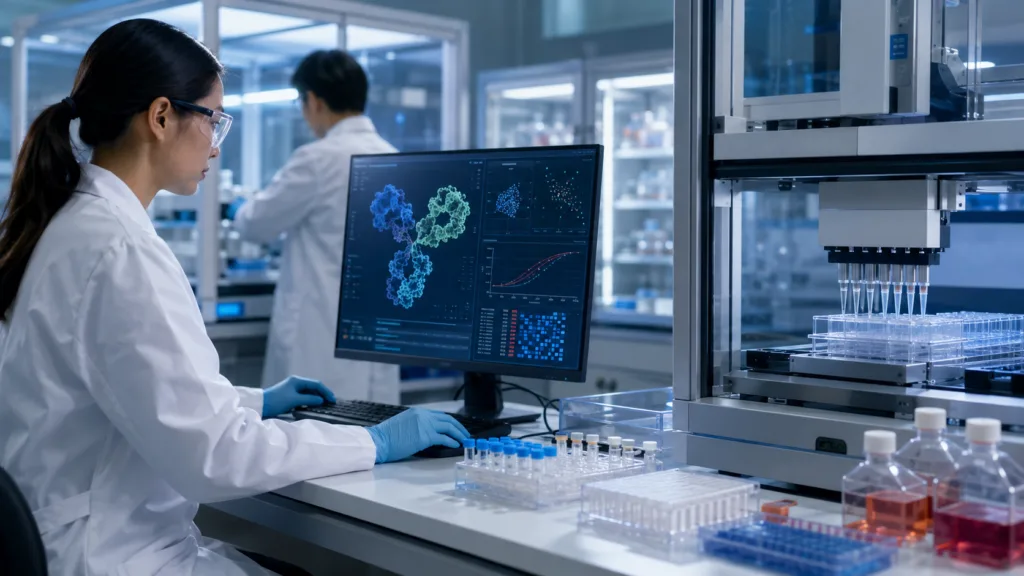
How does RushData convert antibody assays into useful feedback for artificial intelligence models?
Biointron has divided RushData into Basic, Standard and Premium service levels. The Basic package is designed for rapid screening using high-throughput expression in supernatant, titer measurement by biolayer interferometry and a two-point affinity assessment. The Standard service adds purification, concentration measurement, non-reducing capillary gel electrophoresis and multi-point affinity analysis using biolayer interferometry or surface plasmon resonance. The Premium package adds developability profiling to the Standard dataset.
This tiered design reflects different decisions within antibody discovery. A team screening thousands of early candidates may not need extensive characterization for every molecule. Supernatant-level expression and a limited binding readout can support triage, while purified material and more detailed kinetic analysis are more appropriate for a smaller group of leads. The service architecture therefore allows customers to spend more analytical resources only after the candidate pool has narrowed.
The data-integration layer may be as important as the assays. Biointron’s RushData page describes order-based application programming interface access that returns results in a structured JSON payload. For an AI discovery company, this could reduce manual handling and make it easier to link each antibody sequence with expression, binding, purity and developability labels. In principle, those labels can be used to retrain ranking models, test whether predicted properties match experimental outcomes and guide the next sequence-generation cycle.
However, machine-readable does not automatically mean machine-learning ready in the scientific sense. Useful model training requires consistent assay controls, clear metadata, traceable sample identities, defined missing-value handling and enough diversity across targets, formats and sequence families. Biointron has described the structure and assay menu, but it has not publicly disclosed detailed validation showing how RushData datasets affect model performance, hit rates or downstream candidate quality.
Why could early developability testing matter as much as binding affinity for antibody programmes?
A strong binder can still be a poor drug candidate. Antibodies may show self-association, nonspecific binding, aggregation risk, low thermal stability, poor expression or difficult solution behaviour, any of which can complicate manufacturing, formulation, pharmacokinetics or dosing. If these liabilities are discovered only after extensive optimization, a programme may have invested heavily in a molecule that was never well suited for development.
RushData’s Premium package includes differential scanning fluorimetry for thermal behaviour, a polyspecificity reagent assay for polyreactivity and affinity-capture self-interaction nanoparticle spectroscopy for self-interaction. These are established types of early developability measurements that can help compare candidates using small amounts of material. Their inclusion gives the platform a broader purpose than confirming whether an AI-designed antibody binds its intended target.
The analytical value comes from combining properties rather than treating any single score as decisive. A candidate with attractive affinity but high self-interaction may be less desirable than a slightly weaker binder with cleaner biophysical behaviour. Similarly, a molecule with strong thermal stability could still have problematic nonspecific binding. Multidimensional ranking is therefore well suited to machine learning approaches that are intended to optimize several properties at once rather than maximize affinity alone.
These assays remain risk indicators, not guarantees. Early thermal stability or self-interaction results do not establish long-term formulation stability, clinical pharmacokinetics, immunogenicity, safety or efficacy. The platform can support better discovery decisions, but it cannot compress the biological and regulatory uncertainty of an antibody programme into a single developability score.
Where does RushData fit within the competitive market for AI antibody discovery services?
Biointron is positioning RushData between computational design companies and conventional antibody contract research workflows. Some AI biotechnology companies are building automated laboratories internally, while others rely on external providers for sequence synthesis, expression and characterization. RushData offers a middle path in which the customer retains its models and discovery strategy while outsourcing standardized experimental generation and receiving structured data back.
That position could appeal to smaller artificial intelligence drug discovery companies that want to avoid the capital cost and operational complexity of building a high-throughput mammalian expression and biophysical screening facility. It could also be relevant to established pharmaceutical groups that need overflow capacity, specialized turnaround times or an external dataset for model benchmarking. The reported ability to process more than 3,000 molecules in parallel gives Biointron a scale claim that is aligned with computationally generated libraries rather than traditional small-panel antibody projects.
The competitive test will be whether the service is differentiated on quality and integration, not only speed. Other contract research organizations can provide recombinant antibody expression, binding assays and developability services. RushData’s more distinctive elements are the combination of those services, the emphasis on standardized multi-parameter datasets and direct data retrieval for artificial intelligence pipelines.
Biointron can strengthen that position by publishing representative performance data across multiple antibody formats and targets. Customers will want to understand assay reproducibility, failure rates, usable yield, the proportion of molecules that progress from Basic to Standard or Premium testing, and the relationship between rapid transient CHO results and later stable-expression or formulation outcomes. Without those benchmarks, the platform’s throughput is clear, but its comparative predictive value remains largely company-described.
What evidence is still needed to establish RushData’s commercial and scientific differentiation?
The July launch materials do not provide pricing, guaranteed end-to-end turnaround times, capacity utilization, independent customer outcomes or a head-to-head comparison with internal laboratories or competing service providers. They also do not disclose how many RushData projects have been completed, whether the platform has supported a candidate entering formal preclinical development or how often early developability findings have changed a customer’s design strategy.
Data governance will also matter. AI antibody discovery can involve valuable proprietary sequences, target information and model-generated libraries. Biointron states that it uses confidentiality protocols and offers controlled application programming interface access, but prospective customers will still assess data location, access controls, retention policies, intellectual property ownership, cybersecurity practices and whether project data can be segregated from any broader platform learning.
Modality breadth is another important question. Conventional immunoglobulin G antibodies are only part of the current biologics landscape. Bispecific antibodies, multispecific constructs, antibody fragments, single-domain antibodies and antibody-drug conjugate components can create different expression, assembly and developability challenges. Biointron says RushData supports custom workflows for targets and modalities, but detailed public evidence across these more complex formats would help clarify where the system is strongest and where bespoke development remains necessary.
What will determine whether RushData becomes recurring discovery infrastructure rather than a one-off service?
RushData’s long-term opportunity rests on repetition. A single batch can help identify promising molecules, but the platform becomes more valuable when a customer can run successive design cycles under consistent conditions, compare results across generations and feed experimental outcomes directly back into its computational system. That recurring workflow could make the service part of a customer’s discovery architecture rather than a conventional outsourced assay order.
Biointron already has the core components of that proposition: rapid CHO expression, tiered binding and developability packages, parallel processing and structured data access. The next commercial step is to demonstrate that these components produce reproducible decisions across real programmes and that the speed advantage survives at scale when thousands of samples, custom targets and more complex modalities enter the workflow.
The launch therefore marks a useful expansion of Biointron’s antibody services, but the decisive metric will not be the number of sequences processed. It will be whether RushData helps customers select better candidates with fewer experimental cycles, lower attrition and data that measurably improves the next model iteration. That is the point at which rapid wet-lab validation moves from a service feature to a defensible role in AI-driven biologics discovery.