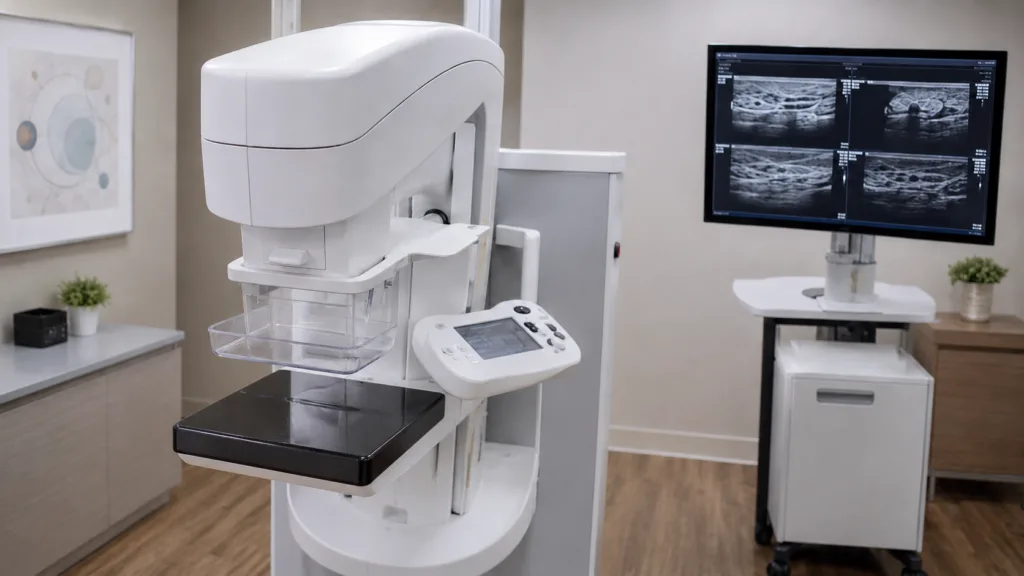
GE HealthCare Technologies Inc. has launched Invenia Automated Breast Ultrasound Prime and ABUS StreamVue, expanding its breast imaging portfolio with an acquisition system designed for large screening networks and a redesigned enterprise viewer for more flexible exam review. The company said ABUS StreamVue recently received United States Food and Drug Administration 510(k) clearance and CE marking, while Invenia ABUS Prime is being positioned for supplemental breast cancer screening in women with dense breasts.
The announcement is not primarily a new clinical indication or a new claim that automated breast ultrasound can replace mammography. Its strategic significance lies in GE HealthCare’s attempt to make supplemental ultrasound easier to deploy across multi-site imaging organisations, where image acquisition, radiologist availability, data movement and reading consistency can be as limiting as the scanner itself.
Invenia ABUS Prime had already been presented in the United States at the Society of Breast Imaging symposium in April 2026. GE HealthCare described the platform at that time as an enterprise-ready system intended for large breast imaging programmes, particularly networks operating five or more Invenia ABUS Prime units. The August launch therefore represents a broader commercial and workflow expansion rather than the first appearance of the underlying device.
Why is GE HealthCare positioning Invenia ABUS Prime as an enterprise screening platform?
Automated breast ultrasound separates image acquisition from interpretation. A trained technologist can acquire standardized three-dimensional breast volumes, which can subsequently be reviewed by a radiologist at another workstation or location. That structure differs from conventional handheld ultrasound, where image acquisition and real-time interpretation are closely tied to the operator conducting the examination.
For imaging groups, the potential advantage is not simply automation for automation’s sake. Standardized acquisition may allow a network to distribute screening capacity across several outpatient sites while concentrating interpretation among a smaller group of breast imaging specialists. A system that works technically at one flagship centre can still become operationally awkward when an organisation attempts to deploy it across ten clinics, multiple picture archiving systems and a limited radiologist pool.
GE HealthCare appears to be addressing that problem by pairing Invenia ABUS Prime with ABUS StreamVue. The company describes StreamVue as a redesigned enterprise viewer intended to enable more flexible review of examinations across a health system. Its FDA clearance and CE marking are separate from the Premarket Approval pathway governing the Invenia ABUS acquisition platform, an important regulatory distinction when evaluating what each product is authorised to do.
The pairing also reflects a wider medical imaging trend. Equipment vendors increasingly compete through connected acquisition, software, remote access, artificial intelligence integration and enterprise workflow rather than scanner specifications alone. In that environment, the viewer is no longer a polite accessory sitting quietly in the corner. It can determine whether large image datasets reach the right specialist quickly enough to make the entire screening model commercially practical.
What does the FDA status of Invenia ABUS Prime actually permit?
Invenia ABUS Prime is listed by the FDA as a Class III automated breast ultrasound device under Premarket Approval number P110006. The agency approved a 180-day PMA supplement in February 2025 covering Invenia ABUS Premium and Invenia ABUS Prime, including transducer modifications, hardware changes, new device names, Auto Nipple Detection and Scan Quality Assessment features.
The underlying indication is precise. Invenia ABUS is intended as an adjunct to mammography for screening asymptomatic women whose mammograms are normal or benign, whose breasts are classified as dense and who have not undergone previous clinical breast intervention. It is intended to increase cancer detection in that defined population. It is not authorised as a replacement for mammography, diagnostic mammography, tissue sampling or diagnostic handheld ultrasound.
That distinction matters because vendor language around dense breast detection can easily sound broader than the approved use. Invenia ABUS Prime is a supplemental screening system for a specified population following mammography. A suspicious ABUS finding can lead to further diagnostic evaluation, but the screening examination does not independently establish a breast cancer diagnosis.
ABUS StreamVue follows a different regulatory route because it is viewing software rather than the Class III acquisition system. GE HealthCare reported that the enterprise viewer received 510(k) clearance and CE marking. A 510(k) clearance means the FDA accepted the device for its stated intended use through the applicable substantial-equivalence pathway. It should not be described as Premarket Approval or as independent validation that the software improves patient outcomes.
Does the evidence support using automated ultrasound after a negative mammogram?
The clinical case for supplemental ultrasound begins with the limitations of mammography in dense breast tissue. Dense fibroglandular tissue can obscure abnormalities on a mammogram and is itself associated with higher breast cancer risk. Since September 10, 2024, mammography facilities in the United States have been required to include breast density information in patient communications under the amended Mammography Quality Standards Act regulations.
The pivotal evidence associated with automated breast ultrasound indicates that adding the modality to mammography can identify cancers that mammography alone did not detect. The prospective, multicentre SomoInsight study enrolled 15,318 women with heterogeneously or extremely dense breasts. Researchers reported that adding automated breast ultrasound detected an additional 1.9 cancers for every 1,000 women screened, with most of the additional cancers being invasive.
The same study also illustrates why added detection should not be treated as the whole story. Supplemental ABUS increased recalls substantially, creating more follow-up imaging and potential biopsies for women who did not ultimately have cancer. Reviews of the evidence have similarly found that automated or handheld supplemental ultrasound can identify additional cancers but may also increase false-positive findings and lower positive predictive value.
Evidence that supplemental ultrasound improves long-term outcomes remains less mature. The United States Preventive Services Task Force continues to conclude that evidence is insufficient to determine the balance of benefits and harms of supplemental breast ultrasound or magnetic resonance imaging in women with dense breasts following an otherwise normal mammogram. The position is not a recommendation against supplemental imaging. It reflects the absence of adequate evidence showing effects on outcomes such as advanced cancer incidence, morbidity or mortality across repeated screening rounds.
This leaves imaging providers with a familiar medical technology tension. The modality can detect additional cancers, yet the best method for selecting patients, controlling recalls and demonstrating outcome value remains open to further study. Risk-based screening pathways may therefore be more defensible than offering the same supplemental examination to every woman whose mammogram reports dense tissue.
Why could ABUS StreamVue matter as much as the new acquisition system?
Large screening programmes do not struggle only with acquiring images. They must move, store, retrieve, compare and interpret large volumetric datasets without forcing radiologists to switch repeatedly between disconnected systems. Delays in loading studies, inconsistent hanging protocols and limited access to prior examinations can quietly erase the productivity promised by faster acquisition.
ABUS StreamVue appears intended to reduce that friction by enabling enterprise-wide exam review. Flexible access could allow scans acquired at satellite locations to be routed to breast radiologists working elsewhere within the network, potentially improving utilisation of specialist capacity. The operational value will depend on how effectively the viewer integrates with existing picture archiving and communication systems, radiology information systems, reporting tools and identity-management controls.
Cybersecurity and data governance will also be procurement considerations. Enterprise viewing expands the number of workstations and locations from which sensitive imaging data may be accessed. Hospitals will need clarity on hosting architecture, encryption, authentication, audit trails, software updates, disaster recovery and whether images are processed locally, centrally or through cloud infrastructure.
The regulatory clearance establishes that ABUS StreamVue may be marketed for its cleared function. It does not independently establish that the platform shortens reporting time, reduces missed cancers, lowers costs or improves patient outcomes. Those commercial claims will require deployment data from real health systems, ideally showing measurable improvements in turnaround time, radiologist productivity, repeat scans and programme economics.
Will dense breast notification translate into sustainable demand for ABUS screening?
National breast density notification has increased awareness, but notification does not automatically create a funded screening pathway. A patient may be told that dense tissue can make cancers harder to see on a mammogram, yet the next step can vary according to individual risk, clinician judgement, local practice, state insurance rules and access to supplemental modalities.
For providers, reimbursement is likely to be one of the largest determinants of adoption. Capital equipment, technologist time, disposable materials, maintenance, software licensing and radiologist interpretation all create costs. A billing code does not necessarily guarantee that every payer will cover the examination for every patient with dense breasts.
Patient selection will also affect programme performance. Supplemental ultrasound may be particularly relevant for some women who cannot undergo magnetic resonance imaging or where magnetic resonance imaging capacity is constrained. Other patients may be directed toward magnetic resonance imaging, contrast-enhanced mammography or a different risk-based pathway. Invenia ABUS Prime therefore competes not only with other ultrasound systems but with alternative uses of a breast imaging department’s budget, staff and appointment capacity.
Training remains another practical variable. Automated acquisition is designed to reduce operator dependence compared with handheld ultrasound, but it does not eliminate the need for correct positioning, adequate coverage and quality control. Features such as Scan Quality Assessment and Auto Nipple Detection may assist technologists, although providers will still need competency programmes and processes for recognising examinations that require reacquisition. The FDA’s 2025 PMA supplement specifically covered these features and associated hardware changes.
How does the breast imaging launch fit GE HealthCare’s broader commercial position?
The launch arrives shortly after a stronger second-quarter performance from GE HealthCare. The company reported second-quarter 2026 revenue of $5.3 billion, an increase of 5.7%, while organic orders rose 11.1% and backlog reached a record $23.9 billion. Advanced Imaging Solutions, which now combines imaging and advanced visualisation activities, generated revenue of $3.77 billion, up 7.9% from the prior-year period.
That backdrop gives GE HealthCare a sizeable installed base and commercial infrastructure through which to introduce connected breast imaging products. The company is also developing a wider women’s health ecosystem spanning mammography, automated and handheld ultrasound, contrast-enhanced mammography, artificial intelligence applications and enterprise imaging. Its expanded collaboration with RadNet Inc.’s DeepHealth subsidiary further demonstrates a strategy built around combining hardware with cloud-based viewing, cancer detection, density assessment and workflow tools.
Investor sentiment improved sharply after the July 29 earnings announcement. GE HealthCare shares rose about 12% during the session as revenue and adjusted earnings exceeded market expectations, although the rally was driven by the overall quarterly results rather than the subsequent ABUS product launch. The stock closed at $69.94 on July 30, down 2.73% for that session and about 22% below its January 2026 52-week high of $89.77.
The breast imaging announcement is therefore best viewed as an incremental commercial execution signal rather than a stand-alone financial catalyst. Its longer-term importance will depend on placements, software uptake and whether GE HealthCare can generate recurring service or licensing revenue around the acquisition hardware.
What will determine whether the expanded ABUS portfolio succeeds?
The next useful evidence will not be another broad statement about artificial intelligence or earlier detection. Hospitals, investors and breast imaging specialists will need measurable deployment results.
Those measures include the number of Prime systems installed per network, examinations completed per technologist, repeat acquisition rates, average interpretation time, remote-reading utilisation, recall and biopsy rates, software availability, payer coverage and the percentage of eligible women who complete supplemental screening after receiving a dense breast notification.
GE HealthCare has assembled the components of an enterprise proposition: a regulated acquisition system, workflow assistance, centralized viewing and a broader breast imaging portfolio. The remaining challenge is proving that these components work together economically and consistently outside carefully selected early-adopter sites.
Invenia ABUS Prime may help imaging providers detect additional cancers that are obscured on mammography, but detection performance alone will not determine adoption. The decisive test will be whether ABUS StreamVue and the wider workflow can make supplemental screening scalable without overwhelming radiologists, multiplying unnecessary follow-up procedures or leaving health systems with another sophisticated platform that works beautifully in the brochure and less gracefully on Monday morning.