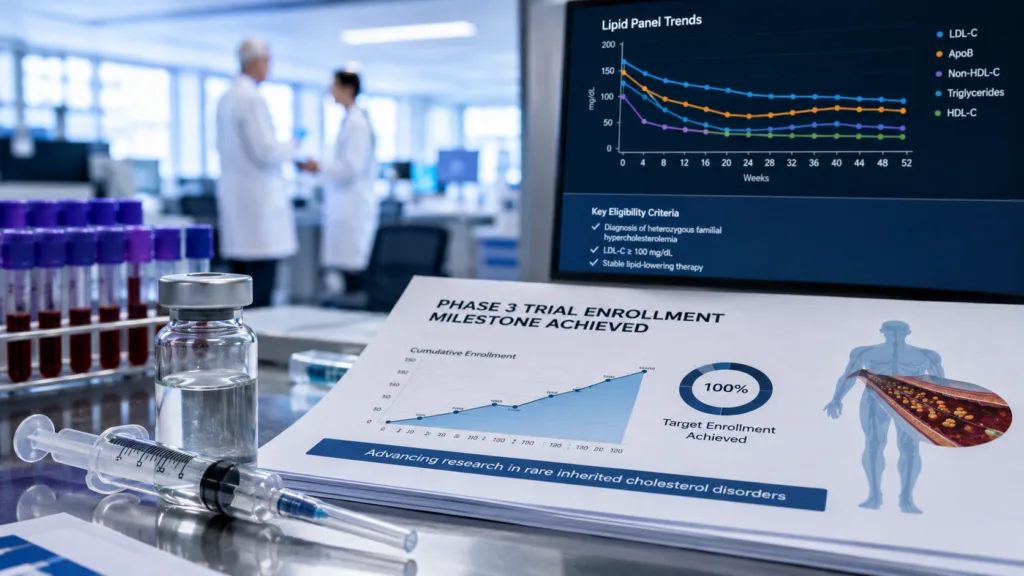
Arrowhead Pharmaceuticals, Inc. has completed enrollment in the global Phase 3 YOSEMITE trial of zodasiran, an investigational RNA interference therapy being evaluated for homozygous familial hypercholesterolemia. The Nasdaq-listed company enrolled 70 adolescent and adult participants, exceeding the study’s original target of approximately 60, and expects the trial to be completed in mid-2027.
The announcement marks an important operational milestone, but it does not provide new efficacy or safety findings. The more consequential event will come when YOSEMITE reports whether quarterly zodasiran can produce a statistically persuasive and clinically meaningful reduction in low-density lipoprotein cholesterol when added to the intensive background treatment already used by people with this ultra-rare inherited disorder.
That distinction matters because zodasiran has so far been supported by encouraging but limited clinical evidence in homozygous familial hypercholesterolemia. The preceding Phase 2 GATEWAY study included only 18 patients, used an open-label design and did not contain a placebo control. YOSEMITE is designed to address several of those limitations through randomisation, double blinding and a placebo-controlled comparison over 12 months.
Why does completing enrollment materially reduce the execution risk surrounding YOSEMITE?
Recruiting patients with homozygous familial hypercholesterolemia is inherently difficult. The condition is exceptionally rare, geographically dispersed and frequently managed by specialised lipid centres, while eligible patients may already be receiving combinations of statins, ezetimibe, PCSK9-directed therapies, lomitapide, evinacumab or lipoprotein apheresis.
Arrowhead initially planned to enrol approximately 60 participants but ultimately randomised 70, citing strong interest from patients and physicians. The larger population will not transform YOSEMITE into a conventional large cardiovascular outcomes trial, but it provides the study with more clinical observations in a disease where every additional enrollee can be difficult to identify.
YOSEMITE includes patients aged 12 years and older with genetically or clinically diagnosed homozygous familial hypercholesterolemia who remain on maximally tolerated lipid-lowering therapy. Participants have been randomised in a two-to-one ratio to receive either 200 milligrams of zodasiran or placebo by subcutaneous injection once every three months, for a total of four doses.
The primary endpoint is the percentage change from baseline in fasting LDL cholesterol at month 12. Eligible participants will subsequently be able to enter an optional open-label extension, which should provide additional information about continued dosing, longer-term tolerability and the durability of lipid reductions.
Completion of enrollment therefore removes one practical risk from the programme. Arrowhead no longer needs to demonstrate that it can locate and randomise enough patients for the pivotal study. It must now execute dosing, retention, endpoint measurement and follow-up without introducing imbalances or missing data that could complicate interpretation.
Can YOSEMITE confirm the LDL cholesterol reductions reported in the small GATEWAY study?
The clinical rationale for YOSEMITE rests substantially on GATEWAY, an open-label, randomised Phase 2 study involving 18 patients with homozygous familial hypercholesterolemia. Participants aged 16 years and older received either 200 milligrams or 300 milligrams of zodasiran on day one and again at month three while continuing stable background lipid-lowering therapy.
Peer-reviewed results published in The Lancet Diabetes & Endocrinology reported mean fasting LDL cholesterol reductions at month six of 35.7% in the 200-milligram group and 39.9% in the 300-milligram group. The findings supported further development, but the confidence intervals were relatively wide, reflecting the small population and patient-to-patient variability.
Earlier interim measurements had suggested LDL cholesterol reductions exceeding 40% in both dose groups. Arrowhead also reported reductions in apolipoprotein B, non-high-density lipoprotein cholesterol and circulating ANGPTL3, indicating that target suppression affected several atherogenic lipid measurements rather than LDL cholesterol alone.
However, GATEWAY was not designed to establish zodasiran’s effectiveness against placebo. Both dose groups received the investigational therapy, the study was open-label and the sample size was too small to provide a comprehensive characterisation of uncommon adverse events or treatment responses across the heterogeneous genetic and clinical presentations of homozygous familial hypercholesterolemia.
YOSEMITE must show that the Phase 2 signal is reproducible under more rigorous conditions. The use of the 200-milligram dose also means the pivotal study will test the lower of the two GATEWAY regimens, although the Phase 2 results did not indicate that the 300-milligram group produced a clearly superior LDL cholesterol response.
A positive primary endpoint would establish that zodasiran lowers LDL cholesterol relative to placebo when added to existing therapy. It would not, by itself, demonstrate fewer heart attacks, strokes, cardiovascular procedures or deaths. The study is primarily a lipid-lowering trial, and LDL cholesterol functions as a well-established biomarker and regulatory endpoint in this setting rather than a direct measurement of long-term cardiovascular outcomes.
Why could an LDL receptor-independent mechanism matter for patients with severe HoFH?
Most cases of homozygous familial hypercholesterolemia involve genetic abnormalities that severely impair the function of the LDL receptor. Because several established lipid-lowering therapies depend partly on functioning LDL receptors, their effectiveness can be reduced in patients with little or no residual receptor activity.
Zodasiran is designed to silence hepatic production of angiopoietin-like protein 3, known as ANGPTL3. Reducing ANGPTL3 expression is intended to increase the activity of enzymes involved in lipid metabolism and lower LDL cholesterol, triglycerides and other atherogenic lipoproteins through pathways that do not require normal LDL receptor function.
That biological rationale has already been clinically validated at the target level by evinacumab, an ANGPTL3-blocking monoclonal antibody marketed as Evkeeza. The United States label for Evkeeza covers adults and children aged one year and older with homozygous familial hypercholesterolemia as an adjunct to diet, exercise and other LDL cholesterol-lowering therapies.
The presence of an approved ANGPTL3 therapy reduces the biological uncertainty surrounding the target, but it creates a demanding commercial comparator for Arrowhead. Evinacumab is administered as an intravenous infusion every four weeks, while the YOSEMITE regimen involves one subcutaneous zodasiran injection every three months.
A quarterly subcutaneous therapy could potentially reduce treatment visits and administration burden. That possibility remains a commercial hypothesis, however, because YOSEMITE is not a head-to-head trial against evinacumab and cannot establish comparative efficacy, safety, adherence, convenience or value.
Patient preferences will also depend on factors that a registration trial cannot fully answer, including injection experience, monitoring requirements, availability through specialist centres, insurance coverage, out-of-pocket exposure and whether physicians are comfortable switching patients whose LDL cholesterol is already responding to another ANGPTL3-directed treatment.
What safety evidence will regulators need beyond the favourable Phase 2 findings?
Arrowhead has described zodasiran’s clinical safety profile as favourable to date. In GATEWAY, the company reported no treatment discontinuations, drug-related serious adverse events or deaths. Frequently reported events included COVID-19, nasopharyngitis, upper respiratory tract infection and dizziness.
The Phase 2 publication therefore did not identify an obvious safety obstacle to continued development. Nevertheless, 18 patients cannot exclude uncommon reactions, clinically relevant laboratory abnormalities or risks that may emerge after repeated exposure.
YOSEMITE will expand the treated population and provide a year of blinded comparative data. Regulators are likely to evaluate adverse events alongside liver tests, metabolic measurements, injection-related reactions, treatment discontinuations and any imbalances between zodasiran and placebo.
The reduction of ANGPTL3 also lowers triglycerides and high-density lipoprotein cholesterol. Changes in these biomarkers are consistent with the target’s biological function, but regulators and clinicians will still examine the total metabolic profile rather than interpreting LDL cholesterol reduction in isolation.
The optional extension will be important because a treatment for homozygous familial hypercholesterolemia would be used chronically, potentially beginning during adolescence and continuing for many years. A one-year pivotal period can support an initial regulatory assessment, but longer exposure will be necessary to build confidence around sustained dosing.
Zodasiran has received orphan drug designation from the United States Food and Drug Administration for homozygous familial hypercholesterolemia. The designation provides development incentives for a rare-disease programme, but it is not approval and does not establish that the therapy is effective or safe. The FDA’s orphan-drug database continues to list the candidate as designated but not approved for the orphan indication.
Could quarterly dosing give zodasiran a meaningful commercial position after approval?
The commercial case will depend on more than meeting the LDL cholesterol endpoint. Homozygous familial hypercholesterolemia treatment usually involves multiple therapies because many patients remain substantially above recommended LDL cholesterol levels despite aggressive intervention.
Current management can include conventional oral drugs, injectable PCSK9-directed therapies, lomitapide, evinacumab and lipoprotein apheresis. European Atherosclerosis Society guidance supports the early use of combination lipid-lowering treatment and the addition of therapies such as lomitapide or ANGPTL3 inhibition when LDL cholesterol goals remain unmet.
Zodasiran could therefore be positioned as an additional component of a treatment combination rather than a universal replacement for existing therapy. Its potential value may be greatest in patients who remain poorly controlled, have limited LDL receptor function, struggle with treatment burden or lack practical access to frequent intravenous infusions and apheresis.
Pricing and payer policy will be central. Rare-disease lipid treatments can generate high annual costs, and payers may require genetic or specialist-confirmed diagnosis, documentation of inadequate response to other treatments and continued evidence that LDL cholesterol is falling.
Arrowhead would also need to establish reliable manufacturing, distribution and specialist prescriber support. The company now has direct commercial experience following the United States launch of Redemplo, its approved plozasiran product for adults with familial chylomicronemia syndrome. That infrastructure could support another rare cardiometabolic launch, although homozygous familial hypercholesterolemia involves different treatment centres, competitors and reimbursement considerations.
Why is YOSEMITE an important pipeline signal without being Arrowhead’s main near-term stock catalyst?
Arrowhead Pharmaceuticals shares were trading at approximately $85.53 at the latest market close, giving the company a market capitalisation of about $12.18 billion. The stock was close to the upper end of its 52-week range of roughly $15.01 to $95.49.
The shares had gained approximately 19% over the five trading sessions from July 20 to July 27, although the most significant movement followed Arrowhead’s July 22 disclosure of Phase 3 plozasiran results in severe hypertriglyceridemia. The stock closed at $71.65 on July 20, jumped to $88.70 on July 22 and finished July 24 at $85.60.
The YOSEMITE enrollment announcement arrived after that major repricing and coincided with only a marginal movement in the shares. It is therefore better interpreted as an incremental pipeline execution update rather than the principal cause of the company’s recent stock performance.
Arrowhead also appears financially equipped to continue the programme. At March 31, 2026, the company reported approximately $1.78 billion in cash resources after completing concurrent financings that generated $930 million in gross proceeds. Research and development expenditure was $173.3 million during the fiscal second quarter, while the company recorded a net loss attributable to Arrowhead of $132.7 million.
That balance sheet reduces near-term financing pressure around YOSEMITE, but investors will still weigh zodasiran against Arrowhead’s broader clinical and commercial portfolio. The company is simultaneously funding the Redemplo launch, additional plozasiran indications and multiple RNA interference programmes outside cardiometabolic disease.
The next meaningful zodasiran milestone is not another enrollment update. It is the completion of YOSEMITE, expected in mid-2027, followed by the disclosure of blinded Phase 3 efficacy and safety results. A regulatory submission in multiple markets would depend on those results being successful and on the broader evidence package satisfying the relevant agencies.
Until then, zodasiran remains an investigational therapy with a plausible mechanism, encouraging Phase 2 evidence and a fully enrolled pivotal trial. The decisive question is whether a quarterly 200-milligram regimen can consistently lower LDL cholesterol across a larger and more diverse HoFH population without introducing safety or tolerability issues that weaken its practical value.
Enrollment has put that question on a defined timetable. YOSEMITE’s results will determine whether zodasiran develops into a differentiated rare-disease product or remains another promising lipid therapy whose early signal could not be fully reproduced under Phase 3 conditions.