Kyowa Hakko USA has disclosed new preclinical findings suggesting that Cognizin citicoline may influence biological processes involved in neuromuscular junction formation and motor-neuron coordination. The research, conducted by scientists at Kirin Holdings Company, Limited, was presented at the American Society for Nutrition’s NUTRITION 2026 conference on July 27, 2026.
The study found that citicoline increased the expression of genes associated with neuromuscular junction development, enhanced acetylcholine receptor clustering in a laboratory co-culture model and increased synchronised activity among induced pluripotent stem cell-derived motor neurons. These observations give Kyowa Hakko Bio Co., Ltd. an early scientific basis for investigating whether Cognizin, which has primarily been positioned as a cognitive-health ingredient, could eventually support products targeting physical performance or age-related motor function.
However, the research does not demonstrate that Cognizin improves muscle strength, balance, mobility, athletic performance or physical function in people. The disclosed experiments were conducted in cells, and the company has not reported an animal study or a controlled human trial evaluating neuromuscular outcomes. The commercial opportunity is therefore still hypothetical, even though the underlying biological signal may be relevant enough to justify further investigation.
What did Kirin’s cell models actually show about neuromuscular junction formation?
Kirin researchers created a neuromuscular cell model by co-culturing C2C12 mouse myoblasts with NSC-34 motor neuron-like cells. Citicoline was added to the model, after which the researchers measured the expression of genes involved in neuromuscular junction development and used immunostaining to examine acetylcholine receptor clustering.
The company reported increased expression of DOK7 and CHRNE. DOK7 is involved in signalling processes required for neuromuscular synapse formation, while CHRNE encodes an acetylcholine receptor subunit found at the muscle side of the neuromuscular junction. Kirin also reported increases in the number, area and intensity of acetylcholine receptor clusters.
This combination of gene-expression and imaging findings is more informative than relying on a single molecular marker. It indicates that citicoline affected several measurements associated with the organisation of the postsynaptic structure through which a motor neuron communicates with a muscle fibre.
The researchers separately tested citicoline in motor neurons derived from induced pluripotent stem cells. Microelectrode arrays were used to measure neuronal activity, with the company reporting an increase in the Synchrony Index after citicoline exposure. Kirin interpreted the result as evidence of enhanced synchronisation among motor neurons, a process that may be relevant to the control of muscle output and rapid force generation.
There is nevertheless an important separation between the two experimental systems. The acetylcholine receptor findings came from a co-culture involving mouse muscle cells and motor neuron-like cells, while the synchrony result came from an assay involving induced pluripotent stem cell-derived motor neurons. The disclosed material does not establish that both effects occur together within an intact human neuromuscular system.
Why is acetylcholine receptor clustering relevant without proving better physical performance?
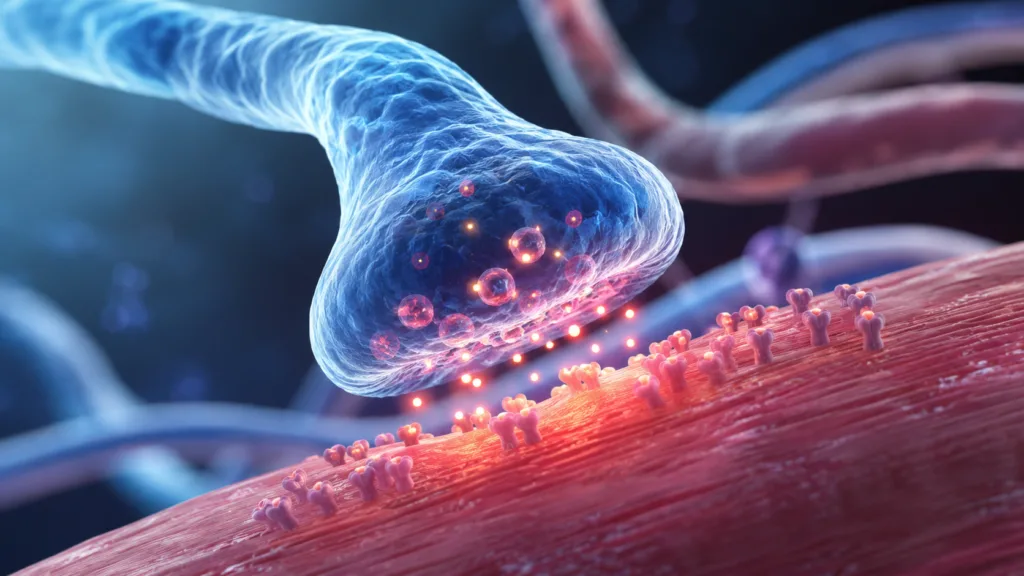
The neuromuscular junction is the specialised connection where a motor neuron transmits a signal to a skeletal muscle fibre. Acetylcholine released from the nerve terminal binds to receptors concentrated on the muscle membrane, initiating the events that lead to muscle contraction. The density and organisation of these receptors are therefore important to effective neuromuscular transmission.
Acetylcholine receptor clustering is an established laboratory indicator of neuromuscular junction development. Increasing clustering in a cell model can strengthen the biological rationale for examining whether an intervention influences the formation or organisation of the junction.
It is not, however, a substitute for demonstrating a functional improvement. A laboratory model cannot fully reproduce the complexity of a living neuromuscular system, which includes mature muscle architecture, peripheral nerves, blood supply, metabolism, inflammation, physical loading and signalling from the brain and spinal cord.
The company’s announcement did not disclose the citicoline concentrations tested, the size of the reported effects, detailed statistical values, the number of experimental replicates or whether responses followed a clear dose-dependent pattern. It also did not describe comparisons with an active control or another ingredient targeting neuromuscular biology. These details will be important when the complete dataset becomes available.
The findings should consequently be viewed as mechanism-generating evidence. They indicate that citicoline may interact with pathways relevant to neuromuscular junction formation, but they do not establish that oral consumption delivers enough citicoline to the relevant tissues to reproduce those effects in people.
How far is Cognizin from supporting sports nutrition or healthy ageing claims?
Kyowa Hakko has identified sports nutrition and healthy ageing as potential commercial areas for the research. Both markets have understandable interest in preserving the connection between the nervous system and skeletal muscle, although the required evidence will differ substantially between applications.
A sports-nutrition programme would need to examine outcomes such as voluntary force generation, reaction time, rate of force development, coordination, fatigue resistance or recovery. Researchers would also need to determine whether citicoline produces an effect beyond normal training adaptation and whether any improvement is meaningful to trained or recreationally active populations.
Healthy-ageing research would require a different study design. Relevant endpoints could include grip strength, walking speed, balance, chair-rise performance, fall-related measures and validated assessments of daily physical function. Trials would need to distinguish a possible neuromuscular effect from changes caused by exercise, dietary protein, baseline nutritional status, medication use or underlying disease.
Kirin connected its research rationale to dynapenia, a decline in muscle strength that may occur even when muscle mass is relatively preserved. The concept is commercially relevant because it moves the formulation discussion beyond building muscle tissue and toward maintaining the quality of communication between nerves and muscles.
Yet the current experiment did not enrol older adults, people with dynapenia or athletes. It did not measure muscle mass, physical performance or functional decline. References to healthy ageing and sports nutrition should therefore be understood as proposed research and product-development directions rather than substantiated benefits.
Could Cognizin expand beyond cognitive health without weakening its established positioning?
Cognizin is a branded form of citicoline developed by Kyowa Hakko Bio. Citicoline is associated with the synthesis of phosphatidylcholine, an important component of cell membranes, and has principally been researched and marketed in relation to neural and cognitive functions.
Previous human studies have examined Cognizin in cognitive settings. A randomised, double-blind, placebo-controlled trial involving 100 adults aged between 50 and 85 with age-associated memory impairment evaluated 500 milligrams of citicoline daily for 12 weeks. The study reported greater improvements in certain secondary measures of episodic and composite memory among participants receiving citicoline, although the research did not evaluate neuromuscular junctions or physical-function outcomes.
The new cell research does not extend those cognitive results into muscle health. It instead opens a separate evidence pathway based on a plausible connection between neural signalling and muscle activation.
Commercially, that distinction matters. Ingredient companies often attempt to extend established branded ingredients into adjacent wellness categories, but a recognisable brand and an existing safety or cognitive evidence package do not automatically substantiate a new physiological claim.
Kyowa Hakko’s opportunity lies in building a connected but clearly segmented narrative. Cognizin may continue to be positioned primarily as a cognitive-health ingredient while the company investigates whether its neural effects have relevance to the control of movement. Jumping directly to a broad mind-and-muscle positioning could create more regulatory and scientific questions than commercial advantages.
The timing nevertheless fits Kirin Holdings’ broader effort to expand its health-science business. In July 2026, Kirin and its Blackmores subsidiary announced the introduction of Cognizin-containing cognitive supplements in Australia and New Zealand. The products contain 250 milligrams of Cognizin per tablet and are being commercialised using jurisdiction-specific cognitive and brain-health positioning.
A credible neuromuscular evidence package could eventually give the group additional formulation options across supplements, functional beverages and performance-nutrition products. At present, however, the new study is better understood as research-led portfolio exploration than as support for an immediate product launch.
What regulatory questions would follow a neuromuscular positioning strategy?
Citicoline already has a regulatory history as a food and supplement ingredient, but permission to use an ingredient does not automatically authorise every proposed benefit claim.
Within the European Union, citicoline is included in the Union list of authorised novel foods for specified uses. The current listing permits its use in food supplements at up to 500 milligrams per day and in foods for special medical purposes under defined conditions, while also requiring labelling that states products containing citicoline are not intended for children.
Kirin also stated that Cognizin citicoline had been listed as a new ingredient by Australia’s Therapeutic Goods Administration before the 2026 Blackmores product launch. Claims and indications remain dependent on the rules and accepted evidence in each jurisdiction.
A future neuromuscular claim would therefore require more than evidence that the ingredient may legally be included in a product. Regulators and advertising authorities would examine whether the wording is supported by human evidence, whether the tested dose matches the commercial formulation and whether the claimed population corresponds to the participants studied.
Claims involving maintenance of normal neuromuscular function would also need to be separated from claims suggesting treatment or prevention of muscle weakness, age-related functional decline or neurological disease. The latter could move a product toward medicinal territory and would demand a much more extensive clinical and regulatory package.
Which studies could turn Cognizin’s laboratory signal into credible human evidence?
The most informative next step would be replication with fuller methodological disclosure. This should include the concentrations tested, exposure periods, dose-response relationships, experimental replication, statistical effect sizes and confirmation that the observed changes are reproducible across relevant cell models.
An animal study could then examine whether oral citicoline reaches the tissues involved in neuromuscular transmission and whether the cell-level findings translate into changes in junction structure, nerve conduction or physical performance. Such research would still remain preclinical, but it could help determine whether the mechanism survives the transition from a controlled dish to a living system.
Human proof-of-concept research would ultimately be decisive. A well-controlled trial could combine physical-function endpoints with exploratory physiological measurements, such as electromyography or assessments of motor-unit recruitment. The population, dose and duration would need to match the intended commercial use.
For healthy ageing, a trial may need several months and should account for exercise, protein intake and baseline frailty. For sports nutrition, shorter studies may be possible, but they would need sensitive and reproducible performance endpoints rather than subjective reports of energy or readiness.
The commercial value of the July 2026 announcement is therefore not that Cognizin has already become a neuromuscular-health ingredient. Its significance is that Kirin has identified a testable biological pathway through which an established cognitive ingredient might enter a new research category.
Whether that pathway becomes commercially useful will depend on the next evidence layer. Until animal and human studies demonstrate measurable effects on muscle signalling or physical function, the acetylcholine receptor and motor-neuron findings remain an intriguing laboratory signal rather than proof of a consumer benefit.