
American Industrial Partners has completed its approximately $1.272 billion acquisition of Avanos Medical, converting the medical device manufacturer into a privately held company and ending the trading of its shares on the New York Stock Exchange. Under the transaction completed on July 27, 2026, eligible Avanos Medical stockholders are entitled to receive $25 in cash for each share they owned.
The closing transfers a portfolio of enteral feeding, neonatal care, surgical pain, chronic pain and recovery products to an investment firm that describes itself as operationally focused. American Industrial Partners is not simply purchasing a collection of device brands. It is acquiring a company with a rapidly expanding specialty nutrition franchise, uneven performance across its pain-management operations and a substantial opportunity to improve margins, product prioritisation and manufacturing efficiency away from the immediate scrutiny of public markets.
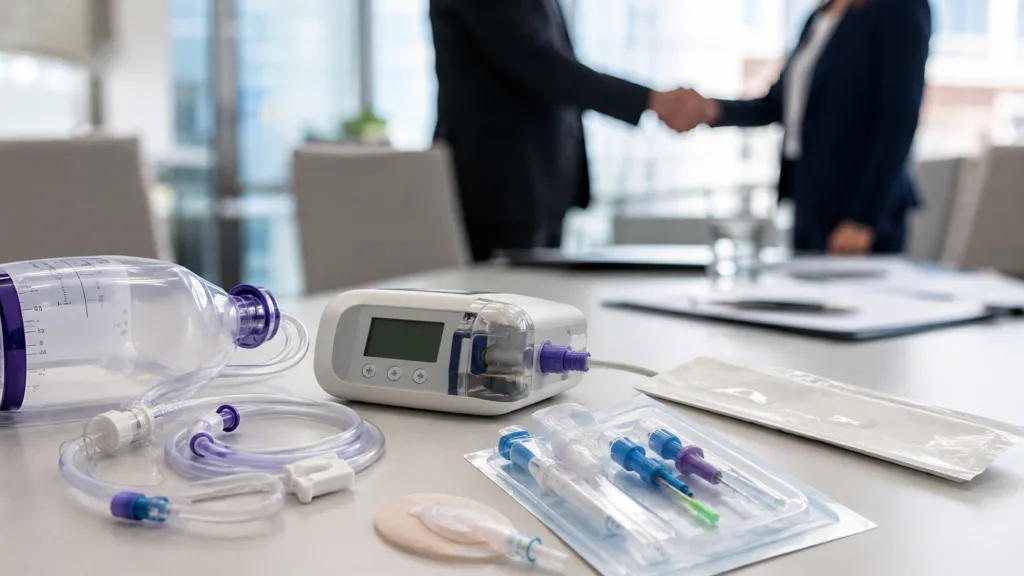
Avanos Medical entered the transaction with recognisable clinical and hospital-facing brands, including MIC-KEY low-profile feeding tubes, CORTRAK feeding-tube guidance products, NeoMed neonatal solutions, ON-Q elastomeric pain pumps, Game Ready cold and compression systems and COOLIEF cooled radiofrequency technology. These products span hospitals, operating rooms, ambulatory surgery centres and home-care environments, giving the new owner exposure to both procedure-linked demand and recurring consumption of feeding and pain-management supplies.
Why did American Industrial Partners value Avanos Medical at approximately $1.27 billion?
American Industrial Partners agreed to pay $25 per share in cash, representing a premium of approximately 72.1% to Avanos Medical’s closing share price on April 13, 2026, the final full trading day before the acquisition was announced. The price also represented an approximately 82.8% premium to the company’s 30-day volume-weighted average share price through that date.
The premium indicates that Avanos Medical’s public-market valuation had not fully reflected the operating improvement or strategic value that the buyer believed could be extracted from the business. It also compensated shareholders for surrendering any participation in future improvements under American Industrial Partners’ ownership.
Avanos Medical’s board appears to have maintained pricing discipline during negotiations. The company’s proxy materials showed that directors were willing to pursue another sponsor unless American Industrial Partners increased its offer to at least $25 per share. The investment firm ultimately presented $25 as its highest offer, after which the parties executed the merger agreement.
Stockholder support was decisive. Approximately 99.75% of the shares voted at the July 22 special meeting supported the acquisition, representing roughly 74.96% of all outstanding Avanos Medical shares as of the record date. Regulatory approvals had already been obtained before the vote, clearing the remaining major obstacles to completion.
Based on Avanos Medical’s reported 2025 revenue of $701.2 million, the $1.272 billion enterprise value equates to approximately 1.8 times trailing annual revenue. Compared with the company-reported 2025 adjusted EBITDA of $86.8 million, the transaction value represents about 14.7 times adjusted EBITDA. These are simple trailing calculations rather than transaction-adjusted valuation measures, but they illustrate that American Industrial Partners paid for more than the company’s recent earnings profile.
What does Avanos Medical’s latest performance reveal about the business being acquired?
Avanos Medical entered the acquisition with improving revenue momentum but mixed profitability across its two core reporting segments. First-quarter 2026 net sales increased 8.8% from the previous year to $182.2 million. Net income was $5.1 million, while adjusted EBITDA reached $21.8 million, only slightly above the $21.6 million reported in the corresponding 2025 quarter.
The contrast between sales growth and largely unchanged adjusted EBITDA is important. It suggests that higher revenue was not yet translating into proportionate earnings expansion, leaving American Industrial Partners with an identifiable margin-improvement opportunity. Tariffs, product mix, selling expenses and investment requirements may all influence the pace at which revenue growth produces stronger cash generation.
The company’s cash position also showed why operational discipline will matter. Avanos Medical used $12.3 million of cash in operating activities during the first quarter of 2026, compared with generating $25.7 million a year earlier. Free cash flow was negative $16.6 million, cash declined to $65.6 million and total debt stood at $98.2 million at the end of March.
Those figures do not indicate a severely leveraged company. They do, however, show that working capital, capital expenditure and operating efficiency will need attention, particularly if the new owner plans to accelerate product development or pursue additional acquisitions.
The full-year 2025 results presented a similarly mixed picture. Revenue increased 1.9% to $701.2 million, but adjusted EBITDA declined to $86.8 million from $107.6 million in 2024. Free cash flow decreased to $43.1 million from $82.9 million, while the company reported a net loss of $72.9 million that included substantial impairment charges.
Why is Specialty Nutrition Systems likely to anchor the private-equity growth strategy?
Specialty Nutrition Systems was responsible for $124 million of Avanos Medical’s first-quarter 2026 sales, or approximately 68% of total quarterly revenue. Segment sales increased 22.7% from the comparable period, supported by strong volume growth across enteral feeding and neonatal products. Operating income reached $23.1 million, equivalent to 18.6% of segment revenue.
This performance makes Specialty Nutrition Systems the clearest growth and earnings engine within Avanos Medical. The portfolio includes MIC-KEY enteral feeding tubes, Corpak feeding solutions, NeoMed neonatal and paediatric products, and Nexus TKO anti-reflux needleless connectors. MIC-KEY and Corpak each represented more than 10% of consolidated Avanos Medical sales during 2025, demonstrating the commercial importance of these franchises.
Enteral nutrition products can also create attractive commercial characteristics because feeding systems require accessories, replacements and ongoing clinical support across hospital and home-care settings. Demand can be influenced by patient volumes, distributor inventories, reimbursement practices and healthcare-provider preferences, but established product familiarity can create meaningful switching considerations.
American Industrial Partners may therefore focus on expanding production capacity, strengthening distribution, increasing penetration outside North America and extending the product portfolio around established feeding platforms. Avanos Medical generated $137.1 million of its first-quarter revenue in North America, while Europe, the Middle East and Africa contributed $30.6 million and Asia-Pacific and Latin America contributed $14.5 million. The faster reported growth outside North America suggests that international execution could become an important part of the ownership plan.
The strategic risk is that rapid growth must be supported by consistent manufacturing, regulatory compliance and product availability. Feeding products are clinically important components of care pathways, so supply interruptions or quality problems can carry consequences beyond a missed sales quarter. American Industrial Partners’ operating agenda will need to protect reliability while pursuing efficiency.
Can private ownership repair the weaker economics of Pain Management and Recovery?
Pain Management and Recovery generated first-quarter 2026 revenue of $56.3 million, accounting for approximately 31% of Avanos Medical’s consolidated quarterly sales. Segment revenue was largely unchanged from the previous year, and the business recorded an operating loss of $1.8 million compared with operating income of $0.2 million in the corresponding period.
Performance within the segment was uneven. Radiofrequency ablation revenue increased 8.8%, while surgical pain and recovery revenue declined 11%, primarily because of lower volume. The RFA portfolio includes COOLIEF, Trident and ESENTEC technologies used in minimally invasive procedures for chronic pain, while the surgical portfolio includes ON-Q and ambIT pain pumps and Game Ready cold and compression systems.
The mix shift matters because the commercial models are different. Radiofrequency products depend on physician training, procedure adoption, equipment placement, disposable utilisation and reimbursement. Surgical pain pumps and recovery systems depend more heavily on surgical volumes, hospital protocols, outpatient pathways and the willingness of institutions to incorporate non-opioid pain-management options into routine practice.
American Industrial Partners will need to decide where incremental investment can produce defensible growth and where the portfolio requires simplification. Improving the segment may involve sharper sales-force allocation, product-line rationalisation, manufacturing changes or selective investment behind higher-growth RFA technologies.
Private ownership could make those decisions easier because Avanos Medical will no longer need to explain every quarterly fluctuation to public shareholders. That freedom is useful, but it is not magic. Hospital adoption will still depend on clinical evidence, reimbursement, training requirements, procedural economics and reliable product support.
How could American Industrial Partners change Avanos Medical’s operating priorities?
American Industrial Partners manages approximately $17.8 billion in assets and has completed more than 145 platform and add-on acquisitions. Its portfolio companies collectively generated approximately $32 billion in annual revenue and employed more than 74,000 people as of March 31, 2026. The firm has positioned its operating expertise as the principal advantage it brings to Avanos Medical.
The immediate opportunities are likely to include procurement, manufacturing utilisation, supply-chain resilience, commercial productivity and cost control. Avanos Medical had already announced expanded transformation initiatives intended to generate between $15 million and $20 million of incremental annualised savings by the end of 2026. American Industrial Partners now has the option to accelerate, modify or extend that programme.
Research and development spending will require careful treatment. Avanos Medical reported $5.2 million of research and development expense in the first quarter, slightly below $5.4 million a year earlier. Aggressive cost reduction could improve near-term earnings, but underinvestment could weaken the product pipeline and eventually erode the value of the brands American Industrial Partners has acquired.
A more productive strategy would separate administrative savings from clinically and commercially important investment. Resources can be concentrated around high-growth feeding systems, differentiated RFA products, manufacturing quality, regulatory maintenance and product improvements that reduce workflow burden for clinicians.
The buyer may also use Avanos Medical as a platform for additional medical technology acquisitions. The existing commercial infrastructure, manufacturing footprint and hospital relationships could support complementary products, although any add-on transaction would need to strengthen rather than complicate a portfolio that already spans multiple care settings and purchasing models.
What does the acquisition mean for former Avanos Medical shareholders and market sentiment?
Avanos Medical’s former public shareholders receive a substantial premium and avoid the execution risk associated with the company’s ongoing transformation. They also give up any future upside that American Industrial Partners may create through margin expansion, portfolio restructuring or acquisitions.
The disappearance of the AVNS ticker also ends the conventional stock-sentiment story. Avanos Medical shares will no longer provide a daily measure of investor expectations, and the company will eventually cease the periodic public-reporting obligations associated with its former exchange registration.
That reduced transparency is one of the most consequential changes for competitors, suppliers and industry observers. Revenue, profitability, product performance and capital-allocation decisions may become less visible after the company completes the process of terminating its public registration.
For American Industrial Partners, confidentiality can support longer-term restructuring. For the wider market, it makes indirect indicators more important, including product launches, regulatory filings, hospital contracts, distributor activity, manufacturing investments and management changes.
What will determine whether the Avanos Medical acquisition succeeds?
The first test will be whether Avanos Medical can preserve the momentum of Specialty Nutrition Systems without sacrificing service levels or manufacturing reliability. Growth led by MIC-KEY, Corpak and NeoMed provides the company with a strong starting point, but the value of that growth will depend on margins, cash conversion and international execution.
The second test will be whether Pain Management and Recovery can return to consistent profitability. Radiofrequency ablation growth is encouraging, but the decline in surgical pain and recovery sales shows that the entire portfolio is not moving in the same direction. American Industrial Partners will need to determine which brands deserve additional capital and which require repositioning.
The third test will be innovation. Avanos Medical chief executive officer Dave Pacitti indicated at closing that the new owner’s operational resources could allow the company to move faster on its existing innovation roadmap. That expectation will eventually need to be demonstrated through measurable product development, regulatory progress and commercial adoption rather than broader statements about accelerated growth.
American Industrial Partners has acquired a medtech company with valuable products, improving top-line momentum and a clear internal performance gap. The acquisition will look well timed if private ownership converts strong nutrition growth into durable cash generation while restoring the economics of the pain-management portfolio. If those improvements fail to emerge, the generous takeover premium and approximately 14.7-times trailing adjusted EBITDA valuation will leave considerably less room for operational disappointment.