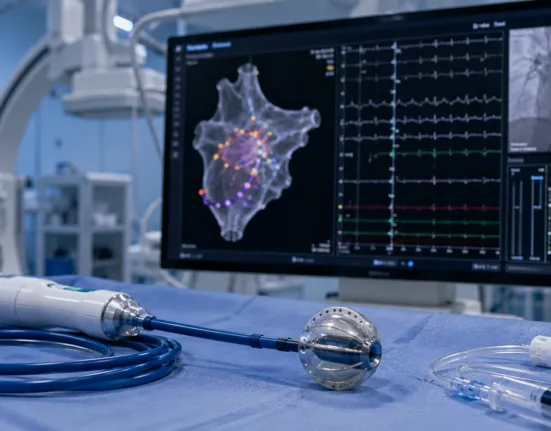
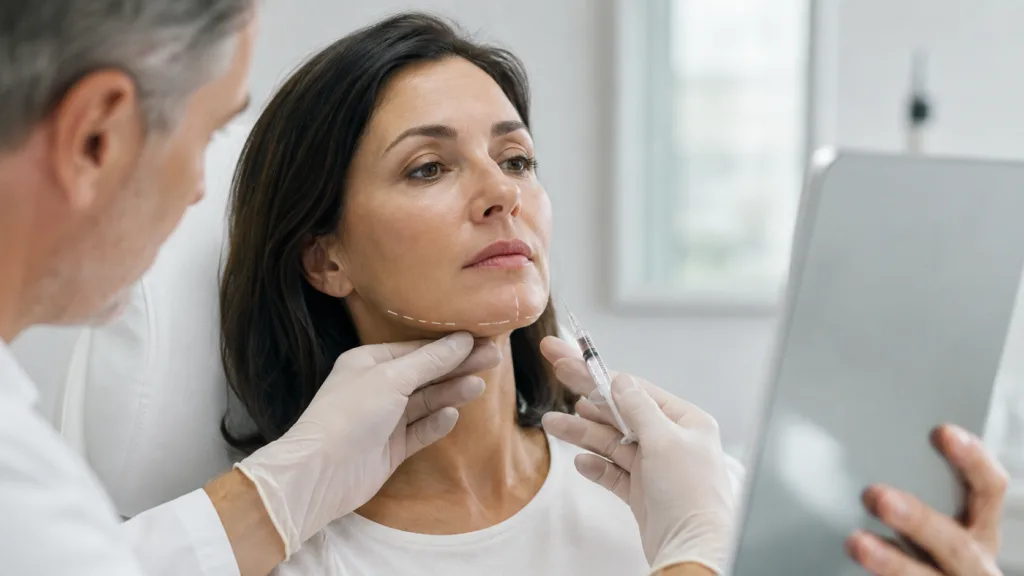
Galderma Group AG (SIX: GALD) said on August 11, 2026 that Restylane Shaype has been approved in the European Union under the Medical Device Regulation for temporary augmentation of the chin region, extending the injectable’s geographic reach after earlier approvals and launches outside Europe. The hyaluronic acid injectable uses Galderma’s NASHA HD technology and is engineered for deep injection to provide high structural support in the chin, a positioning the company describes as a “bone-mimicking” effect.
The approval is significant for Galderma because Restylane Shaype is not simply another formulation aimed at filling wrinkles or restoring diffuse facial volume. The product is built around a much firmer gel profile intended to create projection and definition in an anatomical area where mechanical support matters, potentially giving Galderma a more specialized product for clinicians performing lower-face contouring. Its entry into Europe also comes as the company is trying to sustain growth in fillers despite describing the broader filler market as soft.
That distinction, however, requires careful interpretation. Galderma calls Restylane Shaype the first and only hyaluronic acid injectable with a bone-mimicking effect, but chin augmentation with injectable hyaluronic acid is not new, and existing high-firmness products already compete for lower-face procedures. A 2026 randomized study directly compared Restylane Shaype with AbbVie’s Juvéderm Volux, making the European opportunity less about creating a new category and more about whether Galderma has produced a sufficiently differentiated tool to change injector preference within an established one.
What exactly has the European Union authorized for Restylane Shaype under the Medical Device Regulation?
Galderma’s announced European indication is specifically temporary augmentation of the chin region. The wording matters because the company is also studying and discussing Restylane Shaype in broader lower-face treatment strategies, including combination approaches and potential use around the jawline, but those development and educational activities should not be confused with the scope of the newly announced European indication.
The European regulatory framework also differs from the drug approval system. Dermal fillers used for aesthetic purposes fall within the European Union Medical Device Regulation framework, including products covered by Annex XVI, and European Commission guidance describes injectable dermal fillers as products introduced into the skin to provide facial volume or fill wrinkles. Such products are regulated under device requirements even when the intended purpose is aesthetic rather than treatment of disease.
European Commission guidance further treats absorbable dermal fillers administered by injection as implantable products for classification purposes because they are introduced through a clinical intervention and remain in the body after the procedure before eventually being absorbed. That makes the MDR decision an important market-access milestone, but it should not be interpreted as an European Medicines Agency-style marketing authorization for a pharmaceutical product or as authorization for every facial application in which the gel might technically be used.
Galderma has already built commercial experience with Restylane Shaype elsewhere. Health Canada approved the injectable for temporary chin augmentation in January 2024, followed by commercial availability in Canada the following month, while Galderma has subsequently expanded the product into markets including Brazil and Thailand. The European authorization therefore represents geographic scale-up of an existing product rather than the beginning of its clinical or commercial history.
How strong is the clinical evidence supporting Restylane Shaype for chin augmentation?
The pivotal evidence package is more substantial than a typical product-launch study. Galderma’s study 43BBJ2001 was a randomized, evaluator-blinded, parallel-group, no-treatment-controlled multicenter trial that enrolled 140 adults seeking augmentation and correction of chin retrusion. The ClinicalTrials.gov record shows that the study began in January 2021, reached primary completion in September 2021 and completed follow-up in June 2022.
Published results reported that 103 participants received Restylane Shaype while 37 initially served as untreated controls. At three months, 83.3% of participants in the treatment group met the reported chin-retrusion improvement criterion compared with 10.8% of controls, supporting the effectiveness of the product for the studied indication. Follow-up continued through 12 months, with investigators reporting persistent aesthetic improvement and high patient satisfaction over the observation period.
The safety findings were also broadly supportive within the limits of the study. Product-related or injection-related adverse events were reported as predominantly mild or moderate and transient, while the publication reported no product-related or injection-related serious adverse events. That does not make injectable treatment risk-free, but it provides a more useful evidence foundation than relying solely on rheological measurements or practitioner preference.
Galderma’s latest European announcement highlights another way of looking at durability. The company reported that 83% of treated participants showed improved structure and definition at three months and 66% continued to show improvement at 12 months, while 84% indicated willingness to undergo Restylane Shaype treatment again. Up to 97% said they would recommend the procedure to a friend. These satisfaction and aesthetic measures strengthen the commercial case, although they should be interpreted separately from the controlled primary efficacy comparison.
Does the “bone-mimicking” design translate into a meaningful advantage over other chin fillers?
The technical differentiation begins with gel mechanics. NASHA HD technology produces a particularly high G-prime, a measure associated with gel firmness, and Restylane Shaype has the highest G-prime within the Restylane portfolio. Galderma argues that this combination of firmness, deep injection and product design allows the injectable to create projection and structural support with characteristics intended to mimic some of the support normally provided by underlying bone.
The phrase “bone-mimicking” should nevertheless be understood as a description of the filler’s mechanical and aesthetic behavior, not evidence that injected hyaluronic acid becomes equivalent to bone or produces permanent skeletal augmentation. Restylane Shaype remains an absorbable hyaluronic acid injectable used for temporary augmentation, and the European indication reflects that temporary role.
More interestingly, the product now has direct comparative evidence against another high-G-prime filler. A prospective, randomized, evaluator-blinded study published in Aesthetic Surgery Journal in 2026 assigned 40 participants with mild to severe chin retrusion to Restylane Shaype or Juvéderm Volux. Total filler volume was virtually identical between groups, at a mean 1.86 mL with Restylane Shaype and 1.85 mL with Juvéderm Volux, and the difference was not statistically significant.
When investigators focused on injections around the menton and pogonion, Restylane Shaype required about 15% less product, but that difference was also not statistically significant. One shape-correction efficiency measure significantly favored Restylane Shaype, while secondary endpoints did not show significant differences between the products. The comparison therefore provides evidence of potentially useful mechanical differentiation, but it does not support a sweeping claim that Restylane Shaype is clinically superior to established high-firmness competitors across all relevant outcomes.
That nuance may ultimately strengthen rather than weaken Galderma’s positioning. In aesthetic medicine, product selection frequently depends on anatomy, desired projection, injection plane, gel behavior and practitioner technique rather than a single efficacy percentage. A formulation capable of generating relatively high structural support gives Galderma another specialized option within Restylane, even if the competitive argument remains more sophisticated than “new product beats old filler.”
Why does the European launch matter when Galderma says the filler market remains soft?
Restylane Shaype enters Europe against an unusual commercial backdrop. Galderma is growing its injectable aesthetics business even while describing softness in the wider filler market. During the first half of 2026, Injectable Aesthetics generated $1.437 billion in net sales, up 12.1% year-on-year at constant currency, while Fillers & Biostimulators produced $611 million, up 10.5%.
The quarterly picture shows why differentiated product launches matter. Fillers & Biostimulators generated $328 million in the second quarter, with constant-currency growth of 7.6%, slower than the 14.1% growth recorded by Galderma’s neuromodulator business during the same period. Galderma nevertheless said it continued to gain share in Fillers & Biostimulators in both the United States and international markets.
Restylane Shaype therefore addresses a strategic need as much as a portfolio gap. Galderma does not need another undifferentiated HA filler competing primarily through branding and discounting. It needs formulations that give injectors a reason to select one Restylane product for a specific structural objective, increasing the value of the wider portfolio and potentially supporting multi-product treatment strategies.
There is already evidence that geographic expansion can contribute to this strategy. Galderma previously said Restylane Shaype was performing strongly following its Brazilian launch, while the company has continued adding Restylane indications and expanding injectable products across international markets. Europe now gives Galderma access to another large established aesthetic medicine market where practitioner familiarity with hyaluronic acid injectables is already high.
What will determine whether Restylane Shaype becomes a meaningful European growth driver?
Regulatory access removes one barrier, but commercial adoption will depend heavily on injector experience. A product engineered for supraperiosteal or otherwise deep structural placement places particular importance on anatomical assessment, injection technique and understanding how the gel behaves under mechanical forces. Galderma is addressing that requirement through its Shayping Technique and broader AART assessment methodology, which are designed to standardize facial assessment and treatment planning.
The next commercial question is whether those characteristics create enough observable value for practitioners to alter established purchasing habits. Europe already has a mature filler ecosystem, and the existence of a published head-to-head comparison with Juvéderm Volux demonstrates that Restylane Shaype is entering a competitive high-firmness segment rather than an uncontested market. That means claims around projection efficiency, natural appearance, durability and product volume will ultimately matter most when they translate into reproducible outcomes across a much broader real-world injector population.
Broader lower-face expansion could provide another growth lever, but the distinction between current authorization and future opportunity must remain clear. Galderma has been investigating Restylane Shaype alongside Restylane Defyne and Restylane Lyft and has discussed applications involving wider lower-face shaping, yet the August 2026 European decision announced by the company is specifically for temporary chin augmentation.
The European approval therefore strengthens Galderma’s Restylane strategy without settling the competitive argument. Restylane Shaype brings a technically distinctive, clinically studied high-firmness gel into a large new geography at a time when Galderma is already gaining share despite softness in fillers. Whether it develops into a meaningful growth driver will depend less on the novelty of the “bone-mimicking” label and more on whether European injectors consistently find that its mechanical properties improve treatment planning, projection and patient satisfaction enough to earn a recurring place in their lower-face protocols.