Kandu, Inc. has gained peer-reviewed randomized evidence for its FDA-authorized IpsiHand brain-computer interface after the BCI-REHAB trial found significantly greater improvement in upper-extremity motor function among chronic stroke survivors using the at-home system than among participants assigned to a conventional home exercise programme. Eighty-five participants were randomized, and the analyzed population showed an average six-point improvement on the Upper Extremity Fugl-Meyer Assessment after 12 weeks with IpsiHand compared with 1.5 points in the control group, producing an estimated treatment difference of 4.5 points with a P value of 0.0007. The study was published online in Stroke: Vascular and Interventional Neurology on August 13, 2026 and publicly highlighted by Kandu on August 18.
The study is important because IpsiHand is not an experimental BCI waiting for its first regulatory pathway. FDA granted the original Neurolutions IpsiHand Upper Extremity Rehabilitation System De Novo marketing authorization in 2021 after also designating it a Breakthrough Device, creating a new low- to moderate-risk device classification for systems of its type. The current trial therefore addresses a different question: whether a commercially available non-invasive BCI can outperform a more conventional home rehabilitation programme in a randomized post-market study rather than merely demonstrating feasibility in uncontrolled patients.
How does IpsiHand turn brain activity into movement of a weakened hand?
IpsiHand uses electroencephalography to identify motor-intention signals generated by the hemisphere on the same side as the impaired limb and links those signals to a powered handpiece worn on the affected extremity. When the system detects the neural pattern associated with an attempted movement, the orthosis assists the hand in opening or closing, repeatedly pairing the patient’s intention to move with actual physical movement of the impaired limb. The therapeutic hypothesis is that repeated pairing can promote neuroplastic reorganization and strengthen surviving pathways involved in movement control rather than merely moving the hand passively.
This use of ipsilateral, or contralesional, activity is scientifically interesting because a stroke often damages motor pathways on one side of the brain while leaving other networks intact. Earlier work supporting IpsiHand suggested that usable motor-related signals can still be identified in the undamaged hemisphere and translated into device control, creating a rehabilitation pathway for patients whose conventional descending motor circuits remain impaired.
The FDA-authorized system is intended for chronic stroke rehabilitation rather than acute emergency treatment, and the new randomized trial enrolled patients whose stroke occurred at least six months before enrollment. That timing directly challenges the widespread perception that most meaningful recovery must occur during the first several months after stroke, although the trial does not imply that every chronic stroke survivor will respond or that early rehabilitation is any less important.
What did the BCI-REHAB randomized trial actually show?
Investigators screened 109 people aged between 18 and 85 years with chronic upper-extremity paresis or plegia following stroke, and 85 met eligibility criteria and were randomized to IpsiHand or a standard at-home exercise programme. Participants were instructed to complete therapy five times a week for 12 weeks, with change in the Upper Extremity Fugl-Meyer Assessment serving as the primary outcome. Forty-three participants were allocated to IpsiHand and 42 to control.
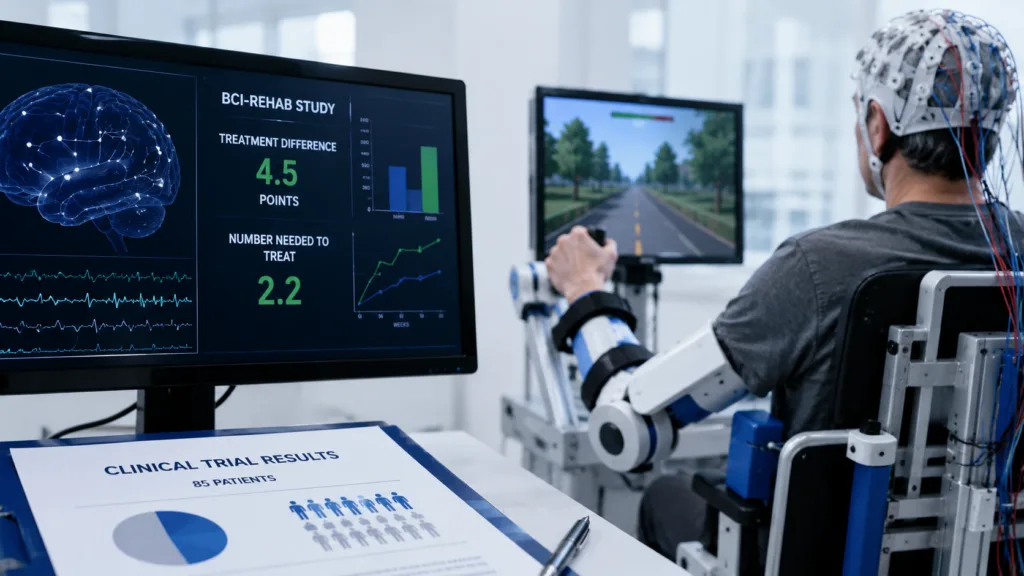
Among participants included in the primary analysis, the mean improvement was 6.0 points with IpsiHand, with a 95% confidence interval of 3.9 to 8.1, compared with 1.5 points in controls, whose confidence interval ranged from minus 0.1 to 3.1. The resulting treatment difference was 4.5 points, with a 95% confidence interval of 1.9 to 7.1. Investigators also estimated a clinically meaningful response rate of 55.5% in the BCI group compared with 9.6% among controls, an absolute difference of 45.8 percentage points that translated into a number needed to treat of approximately 2.2.
A number needed to treat of 2.2 is a compelling figure because it implies that treating slightly more than two similar patients with IpsiHand rather than the comparator would produce one additional clinically meaningful responder under the study conditions. It should nevertheless be interpreted in the context of this particular population, protocol and analysis rather than extrapolated automatically to every stroke survivor.
The result is more persuasive than earlier single-arm studies because participants were randomized against an active home exercise comparator. At the same time, one feature of trial conduct deserves unusually prominent attention: 17 of the 42 participants assigned to the control group declined further participation because they were dissatisfied with their treatment assignment, leaving 62 participants in the primary analysis, including 37 in the IpsiHand group and 25 controls.
Why does the control-group dropout matter when the efficacy result was statistically significant?
Differential dropout can introduce bias into a randomized trial if participants who remain are systematically different from those who leave. Randomization creates comparable groups at the beginning, but that protection can be weakened when a large and uneven proportion subsequently disappears from one arm, especially when withdrawal is directly related to disappointment over not receiving the investigational device.
The 17 control participants who withdrew represented roughly 40% of the originally randomized control group. Researchers can use statistical methods to account for missing information, but no method can recreate with certainty what those participants’ motor outcomes would have been after 12 weeks had they stayed in the study. The published treatment difference therefore remains statistically significant and clinically interesting, but the attrition should temper claims that the effect size has been established with the same certainty that might come from a trial with near-complete follow-up in both groups.
There is also a behavioral interpretation worth considering. Participants enrolling in a brain-computer-interface trial may be particularly motivated to receive the technology, making dissatisfaction with allocation to ordinary home exercise understandable. That does not invalidate randomization, but it demonstrates why device trials can face blinding and expectation challenges that differ from conventional pill-versus-placebo studies.
The appropriate conclusion is therefore stronger than saying the trial merely suggests benefit but narrower than declaring that IpsiHand has definitively transformed chronic stroke rehabilitation. The trial provides randomized evidence of a meaningful motor-function advantage under the studied conditions, while attrition creates an important limitation that future studies and real-world evidence can help address.
Why is an at-home BCI particularly relevant for chronic stroke rehabilitation?
Rehabilitation intensity often declines substantially after patients leave inpatient or outpatient programmes, even though motor impairment may persist for years. Traditional therapy requires clinician time, travel and repeated appointments, while patients with severe disability may face transportation barriers that make sustained high-frequency rehabilitation especially difficult.
BCI-REHAB tested a model specifically designed to move repeated training into the home. Five sessions per week for 12 weeks would be demanding if every session required travel to a rehabilitation center, whereas a home device can theoretically increase therapy intensity while reserving clinician involvement for assessment, supervision and programme adjustment. Kandu now combines IpsiHand with a broader stroke-recovery business that includes telehealth and navigation services, positioning the device as one component of longitudinal post-acute care rather than a stand-alone robotic hand exercise.
This model could become important economically if home BCI allows patients to receive meaningful additional rehabilitation without adding equivalent amounts of therapist time. That proposition still needs stronger health-economic evidence, including whether patients adhere to sessions after initial enthusiasm, how much clinician support remains necessary and whether improvements reduce downstream care needs.
The device also has practical exclusions. FDA’s original authorization states that IpsiHand should not be used in patients whose severe spasticity or rigid wrist and finger contractures prevent proper fitting or positioning of the handpiece, or in people with certain skull defects following craniotomy or craniectomy. Those limitations underline that BCI rehabilitation is not a universal solution for every post-stroke motor deficit.
Does a six-point Fugl-Meyer improvement translate into meaningful everyday function?
The Upper Extremity Fugl-Meyer Assessment evaluates motor impairment rather than directly measuring whether a person can independently prepare food, dress, use a phone or return to work. A six-point mean increase therefore represents an improvement in motor capability, but the relationship between that numerical change and day-to-day independence can vary substantially according to baseline impairment and which specific movements recover.
That is why the response analysis is useful alongside the average score. More than half of the IpsiHand-treated participants met the study’s threshold for clinically meaningful improvement compared with fewer than one in 10 controls, suggesting that the group-level difference was not generated solely by a tiny number of extreme responders. Still, future studies linking motor scores with patient-reported function, activities of daily living and durability after therapy stops would make the clinical interpretation stronger.
Durability matters particularly for neurorehabilitation. If repeated BCI therapy produces genuine neuroplastic changes, benefits might persist after intensive use declines, whereas improvement dependent on continuous device-assisted movement could require a different long-term treatment model. The 12-week randomized study establishes an efficacy window but does not resolve the complete maintenance question.
Could randomized evidence change the commercial trajectory for brain-computer interfaces?
Much of the public attention around brain-computer interfaces has concentrated on implanted systems intended eventually to restore communication or computer control to people with profound paralysis. IpsiHand represents a much nearer-term and less invasive commercial application: scalp EEG detects neural intent, software interprets it and a wearable orthosis turns that signal into repetitive rehabilitative movement.
That lower technological drama may actually make the commercial proposition more immediate. IpsiHand already has FDA marketing authorization, can be used at home and now has randomized evidence comparing it with conventional exercise in chronic stroke survivors. For providers and payers, the argument is consequently moving from whether BCI rehabilitation is technically possible toward whether its incremental functional benefit justifies acquisition, reimbursement and ongoing patient support.
The new publication substantially strengthens that argument, but the control-group attrition prevents the study from being treated as the final word. Larger studies with stronger participant retention, longer follow-up and endpoints tied directly to daily function could determine whether the 4.5-point treatment difference translates into sustained independence and healthcare savings.
BCI-REHAB nevertheless moves the field forward in an important way. The device did not simply activate a robotic brace when patients thought about movement; participants randomized to IpsiHand demonstrated greater recovery on a standardized motor assessment than those assigned to a conventional home exercise programme more than six months after stroke. That is a considerably higher evidentiary bar than demonstrating feasibility, and it gives at-home non-invasive BCI rehabilitation a stronger clinical foundation even as the trial’s attrition reminds the field that promising neurotechnology still needs unusually careful evidence interpretation.