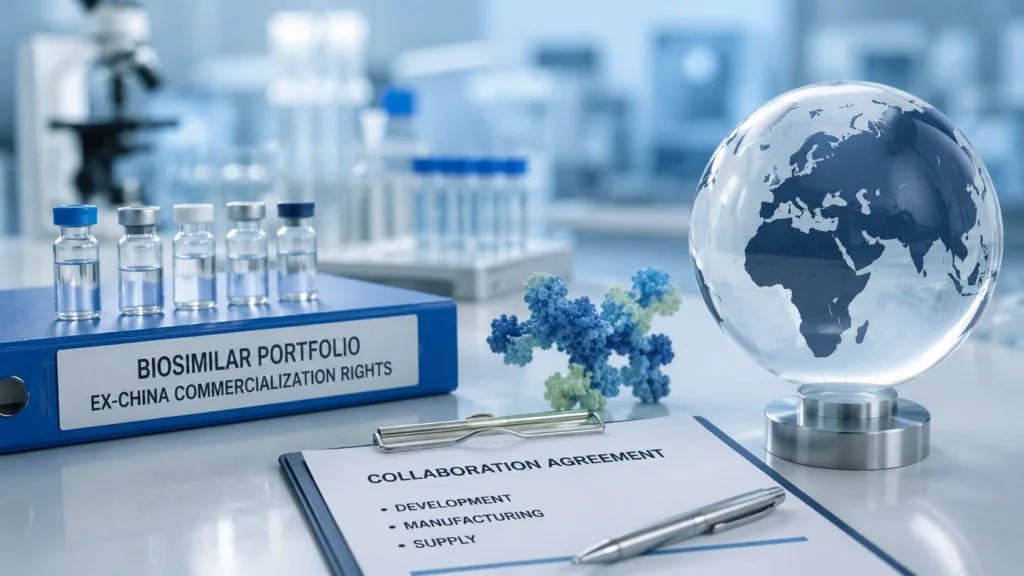
Sandoz Group AG and Shanghai Henlius Biotech, Inc. have signed one of Sandoz’s largest biosimilar collaborations to date, creating a framework covering as many as 10 proposed monoclonal antibody or antibody-drug conjugate biosimilars and immediately bringing three reference blockbusters into the partnership. The initial assets are Henlius’ proposed cetuximab biosimilar HLX05-N, evolocumab biosimilar HLX16 and a proposed belimumab biosimilar, while Sandoz has also obtained an option involving Henlius’ recombinant human hyaluronidase HLXTE-HAase1001. The milestones-based collaboration carries total potential consideration of up to $322 million, with near-term payments associated with the initial portfolio potentially reaching $100.5 million during 2026.
The agreement divides responsibilities in a way that plays directly to the two companies’ existing infrastructure. Henlius will remain responsible for development, manufacturing and supply of partnered products, while Sandoz will contribute global commercial strategy, registration, market access and commercialization across relevant markets outside China. Most of the potential 10 programmes remain at early development stages, which makes this less a transaction for a collection of near-launch assets and more a pipeline-building alliance designed around biosimilar opportunities emerging over the next decade.
What exactly does Sandoz get for the potential $322 million consideration?
The collaboration establishes a framework under which Sandoz can receive global commercialization rights outside China for agreed biosimilar programmes while Henlius performs much of the underlying development and manufacturing work. The initial three products have already been identified, with an additional option for recombinant human hyaluronidase that could support conversion of selected intravenously delivered biologics into faster subcutaneous presentations. Sandoz says the agreement increases its biosimilar pipeline to 39 assets with potential expansion to 46 if all contemplated programmes enter the collaboration.
Henlius describes the $322 million maximum as a combination of upfront payments, relevant milestone payments and the non-refundable option fee connected with the initial arrangements. The company expects total amounts invoiced during 2026 to reach as much as $100.5 million, meaning the full headline value is not guaranteed and depends on development and other milestones across the collaboration. This is exactly the distinction that matters in pharmaceutical deal reporting: $322 million represents maximum potential consideration under the disclosed framework, not cash transferred to Henlius at signing.
Territories also differ by asset. HLX05-N carries exclusive Sandoz rights across major markets including the United States, Canada, European Union, United Kingdom, Switzerland, Japan, Australia and New Zealand, alongside semi-exclusive rights in certain Asian and other markets. For HLX16 and the proposed belimumab biosimilar, Sandoz receives exclusive commercialization rights across all markets worldwide outside China, leaving Henlius with the Chinese opportunity while placing the much broader international commercialization effort with Sandoz.
Why are cetuximab, evolocumab and belimumab attractive biosimilar targets?
The initial portfolio spans oncology, cardiovascular disease and autoimmune disease rather than concentrating the transaction around one therapeutic area. HLX05-N is being developed as a biosimilar to cetuximab, the EGFR-targeting antibody marketed as Erbitux and used in selected patients with metastatic colorectal cancer and squamous cell carcinoma of the head and neck. Henlius began a Phase 1 clinical study of HLX05-N in metastatic colorectal cancer in July 2026, making it the most clinically advanced of the three initial programmes.
HLX16 targets evolocumab, the PCSK9 inhibitor marketed as Repatha for lowering LDL cholesterol and reducing cardiovascular risk in appropriate patients. The Henlius programme remains preclinical, while the reference product generated approximately $6.60 billion in global 2025 sales according to IQVIA figures cited by the company. That revenue base helps explain the commercial appeal, although the ultimate biosimilar opportunity will depend on intellectual-property timing, competitive entries, pricing and the speed at which payers and physicians adopt lower-cost alternatives.
The proposed belimumab biosimilar addresses Benlysta, which is used for systemic lupus erythematosus and lupus nephritis in eligible patients. Henlius says the reference product generated approximately $2.48 billion globally in 2025, while the proposed biosimilar is still in preclinical development. Cetuximab generated approximately $1.70 billion over the same period, putting combined 2025 reference-product sales for the initial three targets above $10 billion according to the figures supplied by Henlius.
Those sales numbers should not be converted mechanically into future biosimilar revenue. Several competitors may pursue the same reference products, biosimilar pricing is lower than originator pricing, and market share depends on tendering, payer preferences, interchangeability considerations and physician adoption. What the numbers do demonstrate is why Sandoz is willing to commit early to programmes that may still be years from commercial launch.
Why is recombinant human hyaluronidase strategically different from the three biosimilars?
HLXTE-HAase1001 is not simply another biosimilar to a blockbuster antibody. Recombinant human hyaluronidase can temporarily modify the extracellular matrix to increase dispersion and absorption of co-administered medicines, potentially allowing therapies normally delivered through lengthy intravenous infusions to be reformulated for substantially faster subcutaneous administration. Henlius says the programme remains in process development, while Sandoz has obtained an option rather than the same definitive rights structure applying to the initial biosimilar assets.
The commercial attraction becomes clearer as biologics compete increasingly on convenience after molecules themselves become difficult to differentiate. Hospitals and patients may prefer a short subcutaneous injection to a prolonged infusion when efficacy, safety and regulatory evidence support that route, while pharmaceutical companies can use novel formulations to extend product lifecycles or defend market share.
For a biosimilar manufacturer, however, subcutaneous conversion creates additional scientific and regulatory complexity. A biosimilar must demonstrate high similarity to the relevant reference biologic, while a different administration system can create additional development questions around exposure, immunogenicity and clinical comparability. The option gives Sandoz access to a potentially valuable enabling technology without requiring the company to commit fully before the development pathway becomes clearer.
Why are Sandoz and Henlius expanding a partnership that began only in 2025?
The two companies already had an exclusive commercialization agreement covering HLX13, Henlius’ proposed ipilimumab biosimilar, across 46 countries and regions including the United States and Europe. The new framework moves the relationship from one oncology biosimilar into a pipeline-scale collaboration that spans several therapeutic areas and could eventually contain as many as 10 programmes.
Henlius brings an integrated development and manufacturing operation with 84,000 liters of biologics capacity and products already approved by regulators including FDA and the European Commission. Sandoz brings a commercial footprint in roughly 100 countries, a portfolio of about 1,300 medicines and decades of experience launching biosimilars across highly regulated markets. That division allows Sandoz to add pipeline breadth without building every programme internally while giving Henlius access to established market-access and commercialization infrastructure outside China.
Sandoz says the collaboration expands its biosimilar pipeline to 39 assets immediately, with the potential to reach 46, while its currently marketed biosimilar portfolio contains 13 molecules across nearly 100 countries. The company is explicitly positioning this expansion around a major coming wave of biologic loss of exclusivity, where early pipeline control can matter because biosimilars require years of analytical, manufacturing and clinical development before launch.
Could early-stage partnering become the next major biosimilar competitive strategy?
Biosimilar competition was once dominated by individual asset-by-asset development decisions made relatively close to important patent expirations. As the market matures, large manufacturers increasingly need portfolio depth, manufacturing scale and early visibility into future loss-of-exclusivity opportunities because multiple competitors may target the same blockbuster years in advance.
The Sandoz-Henlius agreement reflects that shift. Most contemplated programmes are early, and commercial outcomes remain far away, but Sandoz can influence global development and registration strategy earlier while Henlius can plan manufacturing around a partner with substantial international demand. That reduces the risk that a technically successful biosimilar reaches late development only to discover that its clinical programme or product presentation is poorly aligned with the requirements of key markets.
The deal also shows that biosimilar partnerships can become materially larger and more strategic even without the multibillion-dollar headline values associated with innovative oncology licensing. Up to $322 million for a portfolio framework still leaves substantial development risk with both partners, while commercialization economics will ultimately depend on how many of the potential 10 programmes actually advance, achieve regulatory approval and win meaningful market share.
Sandoz is effectively paying for a pipeline factory rather than three finished drugs. Henlius supplies development, manufacturing and biological expertise, while Sandoz supplies regulatory and commercial reach outside China. If the collaboration eventually reaches all 10 assets, its strategic significance could substantially exceed the initial three biosimilars now generating the headlines; if only a few programmes survive development and intense competition, the milestones-based structure limits the amount paid for assets that never reach market.