The human brain requires an unusually stable chemical environment. Small changes in ions, toxins, inflammatory molecules or circulating metabolites can disrupt neuronal signaling, so brain capillaries have evolved into one of the body’s most selective vascular interfaces. Their endothelial cells form exceptionally tight connections, suppress much of the nonspecific vesicular transport seen in other blood vessels and work with pericytes, astrocytes and basement-membrane structures to regulate what crosses from blood into neural tissue. This blood-brain barrier is essential to normal brain function, but the same selectivity creates one of pharmaceutical development’s hardest engineering problems.
Small lipophilic molecules can sometimes diffuse across efficiently, but antibodies, enzymes, proteins, many peptides and nucleic-acid medicines generally enter the brain poorly after ordinary systemic administration. For decades, drug developers responded by designing molecules small enough to cross naturally, injecting drugs directly into the central nervous system or accepting that powerful biologics validated elsewhere in the body could not reach sufficient brain concentrations. That assumption is now changing. In 2026, the first FDA-approved biologic specifically engineered to use transferrin-receptor transport to cross the blood-brain barrier reached the US market, turning the brain-shuttle concept from experimental delivery science into clinically validated pharmacology.
What actually creates the blood-brain barrier?
The BBB is not a separate membrane wrapped around the brain. It is largely a specialization of the endothelial cells lining central nervous system capillaries.
In most peripheral tissues, blood-vessel walls allow substantially more movement of molecules between cells or through intracellular vesicles. CNS endothelial cells are joined by specialized tight junctions that strongly restrict paracellular movement, while transporter proteins selectively move nutrients such as glucose and amino acids that neural tissue requires. Efflux pumps can actively push some foreign molecules back toward the circulation.
Pericytes surrounding capillaries and astrocytic endfeet contacting the vascular structure help maintain this phenotype, meaning the BBB behaves as a multicellular neurovascular unit rather than a simple layer of endothelial bricks.
This biological sophistication explains why simply making a drug “cross the barrier” can be difficult. The system has evolved specifically to recognize useful molecules, exclude harmful ones and minimize uncontrolled traffic.
Why can a medicine work perfectly in a test tube and fail in the brain?
A drug can demonstrate extraordinary potency against a neuronal target and still have little therapeutic effect if only a tiny fraction reaches the relevant cells after dosing.
Large biologics illustrate the problem most clearly. Monoclonal antibodies are highly effective against extracellular targets throughout the body because they circulate for long periods and can enter many tissues, but intact antibodies penetrate the healthy CNS inefficiently. Nature Reviews Drug Discovery has described the BBB as a major reason why antibodies, enzymes and other large therapeutics have historically struggled to become effective brain drugs.
Increasing the systemic dose is often a poor solution. If 99% or more of exposure remains outside the brain, escalating the dose can increase liver, immune or peripheral-tissue toxicity long before CNS concentrations become optimal.
Drug delivery therefore becomes part of the medicine’s pharmacology rather than a secondary formulation issue.
How does a transferrin-receptor brain shuttle work?
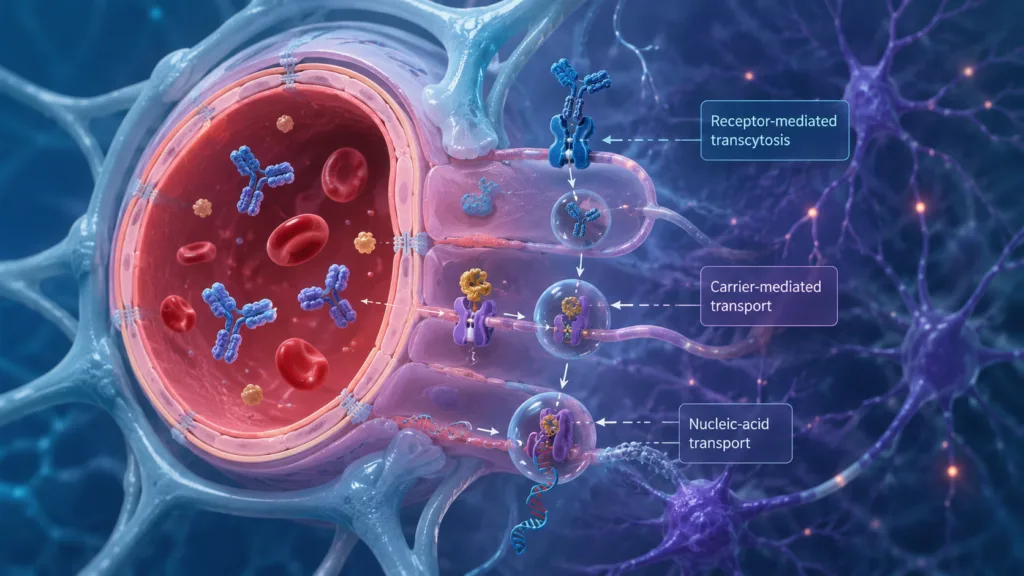
The BBB already transports certain large molecules through receptor-mediated transcytosis. Transferrin, which helps transport iron, interacts with the transferrin receptor on brain endothelial cells. After receptor binding, the complex can be internalized into vesicles, trafficked through the endothelial cell and released on the brain side of the vasculature.
Brain-shuttle developers exploit this biological route by engineering a therapeutic molecule with an additional binding component that engages a receptor such as transferrin receptor. The endothelial cell effectively treats the engineered medicine as cargo worthy of internal transport.
The strategy sounds simple but is remarkably sensitive to binding properties. Extremely strong receptor binding can cause the therapeutic molecule to become retained inside endothelial cells or routed toward degradation instead of being released into the brain. Lower-affinity or specially engineered binding can sometimes produce better transcytosis because the molecule lets go at the correct stage.
This creates an unusual pharmacological optimization problem in which tighter binding does not necessarily mean better delivery.
What did the first FDA-approved brain-shuttle biologic establish?
Denali Therapeutics’ AVLAYAH, or tividenofusp alfa-eknm, received FDA accelerated approval in March 2026 for certain pediatric patients with neurologic manifestations of Hunter syndrome. Denali describes it as the first FDA-approved biologic specifically designed to use transferrin-receptor-mediated transport to cross the BBB.
Hunter syndrome is caused by deficiency of iduronate-2-sulfatase, an enzyme needed to break down glycosaminoglycans. Conventional enzyme replacement can treat systemic manifestations, but getting enough replacement enzyme into the brain has been a much more difficult problem.
AVLAYAH links enzyme-replacement pharmacology with Denali’s TransportVehicle technology, giving the therapeutic protein access to transferrin-receptor-mediated trafficking. Its approval provides regulatory validation that an engineered large molecule can be developed explicitly around BBB transport rather than relying on passive entry.
It does not establish that every transferrin-receptor shuttle will deliver enough of every therapeutic cargo for every neurological disease.
Why might Alzheimer’s and Parkinson’s disease be much harder than Hunter syndrome?
A lysosomal-storage disease provides a relatively straightforward biological objective: deliver a missing enzyme widely enough that affected cells can restore some deficient metabolic function.
Neurodegenerative diseases may require much more demanding pharmacology. An Alzheimer’s antibody might need adequate concentrations across large regions of cortex over years, while a Parkinson’s therapy could need access to particular neuronal populations or intracellular targets.
Disease progression can also alter the barrier itself, creating regional differences in permeability and vascular function. Target abundance, patient age and pathological changes may affect the same shuttle differently across populations.
This is one reason several companies are building platform technologies rather than one isolated brain-penetrant medicine. If developers can understand how receptor affinity, valency and therapeutic cargo interact, they may reuse the transport architecture across enzymes, antibodies and other biologics.
Why are researchers looking beyond transferrin receptor?
Transferrin receptor is attractive because it is well characterized and abundant on BBB endothelial cells, but it is also expressed outside the brain and participates in essential iron biology.
Researchers are therefore searching for receptors that offer strong brain endothelial expression, efficient internalization, useful recycling and lower peripheral exposure. CD98 heavy chain has emerged as one alternative under active investigation, with 2026 research demonstrating engineered CD98hc-targeting antibody shuttles capable of increasing CNS delivery across preclinical species.
An ideal shuttle receptor would combine abundant BBB expression, rapid transcytosis, low saturation at therapeutic doses and sufficient selectivity to avoid transporting excessive amounts of medicine into unrelated tissues.
Biology rarely provides that perfect combination, which is why receptor selection remains a major competitive dimension.
Can focused ultrasound open the BBB instead of engineering the drug?
Focused ultrasound takes a very different approach. Rather than teaching a therapeutic molecule to use an existing transport system, ultrasound combined with circulating microbubbles can transiently alter BBB permeability in a geographically defined region.
The attraction is flexibility. A physician could potentially increase local access for antibodies or other drugs without redesigning each molecule into a shuttle format.
The trade-off is procedural complexity. Treatment requires specialized equipment and imaging, and opening the BBB must be controlled carefully enough to permit therapeutic entry without allowing unwanted plasma proteins or inflammatory mediators to damage neural tissue.
This makes focused ultrasound particularly interesting for diseases where treatment can be concentrated anatomically, while systemic receptor-mediated transport may be more suitable when disease affects large or diffuse areas of the brain.
Could nanoparticles solve the problem for RNA and gene medicines?
Nanoparticles can protect nucleic acids from degradation and potentially be engineered with ligands that promote uptake into BBB endothelial cells or specific brain populations. The challenge resembles the wider extrahepatic RNA-delivery problem: uptake into the endothelial cell is only one step.
The carrier must cross the endothelial layer rather than become trapped inside it, release its cargo on the correct side, enter the desired neural cell and then deliver enough RNA into the appropriate intracellular compartment.
Viral vectors face related constraints. Some naturally or experimentally engineered capsids can reach CNS tissue, but immune responses, species differences and tissue specificity complicate systemic use.
This means the BBB problem cannot be solved merely by inventing a nanoparticle small enough to circulate through brain capillaries. The drug needs a biological transport itinerary from bloodstream to its final cellular target.
Why does brain exposure need to be measured more carefully than plasma exposure?
For conventional systemic medicines, blood concentration can often serve as a useful proxy for exposure reaching the therapeutic site. Brain-shuttle drugs break that assumption.
Two engineered antibodies can show similar plasma pharmacokinetics while producing radically different brain concentrations depending on how efficiently they undergo transcytosis. Researchers also have to distinguish genuine drug present within brain tissue from drug still trapped inside capillary blood or endothelial cells. Recent bioanalytical work has emphasized how pre-analytical handling and measurement methodology can materially influence estimates of brain exposure for receptor-mediated therapeutics.
That makes pharmacokinetic validation unusually important. A brain shuttle must prove not merely that it binds the transport receptor but that meaningful amounts of intact, pharmacologically active drug reach brain parenchyma.
Will crossing the blood-brain barrier make previously failed neurological drugs work?
Sometimes, potentially, but poor delivery is only one reason CNS trials fail. Alzheimer’s, Parkinson’s, ALS and other brain diseases involve complex biology, and a perfectly delivered drug can still fail if the chosen molecular target is not sufficiently important or if treatment begins too late.
Brain shuttles can remove one source of uncertainty. If researchers know a biologic reaches therapeutic concentrations throughout the brain and the disease still does not respond, the result tells them more clearly that the target or therapeutic mechanism may be wrong.
The significance is therefore broader than simply increasing exposure. Better delivery makes CNS drug experiments more informative.
For decades, drug discovery often asked whether a molecule was capable of crossing the blood-brain barrier before asking whether it was the best possible medicine for the target. The emerging shuttle technologies reverse that constraint by trying to make the barrier itself part of the delivery mechanism.
The first engineered BBB-crossing biologic has now reached regulatory approval, but the larger pharmaceutical opportunity remains ahead. If developers can reliably ferry antibodies, enzymes and eventually nucleic-acid therapies into neural tissue, the question in brain drug discovery may gradually shift from “Can the medicine get there?” toward the far more scientifically productive question, “What should it do once it arrives?”