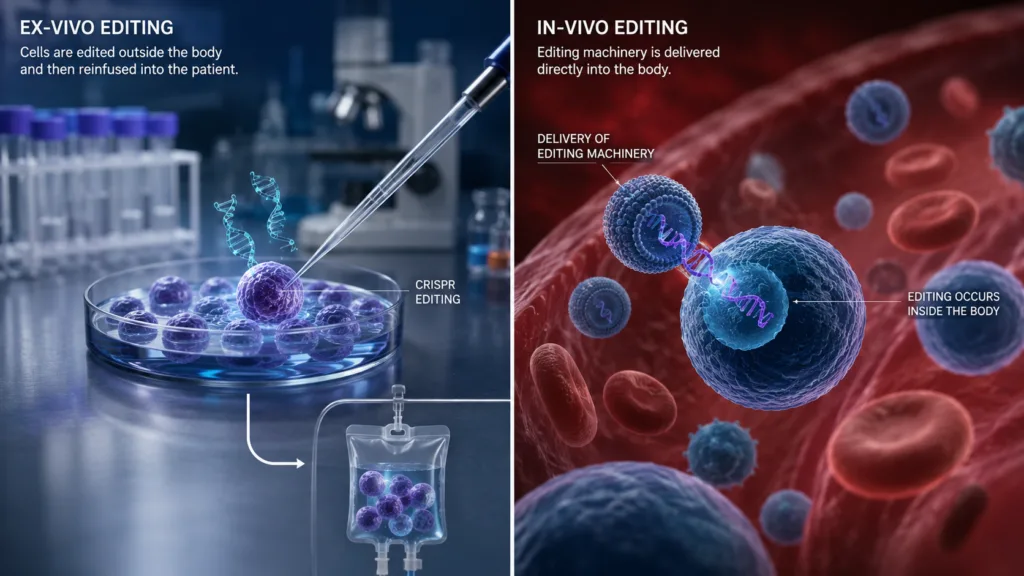
The first generation of approved CRISPR medicine edits cells outside the patient. Blood-forming stem cells are collected, genetically modified under controlled manufacturing conditions and returned after intensive preparation, allowing scientists to test and characterize the final cellular product before infusion. In-vivo genome editing removes that intermediate step. A delivery vehicle carrying the editing machinery is administered directly to the patient, reaches the intended tissue and changes DNA inside living cells that may remain in the body for decades. The approach could eventually transform gene editing from a specialized cell-manufacturing procedure into something closer to a one-time drug infusion, but that convenience makes delivery precision and long-term safety considerably more demanding.
Clinical development has already moved well beyond proof of concept. Early in-vivo CRISPR work demonstrated substantial transthyretin reduction after a single systemic dose in hereditary ATTR amyloidosis, while a randomized Phase 3 hereditary angioedema trial published in 2026 found that a single 50 mg infusion of lonvoguran ziclumeran reduced the least-squares mean monthly attack rate from 2.10 with placebo to 0.26, an 87% relative reduction, during the primary assessment period. The field has therefore progressed from asking whether genome editing can occur inside a human body to asking how many tissues can be reached safely and whether irreversible editing can outperform highly effective chronic therapies.
How is in-vivo gene editing different from Casgevy?
Casgevy demonstrates that CRISPR editing can become an FDA-approved medicine, but it is fundamentally an ex-vivo therapy. Patient hematopoietic stem cells are collected and edited outside the body using CRISPR/Cas9, after which the patient receives myeloablative conditioning and the modified cells are infused back so they can establish themselves in the bone marrow. FDA first approved Casgevy in 2023 and subsequently expanded its US use in 2026 to eligible patients aged two years and older with sickle cell disease or transfusion-dependent beta thalassemia.
The ex-vivo route gives manufacturers control. Cells can be edited in a defined facility, tested and released according to manufacturing specifications before the patient receives them. The disadvantage is that treatment involves cell collection, individualized manufacturing, chemotherapy conditioning and access to specialized transplant-capable centers.
In-vivo editing instead packages the CRISPR components into a delivery system and injects that system directly into the patient. There is no opportunity to remove a poorly edited cell population afterward because editing happens inside the target organ. Delivery therefore becomes inseparable from safety: the therapeutic system must reach enough desired cells to create benefit while minimizing exposure to tissues where editing is unnecessary or potentially dangerous.
Why has the liver become the first major organ for systemic CRISPR therapy?
The liver is unusually accessible to lipid nanoparticles, the same broad delivery technology that transformed mRNA medicines. After intravenous administration, appropriately engineered nanoparticles naturally accumulate in hepatocytes, giving developers a relatively mature route for delivering RNA cargo encoding the CRISPR machinery.
Many therapeutically interesting circulating proteins are also produced predominantly in the liver. Transthyretin is an especially attractive example because more than 99% of circulating TTR originates there. NTLA-2001 was designed as a lipid nanoparticle containing messenger RNA encoding Cas9 and a guide RNA targeting the TTR gene. In the first six treated patients reported in 2021, mean serum TTR reductions reached 52% at the lower dose and 87% at the higher dose by day 28.
Hereditary angioedema provides another liver-compatible target because reducing hepatic production of plasma kallikrein can suppress the biochemical cascade responsible for swelling attacks. The success of these programmes does not mean liver editing is trivial, but it demonstrates how much easier in-vivo CRISPR becomes when disease biology and delivery biology point toward the same organ.
What did the Phase 3 hereditary angioedema trial prove?
The 2026 HAELO study randomized 80 patients aged 16 years or older with hereditary angioedema caused by C1 inhibitor deficiency in a two-to-one ratio to a single infusion of lonvoguran ziclumeran or placebo. From weeks five through 28, the least-squares mean attack rate was 0.26 per month in the gene-editing group compared with 2.10 in the placebo group, representing an 87% relative reduction with a P value below 0.001. No serious or Grade 3 or higher adverse events were reported in the lonvo-z group during the reported period.
That is a fundamentally different clinical proposition from lowering a laboratory biomarker. Hereditary angioedema attacks can cause severe swelling and can become life-threatening when the airway is involved, so reducing actual attack frequency in a randomized Phase 3 trial shows that permanent editing of a disease-relevant pathway can translate into clinically meaningful benefit.
The follow-up is still short compared with the expected lifespan of an edited liver cell. Median follow-up in the reported analysis was 7.5 months, which is sufficient to establish the trial’s primary efficacy result but nowhere close to the duration needed to characterize every long-term consequence of permanent genome modification.
If the treatment is given once, why might monitoring last for years?
Genome editing is intended to create durable DNA changes. A conventional medicine can usually be discontinued when an unexpected adverse effect emerges, after which drug concentration declines. A permanent genomic edit cannot simply be withdrawn.
Long-term surveillance therefore has to consider unintended edits as well as consequences of the intended edit. CRISPR nucleases are designed around specific DNA sequences, but sufficiently similar genomic sites can theoretically be cut unintentionally. Double-stranded DNA breaks can also generate insertions, deletions and structural rearrangements during repair, including outcomes that may not be captured fully by standard short-term toxicology.
FDA prescribing information for the approved ex-vivo CRISPR product Casgevy already includes a warning concerning potential off-target genome editing, demonstrating that this is not merely an academic issue associated with experimental programmes.
For in-vivo therapies, the challenge is greater because researchers cannot directly recover and sequence every edited cell inside the patient. Safety assessment therefore combines preclinical off-target prediction, deep sequencing, biodistribution studies, clinical laboratory monitoring and prolonged follow-up.
Why is delivery now more limiting than the DNA-cutting machinery itself?
CRISPR enzymes can be reprogrammed relatively easily by changing the guide RNA sequence. The human body cannot be reprogrammed so conveniently. A therapy intended for the brain, skeletal muscle, lung or kidney must cross biological barriers, enter the correct cell type, escape intracellular compartments and release enough editing machinery into the appropriate cellular location without producing unacceptable systemic exposure.
Lipid nanoparticles currently have their greatest clinical maturity in the liver. Viral vectors can reach additional tissues but introduce their own questions involving immunogenicity, persistent expression and redosing. Engineered nanoparticles, virus-like particles, conjugates and tissue-specific targeting ligands are therefore being developed to expand the anatomical reach of editing.
This makes in-vivo gene editing partly a delivery-platform industry. A company able to edit one liver gene successfully has demonstrated CRISPR pharmacology, but a platform capable of delivering editors selectively to heart, muscle, immune cells and the central nervous system would open a dramatically larger disease universe.
Will base editing and prime editing eventually replace conventional CRISPR cutting?
CRISPR/Cas9 commonly creates a double-stranded DNA break and relies on cellular repair to generate the intended functional outcome, such as disrupting a disease-associated gene. Base editors modify individual DNA bases without creating the same type of double-strand break, while prime editing is designed to perform more versatile sequence changes through another editing mechanism.
These newer tools potentially expand the range of mutations that can be corrected while reducing some risks associated with double-strand-break repair. They introduce different challenges involving editor size, delivery, off-target chemistry and efficiency, meaning there is no reason to assume one editing technology will dominate every disease.
The therapeutic architecture will increasingly be chosen according to the biological task. Disabling a harmful liver-produced protein may require a relatively simple knockout, while correcting a specific pathogenic mutation in a long-lived tissue may demand a more precise form of sequence repair.
Could in-vivo editing eventually become easier to deliver than chronic biologic therapy?
For appropriate diseases, that is the commercial promise. A patient with hereditary angioedema can already receive effective preventive therapies, but many require repeated dosing indefinitely. A single gene-editing infusion capable of producing durable suppression creates a radically different treatment burden.
The comparison cannot be made on convenience alone. A chronic medicine has an established safety profile, its dose can be modified and therapy can generally be discontinued. Genome editing asks the patient and clinician to exchange repeated treatment for a biological change intended to persist for years and potentially decades.
That trade-off is likely to define in-vivo CRISPR medicine. The technology becomes most compelling when disease is serious, the target biology is exceptionally well understood and a permanent change offers a meaningful advantage over continuous therapy.
The HAE Phase 3 result suggests that this threshold can be reached clinically. The next leap is anatomical. Gene editing has shown that it can reach the liver and generate a major therapeutic effect after one dose; proving that the same principle can operate safely in tissues that nanoparticles do not naturally seek out will determine how large in-vivo genome editing ultimately becomes.