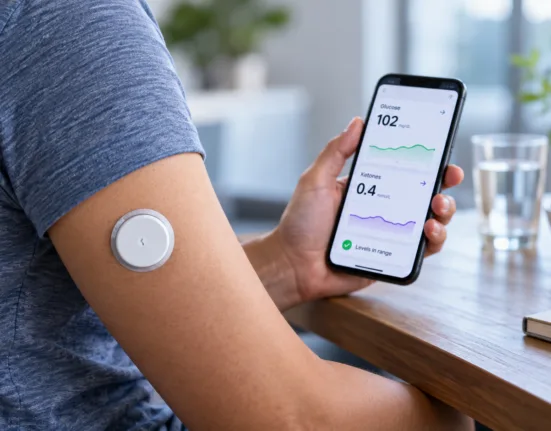
Abbott (NYSE: ABT) has received FDA De Novo authorization for Libre Duo 10 Day, creating the first US wearable capable of continuously monitoring both glucose and ketones from one sensor and establishing a new regulatory category for integrated continuous glucose and ketone monitoring. The device is authorized for people aged two years and older living with diabetes and measures both analytes in interstitial fluid every minute, transmitting readings to a compatible smartphone while providing automatic alerts when ketones rise to concerning levels. FDA based its authorization on six clinical studies involving more than 600 participants and said the system demonstrated the ability to track clinically meaningful ketone changes during its wear period, including elevated levels before diabetic ketoacidosis.
The development addresses a gap that conventional continuous glucose monitors cannot solve. CGMs transformed diabetes management by showing glucose continuously rather than as isolated finger-stick measurements, but DKA is driven by excessive ketone production when insulin becomes insufficient. Ketones can sometimes rise before glucose alone provides an obvious indication of the emerging emergency, particularly in circumstances such as illness, insulin-delivery interruption or use of certain glucose-lowering medicines. Libre Duo adds a second continuous biochemical channel rather than asking patients to recognize symptoms and perform a separate blood or urine ketone test after the problem has already become apparent.
Why can glucose look acceptable while ketone risk is still increasing?
DKA develops when the body does not have enough effective insulin and begins relying heavily on fat for energy, generating acidic ketone bodies in the process. Hyperglycemia commonly accompanies this physiology, but the relationship is not perfectly synchronized. Certain situations can produce significant ketosis at glucose levels that do not look dramatically elevated.
This matters because current diabetes technology can create a false sense that glucose is the only acute biochemical variable worth watching. A conventional CGM may show relatively stable values while ketone production is beginning to accelerate, meaning patients following glucose alone could miss an early warning.
FDA specifically emphasizes that ketone information from Libre Duo should still be interpreted alongside glucose readings and symptoms. The device is intended to provide earlier visibility, not independently diagnose every episode of DKA or replace appropriate medical evaluation when a patient becomes unwell.
Continuous measurement also adds trend information. A single blood ketone test can show that a level is elevated at one moment but not whether it has been rising rapidly or stabilizing after corrective treatment. Libre Duo’s minute-by-minute readings potentially make the direction of travel as important as the absolute value.
What did FDA require before creating an entirely new integrated monitoring category?
Libre Duo entered through the De Novo pathway rather than a conventional 510(k) because there was no existing legally marketed predicate device combining these functions under an established classification. FDA created special controls for the new integrated continuous glucose and ketone monitoring category, allowing future similar devices potentially to pursue the 510(k) substantial-equivalence pathway against the regulatory framework Abbott has now established.
The clinical programme included more than 600 people aged two years and older across six studies covering a range of glucose and ketone concentrations. FDA concluded that the system accurately tracked clinically meaningful ketone differences during its ten-day wear period and could identify elevated levels before DKA onset.
That does not mean every sensor will physically remain attached and functioning for the entire labeled period. Abbott reports that 84.1% of adult sensors and 68.8% of pediatric sensors in its wear-duration evaluation lasted the full ten days, implying that approximately 16% of adult sensors and 31% of pediatric sensors could fail to complete the entire wear period under labeled use.
This is particularly relevant in children, one of the populations where continuous ketone information may have considerable value but where activity, small body size and sensor adhesion can make full wear more difficult.
Why is the pediatric authorization commercially and clinically important?
Type 1 diabetes commonly begins in childhood, and DKA remains one of the most serious acute complications for pediatric patients. Children may also have difficulty recognizing or communicating early symptoms such as nausea, fatigue or abdominal discomfort, while parents can struggle to know when an ordinary viral illness is becoming a metabolic emergency.
Libre Duo’s age-two-and-older indication therefore gives Abbott access to a high-risk population from the outset rather than introducing the product initially only for adults. Caregiver connectivity through LibreLinkUp could allow parents or other family members to follow the same data remotely.
The device also fits Abbott’s broader LibreView clinical ecosystem, giving healthcare professionals access to glucose and ketone information rather than forcing the second analyte into an entirely separate software environment.
The practical value will depend on how effectively families learn to respond to alerts. More information is useful only if thresholds lead to appropriate actions around hydration, insulin correction, confirmatory testing and medical evaluation.
Could continuous ketone sensing change automated insulin delivery?
Potentially, although the current authorization should not be conflated with every future pump integration Abbott has announced. The company is working with Beta Bionics, Sequel Med Tech, Insulet, Tandem and MiniMed on integration strategies, with some connections expected from late 2026 and others in 2027.
Current automated insulin-delivery algorithms rely predominantly on glucose. Ketone information could provide an additional safety signal because rising ketones may indicate insufficient insulin delivery even when the system has not yet identified a conventional glucose pattern requiring urgent intervention.
The most obvious use case is pump failure. If an infusion set becomes disconnected or blocked, a person using rapid-acting insulin through a pump can develop insulin deficiency relatively quickly because there may be no long-acting basal insulin in the background. Ketone rise could therefore become an early indicator that the insulin-delivery system is not functioning effectively.
Turning that signal into automated dosing decisions is more complicated. Ketones can rise for different reasons, and responding algorithmically would require careful validation to avoid delivering excessive insulin or generating unnecessary alarms. Abbott’s partnerships indicate the direction of travel, but regulatory authorization of Libre Duo itself does not mean every listed AID integration is already authorized.
How large is the clinical gap in home ketone monitoring?
FDA notes that approximately 40.1 million Americans live with diabetes, including an estimated 2.1 million with Type 1 diabetes. Abbott cites survey evidence indicating that many people with Type 1 diabetes do not keep a blood ketone meter at home and that some have no ketone-testing supplies at all.
This gap exists partly because ketone testing has historically been episodic. Patients are instructed to test during illness, persistent hyperglycemia or suspected insulin deficiency, but the test itself requires recognizing that a problem may be developing.
Continuous sensing changes the sequence. Instead of symptoms triggering a test, the biochemical trend can potentially trigger awareness.
That does not necessarily mean broad continuous ketone monitoring will prevent every DKA hospitalization. Clinical practice will need evidence showing how often alerts occur, how many are actionable, whether they reduce emergency presentations and whether alarm burden creates unnecessary anxiety.
Why is Libre Duo strategically important for Abbott’s diabetes franchise?
Abbott says Libre products are already used by more than eight million people across more than 60 countries, giving the company a large installed ecosystem into which a dual-analyte sensor can be introduced.
Continuous ketone monitoring also creates differentiation in a CGM market increasingly competing on wear duration, sensor size, accuracy, pump compatibility and software. Glucose sensing itself is becoming a mature category; adding another clinically meaningful analyte gives Abbott a way to expand what a diabetes wearable measures rather than simply improving another decimal place of glucose accuracy.
The De Novo authorization is therefore significant beyond one product. FDA has now established a path for continuous ketone sensing as a medical-device category, and competitors can begin determining whether they can build against it.
For patients, however, the most meaningful promise is simpler. DKA can develop in hours, while traditional ketone testing captures only one point in time and is often performed only after concern arises. Libre Duo reverses that model by placing ketone monitoring quietly in the background. The real test after launch will be whether those extra minutes or hours of warning translate into fewer emergencies rather than simply more data on the smartphone screen.