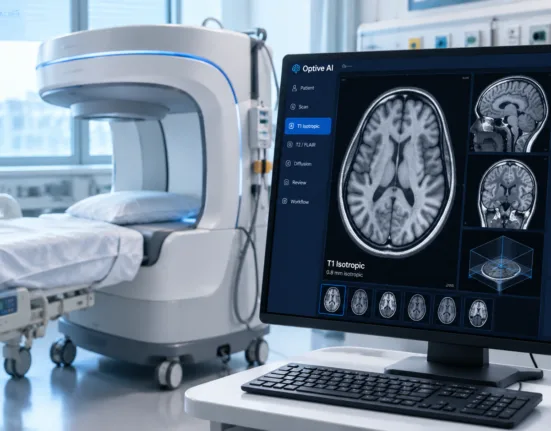
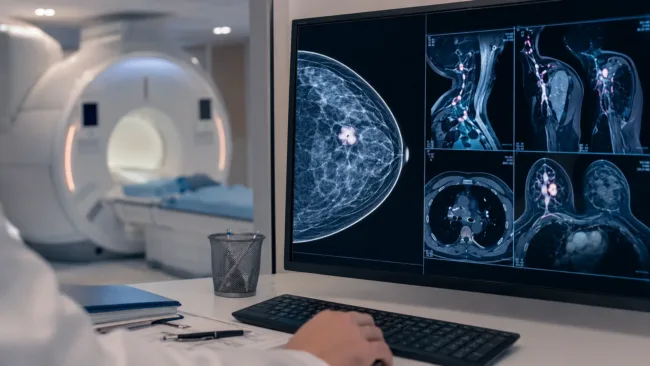
Hyperfine, Inc. (NASDAQ: HYPR) has moved its outpatient portable-MRI strategy from conference data into peer-reviewed evidence, with the Journal of Neuroimaging publishing results from the prospective NEURO PMR study while real-world use of the Swoop system passes 3,000 scans during the first year of the company’s office-market launch. The study enrolled 125 adults across DENT Neurologic Institute and Texas Neurology who required clinically indicated brain MRI for common outpatient problems including headache, cognitive impairment or dementia, multiple-sclerosis follow-up and tumor surveillance. Each participant underwent imaging with Hyperfine’s 0.064-tesla portable system and conventional MRI, which was predominantly performed at 3 tesla.
In blinded independent neuroradiology review, portable MRI and conventional MRI agreed in 92% of patients on whether a structural intracranial abnormality was present or absent. When discordant examinations underwent paired review with clinical history available, concordance increased to 98%. Patient preference was strongly tilted toward the portable scanner: 61% preferred portable MRI compared with 14% preferring conventional MRI, while the remainder did not express a clear preference.
Why would a neurologist want an MRI scanner inside an ordinary office?
Conventional MRI infrastructure is expensive and physically demanding. High-field systems require specialized rooms, magnetic-field safety controls, installation work and trained MRI technologists, which is why most outpatient neurology practices refer patients to hospitals or dedicated imaging centers.
Hyperfine’s Swoop architecture removes much of that infrastructure. The system operates at ultra-low magnetic field strength, can fit in a conventional clinical room without the specialized shielding required by high-field systems and runs from ordinary electrical power. Hyperfine says trained office staff can operate the scanner, potentially allowing imaging to occur during the broader neurological-care pathway rather than requiring a separate external appointment.
That could shorten the time between clinical suspicion and imaging-based decisions, especially for patients with mobility limitations, claustrophobia or poor access to imaging centers. The trade-off is image quality: ultra-low-field MRI inherently produces less signal than high-field equipment, so the clinically relevant question is not whether images look identical but whether they contain enough information for the intended diagnostic task.
What does 92% concordance mean, and what does it not mean?
The primary comparison was deliberately broad: did each examination show the presence or absence of structural abnormality? A 92% blinded concordance rate means the two modalities produced the same high-level classification in roughly nine of every ten participants under independent review.
That does not mean portable MRI detected 92% of every lesion seen on a 3-tesla scanner, reproduced the same anatomical detail or can substitute universally for conventional MRI. Very small lesions, subtle enhancement patterns, vascular abnormalities and specific advanced sequences can demand the spatial resolution, contrast performance or specialized capabilities of high-field systems.
The increase to 98% after paired clinically informed review also needs careful interpretation. Providing clinical history and allowing direct comparison gives readers information closer to real-world diagnostic practice, but it is less independent than the blinded primary evaluation.
The appropriate conclusion is therefore that portable MRI demonstrated high agreement for the structural questions represented in this 125-patient outpatient cohort, not that a 0.064-tesla scanner has become technically equivalent to 1.5- or 3-tesla MRI.
Why might patient preference be commercially important?
MRI can be an unpleasant experience even when clinically routine. Conventional scanners can be noisy and enclosed, and some patients experience anxiety or claustrophobia sufficient to require sedation or prevent completion of the examination.
NEURO PMR participants rated portable MRI more favorably across comfort, anxiety, claustrophobia, noise and overall experience. The four-to-one preference ratio suggests that patient acceptance could become a genuine commercial advantage rather than merely a secondary engineering feature.
Patient preference becomes especially relevant in longitudinal neurological care. People with multiple sclerosis, tumors or other chronic conditions may undergo repeated imaging, so even moderate improvements in convenience and tolerability accumulate across years of surveillance.
The commercial opportunity still depends on reimbursement, scan throughput and whether practices can generate enough appropriate examinations to justify acquiring and operating a scanner. The more than 3,000 office scans Hyperfine reports from the first year provide evidence of use, but they do not reveal whether every installation has achieved comparable economic productivity.
Why is the new publication a meaningful follow-up to earlier Swoop clearances?
Hyperfine already has multiple FDA clearances covering Swoop hardware and Optive AI software, so regulatory status alone no longer answers the most important adoption question. The relevant issue is whether neurologists can integrate ultra-low-field MRI into ordinary outpatient care without sacrificing clinically necessary information.
NEURO PMR provides prospective evidence from actual neurology offices rather than ICU, emergency or controlled technical settings. That makes the publication a distinct milestone from previous image-quality software clearances.
It also begins to build an evidence bridge toward a new business model. Portable MRI was initially most intuitive in hospitals, where moving critically ill patients to a radiology department can be difficult. The office model asks a different question: can imaging be moved to the patient even when conventional MRI is available somewhere else, simply because access and workflow become better?
Where does the evidence remain incomplete?
The study included only 125 participants at two sites, and several common outpatient indications dominated enrollment. Larger multicenter datasets are needed before performance can be generalized across the full spectrum of neurological pathology.
Contrast-enhanced imaging also remains an important frontier. Hyperfine has been studying gadolinium-enhanced ultra-low-field imaging because contrast can be essential in tumor, inflammatory and other neurological assessments. Expansion into that capability could increase the number of cases for which office portable MRI becomes clinically sufficient rather than primarily a structural screening or surveillance tool.
The company is also studying portable MRI in Alzheimer’s treatment monitoring, where amyloid-related imaging abnormalities have created demand for repeated brain scans. That use case illustrates the potential upside of lowering infrastructure requirements, but it will require indication-specific validation rather than assuming the NEURO PMR results automatically translate.
Hyperfine has therefore passed an important but intermediate threshold. More than 3,000 office scans show that clinicians will use a portable scanner, while prospective peer-reviewed evidence shows strong concordance for the structural questions studied. The larger test is whether enough neurological conditions can be managed with ultra-low-field information that brain MRI becomes a routine capability inside the neurologist’s office rather than a specialized hospital resource.