
Stryker is combining a surgical planning platform with more than 100,000 cases of experience with its Incompass Total Ankle System, expanding Prophecy Surgical Planning into a newer implant ecosystem while simultaneously introducing connected limb-reconstruction technology. The September 16 rollout illustrates how the orthopaedic industry is increasingly competing through software, planning and workflow integration rather than implants alone.
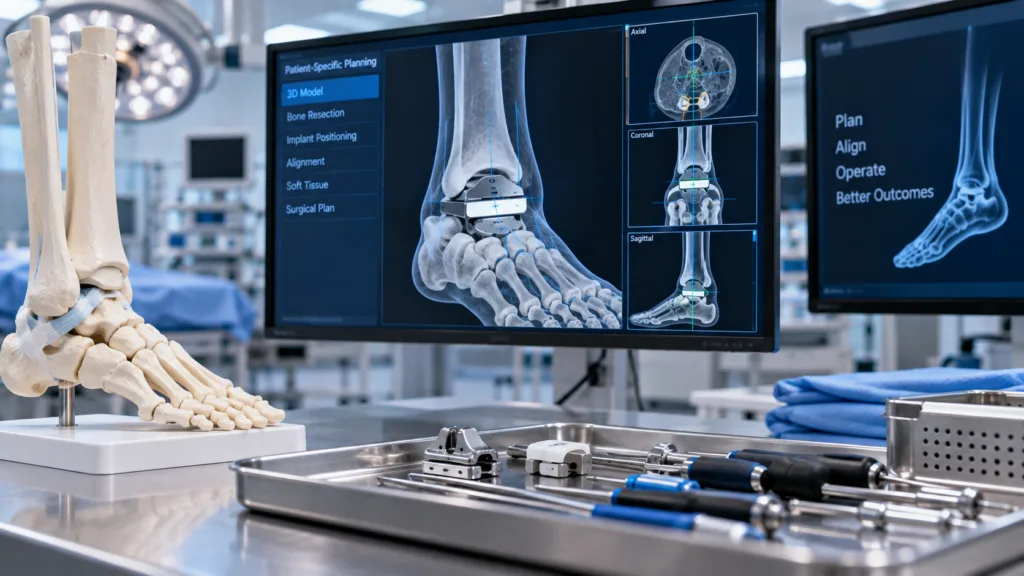
Prophecy has supported patient-specific ankle planning for more than 100,000 cases over approximately 14 years. Its integration with Incompass gives surgeons three-dimensional visualization and multiple fixation approaches inside a common planning environment. Stryker is also introducing Hoffmann LRF smartHEX, which combines new frame components with a mobile application and redesigned planning software for limb reconstruction.
The individual launches are specialized, but the strategic direction is broader. Stryker wants to own more of the orthopaedic workflow surrounding the implant, creating relationships with surgeons before the patient reaches the operating room and continuing through procedure execution and follow-up.
Why does surgical planning matter in total ankle replacement?
Total ankle replacement requires careful alignment because small positional errors can alter biomechanics and potentially affect implant wear, stability and long-term performance. Unlike a standardized product sitting on a shelf, patient-specific planning incorporates an individual’s anatomy into the procedure before surgery begins.
Three-dimensional planning can help surgeons evaluate bone geometry, alignment and implant positioning rather than relying solely on intraoperative judgment.
The potential commercial advantage is stickiness. Once a surgeon becomes comfortable planning cases within a particular vendor’s software ecosystem, using the associated implant system becomes more convenient. Software therefore supports the physical implant business while creating a workflow barrier against competitors.
Stryker has used similar principles in large-joint reconstruction through robotics and digital planning. Extending connected technologies deeper into foot and ankle care applies that model to another orthopaedic specialty.
Why is the 100,000-case installed experience relevant?
Experience matters in surgical planning because every completed case can improve familiarity, workflow refinement and surgeon confidence. Stryker says Prophecy has been used across more than 100,000 ankle cases during 14 years, creating an established base from which to introduce Incompass integration.
That does not mean every previous Prophecy user will move automatically to Incompass. Surgeons choose implants based on design, outcomes, hospital contracts, training and individual preference.
But a mature planning environment can lower adoption friction. Stryker is effectively attaching a newer ankle replacement platform to software infrastructure that some surgeons already know.
In medtech, this can be more powerful than launching an isolated implant because familiarity reduces the number of changes required in clinical workflow.
How does connected care change Stryker’s business model?
Orthopaedic manufacturers historically made money by selling implants, instruments and associated disposables. Digital planning and connected surgical technology allow those companies to participate earlier in the care pathway.
Software can influence implant choice before the operating room. Patient-specific plans can then drive use of proprietary guides or instruments, while mobile applications and follow-up tools can maintain the vendor’s presence after surgery.
The result is an ecosystem strategy in which the implant becomes one component of a larger workflow.
Stryker’s Hoffmann LRF smartHEX introduction fits this direction. The limb reconstruction system links physical rings and struts with a mobile application and planning software, allowing technology to remain involved beyond the initial procedure.
Why is Foot & Ankle strategically attractive?
Foot and ankle orthopaedics includes trauma, deformity correction, reconstruction, sports medicine and joint replacement. Many segments remain less technologically consolidated than hip and knee arthroplasty, leaving space for companies to expand digital planning and procedural ecosystems.
Stryker has also been strengthening shoulder and sports medicine. On August 31, the company agreed to acquire ZuriMED, whose FiberLocker system is designed for rotator-cuff augmentation. Stryker described that market as one of the faster-growing areas within sports medicine.
Taken together, these moves show a company widening its exposure to specialist orthopaedics rather than relying entirely on its dominant large-joint franchises.
This matters because procedure growth can vary significantly by anatomical segment. Diversification across joint replacement, sports medicine, trauma and reconstruction gives Stryker more avenues for growth.
What hospital economics support patient-specific planning?
Hospitals evaluate planning systems differently from implants because software can potentially affect operating-room efficiency as well as clinical outcomes.
A more predictable procedure may reduce intraoperative decision time, instrument requirements or unexpected changes in implant sizing. Even small reductions in operating-room time can carry economic value because surgical facilities are expensive resources.
However, vendors need real-world evidence showing these benefits. Three-dimensional visualization and personalized planning are attractive concepts, but procurement committees increasingly ask whether digital technologies reduce costs, complications or procedure duration.
Stryker’s large historical Prophecy case base gives it a foundation for accumulating such evidence.
How does this fit Stryker’s wider technology strategy?
Stryker has been expanding aggressively beyond conventional orthopaedic hardware. Robotics, surgical navigation, augmented-reality applications and connected planning increasingly surround its implant portfolio.
Earlier in September, the company disclosed the first procedure using its FDA-authorized SportSuite Vision surgical application on Apple Vision Pro at Duke Health, another example of software becoming integrated into procedural workflows.
The common theme is not any individual technology. It is the effort to make Stryker present at multiple stages of surgery: planning, visualization, implants, instrumentation and postoperative management.
That breadth can strengthen recurring customer relationships and make it more difficult for a rival to win one product category without displacing the surrounding ecosystem.
The Prophecy-Incompass integration therefore deserves more attention than a routine product launch. Stryker is taking an established planning platform and using it to support a newer implant franchise, exactly the kind of cross-portfolio leverage that large medtech companies increasingly seek.
