Neuvotion, Inc. has outlined a commercialization strategy for its brain-computer interface and brain-body interface portfolio following publication of a peer-reviewed Nature Medicine study describing restored hand movement and partial sensory function in a person with complete tetraplegia. The July 27, 2026 announcement connects the research to Neuvotion’s broader technology platform, but the company’s immediate commercial product is NeuStim, a separate, non-invasive electrical stimulation device scheduled for launch during fall 2026.
The distinction matters because the double neural bypass described in Nature Medicine remains an investigational system involving intracortical implants, spinal cord stimulation, peripheral muscle stimulation and intensive specialist support. NeuStim, by contrast, received United States Food and Drug Administration 510(k) clearance in November 2024 as a Class II external functional neuromuscular stimulator.
Neuvotion is therefore pursuing a two-track strategy. It can begin building commercial relationships through an already cleared external device while continuing to develop more complex brain-body interfaces that could eventually combine movement decoding, muscle activation, sensory feedback and therapeutic neuromodulation. This approach reduces dependence on the far longer regulatory and clinical pathway facing implanted brain-computer interfaces.
What did the Nature Medicine double neural bypass study demonstrate in complete tetraplegia?
The Nature Medicine publication reported results from a first-in-human study involving a 42-year-old man with chronic C4 sensory and C5 motor complete tetraplegia following a diving accident. The participant entered the study 13 months after his injury and initially had severely limited arm function, no voluntary finger movement and no tactile sensation in his hands or wrists.
Researchers developed what they called a double neural bypass, combining an intracortical brain-computer interface with neuromuscular electrical stimulation, transcutaneous spinal cord stimulation and intracortical sensory stimulation. Microelectrode arrays implanted in the motor cortex recorded signals associated with intended movement, while arrays in the somatosensory cortex delivered stimulation intended to reproduce aspects of touch.
The system used recurrent artificial neural networks to decode attempted hand opening, closing and reaching. A locked decoder achieved accuracy of up to 84.6% across five months without retraining, an important technical result because neural recordings from implanted interfaces can change over time. The participant used decoded movement intentions to control stimulation of his own hand rather than a separate robotic limb.
Transcutaneous spinal cord stimulation paired with activity-based training was associated with increases in voluntary elbow-flexion force. At approximately 35 weeks, measured gains reached 86% on the right side and 62% on the left compared with the established pre-stimulation baseline, allowing the participant to bring his hands towards his face. The study also found, however, that spinal stimulation alone did not improve voluntary control of the hand muscles or restore distal-arm sensation.
The hybrid system subsequently enabled activities including drinking from a cup and self-feeding. The participant also reported being able to scratch and wipe his face outside study sessions, although the researchers identified these particular observations as self-reported rather than controlled outcome measurements.
For precision grasping, the researchers added a reinforcement-learning system that automatically regulated grip force. In a controlled task involving fragile hollow eggshells, successful force control was reported in 87% of trials with the reinforcement-learning component active, compared with 27% when it was inactive. The experiment involved one object type and one target-force range, limiting the extent to which the result can be generalized to everyday environments.
The sensory findings were similarly promising but selective. Following patterned cortical stimulation combined with spinal and peripheral stimulation, the participant demonstrated improved sensitivity at the right wrist and correctly identified wrist touch with an average accuracy of 81% across 11 sessions. Improvements persisted for more than two months after stimulation stopped, but sensation did not return at the tested finger and thumb locations.
Why does the single-participant design prevent broader conclusions about clinical effectiveness?
The publication provides detailed proof of principle, not confirmatory evidence that the double neural bypass will produce similar outcomes across the broader spinal cord injury population. The research involved one participant, no randomized comparator, no blinding of the intervention and multiple system components delivered over an extended period.
The associated ClinicalTrials.gov record describes an open-label, single-cohort early feasibility study designed to enrol up to seven participants. The study remained recruiting in July 2026, with estimated primary completion in December 2027 and study completion in December 2028. The registry continues to classify the bidirectional neural bypass as an unapproved and uncleared investigational device.
Scaling the approach will require evidence that the decoding system, stimulation mapping and sensory intervention can be adapted reliably to people with different injury levels, residual neural pathways, anatomy and rehabilitation histories. The Nature Medicine authors acknowledged that individualized mapping, decoder adjustment and identification of effective stimulation patterns remain important challenges.
Operational complexity is another barrier. The published system required a craniotomy, implanted cortical arrays, extensive programming and a highly trained multidisciplinary team. Study participants may attend sessions as frequently as three times per week, with individual sessions lasting up to four hours over an extended follow-up period. Those requirements are far removed from the procurement and staffing model of a typical outpatient rehabilitation clinic.
The publication also disclosed that Neuvotion founder and chief executive Chad Bouton has financial interests in the company and holds patents in neuroprosthetics and related fields. This does not invalidate the peer-reviewed findings, but it reinforces the importance of independent replication and larger prospective studies before commercial or clinical claims are broadened.
How does FDA-cleared NeuStim differ from the investigational implanted brain-body interface?
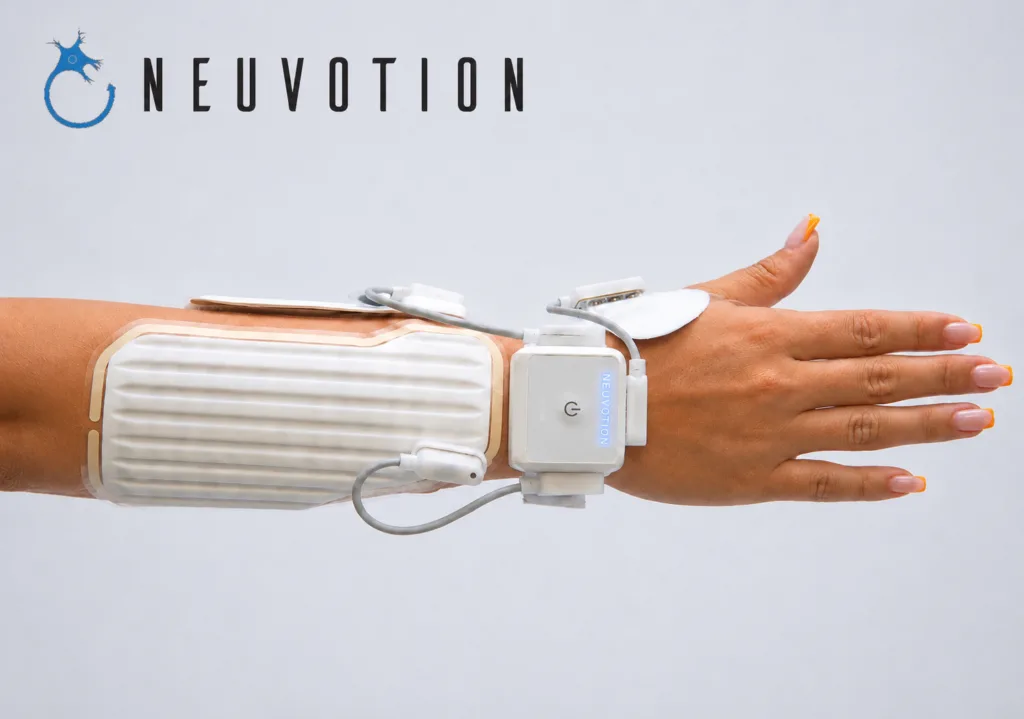
NeuStim NN-01 is the product that gives Neuvotion a near-term commercial pathway. The United States Food and Drug Administration determined the device to be substantially equivalent to the Bioness NESS H200 Wireless Hand Rehabilitation System through the 510(k) pathway on November 22, 2024.
The cleared indications cover functional electrical stimulation for improving hand function and active range of motion in patients with hemiplegia caused by stroke or upper-limb paralysis associated with C5 spinal cord injury. The device is also cleared for neuromuscular electrical stimulation uses including maintaining or increasing hand range of motion, reducing disuse atrophy, increasing local circulation, relaxing muscle spasms and supporting muscle re-education. The cleared configuration is intended for the right arm and right hand and is a prescription-use device.
NeuStim uses disposable electrodes positioned around the forearm and thumb. Its 181 addressable electrode contacts allow clinicians to electronically move the stimulation point, locate muscle responses and save useful stimulation patterns without repeatedly removing and repositioning conventional electrodes. Up to three stored patterns can be combined to create compound movements or treatment sequences.
This technology is related to the muscle-stimulation component of Neuvotion’s broader brain-body interface concept, but it is not the implanted double neural bypass described in Nature Medicine. NeuStim does not require intracortical implants, brain surgery or direct cortical sensory stimulation.
The company has described NeuStim as incorporating artificial intelligence guidance capable of inferring user intentions and assisting movement. However, the public FDA 510(k) summary lists software-controlled functions such as stimulation amplitude, location, pattern selection, device pairing and battery monitoring without identifying an artificial intelligence algorithm. The submission also states that clinical testing was not applicable because clearance was based on substantial equivalence and supporting non-clinical performance testing.
That regulatory record does not prevent Neuvotion from developing additional software capabilities, but hospitals and rehabilitation providers will need clarity about which functions are included within the cleared configuration, which are commercial features and which remain developmental.
Why is Neuvotion launching the external stimulator before pursuing implanted BCI commercialization?
Commercializing NeuStim first gives Neuvotion a more manageable route into rehabilitation centres, physical therapy practices and specialist neurological programmes. An external muscle stimulator can be deployed without neurosurgery and without the infrastructure required to implant, maintain and program intracortical arrays.
The strategy could also help Neuvotion build relationships with rehabilitation clinicians who may later participate in trials or adoption programmes involving spinal and brain interfaces. The company says it is working with rehabilitation centres to support clinical adoption, although the July announcement did not disclose purchase orders, distribution agreements, product pricing, manufacturing capacity or named launch customers.
A cleared product still faces meaningful commercial tests. Rehabilitation providers will assess training time, electrode and consumable costs, ease of patient setup, treatment throughput, durability, technical support and whether the device improves results sufficiently to justify switching from established functional electrical stimulation systems.
Reimbursement may be equally important. Neuvotion has not disclosed specific coding, coverage decisions or payment arrangements for NeuStim. Even where electrical stimulation is reimbursable, coverage can vary according to clinical indication, treatment setting, payer policy and documentation requirements.
The right-arm and right-hand limitation in the cleared label may also narrow initial use. Any expansion to other anatomical configurations, indications or substantially modified software functions could require additional regulatory assessment, depending on the nature of the changes.
What would show that Neuvotion’s commercialization strategy is moving beyond scientific promise?
The first measurable milestone will be whether NeuStim launches during fall 2026 as planned. Commercial availability should be followed by evidence of installations, clinician training, repeat electrode consumption, customer retention and use across multiple rehabilitation organisations rather than isolated evaluation sites.
Prospective clinical evidence specifically involving the commercial NeuStim configuration would strengthen the value proposition. The double neural bypass publication supports Neuvotion’s broader scientific rationale, but it cannot independently establish the effectiveness of the cleared external device because the two systems differ substantially in hardware, invasiveness and therapeutic components.
For the implanted programme, progress will depend on recruiting additional participants and demonstrating reproducible movement and sensory outcomes across varying injuries. Future publications will also need to address procedural safety, implant durability, decoder stability, home-use feasibility and the resources required to operate the system outside a specialist research centre.
Neuvotion’s commercial opportunity lies in connecting several technologies that are usually developed separately: brain-signal decoding, peripheral muscle stimulation, spinal neuromodulation, sensory feedback and rehabilitation software. The Nature Medicine study shows that this integrated concept can produce meaningful function in a tightly controlled single-participant setting.
The next challenge is less cinematic but commercially decisive. Neuvotion must show that its first cleared product can be manufactured, supported, purchased and used consistently in routine rehabilitation, while ensuring that the investigational achievements of the double neural bypass are not mistaken for capabilities already available through NeuStim.