
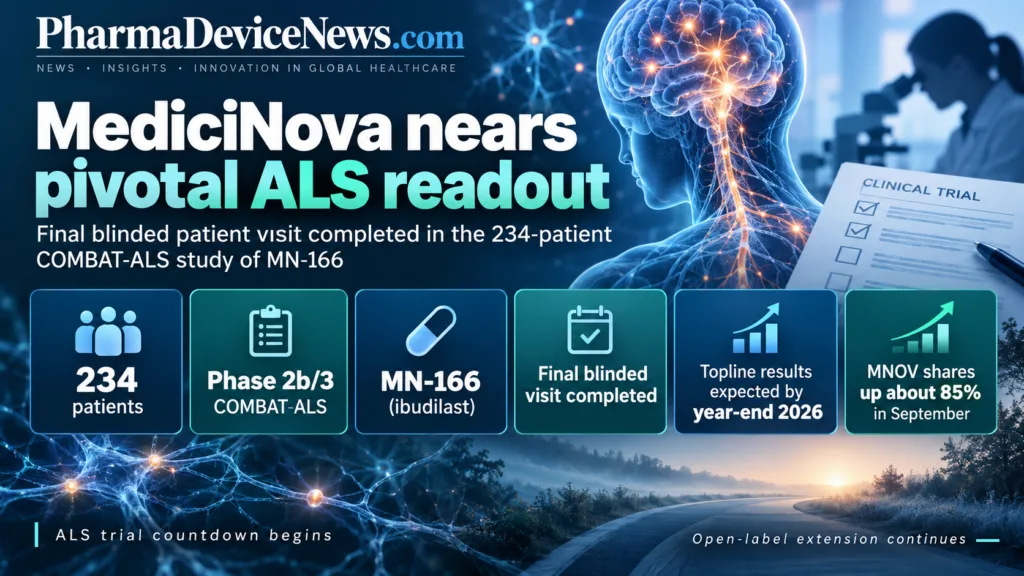
MediciNova Inc. (NASDAQ: MNOV), a California-based clinical-stage biopharmaceutical company developing therapies for neurological, inflammatory and fibrotic diseases, has completed the last patient visit in the double-blind portion of its Phase 2b/3 COMBAT-ALS study evaluating MN-166, or ibudilast, in amyotrophic lateral sclerosis. The milestone means the company can proceed toward database lock and analysis of a trial that could become the most consequential clinical readout in MediciNova’s recent history, with topline results expected before the end of 2026.
Investor attention has intensified well ahead of those results. MediciNova shares have risen approximately 85% during September through September 24, placing MNOV among the strongest-performing U.S.-listed healthcare stocks during the month, according to Stocktwits. The rally has been volatile rather than one-directional: MNOV surged 24.8% on September 16 and another 36.9% on September 17 before retreating over subsequent sessions, including a 5.4% decline to $2.65 on September 24.
The market is effectively moving from anticipation to a clearly defined binary catalyst. COMBAT-ALS randomized 234 patients across sites in the United States and Canada and is designed to determine whether oral ibudilast can slow functional deterioration and improve survival in people with early-stage ALS. MediciNova said remaining participants are continuing into the open-label extension, while the entire study is expected to reach its final patient visit in March 2027.
Why is completion of the COMBAT-ALS final blinded visit important?
Clinical trials cannot produce their definitive efficacy analysis until the prespecified treatment and follow-up period has been completed and the database has undergone cleaning, verification and locking. By reaching the last patient, last visit milestone in the double-blind portion, MediciNova has eliminated much of the remaining uncertainty around whether the pivotal dataset would mature in time for the company’s targeted year-end readout. The next stages will involve finalizing data from clinical sites, resolving outstanding queries and conducting the prespecified statistical analysis.
The importance goes beyond clinical-trial administration. COMBAT-ALS is the controlled study intended to establish whether MN-166 produces a clinically meaningful effect in ALS rather than simply generating biological signals or encouraging subgroup observations. The 234 participants were randomized between MN-166 and placebo for 12 months before entering an optional six-month open-label extension, providing a substantially larger and longer dataset than the company’s earlier exploratory ALS work.
Participants entered the study relatively early in their disease course. MediciNova reported a mean age of 60.6 years, an average ALS Functional Rating Scale-Revised score of 40.6 at screening and a mean interval of 12.5 months from first symptoms. About 46% had upper-limb onset, 32.5% lower-limb onset and 20.9% bulbar onset, characteristics the company said were broadly comparable with populations enrolled in other late-stage ALS studies.
That patient selection could matter because MediciNova’s earlier analyses suggested ibudilast may have a stronger effect when given earlier in ALS. Those previous findings came from much smaller datasets and subgroup analyses, however, making COMBAT-ALS crucial for determining whether the signal holds up prospectively in a substantially larger randomized population.
What does the COMBAT-ALS trial need to show for MN-166?
The primary endpoint is the Combined Assessment of Function and Survival, commonly called CAFS. This global-rank approach combines information on functional deterioration measured by the ALS Functional Rating Scale-Revised with survival, allowing the study to assess whether patients receiving MN-166 fare better overall than those receiving placebo across two clinically important dimensions.
Secondary measures include progression on the ALS Functional Rating Scale-Revised, muscle strength assessed through hand-held dynamometry, quality-of-life measurements and responder analyses examining whether patients remain stable or improve rather than continue declining. These endpoints are particularly relevant in ALS because deterioration can occur across mobility, speech, swallowing and respiratory function, while survival alone may require larger populations or longer studies to demonstrate a statistically reliable difference.
A previous interim analysis did not evaluate treatment efficacy but examined whether six-month measures were meaningfully correlated with later 12-month outcomes. MediciNova reported correlations of 0.71 for CAFS, 0.70 for modified CAFS and 0.69 for ALSFRS-R between the two time points. An independent Data Safety Monitoring Board reviewed the analysis and recommended that COMBAT-ALS continue according to protocol.
The year-end topline announcement therefore has several layers to watch. A successful primary endpoint would represent the clearest evidence yet that ibudilast changes ALS progression, while secondary measures could show whether any benefit is reflected consistently across function, muscle strength and patient quality of life. Safety will remain equally important because a chronic neurodegenerative-disease treatment may need to be administered over extended periods.
What is MN-166 ibudilast and how could it work in ALS?
MN-166 is an orally available small molecule that inhibits phosphodiesterase-4 as well as inflammatory mediators including macrophage migration inhibitory factor. MediciNova is investigating whether those actions can reduce neuroinflammation and other processes believed to contribute to motor-neuron degeneration in ALS. The compound has received Fast Track and Orphan Drug designations from the U.S. Food and Drug Administration for ALS, along with orphan designation in Europe.
Unlike a therapy targeted only at one rare genetic form of ALS, MediciNova is developing MN-166 for a broader patient population. Approximately 30,000 people are estimated to be living with ALS in the United States, according to the National Institute of Neurological Disorders and Stroke, and roughly 90% of cases are considered sporadic rather than arising from a clear familial pattern.
Current treatment options remain limited. Riluzole and edaravone are available for broader ALS populations, while Biogen’s Qalsody, or tofersen, targets adults whose disease is associated with mutations in the SOD1 gene. Even with existing therapies, ALS remains progressive and ultimately fatal, creating substantial demand for treatments capable of preserving physical function or extending survival more meaningfully.
This is what gives COMBAT-ALS unusually high clinical significance relative to MediciNova’s market capitalization. A convincing result could potentially position MN-166 as a broadly applicable oral ALS candidate, while a failed primary endpoint would materially weaken the strongest late-stage rationale supporting the asset.
What did earlier studies suggest about ibudilast in ALS?
MediciNova’s interest in advancing MN-166 into a larger pivotal study was supported partly by an earlier six-month randomized Phase 2 trial. Subsequent subgroup analyses suggested that patients with earlier ALS treated with MN-166 were more likely to remain stable or improve on some functional measures than patients receiving placebo, although several comparisons did not reach conventional thresholds for statistical significance.
For example, among an early-ALS subgroup, 30% of patients receiving MN-166 were classified as responders on the ALSFRS-R total score compared with 9.1% receiving placebo. Approximately 25% of the MN-166 group improved their ALSFRS-R score compared with none of the placebo group, but the small number of participants limited statistical certainty. Quality-of-life responder findings were stronger in one analysis, while muscle-strength differences were less conclusive.
Those earlier findings are therefore better viewed as the hypothesis that COMBAT-ALS is designed to test rather than evidence that the Phase 2b/3 trial will succeed. Small biotechnology stocks can move dramatically ahead of pivotal readouts precisely because encouraging early signals often remain uncertain until tested prospectively in larger controlled studies.
The distinction becomes especially relevant after MNOV’s September rally. Much of the company’s recent increase in market value reflects anticipation rather than new efficacy data. The September 24 announcement confirmed that the trial has reached its analysis stage, but it did not reveal whether MN-166 performed better than placebo.
Why does MediciNova also have 200 ALS patients in an expanded-access program?
Alongside COMBAT-ALS, MediciNova is involved in the SEANOBI expanded-access study, which reached its target enrollment of 200 patients in July. The program is supported by a $22 million grant from the National Institute of Neurological Disorders and Stroke under the ACT for ALS initiative and allows people who cannot participate in traditional randomized trials to receive MN-166 while investigators collect clinical outcomes and biomarker information.
SEANOBI is collecting information including neurofilament measurements, an increasingly important biomarker of neuronal injury. Final patient follow-up is expected in early 2027, after which investigators plan analyses for scientific presentations and peer-reviewed publications. The expanded-access dataset cannot replace randomized placebo-controlled evidence, but it could provide complementary information about safety, biomarkers and treatment performance in a broader real-world ALS population.
Taken together, the two programs mean MediciNova could eventually have information from more than 400 ALS patients across its randomized study and expanded-access initiative. That scale may become relevant in regulatory discussions if COMBAT-ALS produces a positive efficacy result, particularly when regulators examine safety consistency and whether the observed effect translates beyond the tightly controlled pivotal-trial population.
The company has already said that COMBAT-ALS is intended to generate the controlled evidence required for a potential future regulatory submission. A successful result would still need to be reviewed with the FDA to determine precisely what additional data, analyses or studies might be required.
Why has MNOV stock risen about 85% during September?
MNOV entered September trading around the mid-$1 range before accelerating sharply during the middle of the month. The stock climbed 8% on September 15, almost 25% on September 16 and another 36.9% on September 17, when more than 7.3 million shares changed hands. That compares with fewer than 70,000 shares on several quieter sessions earlier in September, showing how rapidly speculative and event-driven interest expanded.
Stocktwits identified MediciNova among the five healthcare stocks with market capitalizations above $100 million that had outperformed Moderna during September, estimating an approximately 85% monthly advance as investors looked toward the ALS readout. Retail sentiment has nevertheless shifted rapidly between bullish and bearish readings, another indication that traders are positioning around a future binary clinical event rather than reacting to results already known.
The stock’s retreat to $2.65 on September 24 is therefore also worth noting. Even after the pivotal trial milestone, shares fell 5.4% during the session and remain well below the $3.90 intraday high reached on September 17. The combination of a large monthly gain and substantial daily reversals points to high expectations but also considerable uncertainty around what the forthcoming dataset might show.
Can MediciNova fund the next stage if COMBAT-ALS succeeds?
MediciNova reported $25.4 million in cash and cash equivalents at June 30, down from $30.8 million at the end of 2025. The company used approximately $5.4 million in operating cash during the first six months of 2026 and posted a $4.9 million net loss over the same period, compared with a $6.1 million loss a year earlier.
Management said in its second-quarter filing that available working capital should fund operations at least through November 2027, although it also cautioned that existing resources may not be sufficient to execute every research and development program as planned. Research, development and patent expenses totaled about $2.1 million during the first half of 2026, down from $3.7 million a year earlier.
A positive COMBAT-ALS result could therefore create both an opportunity and a financing decision. Preparing regulatory submissions, conducting additional FDA-requested work, manufacturing commercial-scale drug and building a launch organization could require substantially more capital than MediciNova currently spends. Management has previously indicated that it may develop programs independently or enter strategic collaborations around selected assets.
That possibility gives the ALS results significance beyond whether the stock rises or falls after a single announcement. Strong data could change the company’s ability to negotiate partnerships, obtain financing or advance MN-166 toward commercialization on more favorable terms.
What should investors watch when MediciNova reports COMBAT-ALS results?
The headline result will be whether MN-166 meets the prespecified CAFS primary endpoint, but the magnitude and consistency of any treatment effect will matter just as much as statistical significance. Investors and neurologists will also examine ALSFRS-R decline, survival information, responder rates, muscle strength, quality-of-life measurements, discontinuations and the overall safety profile.
The results will additionally need to be viewed against a long history of disappointing ALS drug development. The complexity and heterogeneity of the disease have made promising early-stage signals difficult to reproduce in larger studies, making a randomized 234-patient dataset considerably more informative than the smaller subgroup observations that preceded it.
For MediciNova, the timing is now unusually clear. The last blinded patient visit has been completed, database work is underway and topline data remain targeted for the end of 2026. With MNOV already up roughly 85% during September and retail-investor attention increasing ahead of the readout, expectations are building before the most important evidence has actually arrived.
The next major move in MediciNova shares is therefore likely to depend less on another enrollment or operational milestone and far more on whether MN-166 can demonstrate that an oral anti-inflammatory and neuroprotective approach meaningfully alters the course of one of neurology’s most difficult diseases.
