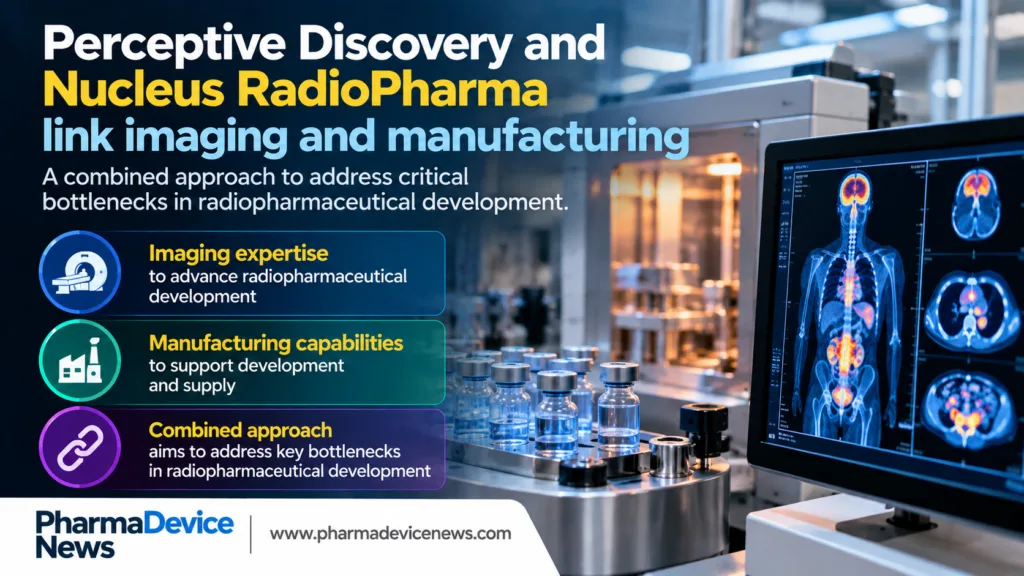
Perceptive Discovery and Nucleus RadioPharma Inc. have formed a strategic partnership connecting preclinical molecular imaging, radiochemistry and dosimetry with Good Manufacturing Practice (GMP) radiolabeling and radiopharmaceutical manufacturing services. Announced on October 9, 2026, the non-exclusive arrangement is intended to improve the transition from early drug discovery into clinical production, addressing an increasingly important development challenge for targeted radiopharmaceutical therapies.
The agreement brings together two specialist businesses operating at different stages of the radiopharmaceutical development pathway. Perceptive Discovery provides preclinical research services, including molecular imaging, biodistribution analysis and radiochemistry, while Nucleus RadioPharma focuses on radiopharmaceutical process development, manufacturing, specialized isotope supply and regulatory support. Rather than creating a newly combined business, the partnership establishes reciprocal referrals for qualified customer opportunities, supported by a joint governance structure.
The announcement comes as radiopharmaceutical developers face growing pressure to coordinate scientific research with the manufacturing capabilities required for human studies. A promising compound must not only demonstrate sufficiently convincing biological and preclinical characteristics but also be produced consistently, meet relevant quality requirements and remain suitable for administration within the constraints imposed by radioactive decay. The collaboration is designed to address these overlapping requirements earlier, although the companies have not disclosed a specific customer programme, financial consideration or quantified reduction in development timelines.
Why could connecting preclinical imaging with GMP manufacturing reduce radiopharmaceutical development delays?
Radiopharmaceutical drug development requires coordination between biological targeting, radioactive isotope selection, imaging technology and pharmaceutical manufacturing. Unlike conventional small-molecule medicines, these products incorporate radioactive components whose physical decay characteristics influence production schedules, quality testing, distribution and clinical administration. A candidate that performs well during laboratory testing may still require substantial process development before it can be manufactured consistently for human investigation.
Preclinical imaging plays an important role in identifying these challenges before clinical development begins. Molecular imaging and biodistribution studies help researchers investigate where a radiolabeled compound travels, how much accumulates in targeted tissues and how much reaches organs that could be vulnerable to radiation exposure. Dosimetry uses relevant measurements and models to estimate absorbed radiation doses, providing information that can support candidate evaluation and later clinical development planning, although animal-derived estimates cannot independently establish human dosimetry or safety.
The difficulty emerges when research-stage preparation methods must be transferred into a controlled manufacturing environment. A radiopharmaceutical that can be synthesized in small experimental quantities may require different equipment, analytical controls or production conditions when manufactured under GMP requirements. If manufacturers become involved only after candidate selection, development teams may discover avoidable problems involving radiolabeling efficiency, product stability, quality specifications or isotope availability.
The Perceptive Discovery and Nucleus RadioPharma partnership attempts to address these issues by giving developers a more coordinated route between preclinical characterization and manufacturing preparation. Stephen Hahn, chief executive officer of Nucleus RadioPharma, indicated that the collaboration is intended to bring manufacturability and scale considerations into development earlier rather than treating production as a separate downstream activity. The commercial proposition is therefore not simply faster laboratory testing but potentially fewer costly adjustments when a radiopharmaceutical programme approaches human studies.
What does the non-exclusive Perceptive Discovery and Nucleus RadioPharma agreement actually cover?
The commercial structure of the agreement is narrower than a fully integrated manufacturing joint venture. Both companies will continue operating independently and will refer suitable business opportunities to one another, while a joint governance structure will support coordination and performance reviews. The companies have also retained a non-exclusive arrangement, meaning sponsors are not required to use both organizations or surrender their ability to select alternative service providers.
This structure could be attractive to biotechnology companies that already have established research or manufacturing partners but require additional capabilities for specific stages of development. A sponsor using Perceptive Discovery for imaging and biodistribution studies could potentially access Nucleus RadioPharma’s process-development and manufacturing capabilities without independently building an entirely new supplier relationship. Conversely, Nucleus RadioPharma could direct customers requiring specialized preclinical imaging or translational research toward Perceptive Discovery.
However, the October 9 announcement does not identify a committed customer programme, minimum business volume, financial consideration or guaranteed development schedule. Neither company has disclosed how commercial revenues generated through the referral arrangement will be allocated, whether referral fees are involved or how responsibilities will be divided for individual customer contracts. The partnership establishes a mechanism for collaboration, but its economic significance will depend on whether referred opportunities become contracted, successfully executed development programmes.
For Perceptive Discovery, the agreement extends its preclinical offering toward a more defined manufacturing pathway without requiring it to construct its own commercial radiopharmaceutical production network. Benjamin Murphy, the company’s chief executive officer, indicated that earlier coordination should help sponsors anticipate development and manufacturing challenges while improving the transition toward clinical investigation. Nucleus RadioPharma, meanwhile, gains another potential source of development-stage customers whose programmes could require increasingly sophisticated radiolabeling, process development and supply arrangements as they mature.
How will isotope supply and manufacturing readiness determine whether radiopharma programmes reach clinical trials?
Radioisotope availability remains an important variable in radiopharmaceutical development because different radionuclides require different production, handling and distribution strategies. Beta-emitting isotopes such as lutetium-177 are used in established radioligand therapies, while alpha emitters such as actinium-225 are attracting substantial research interest because of their radiation characteristics. Diagnostic isotopes, including those used in positron emission tomography and single-photon emission computed tomography, introduce additional considerations involving imaging performance, production geography and usable shelf life.
The physical half-life of an isotope affects how much time remains for radiolabeling, quality-control procedures, shipment and administration. These constraints are particularly important when manufacturing facilities and clinical treatment sites are geographically separated or when production depends on suppliers with limited output. A coordinated development model can help establish realistic manufacturing schedules, but it cannot eliminate radioactive decay or guarantee access to scarce isotopes.
Nucleus RadioPharma has already been strengthening its supply arrangements. In June 2026, the company announced a master purchase and supply agreement with BWXT Medical covering GMP-grade actinium-225 chloride and iodine-123 sodium iodide, with a framework for potentially adding other radionuclides. The agreement supports the company’s broader isotope procurement strategy, although the existence of a supply framework does not independently establish unlimited isotope availability for every customer programme.
Manufacturing readiness introduces another layer of complexity. Nucleus RadioPharma identifies Rochester, Minnesota, as an operating facility within its manufacturing network, while its expansion location at Springhouse Innovation Park in Pennsylvania remains under development. The company has described its Rochester infrastructure as supporting dedicated research and specialized production operations, but individual programmes still require appropriate technical transfer, quality controls and manufacturing readiness before clinical supply can be relied upon.
Radiopharmaceutical manufacturing also requires attention to product identity, radiochemical purity, radionuclidic purity, sterility assurance, stability and radioactive material handling. Production processes must be sufficiently reproducible to satisfy applicable quality expectations, even when the time available for certain quality procedures is constrained by product decay. The Perceptive Discovery collaboration could improve the early identification of these requirements, but facility readiness, qualified procedures and reliable product-specific manufacturing remain separate tests.
How do the companies’ 2026 investments strengthen their positions in radiopharmaceutical outsourcing?
The latest partnership follows a series of investments and collaborations that have expanded Perceptive Discovery’s radiopharmaceutical research capabilities. In January 2026, the company announced $15 million in strategic investments backed by shareholder CapVest Partners LLP to enhance radiochemistry, cell assays and in vitro biology infrastructure. The programme included expansion of astatine-211 research capabilities across locations in the United States and United Kingdom, supporting the company’s growing emphasis on targeted radiopharmaceutical research.
Perceptive Discovery subsequently introduced its α-Sight preclinical alpha-emitter imaging offering through a collaboration with MH3D in April 2026. The technology combines specialized imaging hardware with quantitative analysis capabilities intended to help researchers characterize radiopharmaceutical distribution in preclinical models. In June, the company also announced a collaboration with Certis Oncology to incorporate patient-derived tumor models into radiopharmaceutical research workflows, potentially allowing developers to investigate candidate activity across more biologically characterized experimental systems.
Taken together, these developments indicate that Perceptive Discovery is pursuing a broader position in the preclinical radiopharmaceutical services market rather than relying exclusively on conventional molecular imaging. Its capabilities increasingly cover experimental models, target evaluation, radiochemistry, imaging analysis and translational research. The addition of Nucleus RadioPharma provides a complementary manufacturing connection, although successful coordination across these capabilities will still need to be demonstrated through actual customer programmes.
Nucleus RadioPharma has been expanding its own operational and financial base. In April 2026, the company announced $50 million in financing from OrbiMed to support capacity expansion at Rochester and development of its Pennsylvania manufacturing location. That financing was a separate corporate transaction and should not be confused with any payment or funding commitment under the newly announced Perceptive Discovery partnership.
The manufacturer also established a strategic alliance with Thermo Fisher Scientific in June 2026, combining radiopharmaceutical manufacturing expertise with clinical research services available through Thermo Fisher Scientific’s PPD clinical research business. This arrangement complements the new Perceptive Discovery agreement by addressing another part of the development pathway: the execution of clinical programmes after a candidate has advanced beyond preclinical evaluation. Together with Nucleus RadioPharma’s isotope supply agreements, these collaborations suggest a strategy built around specialist partners rather than bringing every development function under direct ownership.
Why is the radiopharmaceutical outsourcing market attracting larger strategic investments?
The increasing commercial importance of radiopharmaceuticals provides important context for the agreement. Novartis reported approximately $1.99 billion in 2025 net sales for Pluvicto, its lutetium-177-based radioligand therapy for specified patients with prostate-specific membrane antigen-positive metastatic castration-resistant prostate cancer. The product’s commercial performance illustrates that targeted radiopharmaceuticals can generate substantial revenue when clinical evidence, regulatory authorization, treatment infrastructure and manufacturing capacity are successfully aligned.
Expansion of radiopharmaceutical services is also attracting investment from major medical technology companies. On October 5, 2026, GE HealthCare announced a definitive agreement to acquire SOFIE Biosciences for $945 million in cash, with completion expected during the first half of 2027 subject to closing conditions. The proposed acquisition would bring an established United States PET radiopharmaceutical manufacturing network into GE HealthCare’s pharmaceutical diagnostics business, strengthening its position in the time-sensitive distribution of imaging agents.
The GE HealthCare transaction and the Perceptive Discovery collaboration address different parts of the radiopharmaceutical ecosystem. SOFIE Biosciences primarily provides PET radiopharmaceutical production and distribution capabilities, whereas the newly announced partnership focuses on connecting preclinical research with radiopharmaceutical manufacturing services. Nevertheless, both developments illustrate the growing strategic importance of specialized infrastructure, where production expertise, geography, regulatory controls and reliable delivery can influence the viability of radiopharmaceutical programmes.
For independent contract development and manufacturing organizations, this environment creates opportunities alongside competitive pressures. Pharmaceutical sponsors may seek partners with established infrastructure rather than financing highly specialized facilities themselves, particularly during early clinical development when future demand remains uncertain. At the same time, the expansion of large pharmaceutical and healthcare technology companies could intensify competition for specialist personnel, isotopes, manufacturing contracts and development customers.
What clinical and regulatory evidence will developers still need before radiopharmaceuticals can reach patients?
Although the partnership could improve development coordination, it does not establish the clinical effectiveness or safety of any radiopharmaceutical candidate. No new investigational therapy, clinical trial result, regulatory authorization or manufacturing qualification for a specific product was announced as part of the agreement. Its immediate significance is operational rather than clinical, with potential benefits depending on whether coordinated services help sponsors generate the evidence and manufacturing packages required for development.
The United States Food and Drug Administration’s final 2019 guidance on oncology therapeutic radiopharmaceuticals addresses the design of appropriate nonclinical development programmes for products used to treat cancer. Such programmes can include investigations relevant to radiation exposure, tissue distribution and toxicology, but the precise requirements depend on the candidate and its proposed clinical use. Data from preclinical imaging can inform these assessments without replacing clinical evaluation of safety, tolerability, pharmacokinetics and therapeutic activity.
Regulatory expectations are also evolving around radiopharmaceutical dosage optimization. In August 2025, the United States Food and Drug Administration issued draft guidance addressing the identification of optimized administered activity and treatment schedules during oncology radiopharmaceutical clinical development. The draft is not final guidance and does not directly address every aspect of first-in-human dose selection or personalized dosimetry, but it reflects regulatory attention to the relationship between radioactive dose, treatment schedule, potential efficacy and toxicity.
For sponsors, better integration between preclinical research and manufacturing may help ensure that the selected compound and its proposed clinical formulation are compatible with a realistic development pathway. However, a successful preclinical imaging result cannot establish that an investigational radiopharmaceutical improves survival, tumor response or other patient outcomes. Those questions require appropriately designed clinical studies, while regulatory authorization and subsequent commercial availability remain dependent on the evidence generated for each product.
Which measurable milestones will determine whether the Perceptive Discovery and Nucleus RadioPharma partnership succeeds?
The most immediate measure of progress will be whether the companies convert qualified referrals into customer development programmes that meaningfully use both organizations’ capabilities. Announcements identifying specific collaborations, the types of radionuclides involved or development programmes advancing from preclinical research toward manufacturing would provide clearer evidence of commercial traction. The number of referrals alone would offer a weaker indication of value than completed technical transfers, contracted manufacturing activities and successful clinical supply execution.
Operational performance will be particularly important because the partnership seeks to address a development transition rather than a single research capability. Relevant measures include the time required to transfer analytical methods and radiolabeling processes, the frequency of manufacturing-related redesigns, the ability to maintain reproducible product quality and the reliability of isotope procurement. Improvements in these areas could reduce avoidable development costs, although demonstrating a genuine acceleration in clinical timelines would require suitable comparisons with conventional workflows.
The non-exclusive structure may also influence the partnership’s development. Its flexibility allows customers to retain existing providers, potentially broadening the addressable pool of sponsors that can use selected services without committing to an entirely new development platform. However, the absence of exclusivity means that future customer relationships and manufacturing contracts cannot automatically be attributed to the collaboration, and each company will have to demonstrate commercially relevant contributions.
For Nucleus RadioPharma, the next meaningful developments will include continued manufacturing readiness, execution of existing supply commitments and progress on its Pennsylvania expansion. Perceptive Discovery will need to demonstrate that its expanded imaging and translational research capabilities can support candidate selection and more effective preparation for clinical manufacturing. The partnership’s longer-term relevance will depend on whether these capabilities operate as a coordinated development pathway rather than a collection of separately marketed services.
The October 9 agreement represents another step toward a more connected radiopharmaceutical outsourcing ecosystem, where research organizations, isotope suppliers, manufacturers and clinical service providers increasingly collaborate across development stages. Its appeal lies in addressing a practical difficulty that conventional pharmaceutical development models do not always accommodate: radioactive medicines require scientific, manufacturing and logistical decisions to be closely synchronized. Whether Perceptive Discovery and Nucleus RadioPharma can deliver measurable improvements will ultimately be determined by the quality of customer programmes transferred between them, the reliability of GMP manufacturing and the successful progression of investigational radiopharmaceuticals into clinical testing.