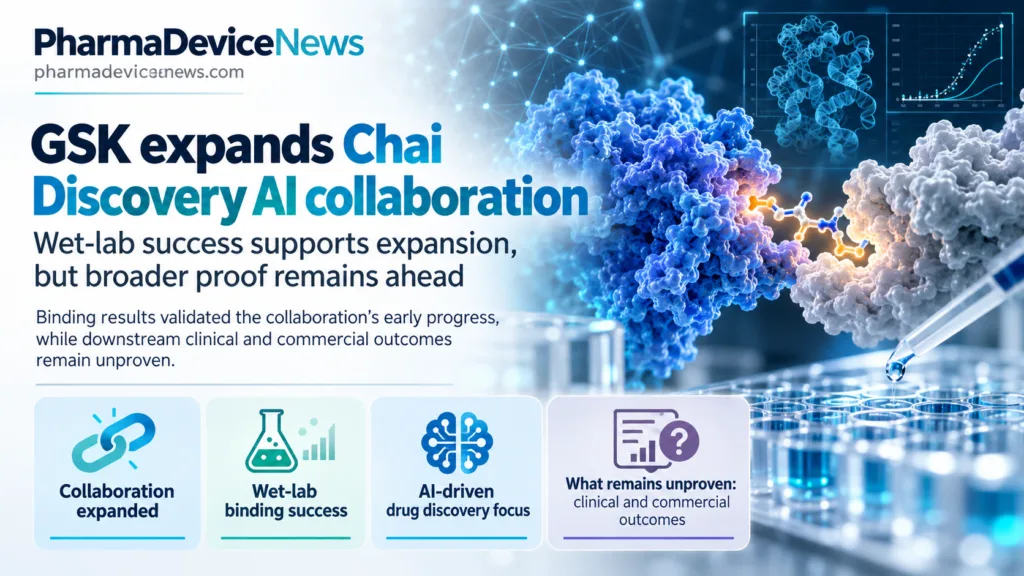
Chai Discovery, a privately held San Francisco biotechnology technology company, announced on October 9, 2026, that GSK plc (LSE: GSK; NYSE: GSK) had expanded its collaboration with the startup after laboratory experiments confirmed that its artificial intelligence-generated molecular designs bound to every therapeutic target evaluated. Under the expanded arrangement, GSK will gain access to Chai Discovery‘s protein-folding and molecular design models for drug discovery activities across its research pipeline. The agreement follows an internal evaluation conducted by GSK scientists, providing an important example of a pharmaceutical company testing an external artificial intelligence platform experimentally before committing to broader use.
The findings are notable because Chai Discovery generated the molecular designs using a zero-shot approach, meaning the models were not specifically trained on the individual GSK targets before producing candidate binders. GSK subsequently tested the designs in its own laboratories and identified molecules with what Christopher Austin, the company’s senior vice president of research and development technologies, described as strong binding affinities. However, neither company disclosed the number of targets, the proportion of successful designs or quantitative binding measurements, leaving the overall experimental success rate unavailable for independent evaluation.
The collaboration also marks another step in Chai Discovery’s rapid commercial expansion following its $400 million Series C financing in July 2026, which valued the company at $3.8 billion. The startup has established partnerships with several major pharmaceutical companies during the year, including Eli Lilly and Company, Pfizer, Novartis, Bristol Myers Squibb and argenx. Its expanding customer base demonstrates pharmaceutical industry interest in the platform, although no medicine resulting from the newly announced GSK collaboration has been identified as entering clinical development.
Why does GSK’s wet-lab evaluation provide stronger evidence than computational antibody design predictions?
The most consequential element of the announcement is GSK’s experimental testing of molecules generated outside its own research organisation. Artificial intelligence systems can predict molecular structures and propose sequences expected to bind therapeutic targets, but computational predictions remain hypotheses until tested against physical biological materials. By conducting laboratory experiments on Chai Discovery’s designs, GSK introduced an empirical assessment that goes beyond evaluating predicted structures or theoretical binding scores.
According to the companies, the testing covered a panel of diverse therapeutic targets and produced at least one successful binder for every target evaluated. This suggests that the models generated experimentally active candidates across the undisclosed target panel rather than demonstrating activity against only one selected protein. The findings supported GSK’s decision to extend an existing technology evaluation into a broader working relationship.
The result is particularly relevant for de novo molecular design, where the objective is to generate candidate proteins or antibodies without relying entirely on the conventional process of identifying binders from large experimental libraries. Traditional antibody discovery frequently involves screening extensive collections of molecular variants before selecting candidates with suitable binding characteristics. A computational design platform capable of producing viable candidates before extensive screening could potentially reduce the number of experimental iterations required during early discovery.
Nevertheless, the ability to produce at least one binder against each tested target is different from demonstrating that most generated molecules successfully bind. The companies did not disclose how many designs were generated, synthesised or screened for each target, nor the proportion that met predetermined affinity thresholds. Without those figures, it is not possible to calculate a binding hit rate or directly compare the GSK evaluation with conventional laboratory discovery methods.
The outcome therefore supports the technical feasibility of the approach under the evaluated conditions but does not establish a general superiority claim. Its immediate significance is that an established pharmaceutical research organisation considered the laboratory findings sufficiently encouraging to expand access to the technology.
What does zero-shot molecular design mean for GSK’s ability to discover new therapeutic antibodies?
Zero-shot molecular design refers to generating candidate sequences for a particular target without additional model training specifically tailored to that target. In Chai Discovery’s case, the models use previously learned relationships between molecular structures, sequences and interactions to propose molecules that may bind to proteins of pharmaceutical interest. The approach is intended to reduce dependence on generating large amounts of experimental training data for each new target before useful molecular designs can be produced.
This capability could become valuable when researchers investigate proteins for which suitable experimental binders are difficult to obtain. Certain membrane proteins, complex protein conformations and inaccessible binding surfaces can present challenges for traditional discovery programmes. A model that can propose new binding sequences using broader learned structural information may offer another route to identifying candidates for experimental testing.
However, zero-shot design does not mean that the underlying model was developed without biological training data. It indicates that target-specific additional training was not performed for the evaluation, rather than establishing that the target or related biological information was entirely absent from the model’s earlier training environment. The extent of any overlap between the evaluation targets and the model’s existing knowledge was not disclosed in the October announcement.
GSK’s results also do not establish that every design had sufficient specificity for pharmaceutical development. A protein may bind strongly to its intended target while also interacting with unrelated proteins, generating unwanted biological activity or presenting difficulties during manufacturing. Affinity is therefore an important first-stage property, but it must be considered alongside selectivity, stability, solubility and other characteristics relevant to developing a therapeutic candidate.
The practical value of zero-shot generation will ultimately depend on whether the resulting molecules consistently meet those broader requirements. If useful candidates can be produced with fewer experimental cycles, the approach could improve research productivity. Establishing that benefit will require programme-level evidence comparing discovery timelines, experimental workloads and candidate quality against alternative methods.
How does Chai-3 fit into the GSK collaboration and Chai Discovery’s evolving technology platform?
Chai Discovery’s platform has progressed through several generations of molecular design models since the company was founded in 2024. Its earlier Chai-1 model focused on molecular structure prediction, while Chai-2 extended the company’s capabilities into generating new protein and antibody designs. Chai-3, introduced in 2026, represents a further development aimed at improving target success rates, binding properties and the design of molecules against challenging biological targets.
The company has previously described Chai-2 as achieving meaningful experimental success in zero-shot antibody design. Research reported in a 2025 preprint described successful antibody binders for approximately half of 52 tested antigen targets under the study’s experimental conditions. The same work reported a 68% target-level wet-lab success rate for miniprotein design, providing earlier experimental support for the broader molecular generation strategy.
These findings are important background, but they should not be treated as measurements from the GSK evaluation. The October 2026 announcement refers to Chai Discovery’s models and identifies Chai-3 as the company’s latest system, without specifying which individual model generated every design tested by GSK. The earlier success rates therefore cannot be applied directly to GSK’s undisclosed panel or used to calculate the performance of the new collaboration.
Chai Discovery has also promoted broader design capabilities involving different antibody formats, epitope selection and challenging molecular targets. Its commercial proposition is that scientists can specify relevant structural or functional requirements before generating candidate molecules, potentially giving research teams greater control over the properties they investigate. Whether that flexibility leads to higher-quality therapeutic candidates across multiple programmes remains an important area for experimental validation.
For GSK, access to different components of the platform could allow scientists to investigate several approaches rather than relying on a single model architecture. The distinction matters because protein structure prediction, binder generation and therapeutic optimisation are related but separate activities. Success at one stage does not automatically establish equivalent performance at the others.
Can GSK combine Chai Discovery’s AI technology with its own experimental research infrastructure?
GSK’s approach is notable because the collaboration is intended to complement its existing internal artificial intelligence capabilities rather than replace them. Christopher Austin indicated that Chai Discovery’s technology would work alongside models developed within GSK, which are continually retrained using experimental laboratory data. This creates the possibility of combining externally developed molecular generation systems with proprietary research information and internal expertise.
Such an arrangement could be particularly useful when different models offer complementary strengths. One model may generate candidate structures, another may help predict binding properties, and internal laboratory systems may provide evidence about how those designs perform experimentally. Combining those capabilities could create a more iterative research process in which laboratory findings inform subsequent rounds of computational design.
The potential advantage lies in connecting molecular generation with experimental learning rather than treating artificial intelligence as a standalone substitute for drug discovery laboratories. Even advanced models require high-quality biological information, reproducible testing procedures and researchers capable of interpreting unexpected results. A platform that integrates efficiently with these existing activities may be more useful than one that performs well only on isolated computational benchmarks.
GSK has separately expanded its investment in data-driven drug discovery. In July 2026, the company announced a research collaboration with Relation Therapeutics involving the generation of large-scale human cellular perturbation datasets and the use of those data in artificial intelligence models. That arrangement carried a potential value of up to $110 million in upfront and success-based milestone payments, illustrating the pharmaceutical company’s interest in combining experimental biological information with computational methods.
The two collaborations address different parts of the discovery process. Relation Therapeutics is focused on producing and applying biological data to improve understanding of disease mechanisms and therapeutic targets, while Chai Discovery offers molecular design capabilities for generating potential binders. They should not be described as components of a single integrated programme, but together they illustrate the range of technologies GSK is evaluating across its research activities.
Why could GSK’s agreement strengthen Chai Discovery’s position among pharmaceutical AI suppliers?
The GSK collaboration follows a period of substantial commercial expansion for Chai Discovery. During 2026, the company announced relationships with major pharmaceutical organisations including Eli Lilly and Company, Pfizer, Novartis, argenx and Bristol Myers Squibb. These agreements differ in structure and scope, but collectively indicate that several established drug developers are evaluating or deploying Chai Discovery’s molecular design capabilities.
The growing number of industry relationships provides Chai Discovery with opportunities to test its technology against a wider range of therapeutic targets and pharmaceutical research requirements. Working with large companies may also expose the platform to more demanding standards for reproducibility, experimental performance and integration into established discovery processes. Those experiences could provide valuable information for refining future models, subject to the relevant contractual restrictions on data access and use.
The GSK announcement differs from a simple initial access arrangement because it was preceded by an evaluation performed in the pharmaceutical company’s own laboratories. That sequence provides some evidence of customer willingness to expand engagement following direct experimental testing. It does not, however, establish the monetary value of the collaboration or confirm that GSK has committed to developing a specified number of drug candidates using the platform.
Neither company disclosed an upfront payment, research funding commitment, milestone structure, royalty arrangement or overall contract value. The duration of the expanded collaboration, allocation of intellectual property rights and potential commercialisation responsibilities were also not detailed publicly. Consequently, the agreement cannot be translated into a confirmed revenue contribution or a forecast of future licensing income for Chai Discovery.
The absence of financial terms matters when assessing the economics of artificial intelligence drug discovery platforms. Some arrangements may primarily involve software or technology access, while others can include research services, joint development, licensing or commercial milestones. The GSK disclosure establishes wider platform access after a successful evaluation but does not provide sufficient information to classify its complete commercial economics.
What does Chai Discovery’s $3.8 billion valuation imply about expectations for AI-designed medicines?
Chai Discovery’s July 2026 Series C financing provides an important financial backdrop to the GSK announcement. The company secured $400 million in new funding at a valuation of $3.8 billion, with investors including Index Ventures, Kleiner Perkins, Sequoia Capital and Dimension. The financing followed earlier funding rounds and reflected substantial investor interest in technologies intended to improve the design of pharmaceutical molecules.
The valuation suggests that investors are assigning considerable value to the company’s potential role within pharmaceutical research. Unlike a conventional biotechnology developer whose prospects may depend on a limited number of proprietary clinical assets, Chai Discovery is building a platform intended for use across multiple partners and target programmes. This could create several potential commercial pathways, although the relative importance of recurring platform revenue, research agreements and any future downstream economics remains undisclosed.
Chai Discovery remains privately held, meaning it does not have a publicly traded share price that can be used to assess investor reaction to the GSK agreement. Its July valuation is a private financing benchmark, not evidence of a current public market capitalisation or realised commercial return. The company has not disclosed sufficient recurring revenue, profitability or detailed contract economics to independently assess how much of that valuation is supported by present business activity.
For a research platform company, repeated pharmaceutical partnerships may help establish commercial credibility, but the quality and eventual output of those relationships will matter more than their number alone. A broad collection of access agreements could create useful early revenue and technical validation without necessarily producing proprietary medicines. More substantial long-term value would require evidence that the platform improves research productivity, advances suitable candidates or generates meaningful contract economics.
The investment case therefore rests partly on whether Chai Discovery can make its technology useful across different pharmaceutical research organisations. GSK’s internal evaluation contributes to that evidence, but it represents an early discovery milestone rather than confirmation of commercially successful drug development.
What scientific hurdles remain between AI-generated protein binders and clinical drug candidates?
The distinction between laboratory binding and therapeutic suitability is particularly important in antibody and protein drug development. A molecule that binds a disease-associated protein may not produce the desired biological effect, particularly when the therapeutic objective requires blocking a signalling pathway, activating a receptor or selectively changing a complex biological interaction. Researchers must establish both the molecular interaction and the functional consequence before concluding that a candidate has useful pharmacological activity.
Subsequent studies typically assess whether promising molecules bind selectively, remain stable under relevant conditions and possess physical properties compatible with pharmaceutical development. Investigators may also need to evaluate aggregation, off-target interactions, immunogenicity potential and the ability to manufacture the molecule consistently. A strong initial binding result can provide a starting point for these investigations, but it does not eliminate their complexity.
Further development requires evidence from appropriate biological systems, pharmacology studies and nonclinical safety assessments. Those investigations help determine whether a candidate has sufficient activity, exposure characteristics and tolerability to justify clinical testing. Depending on the molecule and intended indication, manufacturing development and regulatory documentation can become substantial additional requirements.
The broader scientific literature supports the need for this distinction. A prospective, blinded antibody design benchmark published in Nature Biotechnology in August 2026 found that artificial intelligence systems could produce impressive results in certain experimental settings, but performance was inconsistent across different design tasks. The study reinforced the importance of experimental testing, developability assessment and carefully defined evaluation conditions when judging computational antibody discovery systems.
The GSK evaluation provides useful evidence that Chai Discovery’s models can produce binders against the targets selected for testing, but it does not establish comparable performance across all therapeutic proteins. The companies have not identified a specific candidate entering formal preclinical development, disclosed an Investigational New Drug application or announced clinical trial plans resulting from the collaboration. Any future progress towards a therapeutic programme will therefore require separate evidence.
How could the collaboration affect GSK’s research strategy and investor sentiment?
GSK enters the expanded collaboration during a period of increased emphasis on research productivity and pipeline development. The company reported second-quarter 2026 sales of £8.4 billion, representing 5% growth at constant exchange rates, while outlining plans to accelerate late-stage research and development. It also indicated that more than 20 Phase III trial starts were expected during 2026, demonstrating the scale of its broader development activities.
The Chai Discovery agreement addresses an earlier part of that research pipeline. Generating improved discovery candidates could eventually contribute to the company’s ability to identify and advance new assets, but any effect on clinical development spending, approval probabilities or future product revenue remains uncertain. There is no disclosed evidence that the collaboration will materially change GSK’s near-term financial guidance.
GSK shares closed at 1,750 pence on the London Stock Exchange on October 9, 2026, gaining approximately 0.84% during the trading session. The stock nevertheless finished below its October 2 closing price of 1,779.5 pence, equivalent to a decline of approximately 1.66% over that comparison period. The October 9 gain coincided with the collaboration announcement, but the available evidence does not establish that the agreement caused the movement.
For GSK investors, the arrangement is better understood as an early-stage research capability investment than a near-term financial catalyst. Its strategic value could become clearer if the technology supports named discovery programmes, produces candidates with improved properties or demonstrates measurable reductions in experimental workloads. In the absence of disclosed financial commitments or development assets, assigning a specific earnings contribution would be premature.
The competitive implications are also more nuanced than the addition of another technology supplier. Large pharmaceutical companies increasingly combine internal artificial intelligence research with external specialist platforms, biological datasets and conventional laboratory methods. The ability to integrate these capabilities and demonstrate consistent experimental results may become an important determinant of productivity, particularly as pharmaceutical organisations seek to improve the quality of candidates entering development.
What milestones will reveal whether Chai Discovery’s GSK collaboration delivers lasting research value?
The first meaningful indicator will be whether the broader collaboration progresses from platform access into specific molecular discovery programmes. Identifying a therapeutic target, disclosing laboratory results for optimised molecules or announcing the selection of a development candidate would provide more concrete evidence about the platform’s contribution. Such milestones would also make it easier to assess whether Chai Discovery’s models are helping GSK overcome limitations encountered with existing discovery approaches.
A second indicator will be the availability of more detailed experimental information. Quantitative binding affinities, target-level success rates, the number of designs tested and evidence of reproducibility would strengthen the scientific assessment of the evaluation. Additional data on specificity and developability would also help establish whether the molecules are suitable starting points for therapeutic optimisation rather than simply successful laboratory binders.
The eventual economic significance will depend on how the partners structure and use the expanded relationship. If GSK incorporates Chai Discovery’s models into recurring research activities, the agreement could support sustained platform demand, although the current disclosure does not quantify that opportunity. Any later announcement involving named programmes, research payments or downstream development rights would materially improve visibility into its commercial value.
For Chai Discovery, the October 2026 announcement establishes that its molecular design technology has passed an internal laboratory evaluation at another major pharmaceutical company and secured a broader collaboration as a result. For GSK, it adds an externally developed protein-design capability to an existing research infrastructure that already incorporates internal models and experimental biological data. The next decisive step will be demonstrating that the laboratory binders identified through this approach can be optimised into high-quality therapeutic candidates, providing measurable improvements in drug discovery rather than merely promising computational results.