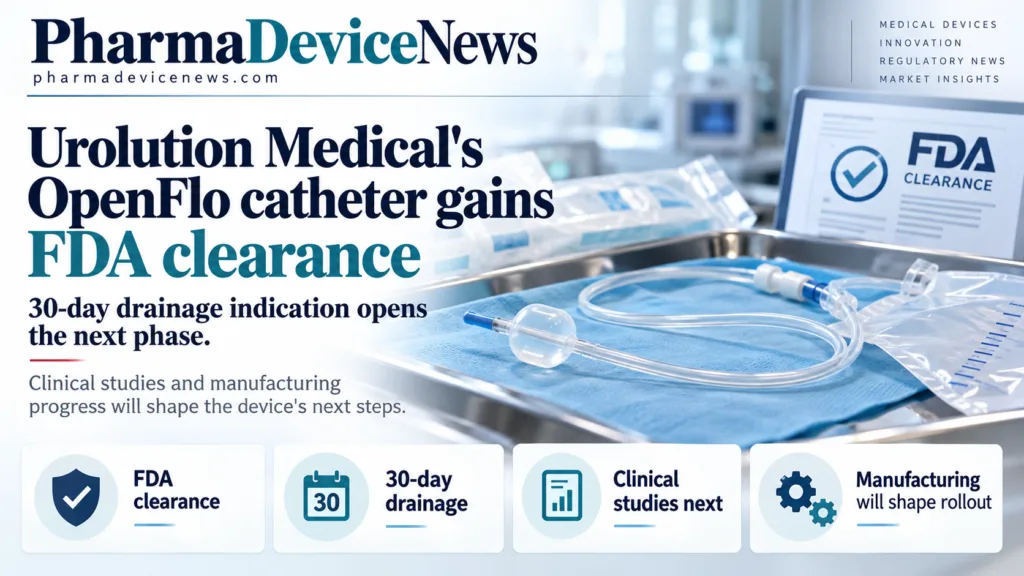
Urolution Medical, Inc., a Minnesota-based medical device developer, announced on October 9, 2026, that it had received United States Food and Drug Administration 510(k) clearance for its OpenFlo Urinary Catheter, an indwelling device incorporating redesigned features intended to differentiate it from conventional Foley catheters. The clearance covers urinary tract drainage in adult patients for indwelling periods of up to 30 days, establishing a regulatory pathway toward commercialization while the company prepares comparative clinical studies to evaluate catheter performance and patient outcomes.
The development moves OpenFlo beyond an important regulatory threshold, but the announcement does not establish that its redesigned architecture reduces catheter-associated urinary tract infections, prevents blockage or improves patient comfort. Urolution Medical has modified the catheter’s distal tip and drainage configuration, two components involved in urine flow and interaction with the bladder. The company is now seeking to determine whether these engineering changes translate into meaningful clinical advantages over established catheter systems.
The distinction between regulatory clearance and clinical differentiation is especially relevant in urinary catheterization, where conventional devices are inexpensive, widely available and integrated into hospital care. New catheter designs must demonstrate that any proposed improvement is clinically useful, operationally practical and economically justified. Urolution Medical’s next phase will therefore depend on more than the cleared indication, with comparative performance data, manufacturing readiness and commercial partnerships likely to determine its market prospects.
What does FDA 510(k) clearance establish for the OpenFlo urinary catheter?
The FDA’s 510(k) pathway evaluates whether a medical device is substantially equivalent to a legally marketed predicate device for its intended use. Substantial equivalence involves assessment of intended use and technological characteristics, including whether any differences introduce new questions of safety or effectiveness. Clearance permits marketing for the specified indication, subject to applicable regulatory requirements, but it should not be confused with premarket approval or independent proof of superiority over conventional devices.
For OpenFlo, Urolution Medical reported clearance for urinary tract drainage in adult patients for indwelling periods not exceeding 30 days. The duration is part of the device’s cleared use and does not mean that patients should routinely remain catheterized for a full month. Clinical decisions about catheter duration must continue to reflect medical necessity, patient circumstances and established infection-prevention practices.
The company has not disclosed a comparative clinical dataset in its clearance announcement demonstrating superiority in infection rates, obstruction frequency, tissue injury or patient experience. Urolution Medical Chief Medical Officer John D. Adams Jr. indicated that the clearance provides an opportunity to investigate whether the differentiated design produces measurable clinical benefits. His comments position the next development phase around comparative evaluation rather than suggesting that improved outcomes have already been established.
The distinction also matters for future product claims. A device cleared for urinary drainage cannot automatically be promoted as an infection-prevention technology or as clinically superior because it incorporates a patented drainage mechanism. Such claims would need appropriate supporting evidence and must remain consistent with applicable regulatory requirements.
How could OpenFlo’s redesigned distal tip and drainage configuration differ from conventional Foley catheters?
Conventional Foley catheters typically use a flexible tubular shaft, drainage openings near the distal end and a retention balloon that holds the catheter inside the bladder. Urine enters through the drainage openings and passes through the catheter lumen into a collection system. Although this configuration has become a standard approach to indwelling urinary drainage, its performance can be affected by factors including catheter positioning, sediment accumulation, biological deposits and interaction with surrounding tissue.
Urolution Medical describes OpenFlo as incorporating a patented architecture that changes important mechanical characteristics of the conventional Foley design. The modifications include the distal tip and drainage configuration, suggesting that the company is pursuing differentiation through the physical structure of the device rather than introducing an entirely new catheterization procedure. However, the announcement does not provide sufficient engineering specifications to determine precisely how the redesigned configuration changes flow dynamics under different clinical conditions.
The design is relevant because drainage openings influence the movement of urine into a catheter and can interact with bladder tissue during use. Research involving conventional urinary catheters has examined how drainage-opening geometry, suction effects and biological deposits contribute to device performance. However, findings from other catheter designs cannot be transferred directly to OpenFlo without testing its specific architecture.
One important engineering objective for urinary catheter development is maintaining dependable drainage while limiting complications associated with the device’s contact with tissue. Achieving that balance involves several interacting design characteristics, including the shape of the drainage openings, the position of the tip, the flexibility of the catheter and the behavior of the retention mechanism. Changes that improve one performance measure may not necessarily improve every aspect of catheter function.
For OpenFlo, the immediate scientific task is to establish what its redesigned architecture changes in measurable terms. Bench testing can evaluate drainage characteristics and mechanical reliability, while clinical investigations can establish whether those differences affect patient outcomes. Until those data are available, the design should be regarded as a potentially differentiated alternative rather than a demonstrated improvement over conventional Foley catheters.
Why are catheter-associated infections and urinary drainage complications important to OpenFlo’s clinical opportunity?
Indwelling urinary catheters remain widely used in hospitals and other healthcare settings for indications involving urinary retention, accurate urine-output monitoring and selected perioperative or longer-term clinical needs. Their routine use creates an important medical device market, but prolonged catheterization carries recognized risks. These include catheter-associated urinary tract infections, obstruction, leakage, urethral injury and other complications requiring clinical intervention.
The Centers for Disease Control and Prevention estimates that approximately 15% to 25% of hospitalized patients receive urinary catheters during their hospital stays. The agency also reports that approximately 75% of urinary tract infections acquired in hospitals are associated with urinary catheter use. These figures illustrate the scale of the infection-prevention challenge, although they do not establish the proportion of complications that could be prevented through changes to catheter design alone.
Catheter-associated urinary tract infections arise when microorganisms enter the urinary tract in association with catheter use. The risk is influenced by factors including duration of catheterization, insertion practices, maintenance of the drainage system and patient-specific vulnerabilities. The Centers for Disease Control and Prevention identifies prolonged catheter use as a particularly important risk factor and recommends limiting catheterization to appropriate indications and removing devices when they are no longer needed.
Mechanical drainage problems represent another dimension of urinary catheter management. Catheter obstruction may involve sediment, encrustation, blood clots or other material interfering with drainage, while catheter positioning and physical characteristics can also affect performance. These complications can lead to additional clinical assessment, catheter replacement or other interventions, depending on their severity and underlying cause.
OpenFlo’s redesigned drainage architecture is relevant to these operational challenges, but Urolution Medical has not announced clinical evidence showing reduced infection, obstruction or catheter replacement rates. A device can maintain urinary drainage effectively without necessarily preventing bacterial colonization or other complications associated with an indwelling foreign body. Establishing whether OpenFlo affects any of these outcomes will require appropriately designed comparative investigations.
The 30-day cleared indwelling period also needs careful interpretation. It defines the maximum duration covered by the reported clearance, not evidence that every patient can safely retain the catheter for that period or that extended catheterization is preferable. The potential clinical value of OpenFlo must be assessed within established catheter-use and infection-prevention practices.
Which clinical endpoints will determine whether OpenFlo provides a meaningful advantage?
Urolution Medical has announced preparations for clinical studies intended to evaluate comparative catheter performance and patient outcomes. However, the company has not disclosed a finalized study protocol, participant count, comparator allocation, primary endpoint or confirmed enrolment timeline. Without these details, it is premature to characterize the planned investigations as pivotal trials or to predict when clinical results may become available.
A meaningful performance evaluation could examine whether OpenFlo provides more reliable urinary drainage than a conventional silicone Foley catheter under comparable conditions. Potential measures include drainage interruptions, catheter obstruction, unplanned replacements and device-related interventions. The precise endpoints must be defined in the eventual study protocols, and these possibilities should not be treated as confirmed elements of Urolution Medical’s clinical programme.
Patient-centered outcomes may also be important, particularly if the company intends to support claims involving comfort or reduced tissue-related complications. Such investigations would need clear definitions of symptoms, adverse events and clinically meaningful differences between treatment groups. A numerical improvement in an engineering measurement does not automatically demonstrate a corresponding improvement in patient experience.
Catheter-associated urinary tract infection outcomes require particularly careful interpretation because infection risk depends on multiple factors beyond the device itself. Comparative studies would need to consider catheter duration, patient characteristics, insertion conditions and infection-prevention practices when evaluating any observed differences. If infection reduction becomes a future product claim, sufficiently robust clinical evidence would be necessary to establish that the finding is reliable and attributable to the relevant treatment comparison.
The strength of the eventual evidence will also depend on study design. Prospective evaluation, clearly defined comparators, appropriate follow-up and standardized outcome assessment can help distinguish meaningful device effects from differences in clinical practice. For a familiar and widely used product category, relatively modest improvements may still be valuable, but their clinical importance must be supported by the magnitude and consistency of the results.
Urolution Medical’s clinical programme will therefore serve two purposes. It can support the company’s understanding of how OpenFlo performs under actual conditions of care while also helping healthcare organizations evaluate whether the redesigned catheter justifies adoption. The company has not yet provided the evidence needed to quantify those potential benefits.
Can conventional silicone catheter manufacturing support OpenFlo’s commercial scalability?
One of the more commercially significant aspects of the announcement concerns the company’s manufacturing strategy. Urolution Medical reported that OpenFlo was engineered to use established silicone catheter manufacturing methods, with production costs comparable to conventional all-silicone Foley catheters. If demonstrated at commercial scale, that approach could help the company avoid some of the cost and manufacturing complexity associated with introducing entirely unfamiliar device materials or production processes.
The claim is strategically relevant because urinary catheters are frequently purchased through established hospital supply contracts and medical distribution channels. Healthcare organizations often evaluate such products within tight procurement budgets, where incremental acquisition costs can influence purchasing decisions. A redesigned catheter offering a useful clinical improvement without a substantial increase in manufacturing cost could therefore present an attractive proposition.
However, manufacturing cost is not the same as commercial selling price or total cost of ownership. Urolution Medical has not disclosed actual unit production costs, intended selling prices, expected gross margins or detailed comparisons with competing products. Its statement concerning cost comparability should therefore be understood as a company-reported manufacturing assessment rather than a verified commercial cost advantage.
Medical device scale-up introduces additional requirements involving quality systems, process validation, supplier controls, sterilization, packaging and manufacturing consistency. A production method that uses familiar materials may still require substantial work to ensure that design characteristics remain consistent across manufactured batches. For OpenFlo, maintaining the integrity of the redesigned distal tip and drainage configuration will be particularly important because those features underpin the proposed differentiation.
The company has not announced validated commercial manufacturing capacity, production volumes or a confirmed large-scale supply agreement. These details will become more consequential as Urolution Medical approaches market introduction. Establishing repeatable production at a competitive cost will be necessary to convert a promising design into a dependable medical device supply business.
What could influence hospital adoption of a redesigned Foley catheter after FDA clearance?
Hospital purchasing decisions involving urinary catheters extend beyond regulatory clearance and individual device specifications. Procurement committees, clinicians, infection-prevention teams and nursing professionals may all contribute to evaluating whether a new product fits existing care practices. A redesigned catheter must therefore demonstrate not only acceptable performance but also compatibility with established clinical procedures and supply systems.
The potential operational appeal of OpenFlo lies in its relationship to familiar catheter technology. Because Urolution Medical is modifying conventional Foley catheter architecture rather than introducing a completely different urinary drainage procedure, the product may have opportunities to fit existing workflows. Nevertheless, the company has not publicly established the level of training, equipment compatibility or practice changes that commercial deployment might require.
Nursing workflow is especially relevant because indwelling urinary catheters require ongoing monitoring and maintenance. Device reliability, ease of handling and compatibility with drainage accessories can affect daily clinical operations, even when the underlying therapeutic purpose remains unchanged. Any benefits in these areas would need to be assessed through usability evidence, clinical experience or appropriately defined performance studies.
Economic evaluation could become another important adoption factor. If a redesigned catheter were eventually shown to reduce unplanned replacements or other resource-intensive complications, hospitals might consider those findings alongside its acquisition price. However, no such cost savings have been established for OpenFlo, and economic projections would need to account for both device expenses and the actual frequency of relevant clinical events.
The competitive environment also creates a substantial barrier for an emerging manufacturer. Conventional Foley catheters are supplied through established medical device manufacturers and distributors with extensive hospital relationships, validated production systems and established procurement contracts. A new entrant must offer a sufficiently persuasive combination of clinical performance, reliability, availability and price to justify changing purchasing arrangements.
For Urolution Medical, commercial partnerships may prove valuable in addressing these requirements. An established medical device distributor or manufacturing partner could potentially provide access to hospital customers and operational infrastructure. The company has indicated that it is pursuing such relationships, but it has not identified a confirmed major distribution agreement or announced a commercial launch schedule.
How does Urolution Medical plan to finance and commercialize OpenFlo after clearance?
Urolution Medical is a privately held medical device developer based in Maple Grove, Minnesota. The company has not disclosed an exchange listing, public market valuation or financial results that would support conventional publicly traded company sentiment analysis. Its commercial progress must therefore be assessed primarily through regulatory achievements, development milestones, disclosed financing arrangements and evidence of market readiness.
The company has indicated that it is seeking strategic partners, additional capital and commercial relationships with established healthcare organizations. Those objectives suggest that the transition from development to market introduction will require resources beyond the technical work already completed. Clinical studies, manufacturing validation, inventory preparation and distribution can all create financing requirements before meaningful commercial revenue becomes available.
The October 2026 announcement did not disclose a new financing round, the amount of capital required or the company’s existing funding position. It would therefore be inappropriate to estimate its cash runway or suggest that the business has secured enough funding for a national product launch. The next financing or partnership announcement may provide a clearer indication of how Urolution Medical intends to support commercial execution.
A potential partnership could involve manufacturing, distribution, clinical development or a combination of responsibilities. Each structure would produce different financial and operational implications, including possible changes to manufacturing control, sales margins and geographic market access. Until terms are announced, the company’s partnership strategy remains an objective rather than a completed transaction.
The company’s intellectual property position may provide some competitive differentiation because OpenFlo incorporates what Urolution Medical describes as patented catheter architecture. Nevertheless, a patent does not establish clinical superiority, manufacturing feasibility or commercial demand. Its practical value will depend partly on whether the protected design contributes to a device that healthcare organizations find worth adopting.
What should clinicians and medical device investors watch as OpenFlo moves toward commercialization?
The first major development to monitor is the design and initiation of Urolution Medical’s planned comparative clinical studies. Disclosure of study populations, comparator devices, endpoints and follow-up periods would provide a more concrete basis for evaluating the company’s clinical development strategy. The most informative results would be those connecting the redesigned catheter architecture to measurable changes in drainage performance, patient experience or other relevant clinical outcomes.
Manufacturing readiness represents a second important milestone. The company will need to show that its established silicone production approach can deliver consistent products at commercially viable scale, rather than relying solely on preliminary manufacturing cost expectations. A confirmed production arrangement, completed manufacturing validation or disclosed commercial capacity would provide evidence that OpenFlo is moving beyond development-stage preparation.
The third milestone concerns market access. Announcements involving established medical device manufacturers, hospital distributors or healthcare customers could clarify how the company intends to commercialize OpenFlo. However, the distinction between a development collaboration, distribution agreement, purchase commitment and actual product sales will remain important when evaluating progress.
The FDA clearance provides Urolution Medical with a meaningful starting point in an established but clinically demanding device category. OpenFlo can now advance toward commercialization for the reported adult urinary drainage indication, while its redesigned distal tip and drainage configuration offer a potentially differentiated engineering approach. The development has not yet established superior clinical performance, reduced infection risk or better patient outcomes than conventional Foley catheters.
The company’s next competitive test will be whether its planned studies establish benefits sufficiently clear to matter in routine urinary catheter care. If Urolution Medical can combine persuasive comparative evidence with repeatable manufacturing and competitive product economics, OpenFlo may have an opportunity to gain adoption in a market where familiar devices dominate. Until those milestones are demonstrated, the October 2026 clearance should be understood as regulatory progress that enables commercial development, rather than proof that the redesigned catheter will deliver better clinical outcomes.