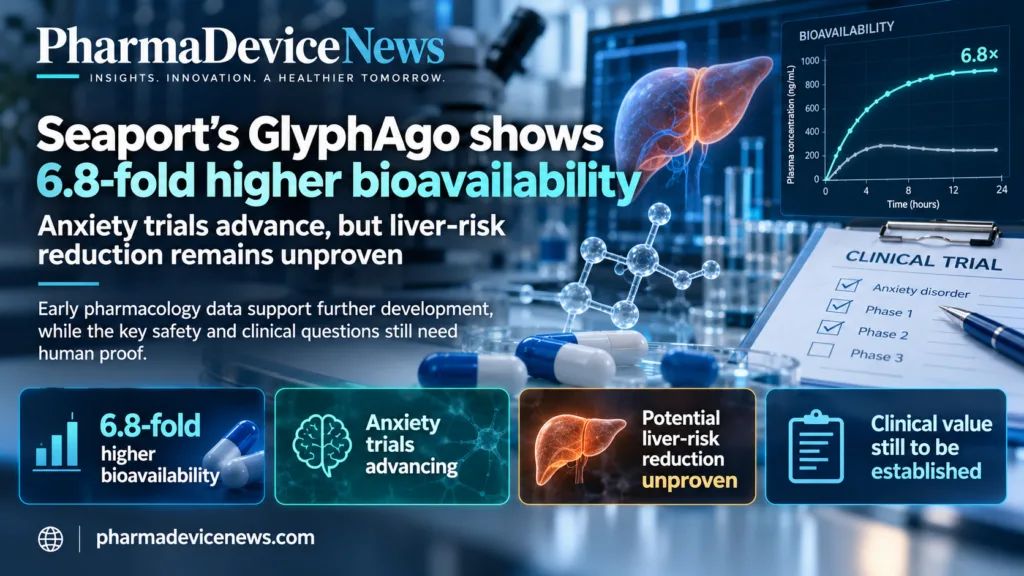
Seaport Therapeutics, Inc. (Nasdaq: SPTX), a clinical-stage neuropsychiatric medicines developer founded by PureTech Health plc (London Stock Exchange: PRTC), has disclosed additional Phase 1 pharmacokinetic findings for GlyphAgo (SPT-320), its investigational oral agomelatine prodrug, at the 39th European College of Neuropsychopharmacology Congress in Munich, Germany. The October 9, 2026 announcement reported a 6.8-fold improvement in agomelatine bioavailability compared with unmodified agomelatine, accompanied by substantially lower variability in drug exposure and no observed accumulation during seven days of repeated dosing.
The findings come from a completed, multi-part Phase 1 programme involving 174 healthy volunteers and provide additional detail behind results previously reported by Seaport Therapeutics. The company is developing GlyphAgo for generalized anxiety disorder, using its proprietary Glyph platform to redirect drug absorption toward the intestinal lymphatic system and reduce first-pass metabolism in the liver. Seaport believes this approach could allow therapeutically relevant agomelatine concentrations to be achieved using lower administered doses, potentially addressing some of the hepatic safety and pharmacokinetic limitations associated with conventional agomelatine.
The latest disclosure arrives as GlyphAgo moves into patient studies. Seaport announced on October 7 that the first patient had been dosed in a Phase 2a study in Australia involving adults with generalized anxiety disorder and sleep disturbance, while a separate Phase 2/3 trial is planned for the first half of 2027. These developments shift the programme from demonstrating improved drug delivery in healthy volunteers toward investigating whether those pharmacokinetic changes translate into clinically meaningful outcomes.
However, the Phase 1 findings do not demonstrate that GlyphAgo improves anxiety symptoms or reduces the incidence of drug-induced liver injury. Those questions require longer-duration clinical studies involving patients, relevant efficacy endpoints and sufficient safety exposure. The central development challenge is whether Seaport can preserve the established pharmacology of agomelatine while meaningfully changing the dosing and monitoring limitations that have affected its wider use.
What do the new ECNP 2026 results reveal about GlyphAgo’s bioavailability and exposure variability?
The latest scientific presentation provides a more detailed assessment of GlyphAgo’s pharmacokinetic behaviour than the company’s earlier topline announcements. The results cover single-ascending-dose, multiple-ascending-dose and crossover evaluations, allowing investigators to examine how agomelatine exposure changes with dose and how consistently the investigational formulation performs between participants. The poster, designated PS02-2029, was scheduled for presentation on October 11 by Daniel Bonner, co-founder and Senior Vice President of Platform at Seaport Therapeutics.
The programme reported a statistically significant 6.8-fold increase in agomelatine bioavailability relative to the conventional drug, exceeding the company’s original twofold development target. This result concerns the amount of active drug reaching systemic circulation rather than an increase in therapeutic efficacy. Although greater bioavailability can allow lower administered doses, the clinical consequences depend on the relationship between systemic exposure, pharmacological activity and adverse effects.
The additional analyses provide particularly relevant information about variability between participants. In the single-ascending-dose portion, the geometric coefficient of variation for agomelatine exposure over 24 hours, measured by AUC0-24, ranged from 12.9% to 26.6% for GlyphAgo. The corresponding variability for unmodified agomelatine was approximately 200%, indicating considerably less predictable systemic exposure with the conventional formulation in that comparison.
A similar pattern emerged when investigators examined maximum observed plasma concentration, or Cmax. GlyphAgo produced geometric coefficients of variation ranging from 17.1% to 50.5%, compared with approximately 217% for unmodified agomelatine. These measurements suggest that the investigational formulation delivered a more consistent pharmacokinetic profile under the conditions evaluated, although consistency of exposure is not equivalent to consistent treatment response.
The crossover analyses provided another comparison, with GlyphAgo showing AUC0-24 variability between 22.6% and 29.7% compared with 234.6% to 350.1% for unmodified agomelatine. For Cmax, the corresponding ranges were 26.5% to 44.0% and 303.7% to 500.9%, respectively. These results support the company’s description of an approximately tenfold reduction in pharmacokinetic variability, although the precise magnitude differs across measures and study conditions.
The distinction between bioavailability and variability is commercially important. A treatment that produces predictable exposure may offer advantages for dose development, patient management and understanding drug interactions, but such advantages must ultimately be evaluated through patient outcomes. Seaport’s Phase 1 findings establish a pharmacokinetic rationale for further investigation rather than a demonstrated improvement in clinical efficacy.
How does Glyph technology seek to bypass agomelatine’s first-pass liver metabolism?
Agomelatine is a medicine with established pharmacological activity involving melatonin MT1 and MT2 receptor agonism and serotonin 5-HT2C receptor antagonism. The drug is approved for major depressive disorder in the European Union and Australia, while Australian regulators have also authorized its use for generalized anxiety disorder in adults. It is not approved by the United States Food and Drug Administration for either indication.
Conventional oral agomelatine undergoes extensive first-pass metabolism, meaning that a substantial proportion of the administered drug is metabolized before reaching systemic circulation. This process contributes to relatively low oral bioavailability and considerable variability in exposure, particularly when hepatic metabolism differs between individuals. The drug’s clinical use is also affected by a recognized risk of elevated liver enzymes and potentially serious hepatic injury.
Seaport’s Glyph platform attempts to address these limitations by modifying the drug into an oral prodrug designed for absorption through intestinal lymphatic pathways. The approach seeks to use an alternative absorption route associated with dietary fat transport, reducing initial passage through the liver and potentially increasing the fraction of active drug reaching the bloodstream. The resulting pharmacokinetic profile may permit lower doses of agomelatine to produce systemic exposure comparable to conventional treatment.
The Phase 1 programme reported that GlyphAgo achieved agomelatine exposure levels comparable to those associated with established therapeutic doses of unmodified agomelatine while delivering a smaller amount of active drug. In its subsequent Phase 2a programme, Seaport selected GlyphAgo doses of 16 milligrams and 32 milligrams, containing approximately 5 milligrams and 10 milligrams of agomelatine, respectively. These doses were chosen using pharmacokinetic evidence indicating that exposure could match or exceed that observed with the conventional 25-milligram agomelatine dose.
The company also reported no meaningful food effect on GlyphAgo exposure in the evaluated conditions, along with no accumulation of agomelatine exposure during seven days of repeated administration. In addition, estrogen-containing oral contraceptives did not produce an observed effect on agomelatine exposure after GlyphAgo dosing in the assessment reported by Seaport. These findings support further examination of the proposed absorption pathway, although they do not establish the absence of all clinically relevant food or drug interactions.
For drug developers, the broader significance lies in the possibility of improving an existing pharmacological mechanism through a different delivery approach. Seaport is not introducing an entirely new molecular target for anxiety treatment, but attempting to modify how a known active drug enters the body. Whether that strategy produces a meaningful therapeutic advantage will depend on evidence extending beyond pharmacokinetic measurements.
Why does agomelatine’s liver safety record remain the biggest clinical challenge for GlyphAgo?
The hepatic safety profile of conventional agomelatine provides the most consequential test of Seaport’s development hypothesis. Although agomelatine has demonstrated antidepressant efficacy and has been authorized for generalized anxiety disorder in Australia, its use requires precautions intended to identify liver injury. The European Medicines Agency has maintained specific monitoring requirements for the approved antidepressant Valdoxan because of the risk of elevated transaminases and other hepatic adverse reactions.
European product information recommends liver function testing before treatment and subsequently at approximately three, six, twelve and twenty-four weeks, with additional monitoring when clinically indicated or following dose increases. Treatment is contraindicated in patients with certain liver conditions and should not be initiated or continued when liver enzyme elevations exceed specified thresholds. These requirements create an important practical consideration for prescribing, particularly when alternative treatments do not require equivalent routine hepatic monitoring.
Seaport’s proposed advantage is that increased bioavailability could allow sufficient systemic agomelatine exposure at lower doses, potentially reducing the amount of drug passing through the liver during initial absorption. The company believes this strategy may reduce the risk of liver enzyme elevations and potentially alter monitoring requirements. However, lower first-pass exposure should not be interpreted as proof that clinically significant liver injury will be prevented.
In its Phase 1 programme, Seaport reported that GlyphAgo was well tolerated at the tested doses and that no serious or severe adverse events, liver-related adverse events or clinically significant changes in alanine aminotransferase, aspartate aminotransferase or bilirubin were observed. These findings are encouraging within the study’s limited duration and healthy-volunteer population. They do not establish long-term hepatic safety or rule out uncommon adverse events that may emerge with prolonged treatment or exposure in patients with additional risk factors.
The absence of accumulation during seven days of dosing also addresses a different question from chronic liver safety. A drug can exhibit stable plasma exposure during repeated administration while still producing adverse effects over longer periods or in susceptible populations. Future trials will therefore need to assess both the anticipated clinical benefits and the hepatic safety profile under treatment conditions more closely resembling routine psychiatric care.
Any eventual change to monitoring requirements would depend on regulatory evaluation of an adequately supported safety package. The European Medicines Agency’s existing requirements for conventional agomelatine cannot simply be assumed to apply identically to GlyphAgo, but neither can they be disregarded because the investigational formulation produces a different pharmacokinetic profile. Establishing a differentiated safety profile could become an important element of the product’s commercial value if clinical development succeeds.
What will the new Phase 2a trial reveal about GlyphAgo’s effects on anxiety and sleep?
Seaport’s newly initiated Phase 2a study in Australia represents the first reported patient-stage evaluation within the company’s current GlyphAgo programme. The six-week trial is enrolling adults with generalized anxiety disorder and coexisting sleep disturbance, a clinically relevant population because anxiety symptoms frequently occur alongside difficulties with sleep initiation, maintenance or quality. The study is designed to investigate pharmacological effects on sleep and anxiety-related measures rather than establish definitive therapeutic efficacy.
Participants are randomized in a double-blind manner between two GlyphAgo dose levels, 16 milligrams and 32 milligrams daily. These formulations contain approximately 5 milligrams and 10 milligrams of agomelatine, respectively, reflecting the company’s objective of maintaining therapeutically relevant exposure while reducing the administered amount of active drug. The publicly described design does not identify a placebo treatment arm in this Phase 2a study, which limits the conclusions that can be drawn about efficacy compared with no active treatment.
The study will assess patient-reported sleep outcomes, including the Insomnia Severity Index, alongside electroencephalography-based measures of sleep architecture. Additional assessments include the Hamilton Anxiety Rating Scale, the Clinical Global Impression-Severity scale, pharmacokinetics, safety and tolerability. Combining subjective sleep reports with physiological measurements may help investigators determine whether GlyphAgo produces changes consistent with its known melatonergic pharmacology.
Sleep architecture assessments can provide information about the organization of different sleep stages, while patient-reported measures capture symptoms that may be more directly relevant to everyday functioning. Agreement between these measures would strengthen the interpretation of a pharmacological signal, although changes in sleep parameters do not automatically establish an improvement in generalized anxiety disorder. Anxiety severity assessments will therefore be important for determining whether any observed sleep effects occur alongside measurable changes in the broader clinical condition.
Seaport expects topline results from the Phase 2a programme in early 2028. The timeline places the readout after the company’s planned initiation of a separate Phase 2/3 generalized anxiety disorder study, indicating that the programmes are expected to proceed partly in parallel. This sequencing may accelerate development, but it also means that some confirmatory activities could begin before the sleep-focused trial has delivered its complete findings.
How will the planned Phase 2/3 study determine whether GlyphAgo can treat generalized anxiety disorder?
The next major development milestone is Seaport’s planned global Phase 2/3 trial, which the company expects to initiate during the first half of 2027. Unlike the dose-comparison Phase 2a study, this programme is intended to provide a randomized, double-blind, placebo-controlled evaluation of GlyphAgo’s efficacy and safety in patients with generalized anxiety disorder. Seaport expects topline results by the end of 2028, subject to successful trial initiation, recruitment and execution.
The clinical challenge will be demonstrating that the pharmacological exposure achieved through GlyphAgo produces meaningful improvement in anxiety symptoms. Conventional agomelatine has been investigated in randomized studies of generalized anxiety disorder, providing evidence that Seaport can use to inform development assumptions. However, prior results obtained with unmodified agomelatine do not independently establish the efficacy of a new prodrug formulation, particularly when dosing and pharmacokinetic behaviour differ.
The planned programme also enters a treatment field with established alternatives, including selective serotonin reuptake inhibitors, serotonin-norepinephrine reuptake inhibitors and psychological therapies. Different options involve distinct efficacy, tolerability, treatment-response and discontinuation considerations, creating potential opportunities for treatments with differentiated pharmacology. GlyphAgo would nevertheless need to demonstrate a favourable benefit-risk profile before any clinical or commercial positioning could be established.
Trial design will be important because generalized anxiety disorder studies must distinguish treatment effects from placebo responses, symptom fluctuations and differences in baseline severity. The exact primary endpoint, statistical testing framework, treatment duration and detailed enrolment criteria will determine how convincingly the results support future regulatory development. Seaport has not disclosed a complete Phase 2/3 protocol in the October 9 announcement, so those aspects should not be inferred from the programme’s anticipated designation.
If the larger study demonstrates clinically meaningful efficacy and acceptable safety, the company could establish a stronger basis for discussing future regulatory requirements. A successful result would not automatically constitute marketing approval, and the eventual submission package would need to satisfy the applicable regulator’s standards. Until such evidence is available, GlyphAgo remains an investigational treatment.
How do the GlyphAgo findings affect Seaport Therapeutics and PureTech Health’s commercial outlook?
The results are relevant to two separately listed biotechnology companies with different economic exposures to the programme. Seaport Therapeutics is directly responsible for advancing GlyphAgo and its wider neuropsychiatric pipeline, while PureTech Health retains an equity interest and additional contractual economics originating from its role in establishing the business. The distinction became more important after Seaport completed its Nasdaq initial public offering in May 2026.
The offering generated approximately $260 million in gross proceeds, strengthening Seaport’s ability to finance multiple development programmes. At June 30, 2026, the company reported $427.3 million in cash, cash equivalents and investments and indicated that its existing resources were expected to support planned operations into 2029. That financial position provides funding visibility across several anticipated clinical milestones, although trial expansion, delays or changes in development priorities could affect future capital requirements.
PureTech Health disclosed in its September 2026 half-year report that it held approximately 31.2% of Seaport’s equity, which it valued at around $360 million as of September 18. The company also retained rights to tiered royalties of 3% to 5% on net sales of Glyph platform products, along with certain development and commercial milestone payments. These royalty and milestone interests are contingent on future events and should not be interpreted as existing product revenue.
Following Seaport’s initial public offering, PureTech also reassessed the accounting treatment of its investment because it no longer considered itself to exercise significant influence over the company. Its remaining shareholding is measured at fair value through profit or loss, meaning movements in Seaport’s market valuation can affect PureTech’s reported financial results. This gives PureTech indirect exposure to GlyphAgo’s clinical development progress alongside its other portfolio interests.
Seaport’s broader pipeline includes GlyphAllo, an investigational oral allopregnanolone prodrug being evaluated for major depressive disorder, with Phase 2b BUOY-1 results expected in the first half of 2027. The company is also developing Glyph2BLSD, a non-hallucinogenic neuroplastogen candidate with first-in-human-enabling activities planned through 2027. These programmes provide diversification, but they also require continuing investment and carry development risks separate from GlyphAgo.
In the latest available trading session on October 9, Seaport Therapeutics shares closed at $18.15, up approximately 1.3% on the day, while PureTech Health shares finished at 111 pence in London, an increase of about 2.8%. The movements coincided with the latest clinical disclosures, but the available information does not establish that the GlyphAgo presentation caused either share-price change. The more meaningful investment considerations remain the quality of forthcoming clinical evidence, Seaport’s development expenditure and the financial value attributed to its pipeline.
What must GlyphAgo demonstrate before improved drug delivery becomes a genuine treatment advantage?
Seaport’s latest GlyphAgo results strengthen the evidence that its delivery platform can materially alter the pharmacokinetic behaviour of agomelatine. The observed increase in bioavailability, reduction in exposure variability and absence of short-term accumulation provide a coherent basis for selecting doses and advancing patient studies. These are important technical development outcomes, particularly for a medicine whose conventional formulation is affected by extensive first-pass metabolism.
However, the clinical development programme now faces two connected but separate tests. The first is whether the modified formulation delivers meaningful therapeutic effects on anxiety symptoms and sleep disturbance, using appropriately designed clinical studies. The second is whether reduced hepatic exposure translates into a safety profile that can justify differentiation from existing agomelatine products, potentially including different monitoring considerations if supported by regulators.
The Phase 2a trial will provide an initial examination of sleep-related pharmacology in patients, while the planned Phase 2/3 study will be a more direct test of efficacy and safety in generalized anxiety disorder. Both readouts are currently expected in 2028, creating a concentrated period of clinical milestones following Seaport’s expanded financing and transition to public ownership. The development sequence also gives PureTech Health continued exposure to potential value creation through its equity, royalty and milestone interests.
The October 2026 ECNP findings therefore establish progress in addressing agomelatine’s drug-delivery limitations without resolving the more consequential questions about long-term treatment. For Seaport Therapeutics, successful development will depend on demonstrating that the pharmacokinetic advantages observed in 174 healthy volunteers translate into clinically meaningful and appropriately monitored outcomes for patients with generalized anxiety disorder. The planned patient studies, rather than the magnitude of the Phase 1 bioavailability improvement alone, will determine whether GlyphAgo can become a differentiated neuropsychiatric medicine.