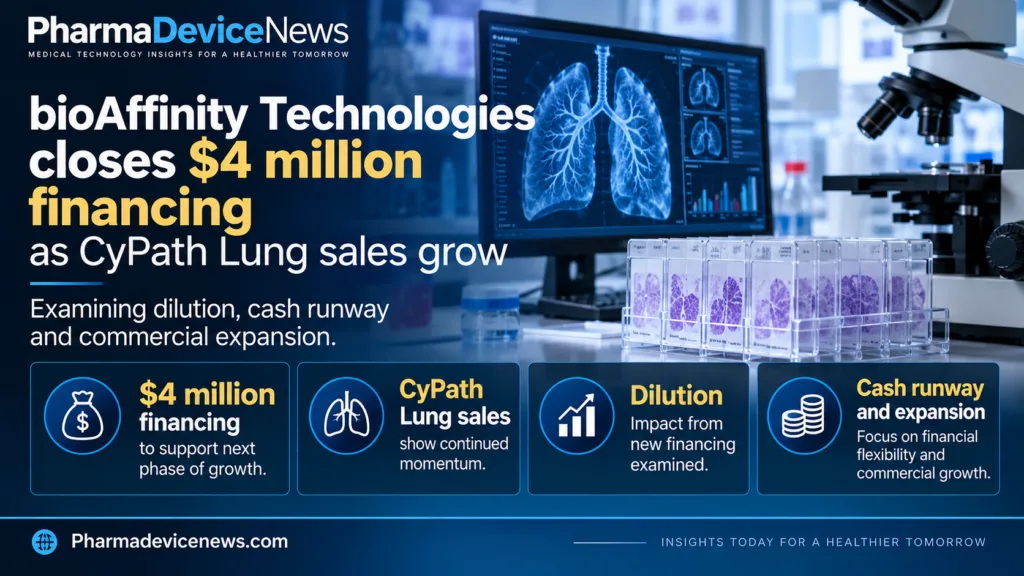
bioAffinity Technologies, Inc. (NASDAQ: BIAF), a San Antonio-based biotechnology company commercializing the noninvasive CyPath Lung cancer diagnostic test, has completed a registered direct stock offering and concurrent private warrant placement generating approximately $4 million in gross proceeds. The financing closed on October 9, 2026, at $6.122 per common share or $6.115 per pre-funded warrant, providing additional working capital as the company seeks to expand adoption of its sputum-based lung cancer testing platform.
The transaction comes three days after bioAffinity Technologies reported that CyPath Lung testing volumes had increased more than 100% through the first nine months of 2026 compared with the corresponding period of 2025. More than 1,620 tests were delivered through September, compared with 775 a year earlier, indicating increasing physician utilization and commercial activity. However, the company’s earlier financial disclosures showed continuing operating losses, substantial cash consumption and a need for external funding, making the latest capital injection an important development in its commercialization strategy.
The financing also introduces a significant potential dilution consideration for existing shareholders. Alongside the immediate sale of common shares and pre-funded warrants, bioAffinity Technologies issued additional investor warrants covering up to 980,072 common shares, with exercise subject to shareholder approval. The transaction therefore addresses near-term funding requirements while creating the possibility of further share issuance, depending on regulatory and contractual conditions and future investor decisions.
How is bioAffinity Technologies’ $4 million financing structured, and what will investors receive?
The financing comprises 116,545 newly issued common shares priced at $6.122 each and 536,836 pre-funded warrants priced at $6.115 each. The pre-funded warrants carry a nominal exercise price of $0.007 per share and can be exercised immediately, subject to their ownership limitations. Together, the common shares and underlying pre-funded warrant shares represent 653,381 potential common shares associated with the initial registered direct offering.
The concurrent private placement adds warrants to purchase up to 980,072 additional common shares at $6.122 per share. These warrants become exercisable following shareholder approval and will expire five years after that approval, distinguishing them from the immediately exercisable pre-funded instruments. Their exercise is not guaranteed, and the company has not received the approximately $6 million that would be generated if all investor warrants were subsequently exercised for cash at the stated price.
WallachBeth Capital, LLC acted as the exclusive placement agent, receiving compensation equivalent to 7.5% of the gross offering proceeds. The transaction also provides for placement agent warrants covering 19,602 shares at an exercise price of $6.122 and reimbursement of specified expenses. After placement fees and estimated offering costs, the company’s capitalization disclosure indicates approximately $3.6 million of net proceeds, below the $4 million gross financing headline.
The registered common shares and pre-funded warrants were offered under an existing shelf registration statement declared effective by the United States Securities and Exchange Commission in November 2023. The accompanying investor warrants were issued through a separate private placement using applicable securities registration exemptions. The distinction between the immediate equity financing and the contingent warrant exercises is important when assessing available cash, future financing flexibility and potential shareholder dilution.
Why does bioAffinity Technologies need additional capital despite growing CyPath Lung sales?
The immediate financing requirement becomes clearer when the company’s commercial growth is considered alongside its operating expenses. During the first six months of 2026, bioAffinity Technologies recorded approximately $2.86 million in consolidated revenue, compared with $3.12 million during the corresponding period of 2025. Although demand for CyPath Lung increased, the company was also restructuring parts of its laboratory services business, including discontinuing certain less profitable pathology activities.
CyPath Lung testing revenue increased to approximately $835,000 during the first half of 2026 from $323,000 a year earlier. This improvement demonstrates progress in commercializing the test, but the diagnostic business remained relatively small compared with the company’s overall cost structure. The difference between increasing product revenue and achieving operating profitability is particularly important for diagnostics businesses that must support laboratory infrastructure, commercial personnel, clinical research and administrative functions.
For the six months ended June 30, 2026, bioAffinity Technologies reported a net loss of approximately $7 million and net cash used in operating activities of approximately $6.43 million. Cash and cash equivalents stood at $2.43 million at the end of June, declining from $6.45 million at December 31, 2025. The company subsequently disclosed that available cash had fallen to approximately $1 million by August 3, before the completion of another financing transaction later that month.
The August quarterly filing also contained a going-concern warning, reflecting management’s assessment that existing liquidity and expected operating performance were insufficient to remove substantial doubt about the company’s ability to fund operations for the required assessment period. Since that filing, bioAffinity Technologies has completed an approximately $4 million private placement in August and the latest approximately $4 million financing in October. Those transactions have improved its funding position, but an updated post-financing cash balance and revised operating outlook are needed before concluding that its longer-term liquidity requirements have been resolved.
What does the latest CyPath Lung sales growth reveal about physician adoption and commercial demand?
On October 6, bioAffinity Technologies reported that more than 1,620 CyPath Lung tests had been delivered through the third quarter of 2026, compared with 775 during the corresponding period of 2025. This represents growth of more than 100% in reported test volume, suggesting that the product is gaining traction among physicians evaluating patients at elevated risk of lung cancer. The latest figures also build on second-quarter 2026 results, when the number of CyPath Lung tests reported increased to 622 from 197 a year earlier.
The company disclosed that the number of ordering physicians increased by 89% in the third quarter compared with the corresponding period of 2025. It also reported that physicians already using CyPath Lung through the first nine months of 2025 increased their testing volume by 48% year over year. The combination of new prescribers and greater utilization among established users is commercially relevant because it suggests that growth is not dependent exclusively on initial trial orders from newly recruited practices.
Nevertheless, increasing test volume does not automatically translate into equivalent growth in recognized revenue or cash collections. Revenue generation depends on billing arrangements, payer mix, reimbursement rates, collection performance and the proportion of completed tests that result in collectible claims. The company has not yet published its complete third-quarter 2026 financial statements, making it premature to calculate the precise revenue or gross-margin contribution associated with the latest reported testing volumes.
The commercial challenge now involves increasing utilization sufficiently to absorb the fixed and variable costs of operating a specialized diagnostic laboratory. Expanding the number of ordering physicians can increase revenue opportunities, but it may also require additional spending on sales personnel, sample logistics, laboratory capacity and customer support. Whether these investments produce improving operating leverage will depend on the relationship between testing volume, revenue per test and incremental operating costs.
How does CyPath Lung work, and why could noninvasive lung cancer testing create commercial opportunities?
CyPath Lung is a sputum-based laboratory-developed test intended to help physicians assess the likelihood of lung cancer in high-risk patients. The test uses flow cytometry to characterize cell populations within sputum samples and applies automated analysis developed using machine-learning techniques. Its approach is designed to provide additional information when physicians are evaluating suspected malignancy, particularly in patients with pulmonary nodules requiring further assessment.
The product is marketed through Precision Pathology Laboratory Services, a wholly owned subsidiary of bioAffinity Technologies operating a laboratory accredited by the College of American Pathologists and certified under the Clinical Laboratory Improvement Amendments. CyPath Lung is commercially offered as a laboratory-developed test, rather than as a test with a conventional United States Food and Drug Administration marketing clearance or approval. Its current clinical role is to supplement physician assessment alongside imaging, patient history and other relevant findings, not to replace established diagnostic procedures or screening recommendations.
In previously published clinical research, CyPath Lung demonstrated 92% sensitivity and 87% specificity in a studied subgroup of high-risk patients with small pulmonary nodules. The company has also reported a negative predictive value of 99% within the relevant study population, an outcome that may be useful when considering the likelihood of malignancy following a negative result. However, negative predictive value depends partly on disease prevalence, and performance in one selected population cannot automatically be generalized to every screening or diagnostic setting.
The potential commercial application relates to a familiar clinical problem: imaging can identify pulmonary nodules without conclusively determining whether they are malignant. Physicians must decide which patients require additional surveillance, diagnostic imaging, biopsy or other interventions, taking account of nodule characteristics and individual risk factors. A sufficiently validated noninvasive test could contribute additional information to those decisions, but evidence that it reduces unnecessary procedures, improves outcomes or lowers healthcare costs requires dedicated clinical evaluation.
Could the new financing accelerate CyPath Lung distribution and clinical validation?
bioAffinity Technologies stated that the financing proceeds will support working capital, anticipated growth in CyPath Lung sales and general corporate purposes. These categories provide management with flexibility to allocate funding between commercial activities and ongoing operations, rather than committing the entire amount to a single development programme. The announcement did not specify a fixed spending allocation for sales expansion, laboratory capacity, additional clinical research or geographic distribution.
The company has already taken steps to broaden commercial access through its distribution relationship with AvMEDICAL, a service-disabled veteran-owned small business serving government healthcare customers. Announced in August 2026, the agreement is intended to support opportunities within federal healthcare networks, including facilities associated with the United States Department of Veterans Affairs. The companies subsequently promoted CyPath Lung at a September conference attended by healthcare professionals and representatives involved in veterans’ medical research.
The distribution relationship could create additional commercial opportunities if it leads to contracts, physician orders and reimbursed testing volumes. However, a distribution agreement does not establish that federal healthcare facilities have committed to purchasing a specified number of tests. Commercial adoption within government healthcare systems may depend on procurement requirements, clinical acceptance, operational integration and the availability of appropriate payment arrangements.
The company is also conducting a longitudinal clinical study initiated in March 2026 to assess CyPath Lung performance in a larger population of high-risk patients with indeterminate pulmonary nodules. The programme is designed to involve approximately 2,000 participants across multiple medical centres, with follow-up intended to evaluate diagnostic performance over time. The study could strengthen the evidence available to clinicians and healthcare organisations, although its eventual findings, enrollment progress and implications for commercial adoption remain separate from the financing announcement.
Why are reimbursement and laboratory economics important to CyPath Lung commercialization?
CyPath Lung operates in a diagnostics market where clinical evidence, physician familiarity and reimbursement arrangements jointly determine commercial potential. The test has an established product-specific Current Procedural Terminology code, 0406U, which became effective in January 2024. That coding framework provides a standardized mechanism for identifying the test in billing processes, but the existence of a code does not establish universal insurer coverage or guarantee payment at a particular rate.
For bioAffinity Technologies, reimbursement quality is especially important because laboratory testing businesses must convert performed tests into recognized revenue and eventually cash receipts. Differences between billed charges, allowed amounts and collected payments can materially influence realized revenue per test. The company must also consider the costs of sample collection materials, specimen transportation, laboratory processing, interpretation and customer service when evaluating the contribution from additional testing volume.
The company’s existing laboratory infrastructure provides a commercial foundation, but higher demand can still generate incremental working-capital requirements. Growth may increase expenses associated with staffing, supplies, equipment maintenance and accounts receivable before cash collections fully reflect additional orders. As testing volumes expand, management will need to demonstrate that unit economics improve sufficiently to offset the broader costs of commercialization.
The evidence supporting CyPath Lung’s clinical utility will remain important to this process. Payers and healthcare organisations may assess whether testing adds meaningful information beyond existing clinical risk models, imaging and established diagnostic pathways. Stronger evidence that CyPath Lung changes appropriate clinical management or reduces avoidable resource use could support future adoption discussions, but those benefits should not be assumed from diagnostic accuracy measurements alone.
How much shareholder dilution could result from the bioAffinity Technologies financing?
The immediate transaction increases the company’s equity-linked securities through the issuance of common shares and pre-funded warrants. Before the offering, bioAffinity Technologies reported approximately 1.17 million common shares outstanding, based on its October 2026 prospectus. The financing adds 116,545 issued common shares and 536,836 shares underlying pre-funded warrants, creating a meaningful increase in the number of potential common shares even before considering the separate investor warrants.
The 980,072 investor warrant shares represent a second potential source of dilution. If shareholder approval is obtained and those warrants are exercised, additional common shares would enter the outstanding share count, reducing existing investors’ proportional ownership unless they also acquire additional shares. The warrant exercise price of $6.122 could produce approximately $6 million in additional gross proceeds if all investor warrants were exercised for cash, but those funds are not part of the financing proceeds already received.
The probability and timing of warrant exercises are influenced by several factors, including the market price of the underlying stock, contractual conditions and investor decisions. Warrants with exercise prices above the prevailing share price may have limited immediate economic incentive for cash exercise, although market conditions can change during their contractual life. The financing therefore creates both a potential future capital source and a possible expansion of the share base, without guaranteeing either outcome.
The transaction also follows a period of significant changes in bioAffinity Technologies’ capital structure. The company completed a one-for-15 reverse stock split in August 2026 and subsequently regained compliance with applicable Nasdaq listing requirements in September. Its October financing must therefore be evaluated against an already changing share count, existing warrants and earlier capital transactions, rather than by comparing the new issuance only with historical pre-split shares.
What does the bioAffinity Technologies stock reaction indicate about investor sentiment?
bioAffinity Technologies shares closed at $4.725 on October 9, 2026, representing a decline of approximately 16.2% from the previous closing price of $5.64. The stock had also declined during the preceding session, when the company announced the financing terms. The sequence indicates substantial near-term selling pressure around the transaction, although market activity cannot be attributed exclusively to the offering without additional evidence.
The October 9 closing price was below the $6.122 price established for the registered direct offering. This difference reflects subsequent trading conditions and does not contradict the company’s description of the original transaction as priced at-the-market under Nasdaq rules. Pricing a negotiated securities offering under applicable Nasdaq requirements is distinct from guaranteeing that the stock will continue trading at or above the transaction price after announcement or closing.
Investor sentiment appears to reflect competing considerations. CyPath Lung’s expanding testing volumes support the company’s commercial development narrative, while continuing operating losses and new equity-linked securities highlight the cost of financing that expansion. The absence of an updated post-financing cash forecast makes it difficult to determine whether the latest transaction materially reduces the likelihood of additional capital needs over the next year.
The company’s longer-term investment profile therefore depends on a transition from externally funded commercialization toward a business model supported by increasingly predictable diagnostic testing revenue. The strongest evidence of such a transition would include continued test-volume growth, improving realized revenue per test, better cash collections and slower growth in operating expenditure relative to revenue. Until those metrics demonstrate sustained improvement, additional financing transactions may remain an important consideration for shareholders.
What will determine whether the $4 million financing supports sustainable CyPath Lung growth?
The next meaningful assessment will come from bioAffinity Technologies’ third-quarter 2026 financial results, which should provide greater detail on revenue, expenses, cash balances and the pace of CyPath Lung commercialization. The company has already disclosed substantial growth in testing volumes through September, but investors and healthcare industry observers will need to determine how that activity translated into revenue and whether it improved the financial efficiency of the business. Updated cash-flow information will also help establish the extent to which the August and October financing transactions have strengthened liquidity.
Commercial execution will remain central to the company’s progress. Growth in the number of ordering physicians suggests that CyPath Lung is reaching a broader clinical audience, while increased utilization among existing physicians indicates that some practices are integrating the test more frequently into patient assessment. Maintaining these trends will depend on continued clinician confidence, consistent laboratory performance, reimbursement access and the availability of evidence demonstrating appropriate clinical applications.
The longitudinal clinical study represents a separate opportunity to strengthen the product’s supporting evidence. More extensive data from patients with indeterminate pulmonary nodules could help clarify diagnostic performance across different clinical populations and disease characteristics. However, the study must generate results capable of supporting specific clinical claims, and successful enrollment or completion alone would not demonstrate improved patient outcomes.
For bioAffinity Technologies, the October financing provides additional resources at a commercially important stage, but its significance cannot be measured solely by the $4 million headline. The company must manage a substantial operating cost base while expanding CyPath Lung revenue, maintaining laboratory quality and navigating the dilution associated with equity-linked capital transactions. Its future financial position will depend on whether rising diagnostic adoption can translate into stronger cash generation before further external funding becomes necessary.