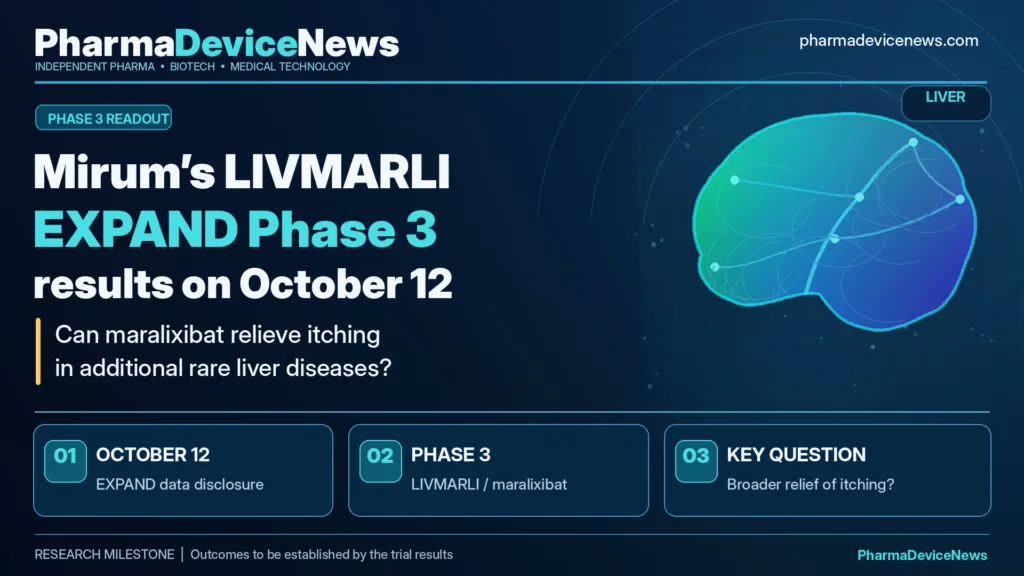
Mirum Pharmaceuticals, Inc. (Nasdaq: MIRM), the Foster City, California-based rare disease biopharmaceutical company, has scheduled an investor conference call for October 12, 2026, at 8:30 a.m. Eastern Time to disclose topline results from its Phase 3 EXPAND trial of LIVMARLI (maralixibat) in additional ultra-rare cholestatic liver diseases. Announced on October 11, the upcoming readout concerns patients aged six months and older experiencing cholestatic pruritus, including those with biliary atresia, and could determine whether Mirum has the clinical evidence needed to pursue another expansion of its established rare liver disease treatment franchise.
The announcement establishes the timing of the clinical disclosure but does not itself provide the trial’s efficacy results, statistical findings or safety outcomes. EXPAND is investigating whether maralixibat can relieve severe itching associated with liver diseases outside its currently authorized indications, including conditions for which approved targeted treatments remain limited. The study’s success or failure will depend on its prespecified clinical outcomes rather than the company’s decision to schedule an investor call.
Mirum completed EXPAND enrollment in March 2026 and previously indicated that topline results were expected during the fourth quarter. The October 12 presentation therefore represents the next planned clinical milestone in a development programme intended to broaden the use of LIVMARLI beyond Alagille syndrome and progressive familial intrahepatic cholestasis, or PFIC. Any future label expansion would still require an appropriate regulatory submission and authorization, even if the new trial reports statistically significant efficacy.
The stakes are meaningful because LIVMARLI is already a substantial commercial product for Mirum. Second-quarter 2026 net sales reached $128.7 million, representing 46% year-over-year growth, making the medicine the largest contributor to the company’s existing product revenue. EXPAND is consequently a test of whether Mirum can extend a successful therapeutic mechanism into additional patient populations, rather than a conventional clinical-stage company attempting to obtain its first marketing approval.
What is the EXPAND Phase 3 trial testing in ultra-rare cholestatic liver diseases?
EXPAND is a randomized, double-blind, placebo-controlled Phase 3 study evaluating maralixibat in pediatric and adult patients with persistent cholestatic pruritus associated with rare liver diseases. The trial includes conditions such as biliary atresia, alpha-1 antitrypsin deficiency, Caroli disease, secondary sclerosing cholangitis and selected metabolic or genetic cholestatic disorders. It excludes patients with Alagille syndrome, PFIC, primary biliary cholangitis, primary sclerosing cholangitis and intrahepatic cholestasis of pregnancy.
The investigation is designed to address a common symptom across multiple diseases that can differ substantially in their underlying causes and progression. Cholestasis occurs when bile formation or flow is impaired, potentially resulting in the accumulation of bile acids and other substances associated with liver dysfunction and severe itching. Although the individual disorders may be extremely rare, their shared cholestatic characteristics provide a rationale for testing an intervention that affects bile acid circulation.
Patients entering EXPAND must have evidence of persistent cholestasis and clinically significant itching. The registered eligibility criteria include serum bile acid concentrations exceeding twice the upper limit of normal and pruritus persisting for more than 90 days. Participants must also meet prespecified symptom severity requirements during screening, helping establish a population with sufficient baseline disease burden to evaluate treatment effects.
The clinical trial registration identifies NCT06553768 and lists an estimated enrollment of 90 participants. That figure is a registry estimate and should not be confused with the final number included in the efficacy analysis, which will need to be established from the forthcoming results. The study’s enrollment-completion announcement and its international site network demonstrate that recruitment has advanced sufficiently for the planned topline analysis.
Why is the 20-week itching endpoint central to LIVMARLI’s potential label expansion?
The primary efficacy endpoint measures the change in itching severity from baseline during the placebo-controlled treatment period. According to the trial registration, the analysis uses the average observer-reported Itch-Reported Outcome severity score over weeks 13 through 20. The instrument measures itching on a scale from zero, indicating no itching, to four, indicating extremely severe itching, with lower scores representing less severe symptoms.
The randomized comparison is important because cholestatic itching can vary over time, and symptoms may also be influenced by other treatments or underlying disease changes. Patients assigned to the investigational treatment receive maralixibat, while the comparator group receives a matched placebo during the initial 20-week period. The design allows investigators to evaluate whether observed changes in itching exceed those occurring without active maralixibat treatment.
The treatment regimen involves dose escalation followed by twice-daily administration during the controlled study period. Mirum previously described the investigated maintenance dose as 285 micrograms per kilogram twice daily, equivalent to 300 micrograms per kilogram expressed as maralixibat chloride. The trial also allows participants to receive the maximum tolerated dose determined during escalation, making treatment exposure and tolerability relevant to interpreting the results.
Secondary assessments include changes in serum bile acid concentrations, which can provide information about the drug’s biological activity. The registry specifies an evaluation based on measurements at weeks 12 and 20, alongside other assessments of disease characteristics and safety. These biochemical findings could strengthen interpretation of the primary symptom outcome, but reductions in serum bile acids would not automatically establish improvements in liver survival or other long-term clinical outcomes.
After the initial placebo-controlled period, the study includes an open-label extension during which participants can receive maralixibat. This extension may provide additional information about continuing treatment, tolerability and the persistence of symptom improvement. However, outcomes from an uncontrolled extension cannot independently provide the same comparative evidence as the randomized portion of the trial.
How does LIVMARLI’s approved mechanism support development in additional liver diseases?
LIVMARLI is an orally administered ileal bile acid transporter inhibitor designed to reduce the recycling of bile acids between the intestine and liver. Under normal physiological conditions, bile acids released into the intestine are largely reabsorbed and transported back to the liver through the enterohepatic circulation. Maralixibat inhibits this reabsorption process, increasing bile acid elimination and potentially reducing the systemic bile acid burden associated with certain cholestatic disorders.
The mechanism has already been clinically validated in specific rare liver disease populations. In the United States, LIVMARLI is approved to treat cholestatic pruritus in patients aged three months and older with Alagille syndrome and patients aged 12 months and older with PFIC. The United States PFIC labeling includes limitations involving certain patients with severe bile salt export pump defects.
European authorization differs in important respects. LIVMARLI is authorized for cholestatic pruritus associated with Alagille syndrome from two months of age and for PFIC from three months of age, subject to the applicable European product information. These existing approvals establish that maralixibat has demonstrated an acceptable benefit-risk profile for specified populations, but they do not authorize treatment of every cholestatic liver disease included in EXPAND.
The rationale for EXPAND is that excessive bile acid accumulation and associated itching may occur across different cholestatic conditions. If blocking intestinal bile acid reabsorption provides meaningful symptom relief in additional populations, Mirum could potentially pursue a broader indication based on the common clinical manifestation. Nevertheless, the effectiveness of the mechanism may vary according to disease biology, residual bile flow, severity of liver dysfunction and other patient characteristics.
This creates an important distinction between an established mechanism and an established indication. The existing approvals support the scientific rationale for further investigation, but new patient populations still require appropriately designed evidence. EXPAND is intended to determine whether that broader clinical benefit can be demonstrated rather than assumed from earlier studies.
Why does Mirum’s earlier EMBARK failure matter when evaluating EXPAND results in biliary atresia?
Biliary atresia deserves particular attention because Mirum previously investigated maralixibat in this condition through a separate clinical development programme. In December 2023, the company reported that its Phase 2b EMBARK study failed to meet its primary endpoint and key secondary endpoints. EMBARK evaluated maralixibat as an adjunctive treatment following Kasai surgery in infants with biliary atresia, focusing on biochemical outcomes associated with liver function.
The primary endpoint in EMBARK was the mean change in bilirubin from baseline to week 26. Mirum reported that the study did not demonstrate the required treatment benefit, although the investigational therapy was generally tolerated without newly identified safety findings in the disclosed results. The outcome represented a setback for attempts to establish a benefit in that particular post-surgical treatment setting.
EXPAND asks a materially different clinical question. Rather than determining whether maralixibat improves bilirubin outcomes following Kasai surgery, the current study evaluates relief of persistent cholestatic itching in a broader population that includes patients with biliary atresia and other rare cholestatic disorders. The primary endpoint, eligibility criteria and clinical objectives therefore differ from those of EMBARK.
The distinction means that failure to demonstrate a particular biochemical benefit after surgery does not automatically establish that maralixibat cannot relieve itching in patients with biliary atresia. Conversely, a positive itching result in EXPAND would not overturn the earlier findings or establish that the drug improves bilirubin outcomes, prevents transplantation or changes the long-term course of biliary atresia. The two studies address related but different therapeutic questions.
The composition of EXPAND’s study population will be important when interpreting the forthcoming data. If the overall trial includes patients with several distinct liver diseases, the distribution of diagnoses could influence the extent to which results can be generalized. Disease-specific analyses may provide useful information, but their statistical status and sample sizes will determine whether they support firm conclusions or remain exploratory.
What clinical evidence has LIVMARLI already established in progressive familial intrahepatic cholestasis?
The evidence supporting maralixibat’s existing clinical use includes the randomized Phase 3 MARCH-PFIC study, published in The Lancet Gastroenterology & Hepatology in 2024. The trial enrolled 93 children with PFIC and evaluated maralixibat against placebo across several genetic disease subtypes. It demonstrated improvements in itching severity and serum bile acid concentrations, supporting the medicine’s therapeutic value in the studied populations.
In the prespecified bile salt export pump deficiency cohort, the least-squares mean change in observer-reported itching severity was approximately negative 1.7 points with maralixibat, compared with negative 0.6 points for placebo. The between-group difference was approximately negative 1.1 points, with a reported p-value of 0.0063. The study also demonstrated a statistically significant reduction in serum bile acid concentrations in that cohort.
Those findings support the biological rationale for testing maralixibat in other cholestatic settings, but they cannot be used to predict the magnitude of benefit in EXPAND. The two studies involve different patient populations and potentially different distributions of underlying disease mechanisms. Direct comparisons of numerical outcomes across the trials would therefore require caution.
The earlier study also provides useful safety context. Diarrhea occurred in 57% of maralixibat-treated participants and 20% of placebo recipients in MARCH-PFIC, with reported cases generally mild or moderate. Serious treatment-emergent adverse events were recorded in 11% and 7% of patients, respectively, although these figures should not be treated as expected EXPAND event rates.
The clinical readout should therefore be evaluated as new evidence rather than simply another confirmation of the PFIC findings. Mirum already has substantial experience with maralixibat in approved populations, but the tolerability profile in additional cholestatic disorders may differ. EXPAND will help establish whether the existing treatment experience can be extended to a clinically diverse group of patients with other rare liver diseases.
Which safety findings could affect the regulatory interpretation of EXPAND?
LIVMARLI’s United States prescribing information includes warnings concerning hepatotoxicity, gastrointestinal adverse reactions and fat-soluble vitamin deficiencies. The medicine is contraindicated in patients with prior or active hepatic decompensation events, including complications such as ascites, variceal hemorrhage or hepatic encephalopathy. These established precautions are particularly relevant when considering broader use among patients who may have serious underlying liver dysfunction.
Gastrointestinal effects are associated with the medicine’s mechanism because inhibiting intestinal bile acid reabsorption increases the amount of bile acids passing through the gastrointestinal tract. Diarrhea and abdominal pain have been reported in prior clinical studies and may require dose adjustment or interruption in clinical practice. For EXPAND, the incidence, severity and treatment consequences of these events will be important when assessing tolerability.
Liver-related safety assessment is more complex because patients with cholestatic disorders may already have abnormal liver function tests. Investigators must distinguish changes associated with underlying disease from potential treatment-related worsening wherever the evidence permits. Baseline liver function, severity of cholestasis and individual adverse-event characteristics can all influence the interpretation of laboratory abnormalities.
The EXPAND protocol excludes certain patients with decompensated cirrhosis, recent serious complications of cirrhosis or substantial laboratory abnormalities. These restrictions help manage risks during clinical investigation but also limit the extent to which future results can be generalized to patients with more advanced disease. If maralixibat ultimately receives a broader indication, the approved labeling would need to reflect the supporting evidence and any relevant safety limitations.
A positive primary endpoint would therefore be necessary but not sufficient for a favorable regulatory assessment. Authorities would consider the size and consistency of the treatment effect alongside adverse events, laboratory changes, discontinuations and the characteristics of the intended patient population. The benefit-risk balance may be particularly important when a medicine is proposed for several rare diseases with differing clinical trajectories.
What could successful EXPAND results mean for Mirum’s existing LIVMARLI business?
Mirum’s commercial performance demonstrates why an additional LIVMARLI indication could be strategically attractive. In the second quarter of 2026, the company generated $128.7 million in global LIVMARLI net product sales, an increase of 46% compared with the corresponding period of 2025. The medicine accounted for approximately 73% of Mirum’s $176.2 million in total quarterly net product sales.
The company also reported $47.5 million in quarterly sales from its bile acid medicines portfolio, including CHOLBAM and CTEXLI. Following its second-quarter performance, management increased 2026 net product sales guidance to between $680 million and $700 million. These figures establish an existing commercial operation capable of supporting specialty medicines across international rare disease markets.
An EXPAND-supported label expansion could allow Mirum to build on its existing clinical relationships, distribution capabilities and patient support infrastructure. The company already works with specialized liver disease centers and healthcare providers familiar with rare cholestatic conditions. Adding eligible patient populations to an established commercial medicine could potentially reduce some of the infrastructure requirements associated with introducing an entirely new pharmaceutical product.
However, the commercial opportunity cannot be quantified simply by combining the prevalence estimates of every disease included in EXPAND. Not all patients with these disorders experience qualifying pruritus, meet treatment eligibility requirements or reside in markets where reimbursement would be available. Disease-specific prevalence, treatment duration, patient identification and payer policies would determine how much additional demand could realistically develop.
The extent of any regulatory expansion would also influence commercial planning. A broad indication covering multiple rare cholestatic diseases would have different implications from a narrower authorization limited by age, clinical characteristics or specific diagnoses. Mirum will need to evaluate the eventual evidence package before determining an appropriate submission strategy.
EXPAND could therefore support incremental growth in an existing franchise, but it does not establish a new revenue stream until regulatory and commercial milestones are achieved. Current sales demonstrate demand within approved populations rather than guaranteed adoption across the investigational indications.
How might Mirum Pharmaceuticals stock respond to the October 12 EXPAND readout?
Mirum Pharmaceuticals shares closed at $86.01 on October 9, 2026, gaining approximately 5.7% during the session. The stock remained below its September levels despite that advance, reflecting a period of considerable movement around the company’s broader clinical and regulatory developments. Because the EXPAND scheduling announcement was released on October 11, the preceding Friday’s closing gain cannot be attributed to the forthcoming study findings.
The company’s market valuation reflects more than LIVMARLI alone. Mirum has expanded its rare disease portfolio through acquisitions and licensing arrangements, including its September 2026 United States approval of ATEBRIOZ (zilurgisertib) for fibrodysplasia ossificans progressiva. Its investigational pipeline also includes volixibat in cholestatic liver disorders and brelovitug in chronic hepatitis delta virus.
These programmes create several independent sources of clinical and commercial uncertainty. For EXPAND specifically, investor interpretation will likely depend on the statistical strength and magnitude of itching improvement, the consistency of supporting measures and any new safety observations. A favorable topline result would strengthen the rationale for a regulatory submission, but it would not establish approval timing or the commercial scope of a future label.
Mirum reported unrestricted cash, cash equivalents and investments of approximately $561.3 million at June 30, 2026. The company also completed convertible debt financing activities during the second quarter, affecting its capital structure and available liquidity. These financial resources provide capacity to support ongoing clinical development and commercial activities, although future spending and debt obligations remain relevant to its financial position.
The EXPAND readout is therefore best viewed as a potential clinical and regulatory catalyst for an established commercial product. Investors will need to separate the immediate implications for the proposed indication from the longer-term effects on sales, reimbursement and the company’s broader portfolio. The scheduled conference call alone provides no evidence of whether the trial has succeeded or failed.
What must Mirum disclose on October 12 to establish EXPAND’s clinical significance?
The most important disclosure will be whether EXPAND met its prespecified primary endpoint of improvement in itching severity compared with placebo. Interpretation will require the actual treatment-group results, the between-group effect size and the applicable statistical analysis. A favorable numerical difference would not necessarily constitute a successful Phase 3 outcome unless the study’s prespecified statistical criteria are met.
The clinical magnitude of any improvement will be equally important. The observer-reported itching scale captures a symptom that can substantially affect sleep, daily activities and family well-being, but an average reduction must be interpreted in relation to baseline disease severity and the placebo response. Information about individual patient responses, missing measurements and consistency across participating disease populations could help clarify how the treatment effect translates into patient experience.
Serum bile acid findings will provide a separate assessment of biological activity. Consistent changes in both symptoms and bile acid concentrations could reinforce the interpretation of treatment response, although serum bile acids are not interchangeable with patient-centered outcomes or measures of long-term liver disease progression. Any claim regarding disease modification, transplant prevention or improved survival would require evidence beyond an itching endpoint alone.
Safety findings will also influence how the results are evaluated. The number of participants experiencing gastrointestinal adverse events, clinically relevant liver test abnormalities, treatment interruptions or serious adverse events will help establish whether the observed efficacy is accompanied by acceptable tolerability. Small rare disease trials can provide important safety information, but they may not identify uncommon risks that emerge only with larger exposure or longer follow-up.
Finally, Mirum’s regulatory plans will determine how quickly the new evidence could become commercially relevant. The company may discuss whether it intends to seek meetings with the United States Food and Drug Administration or other authorities, along with the likely content of a future submission. Such discussions and intentions would remain prospective until formally announced and subsequently acted upon.
EXPAND arrives at an important point in Mirum’s development because LIVMARLI already has a recognized mechanism, established approvals and growing commercial sales. The study is designed to test whether that foundation can support treatment of severe cholestatic itching in additional ultra-rare diseases, including biliary atresia, where an earlier investigation did not demonstrate its intended biochemical benefit. The October 12 results will establish whether the new trial met its primary objective, while the complete efficacy and safety evidence will determine how convincingly Mirum can pursue broader regulatory authorization.