Paradigm Therapeutics, Inc., a privately held clinical-stage biopharmaceutical company based in Mount Pleasant, South Carolina, announced on October 13, 2026, that it has been named a finalist for the 2026 Prix Galien USA Best Start-Up Award. The recognition marks the company’s second consecutive nomination and highlights its development of SD-101, also branded Zorblesia, an investigational topical cream intended to treat wounds and skin lesions across major forms of epidermolysis bullosa. The award ceremony is scheduled for October 29 at the American Museum of Natural History in New York City.
The nomination brings renewed attention to a treatment programme with an unusually long development history. SD-101 contains 6% allantoin and is designed for once-daily application across the skin surface, rather than treatment restricted to individual wounds. Paradigm believes this approach could address the widespread blistering and recurring lesions experienced by children and adults with epidermolysis bullosa.
However, the strongest historical randomized evidence presents a substantial development challenge. The earlier 169-patient Phase 3 ESSENCE trial failed to demonstrate statistically significant improvements in its principal wound-closure outcomes compared with the vehicle control. Paradigm is now pursuing a new Phase 3 study focused on pediatric patients with substantial wound burden, making the forthcoming clinical evidence more consequential than the award nomination itself.
Why is Paradigm developing a whole-body treatment for epidermolysis bullosa?
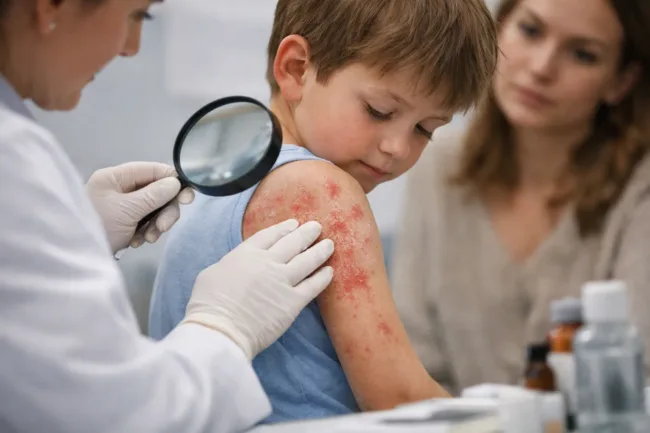
Epidermolysis bullosa is a group of inherited disorders characterized by unusually fragile skin that can blister or tear following minor friction or injury. Disease severity varies considerably between patients and subtypes, but recurring wounds, pain, itching and the need for frequent dressing changes can create substantial clinical and everyday burdens. Severe forms may also involve scarring, infection risk and complications affecting tissues beyond the skin.
SD-101 is intended to address a broad range of skin lesions rather than one specific genetic mutation. Paradigm’s development programme includes epidermolysis bullosa simplex, recessive dystrophic epidermolysis bullosa and intermediate junctional epidermolysis bullosa. The company has emphasized the practical appeal of a formulation that can be applied across affected skin and stored at room temperature without specialized handling.
The medicine’s active ingredient, allantoin, has been investigated for its effects on skin protection and wound healing. However, its presence in a topical formulation does not establish that it improves outcomes in a complex inherited skin disorder. Demonstrating benefit requires evidence that the active formulation performs better than an appropriate control cream when both are administered alongside existing wound care.
That distinction is especially important in epidermolysis bullosa, where wound appearance can fluctuate and some lesions heal spontaneously while new ones develop. A treatment intended for widespread use must show that its benefits are clinically meaningful, reproducible and sustained. Its tolerability must also be established in patients who may have extensive areas of damaged or highly sensitive skin.
What went wrong in the earlier 169-patient ESSENCE Phase 3 trial?
The ESSENCE study, registered as NCT02384460, enrolled 169 patients with epidermolysis bullosa and compared SD-101 6% cream against a vehicle formulation without the active ingredient. Participants were randomized to receive once-daily treatment across the body for approximately three months. The study assessed the time required for a selected target wound to close completely and the proportion of patients achieving complete closure within the evaluation period.
The findings, published in Orphanet Journal of Rare Diseases in 2020, showed no statistically significant difference in time to target wound closure. The reported hazard ratio was 1.004, with a 95% confidence interval of 0.651 to 1.549 and a p-value of 0.985. This result was essentially neutral, providing no evidence of an improvement in the primary time-to-event comparison.
The proportion achieving complete wound closure was also not significantly different between groups. The reported odds ratio was 0.733, with a 95% confidence interval of 0.365 to 1.474 and a nominal p-value of 0.390. Investigators concluded that SD-101 was not more effective than vehicle in achieving the study’s principal wound-healing objectives.
The trial did identify favorable exploratory trends among children aged two to under 12 years and patients with at least 5% of their body surface affected by wounds. These observations provided a possible rationale for investigating a more focused patient population. Nevertheless, exploratory subgroup findings from an unsuccessful trial cannot be treated as confirmed efficacy, particularly when the overall randomized study did not meet its main endpoints.
The medicine was generally well tolerated during ESSENCE, an important characteristic for a treatment intended for extensive skin application. Yet acceptable tolerability and proven efficacy are separate regulatory requirements. The earlier trial established that Paradigm’s successor programme would need stronger evidence that the active cream provides a measurable advantage over its control formulation.
How is Paradigm’s new pediatric Phase 3 study designed to address the earlier failure?
Paradigm is recruiting patients for a new randomized, double-blind, placebo-controlled Phase 3 study identified as SD-007 and registered as NCT07482787. The study is designed to enroll approximately 80 children between 28 days and 12 years of age with selected major epidermolysis bullosa subtypes. Unlike the earlier broader trial, eligibility includes a baseline wound burden affecting at least 5% of the body surface.
Participants must also have a qualifying target wound measuring between 10 and 50 square centimeters. They will receive either SD-101 6% cream or the control formulation applied daily across the body for 60 days. The study includes scheduled assessments of wound closure, itching and changes in the extent of affected skin.
This design appears intended to investigate a population resembling those who showed favorable exploratory trends in the earlier trial. Focusing on younger patients with more extensive skin involvement may provide a clearer opportunity to assess a clinically relevant wound-healing effect. However, selecting a subgroup based partly on previous exploratory findings introduces a need for rigorous prospective confirmation.
The trial is shorter than ESSENCE, with the principal treatment period reduced from approximately three months to two months. A separate open-label extension is intended to provide continued treatment access and additional safety information for eligible participants completing the controlled study. The extension can characterize longer exposure but will not replace the randomized comparison when determining efficacy.
Recruitment through specialized dermatology centers also reflects the rarity of the disease and the difficulty of assembling sufficiently large clinical populations. The approximately 80-patient target makes careful endpoint measurement, participant retention and statistical interpretation especially important. As of the October announcement, Paradigm had not reported results from this new Phase 3 investigation.
How does SD-101 compare with already approved epidermolysis bullosa treatments?
The treatment landscape has changed substantially since the original SD-101 development programme began. In May 2023, the FDA approved Krystal Biotech’s Vyjuvek, a topical gene therapy for wounds associated with dystrophic epidermolysis bullosa involving mutations in the COL7A1 gene. Its mechanism involves delivery of functional genetic material and differs fundamentally from SD-101’s allantoin-based formulation.
The FDA also approved Filsuvez, a topical birch triterpenes gel, in December 2023 for wounds associated with dystrophic and junctional epidermolysis bullosa in patients six months of age and older. In April 2025, Zevaskyn received approval as a cell-based gene therapy for wounds in adult and pediatric patients with recessive dystrophic epidermolysis bullosa. These products demonstrate that the field now includes authorized treatments with distinct mechanisms, target populations and application requirements.
Paradigm’s proposed differentiation concerns broad application across multiple major epidermolysis bullosa subtypes. However, a wider proposed treatment population should not be confused with demonstrated clinical superiority over approved products. There are no randomized head-to-head data showing that SD-101 produces better wound outcomes than these existing therapies.
The practical value of a whole-body cream could depend on application burden, wound coverage, treatment cost and how it fits alongside routine wound care. Nevertheless, the entire proposed clinical benefit remains dependent on successful confirmation in the new development programme. If that evidence is obtained, the company would still need to establish the final indication and labeling through regulatory review.
What do SD-101’s FDA designations and Prix Galien recognition mean for approval?
SD-101 has previously received FDA Breakthrough Therapy, Orphan Drug and Rare Pediatric Disease designations, alongside an orphan designation in Europe. These regulatory programmes can provide development incentives, communication opportunities or potential exclusivity benefits under qualifying circumstances. They do not establish that the medicine has demonstrated the efficacy required for marketing authorization.
The Rare Pediatric Disease designation may also make Paradigm eligible for a priority review voucher if the product ultimately receives a qualifying approval and meets the applicable statutory requirements. The relevant United States voucher programme currently runs through September 30, 2029. Receipt of a voucher is not guaranteed solely because a medicine has received the designation.
The Prix Galien nomination is similarly distinct from a clinical or regulatory determination. The Best Start-Up category recognizes companies associated with scientific innovation, but an award nomination is not evidence that an investigational therapy has met efficacy endpoints. Paradigm’s second consecutive recognition may improve its visibility among industry stakeholders and prospective partners without changing SD-101’s investigational status.
The commercial importance of those relationships could be considerable for a privately held rare disease developer. Paradigm has discussed potential partnerships to support broader access and commercialization, but it has not announced a completed global licensing arrangement or financial terms associated with the nomination. Future investment and partnering interest will likely depend more heavily on the outcome of the new controlled trial.
What must Paradigm demonstrate before Zorblesia can return to an FDA registration pathway?
The immediate challenge is to show that SD-101 provides a statistically persuasive and clinically meaningful improvement in wound healing in the newly selected pediatric population. The earlier ESSENCE failure means that a positive result would need careful examination of effect size, consistency and differences from the previous study. Any regulatory submission would also require a complete assessment of safety, manufacturing and the proposed treatment population.
The company will need to demonstrate that applying the cream across extensive areas of fragile skin remains acceptable during repeated use. Information on treatment-related irritation, infection, discontinuations and application burden could become important, particularly among very young children. Longer-term observations may complement the controlled efficacy results but cannot independently establish the treatment’s benefit over vehicle.
For patients and caregivers, the practical question is whether a broadly applicable cream can reduce wound burden beyond the effects of the accompanying formulation and standard wound care. For regulators, the decisive question is whether the new evidence resolves the uncertainty left by the unsuccessful 169-patient study. The outcome will also determine how convincingly Paradigm can position the treatment within a market that now includes multiple approved options.
The October 2026 Prix Galien nomination provides another moment of recognition for Paradigm Therapeutics, but SD-101’s future rests on its renewed clinical programme. A successful randomized pediatric study could revive a development strategy that encountered a major setback in 2017. Until those results are available, Zorblesia remains an investigational therapy with a plausible whole-body treatment concept, an encouraging tolerability history and an unresolved efficacy question.