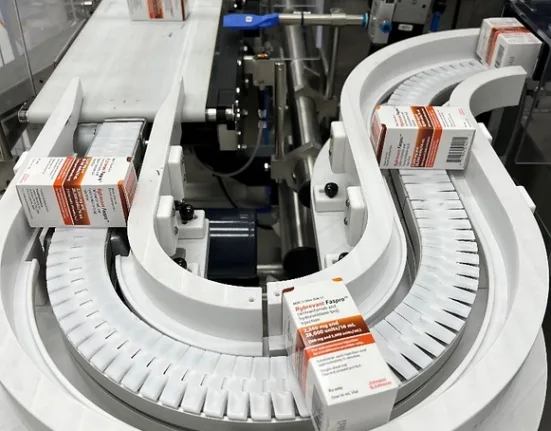
Johnson & Johnson has secured U.S. Food and Drug Administration accelerated approval for Rybrevant Faspro, or amivantamab and hyaluronidase-lpuj, as a single agent for adults with recurrent or metastatic head and neck squamous cell carcinoma whose disease has progressed on or after platinum-based chemotherapy and an anti-PD-(L)1 antibody. The approval, granted on November 5, does not include patients with human papillomavirus-associated oropharyngeal squamous cell carcinoma as identified by p16 testing.
The decision represents the first FDA-approved use of the Rybrevant franchise outside non-small cell lung cancer and, according to the regulator, the first new drug approval in a decade for recurrent or metastatic HNSCC patients previously treated with platinum chemotherapy. The approval is based on the Phase 1b/2 OrigAMI-4 study rather than a randomised Phase 3 survival trial, making the distinction between a strong tumour-response signal and confirmed long-term clinical benefit central to interpreting the development.
Among 102 patients in the primary efficacy population, Rybrevant Faspro produced a confirmed objective response rate of 42%, with 56% of responders maintaining their response for at least six months. The FDA noted that approved therapies available in this difficult treatment setting have generally been associated with response rates around 20% or lower, giving the amivantamab result enough weight to support accelerated approval while a confirmatory Phase 3 programme continues.
Why does the Rybrevant approval matter after platinum chemotherapy and immunotherapy have already failed?
Recurrent or metastatic head and neck squamous cell carcinoma becomes especially difficult to treat after patients progress despite both platinum chemotherapy and PD-1 or PD-L1 checkpoint inhibition. By this stage, the cancer has demonstrated resistance to two of the major therapeutic strategies used across the disease pathway, while patients may also be dealing with swallowing problems, speech impairment, pain, nutritional difficulty and declining performance status.
The FDA’s decision is therefore occurring in a population with substantial unmet need rather than competing directly with highly effective curative treatment. The agency described HNSCC in this setting as aggressive and life-threatening and specifically highlighted the lack of treatment progress, noting that Rybrevant Faspro represents the first drug approval in a decade for recurrent or metastatic disease after prior platinum therapy.
The 42% response rate should still be interpreted within the limitations of a single-arm study. OrigAMI-4 did not randomise patients between Rybrevant Faspro and an active comparator, so differences against historical response rates cannot establish superiority with the confidence of a head-to-head Phase 3 trial. What the study does establish is that a substantial minority of heavily pretreated patients experienced radiographically confirmed tumour shrinkage under blinded independent central review, with more than half of those responders maintaining that response for at least six months.
What exactly did OrigAMI-4 establish, and what has it not yet proved?
OrigAMI-4 is an ongoing multicentre, open-label, multi-cohort Phase 1b/2 study evaluating subcutaneous amivantamab alone and in combinations across different recurrent, metastatic and locally advanced head and neck cancer settings. For the newly approved indication, the FDA evaluated 102 adults whose recurrent or metastatic HNSCC had progressed after platinum-based chemotherapy and anti-PD-(L)1 treatment.
The major efficacy endpoints were objective response rate and duration of response assessed by blinded independent central review under RECIST 1.1 criteria. The confirmed 42% objective response rate had a 95% confidence interval of 32% to 52%, while Johnson & Johnson reported complete responses in 15% of patients and partial responses in 28%. Fifty-six per cent of responding patients had responses lasting at least six months.
Those findings establish anti-tumour activity but do not yet answer whether Rybrevant Faspro extends progression-free survival or overall survival. Accelerated approval allows the FDA to act on response-related endpoints when a serious disease has substantial unmet need, but continued approval can depend on later trials confirming a clinically meaningful benefit. The regulator explicitly stated that it remains unconfirmed whether the observed responses translate into improved long-term outcomes.
That evidence boundary is particularly important for a treatment entering oncology through a single-arm dataset. A 42% response rate can be clinically compelling in a refractory population, but response depth, duration, disease control beyond six months and ultimately survival will determine how durable the commercial and treatment significance becomes.
Why is dual EGFR and MET targeting a new strategy in head and neck cancer?
Amivantamab is a bispecific antibody designed to bind both epidermal growth factor receptor and mesenchymal-epithelial transition factor, better known as EGFR and MET. The drug first built its clinical and commercial identity in EGFR-mutated non-small cell lung cancer, where Johnson & Johnson has developed it across several mutations, combinations and treatment lines.
Head and neck squamous cell carcinoma creates a different biological setting. Johnson & Johnson says EGFR and MET are frequently overexpressed in recurrent and metastatic HNSCC and can contribute to tumour progression and treatment resistance. Rybrevant also has immune-cell directing properties, creating a mechanism that extends beyond straightforward inhibition of a single receptor.
Importantly, the new FDA indication does not require a patient to test positive for a particular EGFR mutation, MET alteration or predefined expression threshold. That differentiates the HNSCC strategy from several Rybrevant lung cancer indications in which molecular testing identifies specific EGFR-mutated populations.
The lack of a required EGFR or MET biomarker could make patient identification operationally simpler, but it also raises an interesting research question. Future analyses may determine whether particular molecular or expression characteristics predict deeper or more durable responses, potentially allowing clinicians to identify patients most likely to benefit even though the current label is not biomarker-restricted.
Why are HPV-associated oropharyngeal tumours specifically excluded from the FDA label?
The approved indication excludes patients with HPV-associated oropharyngeal squamous cell carcinoma, defined through p16 immunohistochemistry. This limitation follows the evidence base rather than representing a general conclusion that Rybrevant cannot work in HPV-associated disease.
Patients with HPV-associated OPSCC were excluded from the primary efficacy population supporting accelerated approval. The FDA therefore did not extend the label into a population for which the pivotal evidence package did not establish the necessary benefit-risk profile.
The distinction has practical implications for oncologists and pathologists because tumour site and HPV status can determine eligibility. Patients with recurrent or metastatic oropharyngeal cancer will need their HPV-associated status understood before the new Rybrevant indication can be applied correctly.
This is also an example of why a headline describing the medicine simply as approved for “head and neck cancer” would be too broad. The actual label is restricted by histology, disease stage, prior treatment history and, for oropharyngeal tumours, HPV status.
How much safety burden accompanies a 42% response rate in this heavily treated population?
The clinical activity comes with a substantial adverse-event burden. In the 102-patient single-agent OrigAMI-4 safety population described by Johnson & Johnson, serious adverse reactions occurred in 39% of patients. Serious events reported in at least 2% included pneumonia, haemorrhage, dysphagia, pneumothorax, anaemia, dyspnoea, fatigue, elevated hepatic enzymes and interstitial lung disease or pneumonitis.
Fatal adverse events occurred in 6% of patients receiving Rybrevant Faspro. Reported fatal events included sudden death in 2% and individual cases of myocardial ischaemia, tumour haemorrhage, aspiration pneumonia and interstitial lung disease or pneumonitis. These events occurred during treatment, but individual adverse-event occurrence does not by itself establish that every death was caused by the drug.
Common adverse reactions were also frequent. Rash occurred in 79% of patients, fatigue in 39%, nail toxicity in 35%, stomatitis in 32% and oedema in 28%. The approved prescribing information carries warnings for hypersensitivity and administration-related reactions, interstitial lung disease or pneumonitis, dermatological toxicity, ocular toxicity and embryo-fetal harm.
The safety profile will matter when physicians compare a response-producing targeted therapy with other available options in patients who may already be medically fragile after multiple lines of treatment. A strong tumour response can justify substantial toxicity in aggressive metastatic cancer, but real-world persistence will depend on whether clinicians can manage rash, pulmonary events, administration reactions and other complications without frequent discontinuation.
Does the five-minute subcutaneous injection meaningfully change treatment delivery?
Rybrevant Faspro combines amivantamab with recombinant human hyaluronidase to enable subcutaneous administration rather than relying on the longer intravenous infusion historically associated with Rybrevant. Johnson & Johnson describes administration itself as taking about five minutes, potentially reducing chair time for patients and infusion centres.
The convenience should not be overstated because the first dose still carries administration-related reaction considerations. Johnson & Johnson reports that administration-related reactions occurred in 16% of the broader OrigAMI-4 single-agent experience, with most occurring around the initial dose, and first-dose monitoring can extend for several hours after injection.
The operational advantage is therefore more nuanced than simply replacing a long infusion with a five-minute visit. Administration time is shorter, but treatment still requires oncology infrastructure, premedication, monitoring and the ability to manage hypersensitivity or cardiopulmonary reactions.
Over repeated treatment cycles, however, shorter administration could become more meaningful. Patients with recurrent head and neck cancer often accumulate substantial healthcare time across imaging, oncology consultations, supportive care and treatment visits, making a subcutaneous option potentially valuable if efficacy and tolerability support continued therapy.
Why is OrigAMI-5 now more important than the accelerated approval itself?
Johnson & Johnson is already running the confirmatory Phase 3 OrigAMI-5 trial, which is designed to test whether adding subcutaneous amivantamab can improve outcomes earlier in recurrent or metastatic head and neck cancer. The study is recruiting approximately 500 previously untreated patients and compares amivantamab plus pembrolizumab and carboplatin with a standard pembrolizumab, platinum and fluorouracil regimen.
The planned primary endpoints include objective response rate and overall survival, with progression-free survival, duration of response and patient-reported outcomes among secondary measures. That makes overall survival the crucial endpoint for determining whether the strong response signal seen in later-line OrigAMI-4 translates into a more definitive clinical advantage when Rybrevant is moved into first-line treatment.
Success could do considerably more than preserve the accelerated approval. A positive first-line trial would move amivantamab into a substantially larger patient population before patients accumulate multiple treatment failures and declining health, potentially changing the commercial scale of the head and neck cancer opportunity.
Failure would create a more complicated picture. The later-line accelerated indication could remain dependent on how regulators interpret the totality of confirmatory evidence, while physicians might question whether a strong response rate in heavily pretreated patients translates into a survival benefit when tested rigorously against current standard therapy.
How important could head and neck cancer become to the growing Rybrevant franchise?
Johnson & Johnson does not report Rybrevant revenue separately from Lazcluze, but the combined franchise is expanding rapidly. Worldwide Rybrevant and Lazcluze sales reached $320 million in the third quarter of 2026, up 62.3% from $198 million a year earlier, while nine-month sales increased 67.4% to $866 million.
The United States accounted for $201 million of third-quarter revenue and $566 million over the first nine months. Johnson & Johnson identified the Rybrevant and Lazcluze franchise among the products driving growth in its oncology business, which reached $7.60 billion in quarterly sales and grew 16.4% year over year.
Head and neck cancer will initially add a relatively narrow, heavily pretreated population rather than instantly transforming those numbers. The greater strategic importance is that amivantamab has now demonstrated enough activity outside EGFR-mutated lung cancer to obtain an FDA-approved indication in an entirely different solid tumour.
That matters for the lifecycle economics of a bispecific antibody platform. If ongoing studies succeed in first-line HNSCC or other solid tumours, Johnson & Johnson could progressively reduce Rybrevant’s dependence on lung cancer and convert a molecularly specialised franchise into a broader oncology asset.
What does the latest approval mean for Johnson & Johnson investor sentiment?
Johnson & Johnson shares closed at $276.22 on November 6, up 1.43% for the session and close to the upper end of a 52-week range of $185.12 to $282.02. The company’s market capitalisation was approximately $665 billion, making the incremental head and neck cancer indication far too small to explain daily share-price movements on its own.
The more relevant investor signal is the continued expansion of Johnson & Johnson’s oncology growth portfolio. Third-quarter Innovative Medicine sales increased 7.7% to $16.76 billion, while oncology revenue rose 16.4%, supported by Darzalex, Carvykti, Tecvayli, Rybrevant and Lazcluze, among other products.
Rybrevant’s new indication therefore operates as a franchise de-risking event rather than a standalone earnings catalyst. The FDA has shown willingness to recognise amivantamab’s activity outside its original lung cancer setting, while the company now has a Phase 3 programme capable of determining whether that foothold becomes a much larger commercial opportunity.
The unresolved issue remains exactly what accelerated approval is designed to leave open. Johnson & Johnson has demonstrated a 42% response rate in a heavily pretreated population where the FDA says existing therapies generally deliver responses around 20% or less, and more than half of responders maintained benefit for at least six months. The next stage is harder: proving that dual EGFR and MET targeting does more than shrink tumours, and that moving Rybrevant earlier can extend survival enough to establish a durable place in head and neck cancer treatment.