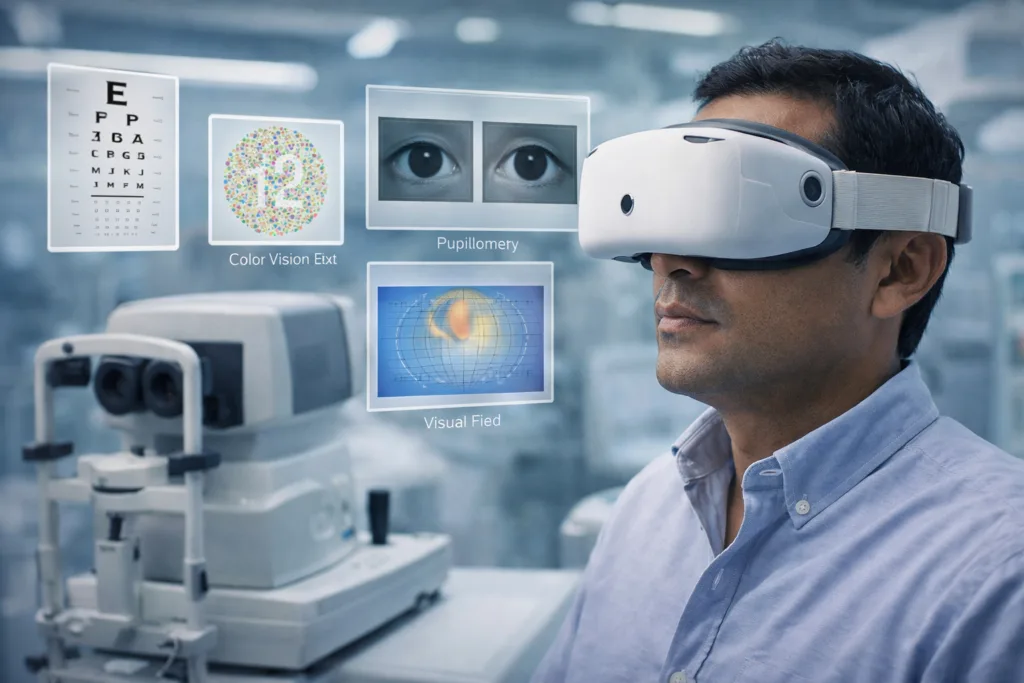
Heru, a Miami-based AI-powered vision diagnostics company spun out of the University of Miami’s Bascom Palmer Eye Institute, has unveiled PretestPro, a software module for its VR-based wearable diagnostic platform that completes a four-test ophthalmic pretest examination in under two minutes. The announcement was made at the Vision Expo meeting in Orlando, Florida, where the company demonstrated PretestPro at its booth. The product expands Heru’s existing wearable platform, which already supports multiple visual field testing modalities, visual acuity, color vision, and pupillometry workflows within a single headset form factor.
Why consolidating pretesting into a wearable platform matters for high-volume eye clinics
Ophthalmic pretesting in most clinical settings still relies on a sequence of discrete instruments, each requiring a trained technician to administer, document, and reset. The practical consequence is that the pretest sequence occupies a disproportionate share of clinical contact time before a physician ever sees the patient. PretestPro targets this bottleneck directly. By running confrontation visual field screening, near cover test, extraocular motility assessment, and quantitative pupillometry within a single guided VR session, the platform eliminates the need for multiple standalone devices and reduces technician-administered steps. The company states throughput improves by roughly threefold relative to conventional pretesting sequences, a figure that, if consistently reproducible in real-world practice environments, would represent a meaningful operational gain for busy ophthalmology and optometry practices.
The commercial logic here is not difficult to follow. High patient volumes strain pre-physician workflows, and clinical staff shortages have made the technician-to-patient ratio a persistent operational constraint in many markets. A validated, self-contained pretesting device that can be deployed in a waiting room or pre-test area without dedicated oversight represents a potential solution to a structural problem, provided the clinical output meets the threshold of acceptability that referring physicians require before acting on the data. That is the central question the platform has yet to fully answer in the public record.
What clinical validation exists and what the published record does not yet confirm
Heru’s platform is described as built on 15 years of vision science research and clinical validation originating at Bascom Palmer, which holds the top national ranking for eye hospitals in the United States. The device carries FDA registration, and the company holds more than 70 patents. However, the public announcement does not detail the specific clinical studies underpinning PretestPro’s four-test bundle as a combined workflow, nor does it identify peer-reviewed publications validating the speed and accuracy claims against conventional gold-standard instruments for each modality. The distinction matters. Individual tests, such as confrontation visual field and pupillometry, have well-established reference performance baselines. Whether a VR-delivered, AI-guided version of those tests achieves equivalent sensitivity and specificity, particularly in populations with reduced visual acuity, cognitive impairment, or poor fixation, requires prospective data that has not been publicly presented as part of this announcement.
Clinicians tracking the field will note that the fixation target described, identified in the platform as Nora, is a patient-guidance mechanism designed to maintain reliable eye positioning during testing. Fixation quality is a known source of variability in visual field assessments, and the reliability of AI-guided fixation across diverse patient populations remains an area requiring further published evidence. That said, the concept of using gaze-tracking within VR hardware to simultaneously enforce fixation and capture extraocular motility is technically coherent and, if validated, represents a genuine efficiency over sequential manual assessment.
How Heru’s platform compares with existing pretesting infrastructure in ophthalmology
The ophthalmology diagnostics market encompasses both legacy tabletop instruments, such as the Humphrey Field Analyzer and Goldmann perimeter for visual field testing, and a newer generation of portable and digital screening devices targeting the same workflow compression Heru is pursuing. Companies including Olleyes, which offers a VR-based visual field platform, and iCare, which has developed portable perimetry and tonometry products, are operating in adjacent spaces. What distinguishes Heru’s PretestPro proposition, at least in principle, is the breadth of modalities bundled within a single exam session rather than individual test replacement. Running confrontation visual field, motility, cover test, and pupillometry in sequence within one device removes the instrument-switching overhead entirely, rather than simply digitising a single test.
The comparison with conventional approaches is also a question of data quality and physician acceptance. Confrontation visual field testing, while widely used as a rapid screening tool, is acknowledged in the clinical literature to have lower sensitivity than automated threshold perimetry for detecting visual field defects. If Heru’s VR confrontation field test offers comparable or superior sensitivity to manual confrontation testing but remains less rigorous than threshold perimetry, its appropriate clinical positioning is as a screening and triage tool rather than a diagnostic replacement. That framing aligns with how pretesting workflows are generally understood, but it does set a limit on how far downstream the platform’s data can meaningfully travel without additional confirmatory testing.
Regulatory status, reimbursement pathway, and adoption barriers the platform still faces
FDA registration, which applies to the Heru wearable platform, is a lower regulatory threshold than 510(k) clearance and does not confer formal premarket review of clinical performance claims in the way that cleared devices do. Regulatory watchers will observe that this distinction has practical implications for how the platform can be positioned in clinical communications and what evidentiary standards payers and health systems will apply when evaluating adoption. As diagnostic AI devices move from research settings into reimbursable clinical workflows, payers in the United States are applying increasing scrutiny to the quality of evidence supporting AI-assisted diagnostic tools. The absence of formal clearance does not preclude commercial deployment, but it does shape the reimbursement conversation.
From an adoption standpoint, the portability argument is more straightforward. Practices in underserved or rural areas that lack the capital or physical space for multiple legacy instruments represent a genuine addressable market for a consolidated, portable alternative. Heru has positioned the platform explicitly as supporting remote locations alongside traditional clinical settings, which suggests awareness of this segment. However, workflow integration, electronic health record compatibility, and staff training requirements represent the practical adoption barriers that conference demonstrations do not fully address. Clinics that have invested in legacy infrastructure will weigh replacement cost against demonstrated efficiency gains, and that calculus will vary substantially by practice size and patient volume.
What clinicians and industry observers will watch as Heru expands the platform commercially
The immediate clinical question is whether published, peer-reviewed performance data for the full PretestPro four-test bundle emerges in the near term. Industry observers note that ophthalmic diagnostics companies operating in the AI-assisted space face growing expectations from clinical buyers for transparent validation data, particularly as the market matures past early-adopter enthusiasm. For Heru, the academic lineage from Bascom Palmer provides meaningful credibility, but credibility is not a substitute for prospectively published comparative accuracy data, especially as the platform moves beyond university-affiliated settings into community practice.
The platform’s scalability outside ophthalmology-dense markets is a secondary consideration worth tracking. VR headset-based diagnostics face a patient tolerance dimension that differs from conventional instrumentation. Older patients, a core demographic in eye care, may experience greater variability in compliance with headset-based testing, and the interaction design burden on the AI virtual technician is accordingly higher. Nora, the platform’s patient-guidance system, is presented as a solution to this challenge, but published usability data across diverse age groups has not been publicly disclosed. For a platform marketed partly on its accessibility advantages, real-world usability evidence across demographic subgroups will be a legitimate area of scrutiny as commercial deployment scales.
The broader strategic bet Heru is making is that AI-driven automation of the clinical pre-visit workflow will become a standard expectation in modern ophthalmology practices, and that platforms offering multi-modal consolidation will displace single-function legacy instruments over a medium-term horizon. That bet is coherent with broader trends in diagnostic digitisation and workflow compression. Whether Heru’s platform becomes a standard-of-care tool or remains a niche efficiency product will depend less on its engineering credentials, which appear substantive, and more on the quality and volume of clinical evidence it generates and publishes in the coming years.