Medtronic plc has received CE mark approval in Europe for the VitalFlow Transport Frame Air and Ground as an accessory to the VitalFlow Extracorporeal Membrane Oxygenation system. The approval gives the medical technology manufacturer a cleared transport configuration for inter-hospital movement of critically ill adult ECMO patients by ambulance and aircraft, expanding the commercial relevance of its VitalFlow platform beyond fixed in-hospital use.
Why Medtronic’s VitalFlow Transport Frame approval matters for mobile ECMO care in Europe
The CE mark is not just a hardware clearance. It is a signal that Medtronic plc is trying to position VitalFlow as a more complete ECMO ecosystem at a time when advanced cardiac and respiratory support is increasingly being stretched beyond the walls of tertiary care centers. Extracorporeal membrane oxygenation remains one of the most resource-intensive forms of critical care, and transport has long been one of the most operationally fragile parts of the pathway. A patient may be cannulated at one facility but require transfer to a specialist ECMO center, transplant center, cardiac surgery unit, or higher-acuity intensive care environment. That transfer creates a narrow safety window in which device stability, team coordination, power management, mounting integrity, and clinical monitoring all matter.
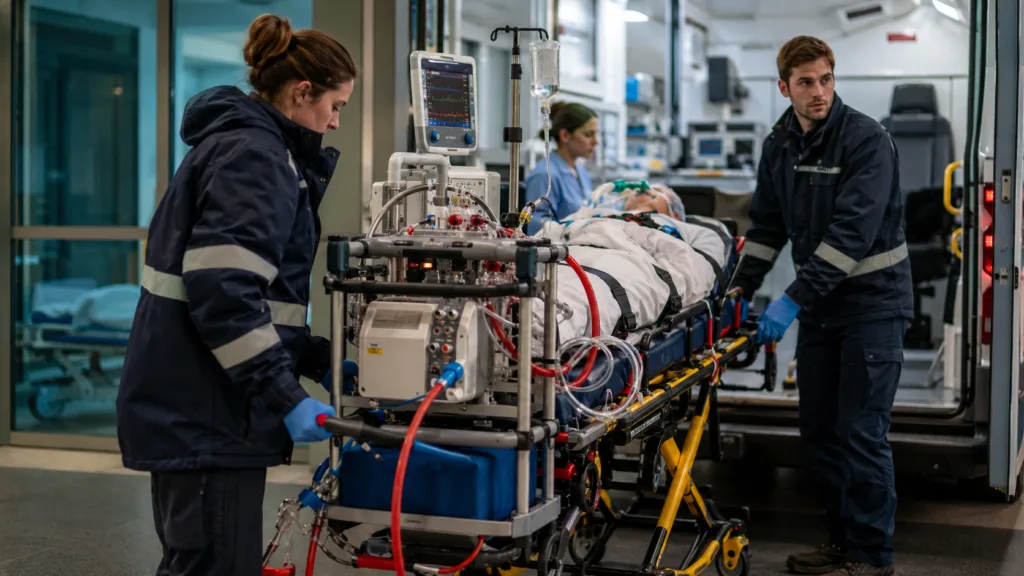
For Medtronic plc, the new approval extends the VitalFlow story from console capability to workflow continuity. The earlier European clearance of the VitalFlow console and related in-hospital accessories gave Medtronic a foundation in hospital-based ECMO support. The transport frame now adds a mobility layer, making the platform more relevant to regional care networks that depend on retrieval teams, hub-and-spoke intensive care models, and specialized ECMO referral systems. The incremental nature of the clearance should not be mistaken for a small commercial detail. In ECMO, accessories can determine whether a platform fits real-world practice or remains confined to idealized hospital settings.
The unresolved question is how quickly European hospitals can standardize around such transport-enabled ECMO workflows. The CE mark permits commercial use in the relevant European regulatory setting, but it does not automatically solve staffing constraints, retrieval team availability, ambulance and aircraft integration, or reimbursement variation across healthcare systems. This is where the strategic story becomes more nuanced. Medtronic plc has cleared an important device-related barrier, but the adoption curve will depend heavily on whether hospitals see the transport frame as a safety and efficiency upgrade that justifies procurement, training, and protocol changes.
How the CE mark could strengthen Medtronic’s position in critical care device platforms
Medtronic plc already has a broad cardiovascular and critical care footprint, and the VitalFlow Transport Frame Air and Ground fits neatly into a strategy of building platform depth rather than selling isolated devices. In high-acuity medical technology markets, hospitals increasingly prefer systems that reduce fragmentation. A console, pump, circuit, oxygenator, cart, and transport configuration that can operate within a broader ecosystem may be more attractive than a patchwork of components that require local improvisation during emergencies.
That matters because ECMO programs are not judged only on product performance. They are judged on repeatability, training burden, response time, patient safety, and the ability to move from routine support to crisis logistics without creating avoidable points of failure. A transport frame designed for air and ground movement addresses a specific practical gap: the need to secure and protect an ECMO system while a patient is being transferred between facilities. In operational terms, this could help ECMO teams reduce reliance on ad hoc transport setups and standardize how the system is mounted, moved, and protected.
The competitive risk is that transport capability may become a baseline expectation rather than a durable differentiator. Other extracorporeal life support and perfusion technology suppliers are also aware that mobility, modularity, and retrieval readiness are increasingly important to hospital buyers. Medtronic plc therefore gains a useful European positioning advantage, but it must still prove that VitalFlow can compete on usability, reliability, service support, and total cost of ownership. In critical care procurement, a cleared accessory opens doors. It does not close the sale by itself.
Why inter-hospital ECMO transport remains a high-stakes clinical and operational challenge
The clinical logic behind the VitalFlow Transport Frame Air and Ground is easy to understand. ECMO is often used when conventional treatment options have failed or when patients face imminent risk from severe cardiopulmonary or respiratory failure. These patients are clinically unstable by definition. Moving them between facilities is not comparable to transporting a routine intensive care patient. The equipment must function under vibration, space constraints, time pressure, and changes in transport environment, while clinicians continue to manage anticoagulation, oxygenation, blood flow, hemodynamics, and complications.
That makes a purpose-built transport frame more important than it may appear at first glance. A transport accessory does not treat the patient on its own, but it can influence whether the treatment environment remains controlled during movement. The fact that the frame has been positioned for both ground and air transport speaks to a real-world need among ECMO centers that support wider referral geographies. In parts of Europe, specialist cardiac and respiratory failure centers serve patients from hospitals that may not maintain full ECMO capability. Transport readiness can therefore affect access to advanced support.
The limitation is that device transportability does not eliminate clinical risk. ECMO remains associated with severe complications, including bleeding, infection, vascular injury, stroke, organ failure, hypoxia, and death. These risks are intrinsic to the therapy and patient population, not merely to the transport setting. Clinicians and regulators will therefore watch whether broader use of transport-enabled systems improves workflow consistency without creating overconfidence around patient movement. The approval supports transport capability, but the therapy remains highly specialized and dependent on experienced teams.
What this reveals about the next phase of ECMO market development
The VitalFlow Transport Frame Air and Ground approval reflects a broader shift in ECMO from rescue therapy concentrated in elite centers toward more structured regional care models. ECMO is still not a mass-market technology, and it is unlikely to become one. However, the pandemic era, rising awareness of severe respiratory failure management, and expansion of advanced heart and lung support networks have pushed hospitals to think more seriously about scalable ECMO infrastructure. This does not mean every hospital wants to operate an ECMO program. It means more hospitals need reliable pathways to transfer eligible patients to centers that do.
Medtronic plc appears to be responding to that reality by extending VitalFlow into the logistics layer of care. The market opportunity is not just the sale of a frame. It is the chance to embed VitalFlow into ECMO networks that need consistency across bedside initiation, intrahospital management, and inter-hospital transfer. In procurement terms, that can make the platform more attractive to hospital systems that think in terms of regional coverage rather than individual device placement.
The risk is that ECMO utilization remains uneven, expensive, and sensitive to local expertise. Even where clinical demand exists, hospitals face workforce shortages, budget constraints, and post-pandemic pressure on intensive care capacity. A transport-ready frame may solve a device integration problem, but it cannot by itself solve the economics of maintaining ECMO retrieval teams. Medtronic plc’s commercial success in Europe will depend on whether the device can fit into funded care pathways rather than merely appeal to specialized clinicians.
Investor sentiment around Medtronic plc and the limits of device-level catalysts
For investors, the CE mark is positive but unlikely to be a standalone valuation-changing event for Medtronic plc. The medical technology manufacturer is a large, diversified business, and a transport accessory within the ECMO portfolio will not move revenue expectations on the same scale as major cardiovascular, diabetes, surgical, or neuromodulation franchises. Medtronic plc shares recently traded at $76.15, with a market capitalization of about $98.2 billion, which places this development in the category of portfolio execution rather than transformational corporate news.
That does not make the approval irrelevant. Large medical technology groups often build sentiment through a steady accumulation of product clearances, platform extensions, and evidence of procedural relevance. The VitalFlow Transport Frame Air and Ground strengthens the perception that Medtronic plc is still investing in high-acuity cardiovascular and critical care workflows, an area where clinical credibility matters as much as near-term revenue contribution. For institutional investors, the more important signal is whether Medtronic plc can keep refreshing specialty platforms while defending margins and maintaining growth across larger franchises.
The investor caveat is that European CE mark approvals do not automatically translate into rapid commercial uptake. Procurement timelines, tender cycles, hospital capital budgets, and clinician training can stretch commercialization. A positive regulatory milestone can therefore support sentiment without immediately changing financial models. The approval adds another layer to Medtronic plc’s cardiovascular technology narrative, but the market will still judge the medical technology manufacturer by broader revenue acceleration, margin resilience, and pipeline execution.
What clinicians, regulators, and hospital buyers are likely to watch next
The next phase will be less about the existence of the transport frame and more about its performance in routine clinical logistics. Clinicians will want to know whether the frame reduces setup complexity, improves transport confidence, protects key components, and supports rapid movement without adding unnecessary handling burden. ECMO teams are already dealing with complex patient physiology, cannulation decisions, anticoagulation management, and transport coordination. Any accessory that claims to improve the transport workflow must prove that it does not create a new layer of complexity.
Regulators and hospital risk teams will focus on safe use in real-world environments. Air and ground transport introduce different stresses, including vibration, confined spaces, securing requirements, and emergency contingency planning. The frame’s role as an accessory means it must be judged as part of a broader system, not as a standalone device. That system-level view is important because ECMO failures rarely come from one isolated variable. They often involve clinical, technical, and operational factors interacting under pressure.
For Medtronic plc, the commercial task is now to convert regulatory clearance into confidence among ECMO centers, transport teams, and hospital procurement committees. The CE mark gives VitalFlow a stronger European platform story, but the real adoption test will come from whether the transport frame helps hospitals standardize one of the most difficult parts of ECMO care. In that sense, this approval is both a regulatory milestone and a practical challenge. It gives Medtronic plc permission to compete more broadly in mobile ECMO support, but it also raises the bar for evidence, training, and execution.