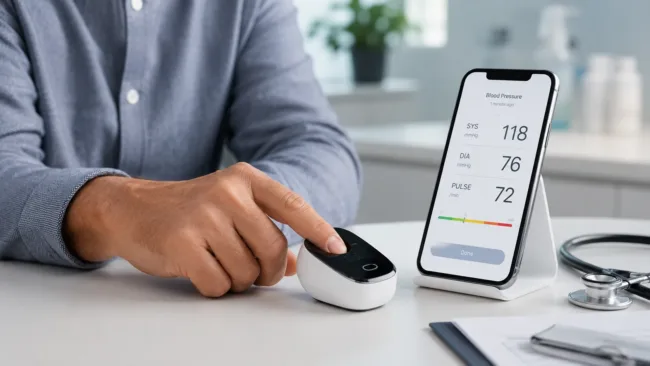
Biobeat Technologies, Ltd. has raised $50 million in Series B funding to commercialize its FDA-cleared, patch-worn, cuff-less 24-hour ambulatory blood pressure monitoring (ABPM) system in the United States. The round was led by Ally Bridge Group, OrbiMed Advisors, and Elevage Medical Technologies, with participation from a strategic investor. The funds will support field sales expansion and accelerate efforts to make continuous ABPM a standard of care for hypertension management
What this changes for ambulatory blood pressure monitoring in the U.S.
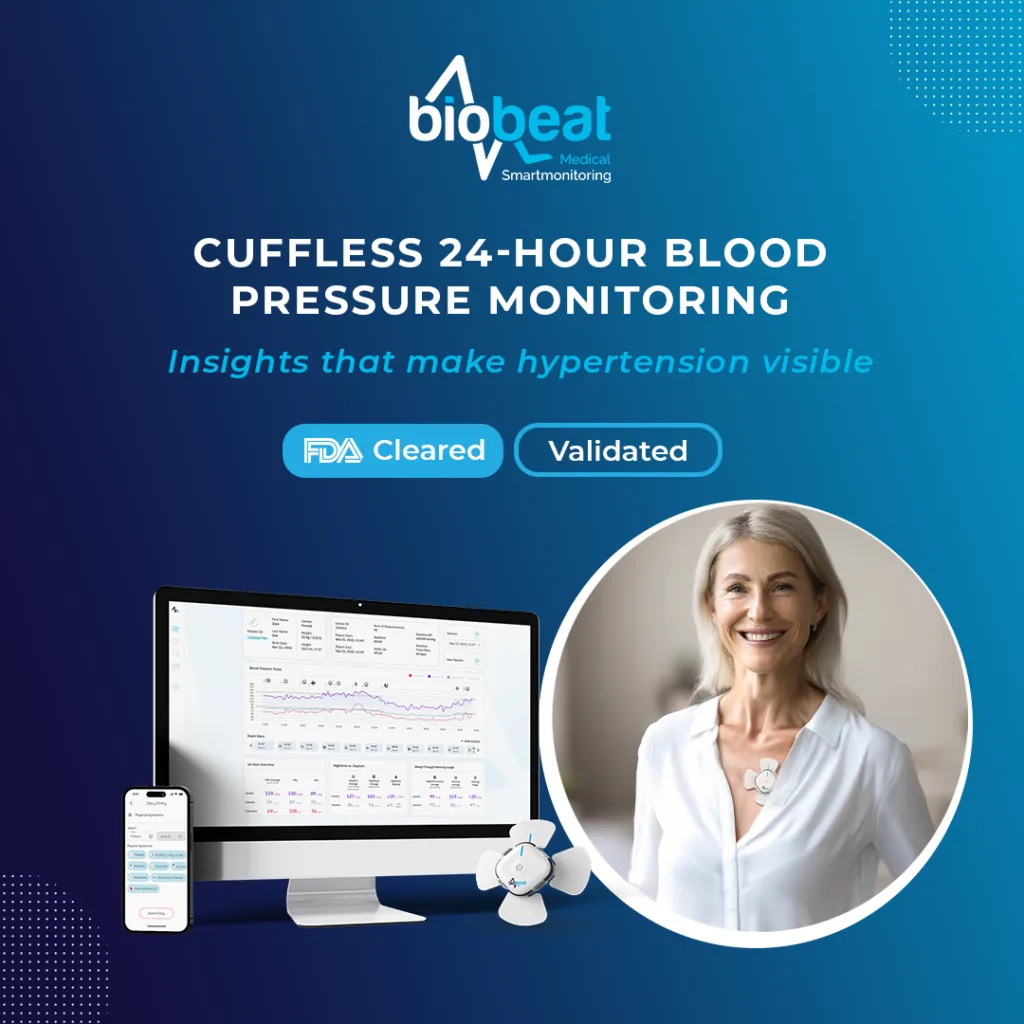
This funding marks a major inflection point for the U.S. ABPM market, which has historically suffered from underutilization. Traditional cuff-based monitors, while clinically validated, have long faced poor patient adherence due to discomfort from repeated inflation cycles and fragmented workflows in clinical settings. Biobeat’s patch-based solution offers a user-centric alternative: no cuffs, no inflations, and no need for equipment returns or complex data extraction.
By integrating automatic data uploads into electronic medical records and enabling device disposal post-use, Biobeat aims to streamline ABPM into routine clinical care. The company’s push for broader adoption comes at a time when guideline-based hypertension diagnosis and medication titration are under increased pressure to modernize with real-world data capture—especially for nocturnal blood pressure patterns, which are often missed in episodic clinic-based measurements.
Industry observers suggest Biobeat is positioning ABPM not as a specialist tool, but as a ubiquitous primary care utility, akin to the transformation seen in cardiac monitoring with the rise of patch-worn ambulatory ECG devices like those pioneered by iRhythm.
Why clinical usability, not just accuracy, is redefining ABPM value
Clinicians tracking the evolution of ABPM argue that accuracy alone is no longer the dominant barrier to adoption. Rather, ease of use, patient compliance, and seamless data integration are becoming decisive factors. Biobeat’s solution sidesteps many of the legacy limitations by embedding sensors into a single-use patch worn on the chest, which requires no patient training and allows for uninterrupted daily and nocturnal activity.
The promise of capturing true circadian blood pressure variation—including early morning surges and nighttime dips—could enable better risk stratification and more tailored antihypertensive therapy. This is particularly relevant for populations with masked or nocturnal hypertension, where clinic-based measurements may misclassify patients. Real-world uptake, however, will likely depend on validation studies across diverse cohorts, payer willingness to reimburse higher-tech ABPM systems, and provider readiness to interpret and act on 24-hour data.
How Biobeat’s commercialization model differs from legacy devices
Unlike reusable cuff-based monitors that require device retrieval and often manual data uploads, Biobeat’s system is designed for single-use convenience. After the 24-hour monitoring period, patients discard the patch and providers receive structured reports almost instantly through EMR integration. This simplifies logistics for clinics and reduces infection control concerns—an area increasingly scrutinized in post-pandemic care workflows.
The commercial scaling plan also signals Biobeat’s intent to build a direct field salesforce rather than rely solely on distributor channels. This model may allow the Israeli-American firm to better target hospital systems, outpatient clinics, and telehealth networks interested in remote diagnostics. In that sense, Biobeat’s approach resembles strategies seen in high-growth medtech verticals like wearable ECG or home-based sleep apnea diagnostics.
Still, the challenge will be persuading clinicians outside cardiology and nephrology—such as primary care physicians—to proactively deploy ABPM in line with recent U.S. guidelines, which endorse it for diagnosis and medication titration in a broader patient pool.
What this reveals about venture appetite for wearables in chronic care
The investor mix in this round underscores rising venture confidence in clinically integrated wearables that go beyond consumer wellness. Ally Bridge Group, OrbiMed Advisors, and Elevage Medical Technologies are all known for funding technologies with potential to shift standards of care. This signals belief in Biobeat’s model not just as an incremental product, but as a platform play in digital hypertension management.
Industry analysts note that cardiovascular and metabolic chronic disease markets are increasingly viewed as ripe for tech-enabled disruption—especially in diagnostics and disease monitoring. But success hinges on more than form factor innovation. Reimbursement alignment, real-world clinical validation, and workflow compatibility remain gating factors.
In that context, Biobeat’s Series B appears to reflect investor conviction that the firm has crossed a key clinical and regulatory threshold. Its FDA clearance lends credibility, but commercial execution—particularly on the scale and speed of provider adoption—will ultimately determine whether Biobeat can unseat incumbent ABPM systems and carve a mainstream role.
What adoption challenges still remain despite regulatory clearance
Despite having FDA clearance, Biobeat’s ABPM device still faces several hurdles before it can achieve standard-of-care status. Payer policies around ABPM reimbursement remain variable, with many requiring prior authorization or limiting use to specific clinical scenarios. Even among eligible patients, clinician awareness and workflow inertia have historically limited deployment.
Moreover, while the device’s usability appears promising, clinical evidence on outcomes impact—such as medication adjustments or cardiovascular event reduction—remains relatively early-stage. Clinicians and payers alike may want to see more longitudinal data on how Biobeat-enabled ABPM translates into clinical decision changes and downstream cost savings.
There is also the question of manufacturing scale and supply chain reliability. Single-use devices, while easier for the patient, require robust production capacity to meet growing demand. Biobeat will need to balance commercialization speed with quality control and cost containment to ensure sustainable growth.
Why the ABPM market may be poised for a structural shift
If Biobeat executes on its vision, it could trigger broader change in how hypertension is diagnosed and managed. The American Heart Association and U.S. Preventive Services Task Force already recommend out-of-office BP monitoring for accurate diagnosis, but real-world uptake has lagged. A patch-based device with EMR integration could close that gap—especially if tied to new value-based care models that reward proactive blood pressure control.
The future of ABPM may depend less on individual device specs and more on how well these systems embed into broader clinical pathways, from telemedicine consults to remote medication management. Biobeat’s bet is that a frictionless, cuff-less platform will tip the balance toward adoption, similar to how continuous glucose monitors transformed diabetes management once they became wear-and-forget.