Zai Lab Limited has presented new preclinical data at IMMUNOLOGY2026 suggesting that ZL-1503, its bispecific antibody targeting interleukin-13 and interleukin-31 receptor alpha, may deliver durable suppression of itch and inflammation across atopic disease models. The update matters because the candidate is already in a Phase 1/1b study in healthy volunteers and adults with moderate-to-severe atopic dermatitis, with first clinical data expected in the second half of 2026.
What makes this program worth watching is not simply that it showed activity in non-human primates. The more interesting signal is strategic. Zai Lab is trying to build a molecule that addresses one of the field’s persistent frustrations: many current biologics improve inflammation well enough, but itch relief, onset speed, durability, and dosing convenience still shape physician preference and commercial separation. That is a high bar in a market already anchored by established agents such as dupilumab, which blocks interleukin-4 receptor alpha and thereby inhibits interleukin-4 and interleukin-13 signaling, and newer pathway-specific entrants such as lebrikizumab and nemolizumab.
Why dual IL-13 and IL-31Rα blockade could matter more than single-pathway refinement
The mechanistic pitch behind ZL-1503 is straightforward and commercially savvy. Interleukin-13 sits deep inside type 2 inflammatory signaling and tissue remodeling, while interleukin-31 is closely associated with pruritus biology. Zai Lab’s argument is that blocking both together could break the itch-scratch-inflammation cycle more effectively than attacking inflammation alone. Its poster reported dose-dependent inhibition of interleukin-31-induced scratching and interleukin-13-driven pSTAT6 signaling for as long as 112 days after a single intravenous dose, alongside evidence of improved lung function and reduced inflammatory features in asthma, allergic rhinitis, and conjunctivitis models.
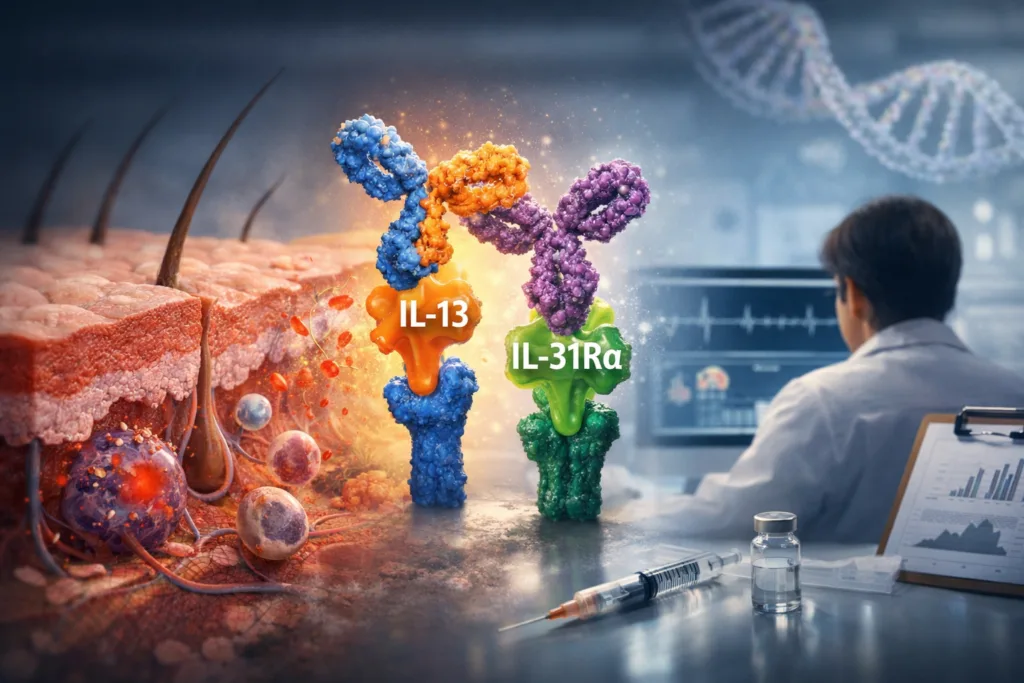
That matters because itch is not a side issue in atopic dermatitis. It is the symptom that keeps patients awake, drives scratching-related skin damage, and often determines how quickly a treatment is judged to be working in real life. In commercial terms, any biologic that can credibly claim faster or more durable itch relief has a chance to stand out even in a crowded immunology market. Nemolizumab’s rise already showed how valuable the itch pathway can be as a competitive lever, and lebrikizumab reinforced how selective interleukin-13 inhibition can still win regulatory traction.
The catch is that elegant biology does not automatically become meaningful clinical differentiation. Preclinical durability over 112 days is intriguing, but it is still preclinical durability. Human pharmacokinetics, dose selection, injection burden, immunogenicity, and real-world efficacy against heterogeneous disease can quickly humble a neat mechanistic thesis. Zai Lab therefore has to prove not only that dual blockade works, but that it works clearly enough to justify entering a market where physicians already have multiple biologic and oral options.
Why the next real test is not efficacy alone, but clinical positioning and dosing credibility
The ongoing Phase 1/1b trial is the inflection point. ClinicalTrials.gov shows the study is evaluating safety, tolerability, and pharmacokinetics in healthy volunteers and participants with moderate-to-severe atopic dermatitis. That means the first readout will likely be judged less on grand efficacy claims and more on whether early human data support the company’s most commercially important promise: durable dual-pathway control that could allow less frequent dosing without giving up meaningful symptom benefit.
This is where the program becomes more than an immunology science story. If ZL-1503 can generate early signs of rapid itch control, sustained pharmacodynamic coverage, and a clean safety profile, Zai Lab may have a partnering-grade asset or at least a program that strengthens the company’s internal innovation narrative. The February 2026 results update showed Zai Lab continuing to emphasize its global innovation engine and path to profitability, which means internal pipeline assets like ZL-1503 are not just scientific bets, they are also capital-allocation statements.
But the clinical bar is unforgiving. A candidate like this cannot survive on the vague promise of being “first in class.” It needs a concrete reason for adoption. That reason could be better pruritus separation, longer dosing intervals, superior control in difficult subgroups, or broader utility across multiple interleukin-13 and interleukin-31-driven diseases. Without one of those advantages becoming visible early, the asset risks being viewed as scientifically interesting but commercially redundant.
Why Zai Lab is entering a market where differentiation, not novelty, decides who wins
Atopic dermatitis is no longer a simple innovation vacuum. Dupilumab remains a foundational therapy with broad labeling and deep physician familiarity. Lebrikizumab added another approved biologic route through selective interleukin-13 inhibition. Nemolizumab validated the importance of the itch axis in Europe, especially for patients where pruritus remains a defining burden. In that setting, a new entrant has to do more than claim balanced pathway inhibition. It has to show why clinicians should switch, sequence, or reserve it.
That competitive backdrop cuts both ways for Zai Lab. On one hand, the market is crowded. On the other, the existence of multiple successful agents proves that atopic dermatitis is big enough, heterogeneous enough, and clinically frustrating enough to reward differentiated therapies. The most attractive scenario for ZL-1503 is not necessarily displacing incumbents outright. It may be finding a position among patients whose disease is heavily itch-driven, incompletely controlled, or poorly matched to current dosing and response patterns.
There is also a broader platform question. Zai Lab’s poster highlighted models beyond dermatitis, including asthma, allergic rhinitis, and conjunctivitis. That does not mean those indications are imminent, but it does show how the company may be thinking about asset expansion if early human data cooperate. A biologic with a believable itch-plus-inflammation thesis across multiple atopic settings is a more strategic proposition than a narrow dermatitis-only program.
What the second half of 2026 needs to show if ZL-1503 is going to become more than a preclinical curiosity
The second half of 2026 is now the date that matters. Zai Lab has already told investors and the market that clinical data are expected then, so the burden shifts from mechanistic storytelling to translational proof. The most important questions are simple, even if the biology is not. Does the drug show tolerability good enough for chronic use? Does the pharmacokinetic profile support the less-frequent-dosing ambition hinted at by the preclinical package? Does itch improve quickly enough to be obvious? And does inflammation move in a way that suggests dual blockade is doing more than adding scientific complexity?
For now, the preclinical data are encouraging but still promotional-adjacent in the way early conference disclosures often are. The true value of the IMMUNOLOGY2026 presentation is that it sharpens the development thesis. ZL-1503 is not trying to be just another cytokine blocker. It is trying to become a clinically practical answer to one of dermatology’s hardest treatment priorities, which is durable itch relief without sacrificing broader disease control. Whether that promise survives contact with human data will determine if this becomes one of Zai Lab’s more important internal immunology assets or just another smart molecule that ran into a smarter market.

Can Zai Lab’s ZL-1503 turn dual-pathway itch control into a real atopic dermatitis advantage? added by Pallavi Madhiraju on
View all posts by Pallavi Madhiraju →