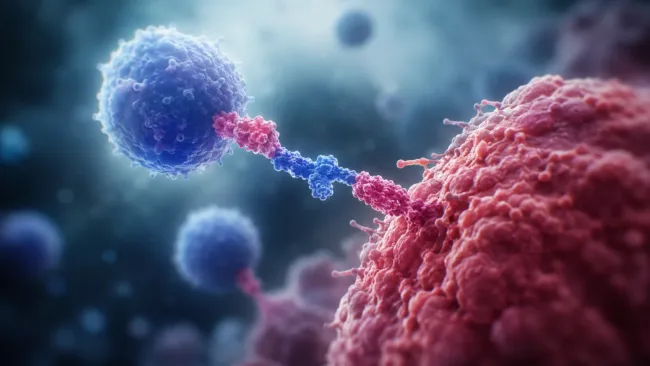
NEOK Bio, Inc. has used the 2026 American Association for Cancer Research annual meeting to put early weight behind its bispecific antibody drug conjugate strategy, presenting preclinical data on NEOK001 and NEOK002 while preparing both assets for Phase 1 entry in the second quarter of 2026. The two candidates, already cleared through Investigational New Drug approval by the United States Food and Drug Administration, are being positioned as next-generation solid tumor therapies that may improve on the efficacy and selectivity limits that have constrained many conventional monovalent antibody drug conjugates.
That matters because the antibody drug conjugate field is no longer a novelty trade. It is a crowded, expensive, and increasingly unforgiving part of oncology, where simply attaching a potent payload to a tumor-targeting antibody is no longer enough to look differentiated. The market now expects better target selection, broader tumor coverage, cleaner safety, smarter linker chemistry, and more convincing evidence that a platform can work beyond a single niche indication. In that context, NEOK Bio is not really selling two poster presentations. It is trying to sell a thesis that bispecific design can widen the therapeutic window in solid tumors, one of the hardest settings in cancer drug development.
Why tumor heterogeneity and off-target toxicity still define the ADC opportunity
The strategic appeal is obvious. Standard antibody drug conjugates often run into a familiar problem. A target may be present on tumors, but it may also appear at lower levels in healthy tissue, which can constrain dosing and limit efficacy. Tumors can also be heterogeneous, with some cells expressing the target strongly and others weakly or not at all. A dual-targeting construct is meant to address both issues at once. In theory, it can improve selective binding in cells that express the right antigen combination while also preserving activity in mixed tumor populations through better internalization and bystander effects. That sounds elegant on a conference poster. The harder question is whether the biology remains elegant in patients.
What NEOK001 reveals about the company’s ambition beyond a narrow single-indication strategy
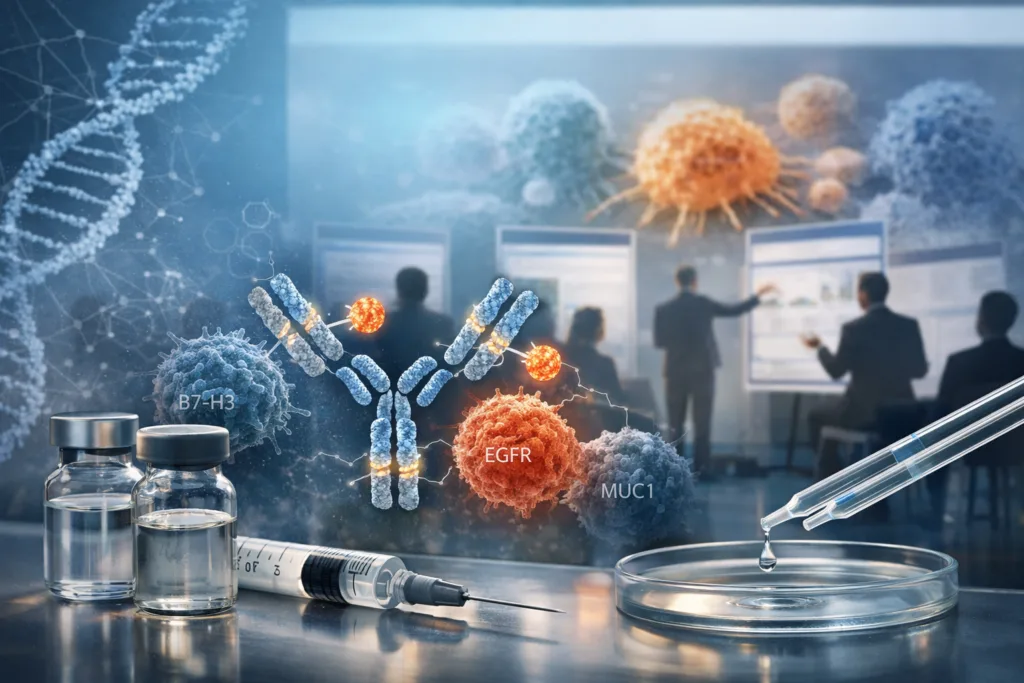
NEOK001, also known as ABL206, is the more obvious flag-planting asset because it targets B7-H3 and ROR1, two proteins that have attracted strong interest in oncology for their expression across multiple solid tumors and their relevance to tumor aggressiveness. The company says the candidate showed broad efficacy across 38 patient-derived xenograft models, with 84% tumor growth inhibition and 53% deep tumor regression across nine major cancer types. Those numbers are designed to send a message beyond simple activity. They suggest NEOK Bio wants investors and industry observers to view NEOK001 not as a narrow, indication-specific asset, but as a platform-grade molecule with tumor-agnostic potential.
That framing is ambitious, and it is also where the risk begins. Patient-derived xenograft models can be useful for showing anti-tumor effect across diverse biological settings, but they are still preclinical systems that do not fully recreate immune interactions, treatment histories, and real-world toxicity complexity in humans. Strong activity across dozens of models looks impressive, but oncology is littered with programs that were powerful in mice and ordinary in the clinic. For NEOK001, the more interesting detail may be that it reportedly outperformed benchmark antibody drug conjugates including trastuzumab deruxtecan and zilovertamab vedotin in selected settings and was able to regress tumors that had regrown after I-Dxd treatment. If that finding translates even partially, it could imply relevance in resistant disease and not just untreated models. That is the kind of angle that catches industry attention fast. The catch is that cross-study or preclinical benchmark comparisons are notoriously slippery, especially when dosing, model choice, and assay conditions differ.
Why safety and pharmacokinetics may matter as much as efficacy for NEOK001
Safety claims are just as important here. NEOK Bio highlighted a favorable profile in GLP toxicology studies, along with stable drug-to-antibody ratio and predictable pharmacokinetics. Those are not glamorous phrases, but they matter in ADC development because many programs stumble not on whether they can kill tumor cells, but on whether they can do so consistently without dose-limiting toxicity, unstable payload behavior, or exposure surprises. A Topoisomerase-1 inhibitor payload such as exatecan is powerful, but it comes with class-level baggage around tolerability and off-target damage. The promise of NEOK001 is therefore not just that it hits harder, but that it might hit smarter. The clinic will decide whether that promise survives contact with actual patients.
How NEOK002 is trying to solve one of EGFR oncology’s oldest commercial problems
NEOK002, or ABL209, may be the subtler asset but perhaps the more commercially intriguing one. It targets EGFR and MUC1, a pairing that attempts to solve a very specific and well-known problem in solid tumor drug development. EGFR is a validated cancer target, but it is also expressed in normal tissues, which has historically made it difficult to exploit aggressively without toxicity. MUC1, meanwhile, is overexpressed or aberrantly expressed in many epithelial cancers. By using a dual-targeting design, NEOK Bio is effectively arguing that it can improve tumor selectivity while dialing down unwanted EGFR engagement in normal tissue.
That is not just a scientific nuance. It is a market positioning argument. The EGFR field is already packed with antibodies, tyrosine kinase inhibitors, and newer targeted approaches. A new entrant has to explain why it deserves clinical oxygen. NEOK002’s answer is that it may offer better internalization and stronger anti-tumor effect in dual-positive tumors while reducing the liabilities that come with broad EGFR-directed activity. The company says the asset achieved tumor regressions in 78% of 36 patient-derived xenograft models, including KRAS-mutant and heavily pretreated tumors. That last detail is especially notable because heavily pretreated solid tumor populations are where commercial need is high, but biological resistance and tolerability challenges often punish ambitious drug designs.
Why the sotorasib combination signal could matter more than the poster headline suggests
The KRAS angle adds another layer of relevance. NEOK Bio also highlighted combination potential with sotorasib, with extended tumor regression for 58 days in KRAS G12C-mutant models. That does not automatically make NEOK002 a combination winner, but it signals that the company is thinking beyond monotherapy positioning. In modern oncology, especially in biomarker-defined solid tumors, the future commercial value of a candidate often depends as much on where it can fit in combination regimens as on its standalone activity. Clinicians and development strategists will be watching whether NEOK002 can eventually be framed as a resistance-management tool, a line-extension opportunity, or a tumor-agnostic combination backbone. Each pathway offers upside, but each also raises the bar on safety, trial design, and partner interest.
What NEOK Bio’s AACR 2026 update says about the second wave of ADC competition
The broader significance of NEOK Bio’s AACR 2026 showing is that it taps into a larger industry shift inside the ADC category. The first wave of ADC enthusiasm was built around validating the modality. The second wave is about refining it. That means better linker chemistry, better payload choice, more precise target biology, and smarter construct engineering. Bispecific ADCs sit squarely inside that second wave. They offer a plausible answer to two of the field’s most persistent questions: how to improve tumor specificity and how to preserve activity in heterogeneous disease. But they also create new manufacturing, comparability, and clinical complexity. A molecule with two targeting arms is not merely a better version of an older format. It can be a more difficult product to characterize, scale, dose, and regulate.
Why the Synaffix linker-payload platform may reduce one layer of development risk
That is one reason the Synaffix technology piece matters more than it might appear at first glance. NEOK Bio’s use of a validated linker-payload platform with a DAR 4 exatecan payload helps reduce one variable in an already complicated development story. In ADCs, consistency of conjugation, payload delivery, and pharmacokinetic behavior can influence everything from manufacturing confidence to regulatory comfort. By leaning on a known technology base for the linker-payload system, NEOK Bio appears to be trying to keep the novelty concentrated in the antibody design rather than reinventing every component at once. For a small oncology developer, that is a sensible risk-management move. Investors like moonshots, but regulators generally prefer fewer moving parts.
What the Phase 1 trials will need to prove before the platform can be taken seriously
Still, the next milestone is where the glamour fades and the hard work begins. Phase 1 trials are expected to start in the second quarter of 2026, with initial clinical data anticipated in 2027. For all the encouraging preclinical language, the first human readouts will be judged on familiar oncology basics: dose escalation behavior, early safety signals, exposure consistency, target-relevant pharmacodynamics, and any hint of durable anti-tumor activity in expansion cohorts. The field has become much less patient with beautiful mechanism stories that fail to produce usable dose levels or meaningful response patterns.
There is also a competitive timing issue. By 2027, the ADC field will likely be even more saturated, with larger players advancing next-generation constructs, dual-target designs, immune-stimulating payload concepts, and smarter combinations. NEOK Bio therefore needs more than scientific novelty. It needs clinical clarity. If NEOK001 can show credible activity in tumors that have become resistant to established ADCs, or if NEOK002 can show that EGFR-based targeting no longer has to mean familiar toxicity tradeoffs, then the company could earn a more serious place in partnership and investor conversations. If the early human data are merely decent, the market may shrug. Oncology is a brutal sector for anything that looks incrementally better but not decisively different.
Why NEOK Bio’s real test begins only after the AACR 2026 buzz fades
The bottom line is that NEOK Bio’s AACR 2026 posters do not yet prove that bispecific ADCs will rewrite the solid tumor treatment playbook. What they do suggest is that the company understands exactly where the ADC market is moving and is trying to position itself ahead of that curve. NEOK001 and NEOK002 are being developed not as generic me-too payload carriers, but as attempts to solve the twin problems of tumor heterogeneity and off-tumor toxicity that have limited many targeted therapies. That makes the story more interesting than a standard conference update. It also makes the coming Phase 1 data far more important. In oncology, elegant engineering gets you attention. Human data decides whether you get a future.