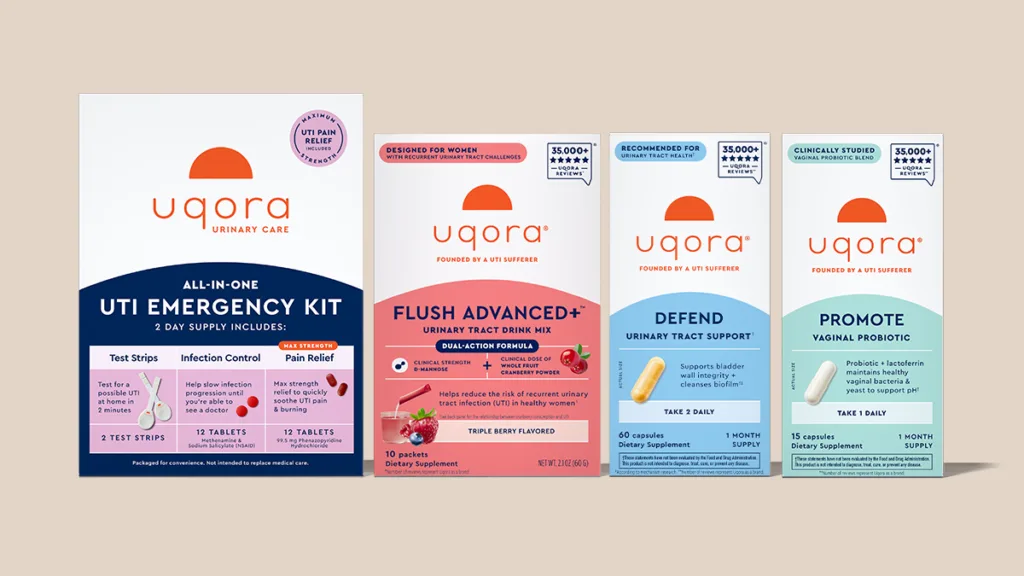
Uqora has launched its urinary and bladder health products in select Target stores and on Target.com, extending the San Diego-based brand’s retail footprint beyond its existing direct-to-consumer and digital channels. The expansion places products such as Uqora Flush Advanced+, Uqora Defend, Uqora Promote, and the UTI Emergency Kit into one of the largest mainstream wellness retail environments in the United States, giving the Pharmavite-owned women’s health brand broader commercial exposure at a time when preventive wellness categories continue to migrate into mass retail.
Why Uqora’s move into Target could accelerate the mainstreaming of urinary health as a retail category
This development matters because urinary tract health has long sat in an awkward middle ground between medical need and consumer wellness. Urinary tract infections are common, recurrent, and highly disruptive, yet the category has historically lacked the broad shelf visibility enjoyed by adjacent areas such as digestive health, immunity, menopause support, or vaginal microbiome products. Uqora’s entry into Target suggests that urinary health is being repositioned as a normalized, proactive purchase rather than a reactive, embarrassment-driven one.
That shift has commercial significance. When a category moves from niche online education and specialty positioning into a national mass merchant, it usually signals that retailers believe consumer awareness has matured enough to support repeat purchasing. It also suggests confidence that the category is no longer too limited, too stigmatized, or too clinically confusing for the average shopper. For Uqora, the reward is obvious: more visibility, more impulse discovery, and a chance to convert curiosity into habitual use. The risk is that mainstream retail exposure also forces the brand to prove that its proposition is simple enough to understand in a crowded aisle where consumers make fast decisions.
The Target launch also works as a reputational filter. Placement in a large retail chain does not amount to clinical validation, but it does indicate that the brand has reached a scale and packaging maturity suited to broader distribution. That matters in a category where consumers often struggle to distinguish between science-backed support, general supplement marketing, and products making claims that are emotionally persuasive but poorly differentiated.
What this retail expansion reveals about how women’s health brands are now being built for omnichannel scale
Uqora’s expansion is not just a store placement story. It reflects a broader playbook in women’s health, where brands often begin with digital storytelling, community-led education, and direct-to-consumer trust building before expanding into physical retail once category awareness improves. In this model, retail is less about replacing online sales and more about validating brand durability while widening the top of the funnel.
That matters because omnichannel strength has become central to consumer health strategy. A brand that lives only online can educate deeply, but scale can be slower and customer acquisition can become expensive. A brand that enters retail too early risks weak sell-through if shoppers do not yet understand the problem it solves. Uqora appears to be moving at the point where it believes awareness of urinary wellness, especially among women seeking preventive approaches, is strong enough to justify a larger physical presence.
For Pharmavite, which already operates across multiple wellness brands, the Target rollout also fits a portfolio logic. Large parent companies increasingly want category brands that can grow from niche loyalty into shelf-ready national businesses. In that sense, Uqora is not only selling urinary health solutions. It is also testing whether a once-underdiscussed category can behave like a broader women’s wellness vertical with repeat purchase potential and cross-sell opportunities.
Still, omnichannel expansion creates pressure. Once products are on shelves, velocity matters. Retailers watch turns, pricing competitiveness, pack architecture, and category fit very closely. A brand can win attention online through detailed explanation, but in-store success often depends on whether the consumer understands the value proposition in seconds. That raises an unresolved question: can Uqora’s product segmentation remain clear enough at shelf level to avoid confusion between prevention, support, symptom relief, and adjacent bladder health positioning?
Why product breadth may help Uqora capture more urinary wellness occasions, but also complicate its message
One of the strongest parts of Uqora’s Target strategy is the breadth of the lineup. The company is not entering with a single hero product alone. It is bringing prevention-focused drink mixes, daily urinary support, vaginal probiotic support, and a UTI-related emergency kit format. That range suggests Uqora is trying to own more of the urinary wellness journey, from proactive care to symptom-adjacent support.
Commercially, that is smart. Categories with multiple entry points are often easier to scale because they allow consumers with different needs to enter the brand ecosystem. A shopper may begin with a product marketed for recurrent urinary support, then later purchase a bladder-focused or microbiome-support product. This kind of ecosystem strategy can raise lifetime value and protect against one-product dependency.
However, product breadth can also dilute a brand if the educational burden becomes too high. Urinary health is already a category that demands careful communication, because shoppers may conflate supplements, preventive support, diagnostic tools, and treatment expectations. If too many products appear to overlap, conversion can slow. If the claims appear too broad or too close to medical treatment language, regulatory scrutiny or retailer caution can increase. That is especially relevant in wellness categories tied to conditions with real clinical and antibiotic treatment pathways.
The strongest brands in health retail do not simply offer many products. They create a clear logic for why each product exists and when it should be used. Uqora’s next challenge is not merely availability. It is whether it can translate a nuanced digital education strategy into retail clarity without losing scientific credibility or slipping into oversimplification.
How Uqora’s Target debut could intensify competition in a still underdeveloped urinary health market
The urinary tract health category remains relatively underbuilt compared with more mature supplement segments. That creates whitespace, but it also invites competition. Once a brand demonstrates that mass retail buyers are willing to allocate shelf space to the category, rivals tend to follow. Competitors may enter through cranberry-based products, D-mannose formulations, bladder support supplements, women’s intimate health platforms, or broader probiotic portfolios looking to extend into urinary wellness.
In that sense, Uqora may benefit from being early, but early leadership is not permanent. The advantage lies in brand recognition, consumer trust, and category education. The vulnerability lies in commoditization. If urinary health becomes a recognized growth segment, lower-cost alternatives and copycat formulations could pressure differentiation. The same shelf visibility that builds category awareness can also make comparison shopping easier.
There is also a broader industry issue at play. Preventive wellness products linked to recurrent health concerns often perform best when they balance lifestyle convenience with credible science. If the category becomes crowded with weak products or overly aggressive marketing, consumer trust can erode across the entire segment. That means Uqora’s long-term opportunity is tied not just to placement but to whether it can help define quality standards in the category.
Why the bigger test now is whether Uqora can convert awareness into lasting consumer trust and repeat sales
The most important question after the Target launch is not whether urinary health deserves more visibility. It clearly does. The real question is whether mainstream exposure will translate into repeat behavior strong enough to support durable retail expansion. Health and wellness shelves are full of products that win a first trial but fail to secure long-term loyalty.
For Uqora, repeat purchase will depend on several things working at once. Consumers need to understand what each product is for. They need to trust that the formulations are credible. They need a reason to stay with the brand rather than switch to cheaper alternatives. And they need to feel that urinary health belongs in an everyday self-care routine rather than only in moments of discomfort or concern.
That is where this launch becomes more than a retail distribution story. It is a test of whether urinary and bladder health can emerge as a defined, modern consumer health category with enough educational clarity, clinical adjacency, and emotional relevance to sustain mainstream demand. If Uqora succeeds, it could help pull urinary wellness out of the shadows and into the same normalized shopping behavior now seen across gut health, menopause care, and intimate wellness. If it falls short, the lesson may be that shelf presence alone cannot overcome a category that still requires too much explanation for fast-moving retail.
Either way, Uqora’s entry into Target is an important market signal. It suggests that retailers, brand owners, and category builders increasingly believe women’s urinary health is no longer a niche conversation. It is becoming a commercial battleground, and perhaps, finally, a visible one.