Medtronic plc has received U.S. Food and Drug Administration (FDA) clearance for its Hugo robotic-assisted surgery (RAS) system in urologic procedures, including prostatectomy, nephrectomy, and cystectomy. The decision allows the Ireland-headquartered medical device giant to formally enter the United States’ high-volume robotic surgery market, long dominated by Intuitive Surgical’s da Vinci platform.
Hugo’s entry into the U.S. could reshape the balance of power in robotic surgery
The FDA approval represents a pivotal moment not only for Medtronic but also for the broader robotic surgery ecosystem in the United States. Urology, particularly prostate surgery, is one of the most mature clinical segments for robotic-assisted procedures. According to industry data, more than 230,000 such urologic surgeries are performed annually in the U.S., and an overwhelming majority have relied on Intuitive Surgical’s da Vinci system.
Medtronic’s Hugo platform brings long-awaited competition into this space. The company is positioning Hugo not just as an alternative system but as part of a broader surgical infrastructure strategy, integrating hardware, digital workflows, and cross-specialty versatility. Industry analysts believe this multi-layered approach could help hospitals manage increasing cost pressures while expanding minimally invasive surgery access to new geographies and specialties.
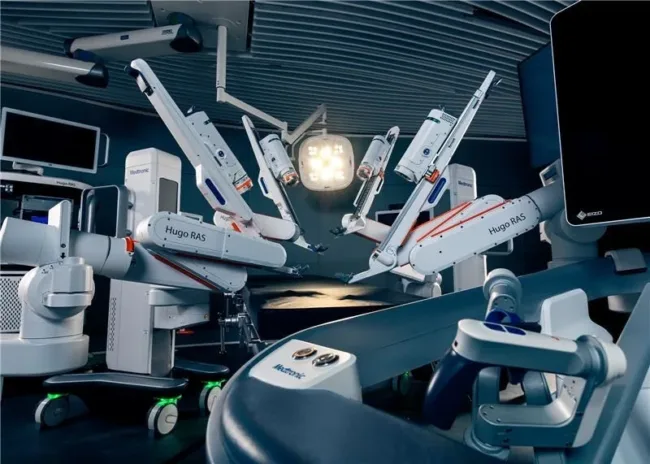
U.S. hospitals have long faced capital investment bottlenecks when attempting to expand their robotic capabilities. The da Vinci platform, while clinically entrenched, is often viewed as rigid in its procurement and upgrade pathways. Medtronic’s entry brings optionality to hospitals that have been awaiting a viable second supplier with both surgical and digital ecosystem capabilities.
Modular architecture and digital ecosystem offer a new take on robotic integration
What differentiates Hugo from most robotic systems currently deployed is its modularity. The robotic arms are designed to be mobile, meaning they can be shared across operating rooms, tailored for specific anatomical needs, and optimized for throughput. This flexibility could help improve asset utilization in multi-theatre hospitals and outpatient surgical centers, where fixed robotic systems often sit idle for large portions of the day.
From a usability perspective, Hugo’s open-console design offers surgeons improved situational awareness and reduced ergonomic strain. Medtronic is also emphasizing the collaborative benefits for the wider surgical team, particularly in training environments and intraoperative coordination.
Equally notable is Hugo’s integration with the Touch Surgery digital platform, which enables secure video capture, AI-based performance analysis, and remote tele-mentoring. In a healthcare environment increasingly focused on outcomes and continuous learning, this capability could help differentiate Medtronic’s offering from single-modality systems that are not connected to a larger digital workflow.
Regulatory and reimbursement experts point out, however, that while such digital tools are valuable, they do not yet have clear billing pathways. For many institutions, the availability of real-time performance insights will be welcomed by surgical teams but may remain a value-add rather than a reimbursable service unless tied to specific clinical or training outcomes.
The delayed U.S. launch now looks more calculated than cautious
Medtronic’s path to U.S. entry has been long. Hugo was first introduced globally several years ago and has already been deployed in more than 30 countries, with tens of thousands of procedures performed in urology, gynecology, and general surgery. While some observers initially viewed the delayed FDA submission as a sign of hesitancy, the company’s expanded clinical dataset and streamlined go-to-market strategy now appear to be deliberate.
Unlike early-stage robotic systems that must pilot in U.S. hospitals while refining hardware and software, Medtronic is launching Hugo in the U.S. with significant procedural history, surgeon feedback, and field-tested stability. The company’s Expand URO study, which was the largest ever conducted in the U.S. for multi-port robotic urologic surgery, demonstrated favorable safety and effectiveness endpoints. The ability to bring this evidence into FDA dialogue likely accelerated the review process and provided confidence to procurement committees assessing platform transitions.
However, questions remain around comparative clinical performance. The published data thus far confirms Hugo meets standard safety and efficacy criteria, but direct comparative trials against da Vinci or other systems have not been publicly disclosed. For value-based hospital systems, this absence may limit the speed of platform conversion unless cost savings or workflow advantages are clearly demonstrated.
From surgical hardware to platform strategy: Medtronic’s broader positioning
What Medtronic is offering with Hugo goes beyond device sales. The company is pitching an integrated surgical platform, supported by its presence across open, laparoscopic, and robotic modalities. This approach could resonate with procurement teams aiming to rationalize vendor contracts and streamline service, training, and inventory across multiple surgical workflows.
Medtronic has also positioned itself as a lifecycle partner rather than a pure-play robotics vendor. Its stated goal is to enable hospitals to tailor the surgical approach—robotic, laparoscopic, or hybrid—based on the patient, not the vendor’s product limitations. This philosophy aligns with trends in personalized surgery and hospital-level optimization, where flexibility and data-driven decision-making are increasingly valued.
From an industry standpoint, Hugo’s approval signals a maturing of the surgical robotics category. For years, analysts predicted the emergence of viable alternatives to Intuitive Surgical, but few contenders were able to combine engineering excellence, regulatory maturity, and commercial scale. Medtronic, by virtue of its surgical portfolio and existing hospital relationships, is arguably the first true full-spectrum competitor.
Commercial uptake will depend on more than device capability
While FDA clearance is a major milestone, real-world adoption will be driven by economics, training, and system support. Medtronic has not disclosed pricing details for Hugo, but the modular architecture and equipment-sharing capabilities are expected to appeal to cost-sensitive institutions. However, even with capital efficiency, adoption requires buy-in from surgical departments, anesthesiology teams, and hospital administration.
Robotic systems also present logistical and workflow challenges, particularly when transitioning from long-established setups. Medtronic has emphasized a phased, partnership-oriented rollout focused initially on leading academic and high-volume hospitals. If successful, this early wave could serve as a proof-of-concept for broader regional expansion.
Medical education stakeholders will also be critical. If Hugo becomes embedded in residency training, it could gain clinical mindshare among new surgeons entering the field. This is particularly important in robotic surgery, where surgeon familiarity often determines platform preference, regardless of price or technical merit.
U.S. clinicians and hospitals will be watching three strategic levers
The immediate focus will be on three questions. First, can Medtronic prove a meaningful difference in cost, flexibility, or clinical outcomes compared to existing systems? Second, how seamlessly can hospitals onboard the system and integrate it into multidisciplinary teams? And third, will the Touch Surgery ecosystem evolve fast enough to support broader digital transformation goals inside the OR?
Clinicians tracking robotic innovation have expressed cautious optimism, especially given Medtronic’s track record in surgical hardware and digital tools. But they also point to unresolved concerns around long-term servicing costs, availability of multi-specialty instruments, and sustained training support.
Meanwhile, procurement experts believe Medtronic may gain early traction with hospitals looking to diversify vendor dependence or replace aging robotic infrastructure without escalating total cost of ownership.
What is clear is that the approval of the Hugo RAS system marks a turning point for Medtronic and for robotic surgery in the United States. The next 12 to 24 months will determine whether this is merely a competitive footnote or a foundational shift in surgical robotics.

How Medtronic’s surgical robotics push could reshape operating rooms nationwide added by Srinath B on
View all posts by Srinath B →