Kanvas Biosciences has received new funding from Gates Foundation to develop an oral, fully synthetic microbiome replacement product for treating and preventing maternal environmental enteric dysfunction in pregnant persons across Southern Asia and Sub-Saharan Africa. The program places the U.S.-based spatial biology and microbial therapeutics company into a difficult but potentially high-impact global health category where intestinal inflammation, impaired nutrient absorption and intergenerational newborn risk remain major unresolved clinical challenges.
Why Kanvas Biosciences is treating maternal EED as a microbiome drug development problem rather than only a nutrition problem
The strategic importance of the Kanvas Biosciences program lies in its decision to treat environmental enteric dysfunction as a microbiome-linked therapeutic problem, not merely as a downstream symptom of poverty, malnutrition or poor sanitation. That distinction matters because EED has historically sat in a difficult clinical grey zone. It is widespread in low-resource settings, strongly associated with impaired growth and immune function, and deeply connected to maternal and child outcomes, yet it has not produced a clean, scalable therapeutic playbook comparable to infectious disease, metabolic disease or inflammatory bowel disease.
Kanvas Biosciences is attempting to move the field toward a more product-defined intervention. The planned oral microbiome replacement product is designed around defined, complex multi-strain consortia rather than a broad dietary supplement or conventional probiotic. That makes the development path more ambitious. A nutrition intervention can aim to improve intake. A microbiome therapeutic has to show that it can safely alter gut ecology, improve biological function, and do so reproducibly across populations where diet, sanitation, background infections and environmental exposures vary widely.
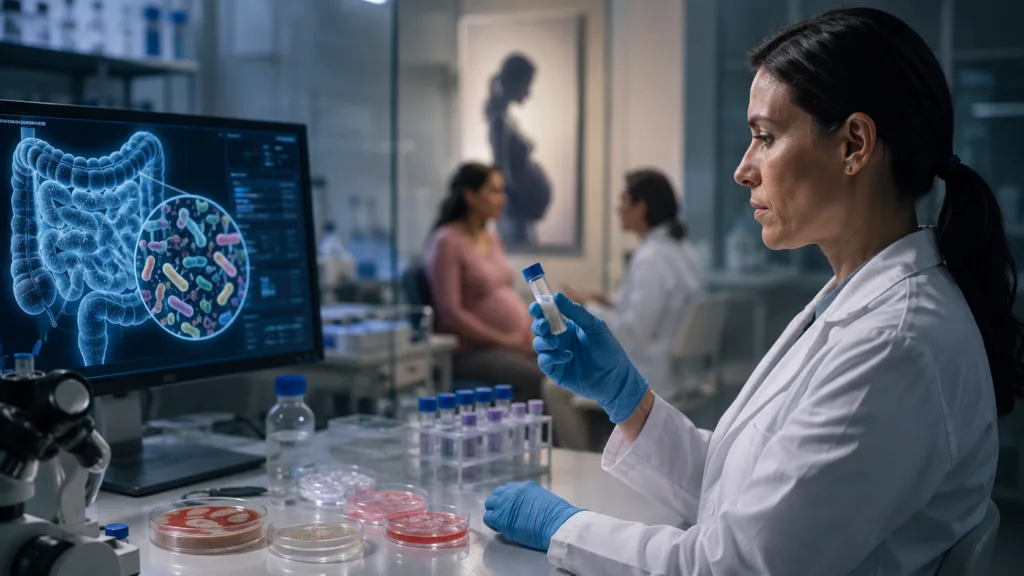
The unresolved question is whether maternal EED can be modified meaningfully through a live biotherapeutic approach at the scale Kanvas Biosciences is targeting. EED is not a single-pathogen condition with a simple eradication logic. It reflects chronic intestinal stress, inflammation, gut barrier disruption and environmental exposure. For Kanvas Biosciences, the opportunity is enormous because maternal intervention could influence both expectant mothers and newborn outcomes. The risk is just as large because the product must work in settings where the underlying drivers of gut dysfunction may persist even after treatment.
How synthetic microbiome replacement could differ from conventional probiotics in global health
The Kanvas Biosciences approach is best understood as part of the next stage of microbiome medicine, where developers are trying to move beyond generic probiotics into rationally designed microbial ecosystems. Conventional probiotic products usually depend on a limited number of familiar strains, often with broad wellness claims and uneven clinical translation. Kanvas Biosciences is instead emphasizing complex consortia with many unique bacterial members, strain selection informed by global metagenomic datasets, and manufacturing designed to produce reproducible live biotherapeutic products.
That is a meaningful shift for environmental enteric dysfunction because the condition may require restoration of broader microbial function rather than the addition of one or two organisms. If gut barrier integrity, nutrient absorption and immune signaling are affected by community-level dysfunction, a richer microbial consortium could theoretically offer a more relevant therapeutic strategy. The company’s emphasis on strains native to impacted regions also reflects a serious translational point. Microbiomes are shaped by geography, diet, environment and early-life exposure, so a product built mainly around Western reference populations may not perform well in Southern Asia or Sub-Saharan Africa.
However, complexity cuts both ways. A multi-strain consortium may be biologically more suitable, but it can also be harder to characterize, regulate, manufacture and clinically validate. Developers must show not only that the strains are safe individually, but that the combined consortium behaves predictably. In maternal health, that safety threshold becomes even higher. Regulators, ethics committees and clinical investigators will likely scrutinize maternal, fetal and neonatal safety signals closely, especially if the product is intended for pregnant populations in low-resource settings.
Why Gates Foundation backing gives the program strategic credibility but not clinical certainty
The Gates Foundation funding gives Kanvas Biosciences more than capital. It signals that maternal environmental enteric dysfunction is being treated as a serious intervention target within global health, especially because EED has long been difficult to translate into mainstream therapeutic development. For a privately held biotech platform company, foundation support can help validate a program that may not fit neatly into the commercial incentives that usually drive drug development in high-income markets.
This matters because the target geographies, Southern Asia and Sub-Saharan Africa, represent areas of high unmet need but challenging reimbursement economics. A product for EED in pregnant persons must be affordable, stable and deployable in low-resource settings, not merely scientifically elegant. Kanvas Biosciences appears to be designing around that reality by emphasizing scalable anaerobic manufacturing, stable formulation and cost structure. That is the right direction, because a live biotherapeutic that requires fragile cold-chain logistics or high per-patient pricing would struggle to reach the populations most affected by EED.
Still, foundation-backed development does not remove the core clinical uncertainty. The program will need to prove that microbiome replacement can achieve measurable health impact, not only microbiome modification. In this field, a convincing signal may require endpoints that connect gut biology to maternal nutrition, infant birthweight, inflammatory markers, immune function or longer-term child development. That is a high bar, especially when background variables such as food access, sanitation, infections and antenatal care may influence outcomes independently of the microbiome product.
How Kanvas Biosciences’ spatial biology platform could shape product design and strain selection
Kanvas Biosciences’ broader platform is relevant because microbiome therapeutics depend heavily on understanding which organisms are present, where they are located, how they interact with host tissue and whether they can be manufactured together. The company’s spatial microbiome imaging platform is intended to map microbial communities and host gene expression in a way that can inform the design of defined consortia. In theory, this gives Kanvas Biosciences a more precise development engine than simple sequencing alone.
The advantage of spatial biology is that it can help developers look beyond presence or absence of strains. In gut disease, location and interaction matter. Bacteria that appear beneficial in one niche may behave differently in another. Host response also matters because a microbial community that looks balanced by sequencing may still fail to repair inflammation or barrier dysfunction. For EED, where gut lining damage and inflammatory disruption are central to the disease model, spatial context could become an important differentiator.
The limitation is that platform sophistication must eventually translate into simple, reproducible clinical performance. Industry observers tracking microbiome drug development have seen many promising platforms struggle when complex biology meets trial variability. Kanvas Biosciences will need to show that its imaging, metagenomic analysis and artificial intelligence models can shorten development time without overfitting to datasets that may not capture real-world heterogeneity across high-burden regions. The strongest proof will not be platform logic. It will be clinical data from relevant geographies.
Why manufacturing may be the hidden make-or-break factor for the Kanvas Biosciences program
For live biotherapeutic products, manufacturing is not a back-office detail. It is part of the therapeutic thesis. Kanvas Biosciences is highlighting vertically integrated anaerobic manufacturing because many gut-associated microbes are difficult to grow, stabilize and combine at scale. If a therapy depends on a complex consortium, reproducibility becomes central to safety, potency and regulatory acceptability.
This is particularly important for a product meant to be affordable and stable in low-resource settings. The company is not only trying to build a microbiome drug. It is trying to build one that can be manufactured consistently, priced appropriately and deployed across climates and health systems that may not support delicate biologics logistics. That makes formulation stability and cost control as important as strain selection.
The risk is that the more complex the consortium, the more difficult it may be to maintain consistency across batches. Live products can vary in viability, relative abundance of strains and functional behavior after manufacturing and storage. Regulators may require a clear potency framework, and clinicians will want confidence that the product administered in one region is functionally comparable to the product tested in another. Kanvas Biosciences’ artificial intelligence models may help identify strains that grow together efficiently during manufacturing, but production success must be demonstrated repeatedly under real operating conditions.
What the oncology pipeline reveals about Kanvas Biosciences’ broader microbiome strategy
Kanvas Biosciences’ existing work on KAN-001 and KAN-004 shows that the EED program is not an isolated bet. KAN-001 is being developed for cancer patients receiving immune checkpoint inhibitors, while KAN-004 targets immune checkpoint inhibitor-induced colitis. Both programs sit in areas where microbiome function, immune response and treatment outcomes are closely linked. That gives Kanvas Biosciences a coherent platform story across oncology, inflammation and global health.
The relevance to EED is that the same platform logic may apply across very different use cases: identify microbial communities associated with healthier outcomes, design consortia to restore function, manufacture them reproducibly and test whether the intervention changes clinical endpoints. In oncology, the commercial incentives may be stronger and the endpoints may be more familiar to drug developers. In maternal EED, the health impact could be broader, but the operating environment is more complex.
This creates a useful tension in the Kanvas Biosciences story. The biotech firm is trying to show that microbiome replacement can be both a high-science therapeutic category and a deployable global health intervention. Success in one area may strengthen confidence in the platform, but evidence cannot simply be transferred from oncology to maternal nutrition. Each indication has its own biology, trial design demands, safety expectations and adoption barriers.
Why maternal EED could become a test case for serious microbiome medicine
Maternal environmental enteric dysfunction may become an important test case because it forces the microbiome field to answer practical questions that go beyond excitement about gut biology. Can a defined consortium treat a condition shaped by poverty, sanitation and chronic exposure? Can a live biotherapeutic be manufactured affordably enough for global health deployment? Can maternal intervention improve infant outcomes in a measurable and clinically meaningful way? These are not small questions, and they are exactly why the Kanvas Biosciences program deserves attention.
For clinicians and regulators, the watch points will likely include safety in pregnant populations, durability of microbiome change, endpoint selection, geographic relevance of study populations and product consistency. For global health stakeholders, the bigger issue will be whether the therapy can fit into maternal care pathways without becoming too expensive or operationally fragile. For microbiome industry observers, the program will test whether platform-driven consortium design can move into areas where the need is massive but the market mechanics are difficult.
The most encouraging aspect of the program is that Kanvas Biosciences appears to be designing for the realities of the target setting from the beginning. Native strain selection, affordability, stability and anaerobic manufacturing are not decorative features in this indication. They are core requirements. The hardest part is that every one of those requirements must hold up in clinical development, manufacturing scale-up and field deployment.
The bottom line is that Gates Foundation funding gives Kanvas Biosciences a credible route to pursue one of the more ambitious applications of microbiome therapeutics. The announcement does not prove that maternal EED can be treated through synthetic microbiome replacement. It does, however, move the field closer to a serious clinical test of whether live biotherapeutic products can address a neglected gut disorder with consequences that extend from mothers to newborns and children. For a microbiome sector still trying to separate durable medicine from elegant biology, that is the part worth watching.