bioAffinity Technologies, Inc. reported first-quarter 2026 results showing sharply higher adoption of CyPath Lung, its noninvasive sputum-based lung cancer diagnostic, even as total consolidated revenue declined after the diagnostics-focused company exited unprofitable pathology services. The update places CyPath Lung at the center of bioAffinity Technologies’ commercial strategy, with physician ordering growth, Department of Defense-backed clinical validation, and pipeline expansion into asthma and chronic obstructive pulmonary disease now shaping the next phase of the company’s story.
Why CyPath Lung’s growth changes the commercial story but not yet the financial one
The most important signal in bioAffinity Technologies’ first-quarter update is not the headline revenue decline. It is the contrast between a shrinking legacy service base and a faster-growing core diagnostic product. CyPath Lung unit sales rose 146 percent year over year, while CyPath Lung testing revenue increased approximately 114 percent to $361,000 from $169,000 in the prior-year quarter. That suggests the U.S.-based diagnostics firm is beginning to see real-world physician uptake for a test positioned between imaging uncertainty and invasive tissue sampling.
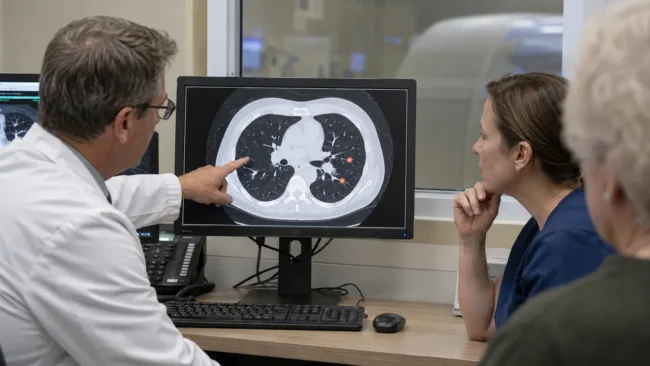
That shift matters because lung cancer diagnostics remain one of the more difficult areas in respiratory medicine. Low-dose computed tomography screening can detect suspicious nodules, but indeterminate findings frequently create a clinical dilemma. Some patients undergo repeat imaging, some move toward biopsy, and others face uncertainty that can persist for months. CyPath Lung is being positioned as a risk-stratification tool for high-risk patients with small indeterminate lung nodules, particularly where clinicians need additional evidence before escalating to invasive procedures.
The limitation is scale. A 114 percent increase in CyPath Lung testing revenue looks strong in percentage terms, but $361,000 remains a small commercial base. For industry observers, that makes the first quarter less a proof of market dominance and more a proof that adoption is moving in the right direction. bioAffinity Technologies still has to show that ordering physicians can be expanded efficiently, that repeat ordering behavior can deepen, and that the test can move beyond early adopter practices into broader pulmonary workflows.

How CyPath Lung is trying to occupy the gap between imaging and biopsy decisions
CyPath Lung’s clinical proposition is built around a simple but commercially powerful idea: not every suspicious lung nodule should automatically trigger invasive testing, but clinicians need more than imaging alone to decide what comes next. The test uses flow cytometry and proprietary artificial intelligence to identify cell populations in sputum associated with malignancy. In a high-risk patient population with small indeterminate nodules below 20 millimeters, bioAffinity Technologies has reported 92 percent sensitivity, 87 percent specificity, 88 percent accuracy, and 99 percent negative predictive value.
The 99 percent negative predictive value is especially important for the commercial argument. In diagnostics, a test that can help rule out malignancy with confidence may reduce unnecessary procedures, lower patient burden, and support more rational use of specialist resources. That is the narrative behind the company’s patient case studies, where negative CyPath Lung results reportedly helped avoid invasive biopsies after other tests or imaging raised concern.
However, clinicians and payers will look beyond selective case studies. Negative predictive value depends heavily on disease prevalence and patient selection. A performance profile that looks compelling in one defined high-risk cohort may not translate automatically across broader screening populations, different practice settings, or mixed-risk patients. This is why the company’s longitudinal clinical trial strategy is not just an academic exercise. It is central to whether CyPath Lung can earn the kind of evidence base needed for broader standard-of-care consideration.
Why the Department of Defense and VA pathway could matter for clinical adoption
The launch of a large-scale longitudinal clinical trial partially funded by the U.S. Department of Defense gives bioAffinity Technologies a strategically useful validation route. The planned study is expected to include up to 20 clinical sites, including Department of Veterans Affairs medical centers and leading U.S. military hospitals, with support from the John P. Murtha Cancer Center Research Program at several federal facilities. For a small diagnostics firm, access to federal medical networks can create evidence credibility that would be difficult to build through commercial outreach alone.
The military and veteran population may also be clinically relevant. Smoking history, occupational exposure, and age-related lung cancer risk make lung nodule evaluation a meaningful issue across federal healthcare systems. If CyPath Lung can demonstrate utility in these settings, bioAffinity Technologies could gain a stronger clinical argument for use among high-risk patients whose imaging results are inconclusive.
The unresolved question is whether federal validation converts into routine ordering, reimbursement support, and guideline-level recognition. Trials can generate confidence, but diagnostics adoption often depends on workflow integration, payer coverage, coding clarity, physician education, and evidence that testing changes management in a cost-effective way. The Department of Defense and VA connection gives CyPath Lung a stronger platform, but it does not remove the commercial execution burden.
What the Q1 revenue decline reveals about bioAffinity’s portfolio reset
Total consolidated revenue declined approximately 27 percent to $1.4 million from $1.9 million in the first quarter of 2025. On the surface, that looks like a weak financial print. The underlying explanation is more nuanced. bioAffinity Technologies discontinued certain unprofitable pathology services in March 2025 to focus on higher-margin services, including CyPath Lung testing. That means the revenue decline partly reflects intentional pruning rather than pure demand erosion.
This is often the painful middle stage for small diagnostics companies. Management wants investors to focus on higher-quality revenue, but the income statement still shows pressure because the growth engine has not yet replaced the legacy base. Direct costs and expenses declined 32 percent to $0.9 million, suggesting the portfolio reset did reduce some cost burden. At the same time, selling, general and administrative expenses rose to $3.2 million from $2.5 million as bioAffinity Technologies added personnel and support services to scale CyPath Lung commercialization.
That trade-off will define investor sentiment through 2026. More sales infrastructure is necessary if CyPath Lung is to expand physician adoption. But a higher commercial spend ahead of meaningful revenue scale increases near-term cash burn. For a microcap diagnostics company, the market usually gives only limited patience unless adoption metrics, reimbursement momentum, or strategic validation begin to reduce financing anxiety.
Why cash runway is becoming the real investor test for bioAffinity Technologies
bioAffinity Technologies ended March 31, 2026 with $3.1 million in cash and cash equivalents, down from $6.4 million at the end of December 2025. Net loss for the first quarter was $3.6 million, compared with a net loss of $2.7 million in the prior-year period. That widening loss is not unusual for a diagnostics company moving from development into commercialization, but it sharpens the cash runway question.
The company’s public market profile reflects that tension. BIAF remains a small-cap and highly speculative healthcare stock, with recent trading around the low single-digit dollar range and a market value that still reflects investor caution rather than broad conviction. The stock has shown volatility, which is common among diagnostics microcaps where commercial updates, financing risk, and clinical validation news can quickly reshape sentiment.
The optimistic reading is that CyPath Lung adoption is accelerating from a small base, physician offices and clinics ordering the test rose 69 percent year over year, and new clinical evidence could strengthen payer and institutional interest. The cautious reading is equally clear: the company needs capital discipline, commercial proof, and a larger revenue base before the equity story can move beyond early traction. Investors are not only asking whether CyPath Lung works. They are asking whether bioAffinity Technologies can afford to scale it.
How the asthma and COPD companion testing strategy expands the platform thesis
bioAffinity Technologies is also trying to show that its flow cytometry and artificial intelligence platform is not limited to lung cancer risk stratification. The collaboration with Brooke Army Medical Center is evaluating whether the platform can detect biologic drug receptors in sputum, including those associated with dupilumab and benralizumab, to guide personalized therapy selection and monitor patient response over time. If successful, this could move the platform into precision respiratory medicine for asthma and chronic obstructive pulmonary disease.
That broader platform story matters because single-product diagnostics companies often face narrow valuation ceilings until they prove repeatable technology utility. A platform that can support lung cancer detection, asthma biologic selection, and chronic obstructive pulmonary disease assessment would create a larger addressable market and potentially diversify revenue over time. It would also align with a broader industry move toward noninvasive, biomarker-led respiratory care.
Still, this remains early-stage pipeline work. A 40-patient collaborative study can support feasibility, but it cannot yet prove commercial utility, payer value, or regulatory durability. The respiratory biologics market is competitive, and companion-style diagnostics need clear evidence that they improve therapy selection or monitoring enough to change prescribing behavior. For now, the asthma and chronic obstructive pulmonary disease work is best viewed as optionality, not a near-term revenue driver.
What clinicians, payers, and investors are likely to watch next
The next phase for bioAffinity Technologies will be judged by a more demanding set of metrics than unit growth alone. Clinicians will watch whether longitudinal data confirm that CyPath Lung meaningfully improves decision-making for indeterminate lung nodules. Payers will look for evidence that the test reduces unnecessary procedures, supports earlier diagnosis, or improves resource allocation. Investors will watch whether physician ordering growth translates into repeat utilization, expanding revenue, and a credible path through cash constraints.
The medical and scientific advisory board additions also suggest that bioAffinity Technologies is trying to professionalize its clinical implementation strategy. Bringing pulmonary and lung cancer specialists into advisory roles can help refine evidence priorities and clinical messaging. Yet advisory strength does not guarantee adoption. The market will want to see whether expert involvement leads to deeper guideline discussions, stronger trial design, and practical workflows that busy pulmonology practices can actually use.
The sharper conclusion is that bioAffinity Technologies has moved CyPath Lung into a more interesting commercial phase, but not yet a de-risked one. The first quarter showed evidence of product-level momentum, especially in ordering growth and CyPath Lung testing revenue. It also exposed the financial reality of scaling a diagnostics business from a small base. For CyPath Lung, 2026 is less about proving that physicians are curious. It is about proving that curiosity can become routine clinical behavior.