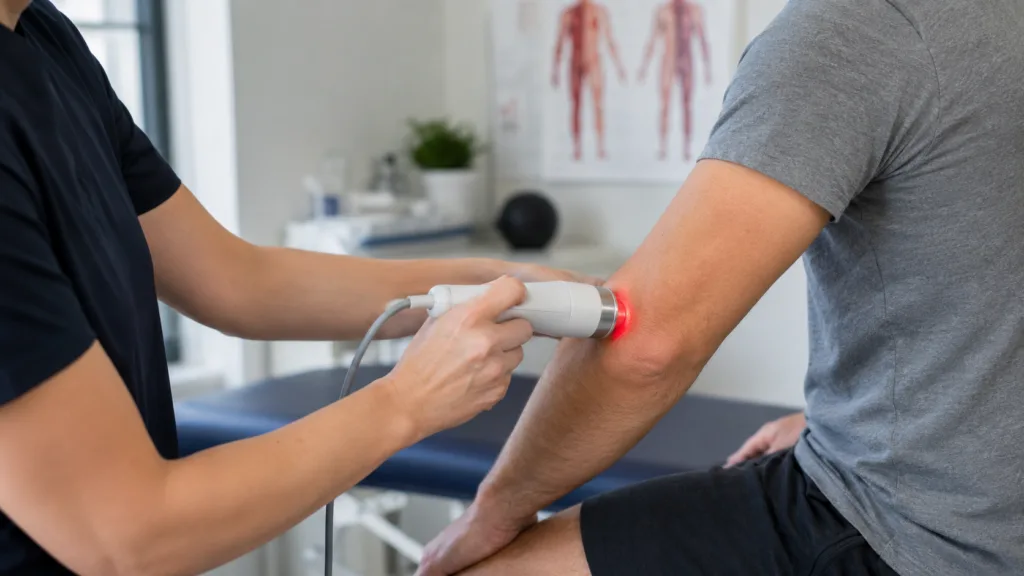
Multi Radiance Medical has secured FDA 510(k) clearance for the MR5 ACTIV PRO Super Pulsed Laser for adjunctive temporary pain relief associated with lateral epicondylitis, commonly known as tennis elbow. The clearance expands the U.S. medical device manufacturer’s labeled indications after a randomized, triple-blinded, placebo-controlled, multicentre clinical trial supported the device’s use in a common musculoskeletal pain condition.
Why does MR5 ACTIV PRO’s lateral epicondylitis clearance matter beyond another pain device label?
The genuine change is not simply that Multi Radiance Medical has added another indication to its portfolio. The more meaningful signal is that photobiomodulation therapy is being positioned with condition-specific clinical evidence in a musculoskeletal disorder where routine care is still fragmented, recurrence is common, and clinicians often balance symptom control against uncertain durability.
Lateral epicondylitis is a high-volume but often underestimated condition. It affects athletes, manual workers, office workers, technicians, healthcare staff, and others whose daily activities place repeated stress on wrist extensor tendons. For clinics, the condition can be frustrating because it is painful enough to impair grip strength and productivity, yet it is rarely treated through one universally accepted pathway. Exercise, bracing, non-steroidal anti-inflammatory drugs, corticosteroid injections, platelet-rich plasma, shockwave therapy, ultrasound-based approaches, and surgery all occupy different parts of the treatment landscape, but none has removed the need for safer and more predictable non-invasive options.
That is where Multi Radiance Medical’s clearance becomes commercially and clinically relevant. The MR5 ACTIV PRO Super Pulsed Laser is not entering a blank market. It is entering a crowded field in which clinicians already have tools, but many of those tools carry trade-offs around durability, cost, patient convenience, evidence strength, or invasiveness. A non-invasive device with a labeled role in temporary pain relief could fit naturally into physical therapy, sports medicine, rehabilitation, occupational health, and musculoskeletal pain clinics. The risk is that a pain relief indication, even one backed by a stronger trial design than many device claims in this category, does not automatically prove broader functional recovery or long-term disease modification.
What does the trial design reveal about the strength and limits of the evidence?
The pivotal evidence is stronger than a typical small open-label device study because it used randomization, placebo control, triple blinding, and multiple clinical sites. Those design features matter in pain studies because subjective endpoints are highly vulnerable to expectation effects, therapist influence, patient perception, and placebo response. In a field where device-based interventions can be visually and procedurally difficult to blind, a sham comparator strengthens the interpretability of the pain signal.
The study enrolled 50 adults aged 18 to 50 with unilateral lateral epicondylitis and baseline pain of at least 50 on a visual analogue scale. Participants received active photobiomodulation therapy combined with static magnetic field or a placebo procedure twice weekly for three weeks, with follow-up after treatment. The headline outcome was clinically persuasive at first glance, with 72% of active-treatment participants meeting the responder definition compared with 40% in the placebo group. That responder definition, at least a 30% reduction in pain intensity from baseline, is clinically understandable because it moves beyond a statistically detectable change and asks whether the patient experienced a meaningful improvement.
The limitation is equally important. Pain intensity improved, and the trial also showed reductions in tumour necrosis factor alpha levels, suggesting a possible anti-inflammatory biological signal. However, the study did not show significant between-group improvement in forearm disability scores, grip strength, or treatment satisfaction. For clinicians, that distinction is critical. Pain relief can support rehabilitation, sleep, work tolerance, and patient confidence, but lateral epicondylitis care is rarely judged by pain alone. A patient who hurts less but does not regain grip strength or function may still face practical limitations in work, sport, and daily activities.
How does this clearance compare with existing options for tennis elbow treatment?
The new indication gives Multi Radiance Medical a clearer regulatory and marketing position in a therapeutic area where treatment decisions are often pragmatic rather than protocol driven. Conservative care remains the backbone of lateral epicondylitis management, especially education, activity modification, load management, and progressive exercise. These approaches are low risk and widely accessible, but they can require time, adherence, and clinician supervision, which means real world outcomes are uneven.
Corticosteroid injections can offer rapid short-term pain relief, which explains their continuing appeal in clinical practice. The strategic weakness of steroid use is durability. Recurrence and poorer longer-term outcomes have pushed many clinicians to become more selective with injections, especially for patients whose symptoms are linked to ongoing occupational or sport-related loading. Platelet-rich plasma and other injection-based biologic approaches aim to address healing rather than just pain suppression, but they introduce cost, variability in preparation, procedural requirements, and reimbursement uncertainty.
Against that backdrop, MR5 ACTIV PRO occupies a different niche. It does not need to displace exercise therapy, injections, or other modalities to become commercially relevant. Its most realistic path is as an adjunctive tool used to reduce pain enough to support rehabilitation and restore tolerability of activity-based recovery. The risk is that adjunctive positioning can also make adoption harder to measure. If a patient improves after receiving laser therapy, exercise, ergonomic changes, and time, clinicians and payers may still ask which component created the clinical value.
What does the FDA 510(k) route mean for regulatory confidence and market expectations?
The 510(k) clearance is important because it gives the MR5 ACTIV PRO a defined U.S. regulatory status for adjunctive temporary pain relief associated with lateral epicondylitis. It also places the device within the established framework for powered light-based laser devices with non-heating effects used in pain therapy. For clinics and procurement teams, that regulatory clarity can reduce hesitation compared with devices making broad wellness or non-specific performance claims.
However, the 510(k) pathway should not be overinterpreted. It is not the same as a premarket approval pathway for high-risk devices, nor does it imply broad superiority over all competing treatments. In practical terms, the clearance supports use under labeled conditions and gives Multi Radiance Medical a stronger foundation for clinical positioning. It does not resolve questions around long-term outcomes, comparative effectiveness, payer coverage, or whether the treatment changes the natural course of tendon pathology.
This distinction matters for medtech observers because musculoskeletal pain is a tempting market for device manufacturers. The patient population is large, the need for non-opioid and non-invasive options is clear, and clinicians remain open to modalities that can reduce pain without adding pharmacological risk. Yet regulators, insurers, and evidence-focused clinicians are increasingly alert to device claims that stretch beyond the data. Multi Radiance Medical’s challenge will be to keep its messaging aligned with the actual label, pain relief as an adjunctive temporary use, rather than implying a comprehensive cure for lateral epicondylitis.
Why could the absence of functional improvement become the main commercial question?
The most important unresolved issue is whether pain relief translates into meaningful functional recovery in routine care. Lateral epicondylitis is not only a pain condition. It is also a performance and participation problem. Patients often seek care because they cannot lift, grip, type, play sport, use tools, or perform repetitive work without discomfort. A treatment that reduces pain but does not clearly improve disability or grip strength may still be useful, but its clinical value proposition becomes narrower.
This does not weaken the clearance itself, because the labeled indication concerns temporary pain relief. It does, however, shape how clinicians may use the device. A sports medicine physician or physiotherapist may view MR5 ACTIV PRO as a way to create a pain window during which strengthening and load progression become easier. A payer or clinic administrator may view the same evidence more cautiously, especially if treatment sessions add cost, appointment time, and device amortisation without proven improvement in function.
The placebo response also deserves attention. Forty percent of placebo-treated patients met the clinical success threshold, which is not unusual in pain studies but is highly relevant for interpretation. A meaningful placebo response does not invalidate the active-treatment benefit, especially when the active group performed better. It does remind the market that patient interaction, treatment ritual, natural recovery, and contextual effects are powerful in musculoskeletal pain care. For Multi Radiance Medical, future data that show durability, functional gains, reduced medication use, faster return to activity, or fewer escalations to injections would strengthen the commercial case considerably.
How could the new indication affect adoption across rehabilitation and sports medicine clinics?
The most immediate commercial opportunity is likely to come from clinics that already use energy-based modalities and want condition-specific support for broader musculoskeletal pain services. Rehabilitation providers, sports medicine practices, chiropractic clinics, occupational health programmes, and multidisciplinary pain clinics may see the clearance as a way to expand non-invasive treatment menus. The device’s drug-free profile is commercially useful in a healthcare environment still looking for ways to reduce reliance on medication-led pain pathways.
Workflow will be decisive. A device can have regulatory clearance and still struggle if it is difficult to schedule, difficult to bill, difficult to explain to patients, or poorly integrated into rehabilitation protocols. Clinics will need clarity on session frequency, treatment duration, staffing requirements, safety checks, documentation, and whether the device is best deployed before exercise therapy, after manual therapy, or as a standalone pain-relief visit. The more standardized the protocol becomes, the easier it will be for Multi Radiance Medical to support training, procurement, and reproducible outcomes.
Reimbursement remains a significant unknown. Many physical medicine technologies face uneven coverage, especially when payers classify them as adjunctive modalities rather than essential interventions. If clinics rely on cash-pay models, adoption may skew toward sports medicine, wellness-oriented rehabilitation, and higher-income patient segments. If stronger outcomes data support medical necessity or reduced downstream resource use, the device could gain a more durable place in mainstream musculoskeletal care.
What does this development reveal about Multi Radiance Medical’s wider device strategy?
Multi Radiance Medical appears to be building a portfolio strategy around condition-specific evidence rather than relying only on broad photobiomodulation claims. That matters because the therapeutic laser market has long carried a credibility gap. Clinicians may be interested in light-based therapy, but they also want dosing clarity, biological plausibility, controlled clinical evidence, and regulatory claims that match the data.
The MR5 ACTIV PRO uses a combination of 905 nm super pulsed laser, 850 nm infrared, and 660 nm red light technology. From an industry perspective, the device’s differentiation is not merely the wavelengths or hardware design. It is the attempt to pair those technical parameters with a defined indication and a reproducible treatment protocol. In medtech, this is often the difference between a product that sits in the broad wellness category and a product that can be discussed seriously in evidence-driven clinical settings.
The risk is that the company’s scientific story still needs broader independent validation. The published trial included a small patient population, short follow-up, and disclosed relationships involving Multi Radiance Medical. Those factors do not negate the findings, but they do raise the bar for follow-on studies. Larger independent trials, pragmatic real world studies, longer follow-up periods, and head-to-head comparisons against standard conservative care would give the platform greater credibility with cautious clinicians and institutional buyers.
What should clinicians, payers, and medtech observers watch after the clearance?
The next phase will be less about the FDA clearance itself and more about implementation. Clinicians will watch whether MR5 ACTIV PRO produces consistent pain relief across broader patient groups, including older adults, chronic cases, workers with persistent ergonomic exposure, and patients who have already failed first-line therapy. The original trial population was relatively small and age-limited, so generalisability remains a practical question.
Payers and procurement leaders will watch whether the device can demonstrate value beyond statistically significant pain reduction. The strongest future case would combine pain relief, functional improvement, reduced recurrence, lower use of injections or medications, faster return to work, and better rehabilitation adherence. Without that wider evidence package, adoption may still occur, but it may remain concentrated in clinics that already favour device-based modalities.
Industry observers will watch whether this clearance encourages more rigorous evidence generation across photobiomodulation therapy. If Multi Radiance Medical can use the lateral epicondylitis indication as part of a broader evidence-led musculoskeletal pain strategy, the company could strengthen its position in a market where non-invasive, non-drug options remain attractive but scrutinised. The smarter reading is not that MR5 ACTIV PRO has solved tennis elbow. It is that the device now has a more credible regulatory and clinical entry point into a stubborn, high-volume pain condition where better adjunctive tools are still needed.
Why is the real test for MR5 ACTIV PRO now commercial execution rather than regulatory permission?
Multi Radiance Medical has cleared an important regulatory hurdle, but the more difficult test begins in the clinic. FDA clearance can open doors, support sales conversations, and validate a specific indication, but it does not guarantee reimbursement, clinician enthusiasm, or patient demand. In musculoskeletal care, adoption usually depends on whether a treatment is easy to integrate, easy to justify, and easy to connect with outcomes that matter to both patients and providers.
The MR5 ACTIV PRO Super Pulsed Laser has a stronger story than many device-led pain products because the lateral epicondylitis indication is supported by a controlled trial rather than only mechanistic rationale. Still, the study’s limitations are exactly where the future opportunity lies. If Multi Radiance Medical can show that short-term pain relief helps patients complete rehabilitation, regain function, return to work, and avoid more invasive escalation, the clearance could become a meaningful platform for growth. If the evidence remains confined to short-term pain reduction, the device may still find a role, but a more selective one.
For the medical device sector, this is a useful case study in how evidence, regulation, and commercial strategy now intersect in pain management. The market wants non-opioid, non-invasive tools. Clinicians want credible data. Payers want measurable value. Patients want relief that helps them function, not only a better pain score. Multi Radiance Medical has gained a clearer seat at that table with MR5 ACTIV PRO. Whether it becomes a routine part of lateral epicondylitis care will depend on the evidence the company and independent researchers generate next.Why Multi Radiance Medical’s MR5 ACTIV PRO clearance matters for tendon pain treatment