
Acousia Therapeutics GmbH has disclosed positive top-line efficacy results for ACOU085, also known by the international nonproprietary name bimokalner, from the completed Phase 2a PROHEAR Study in cisplatin-induced ototoxicity. The exploratory trial evaluated a 6 mg transtympanic dose of the drug against placebo in testicular cancer patients receiving cisplatin-based chemotherapy, placing the German clinical-stage biotech firm’s Kv7.4 activator in a clinically important but still underdeveloped area of oncology supportive care.
Why does Acousia Therapeutics’ Phase 2a signal matter for chemotherapy hearing loss prevention?
The significance of the bimokalner readout is not simply that another early-stage biotech asset has produced a positive Phase 2a signal. Its more important implication is that it keeps alive the possibility of preventing inner-ear damage in adult cancer patients before permanent hearing loss becomes a survivorship burden. Cisplatin remains a highly effective chemotherapy across multiple tumour types, yet its ototoxicity profile has long forced clinicians into a difficult trade-off: protect cancer outcomes first, then manage hearing damage after it appears.
That clinical reality has made cisplatin-induced hearing loss a frustrating field for drug developers. Monitoring can detect damage, audiology follow-up can quantify it, and hearing aids or cochlear implants can support some patients after injury has occurred. None of those interventions truly solves the biological problem of protecting cochlear structures during treatment. A drug that can preserve hearing thresholds during cisplatin exposure would therefore sit in a different category from rehabilitation technologies, because it would target the injury pathway rather than compensate for its consequences.
The risk is that early otoprotection signals can look promising before they are tested against harder regulatory and functional expectations. The PROHEAR results are top-line and preliminary, with further analysis and publication still pending. The trial’s readout appears clinically encouraging because hearing threshold increases were reduced at affected frequencies, but industry observers will want to see the magnitude of benefit, consistency across patients, durability after treatment completion, safety findings, and whether the signal extends from extended high-frequency measures into outcomes that patients recognise in daily listening environments.
How does bimokalner’s local ear delivery strategy differ from systemic otoprotection approaches?
Bimokalner’s positioning is particularly interesting because it is being developed as a local otoprotective therapy, delivered through transtympanic administration into the middle ear using a slow-release gel formulation. That approach is conceptually different from systemic strategies such as sodium thiosulfate, which has an established role in reducing cisplatin-related ototoxicity risk in certain paediatric cancer settings. For adult patients, and especially for metastatic disease settings where chemotherapy intensity and tumour control remain central, the field still lacks a broadly applicable pharmacological standard that clinicians can easily map across indications.
Local delivery gives Acousia Therapeutics a potentially cleaner strategic narrative. If a therapy can concentrate exposure near the cochlea while limiting systemic interaction with cisplatin, it may help address one of the central concerns in otoprotection: whether protecting normal tissue could also interfere with the anticancer activity of chemotherapy. That concern has shaped the development and adoption of otoprotective agents for years, particularly in populations where cure rates, relapse risk and metastatic biology require extreme caution.
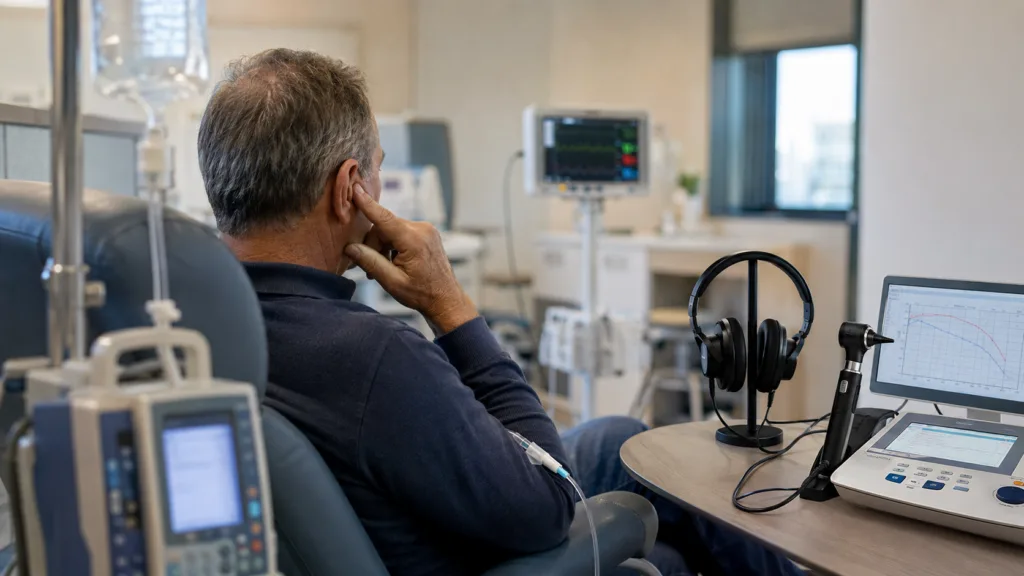
However, local delivery is not an automatic commercial advantage. Transtympanic administration is familiar to ear, nose and throat specialists, but it is not a routine part of most oncology infusion workflows. A preventive therapy that has to be coordinated before each cisplatin cycle would require scheduling between oncology teams, audiology services and otolaryngology clinicians. That could be feasible in academic centres and selected high-risk programmes, but scalability in community oncology would depend on clear clinical value, simple administration protocols, tolerability, reimbursement support and evidence that the procedure burden is justified.
What does the PROHEAR split-body design strengthen and where does it still leave uncertainty?
The PROHEAR Study used a split-body design, with patients acting as their own control through treatment in one ear and placebo in the other. For cisplatin-induced ototoxicity, that design has obvious methodological appeal because systemic chemotherapy exposes both ears, while individual susceptibility to hearing damage can vary sharply across patients. By comparing ears within the same patient, the trial can reduce confounding from age, baseline hearing, cisplatin dose, treatment schedule and genetic or physiological vulnerability.
The study population also strengthens the biological test. Young male testicular cancer patients receiving cisplatin represent a group in which long-term survivorship and treatment-related quality of life are highly relevant. The fact that more than 90% of participants developed ototoxicity in at least one ear after three cisplatin cycles underscores how high the event rate can be in a carefully selected risk population. The hearing loss was mainly seen in the extended high-frequency range, which is consistent with the way cisplatin ototoxicity often emerges before broader speech-frequency impairment becomes more obvious.
The limitation is that a split-ear result does not fully answer the questions regulators, payers and clinicians will eventually ask. A difference between ears in pure-tone audiometry is useful for proof of principle, but it is not the same as demonstrating patient-level benefit across both ears in a larger population. Future studies will need to show whether bimokalner can reduce clinically meaningful bilateral hearing loss, preserve speech understanding in real-world conditions, reduce tinnitus burden, and maintain benefit beyond the immediate post-chemotherapy window. The field will also want clarity on whether the observed benefit remains meaningful at conventional frequencies, not only in extended high frequencies.
Why could extended high-frequency hearing preservation become a meaningful clinical endpoint?
Extended high-frequency hearing is sometimes treated as a technical audiology detail, but in cisplatin ototoxicity it can function as an early warning system. Damage often begins at higher frequencies before progressing into the range most associated with speech perception. A therapy that prevents threshold shifts in the 10 kHz to 16 kHz range could therefore be clinically important if it signals protection against the earliest measurable cochlear injury.
That said, the endpoint debate will matter. Regulators and clinicians may accept high-frequency audiometry as a sensitive measure of ototoxicity, especially in early development, but adoption will be stronger if later trials connect those measurements with outcomes that patients, oncologists and payers understand. Hearing preservation becomes commercially compelling when it can be tied to communication, employment, education, tinnitus, social functioning and long-term survivorship quality.
This is where bimokalner’s next evidence package must do more than confirm a statistically favourable audiogram. The drug candidate will need to demonstrate that its biological signal is robust enough to change clinical practice. If the benefit is limited to subtle high-frequency differences without clear functional consequences, the product could face adoption friction. If, however, high-frequency protection proves to be an early marker for broader hearing preservation, Acousia Therapeutics would have a stronger case for moving the programme into larger and more practice-changing trials.
How does Kv7.4 activation give Acousia Therapeutics a differentiated mechanism in otoprotection?
Bimokalner is designed to modulate the KCNQ4-encoded Kv7.4 potassium channel, which is expressed in cochlear outer hair cells. That makes the programme mechanistically different from approaches that mainly focus on neutralising oxidative stress or altering cisplatin pharmacology. The commercial and scientific appeal lies in the possibility of preserving outer hair cell function and integrity, which would place the drug closer to a cochlear protection strategy than a general chemotherapy detoxification strategy.
If the mechanism continues to hold up clinically, Acousia Therapeutics may gain more than a single indication opportunity. Kv7.4 activation could support a broader inner-ear pharmacology platform, with potential relevance across multiple forms of sensorineural hearing loss. The German biotech firm has already positioned its work around acute and chronic hearing loss, and a positive cisplatin setting could provide the translational proof needed to justify expansion into other ototoxic or degenerative contexts.
The unresolved question is whether a mechanism that looks compelling in preclinical models can travel across disease settings without losing effect size. Cisplatin-induced ototoxicity is an acute, treatment-linked injury model, while age-related, noise-induced or aminoglycoside-associated hearing loss may involve different timelines, cellular stress patterns and patient characteristics. Industry observers will therefore treat the PROHEAR signal as meaningful target validation, but not as proof that the same pharmacology will automatically work across the full sensorineural hearing loss landscape.
What regulatory and commercial questions remain before bimokalner can move beyond proof of principle?
The next development challenge is likely to be trial design rather than headline science. A Phase 2a split-body study can establish biological plausibility, but a registrational path would probably need larger, patient-level evidence showing that bimokalner prevents clinically meaningful hearing loss without compromising cancer care. That means future studies may need to track chemotherapy exposure, oncologic outcomes, audiometric endpoints, patient-reported outcomes, tinnitus, speech discrimination and longer-term durability.
Regulatory agencies will also scrutinise safety in a distinctive way. Inner-ear drugs delivered locally may avoid some systemic exposure concerns, but repeated transtympanic administration still requires data on local tolerability, ear pain, infection risk, tympanic membrane effects, vestibular symptoms and procedure-related discontinuations. In oncology populations, even a low procedural burden can become important when patients are already managing chemotherapy visits, imaging, laboratory monitoring and treatment-related adverse events.
Commercially, bimokalner would need to find its place between oncology supportive care, otolaryngology and audiology. That is both an opportunity and a complication. Supportive-care products can become highly valued when they protect long-term quality of life without disrupting cancer treatment. However, they often require strong education efforts because the prescribing decision may involve one specialist, administration may involve another, and the downstream benefit may be captured by survivorship and hearing-care systems rather than the oncology clinic itself.
Why does the adult cisplatin ototoxicity market still need more than one prevention model?
Sodium thiosulfate has already changed the prevention conversation in paediatric cisplatin treatment, particularly for children with localised, non-metastatic solid tumours. Its approval showed that chemotherapy-related hearing loss can be reduced pharmacologically, which is a major milestone for a field that once had few preventive options. Yet it does not close the adult opportunity, because treatment settings, tumour types, disease stages, timing concerns and patient populations differ substantially.
Adult cisplatin ototoxicity is especially relevant in testicular cancer because cure rates can be high and survivorship can extend for decades. Permanent hearing loss and tinnitus in younger adults can affect work, communication, mental health and quality of life long after the cancer has been treated. In that context, a preventive therapy does not need to replace existing paediatric approaches to be commercially meaningful. It needs to solve a different problem in a population where the unmet need remains substantial.
The competitive question is whether bimokalner can offer enough differentiation to support its own category. A locally delivered cochlear therapy could appeal to clinicians who want to avoid systemic interference with chemotherapy. The trade-off is that it must prove convenience and benefit in real-world treatment pathways. The drug’s market potential will therefore depend not only on efficacy, but on whether Acousia Therapeutics can make prevention operationally simple enough for oncology centres to adopt.
What should clinicians, regulators and industry observers watch in the next bimokalner dataset?
The most important next step is the full dataset. Clinicians will want to know how many patients contributed evaluable data, how hearing thresholds changed across each tested frequency, whether the benefit was consistent across cisplatin cycles, and whether placebo-treated ears worsened in a pattern that strengthens the causal interpretation. They will also look closely at safety, because any preventive drug used alongside curative or life-extending chemotherapy must clear a high tolerability bar.
Regulators will focus on whether the endpoint strategy can mature from proof of principle into a development programme capable of supporting approval. A 10 dB or greater difference between ears across selected frequencies may be useful in a Phase 2a design, but later trials may need more conventional patient-level endpoints. The programme’s credibility will improve if Acousia Therapeutics can show alignment between audiometric preservation, functional hearing relevance and durable protection.
For the industry, the bigger story is whether inner-ear drug development is entering a more investable phase. Hearing loss has historically been dominated by devices, diagnostics and rehabilitation, while pharmacological innovation has struggled with delivery challenges, endpoint complexity and limited regulatory precedent. Bimokalner does not remove those obstacles, but it does sharpen the case that cochlear biology can be targeted in patients, not only in animal models. That is why this readout matters: it gives Acousia Therapeutics a stronger platform from which to argue that hearing preservation can become an active therapeutic goal in oncology, rather than an afterthought once damage has already occurred.
