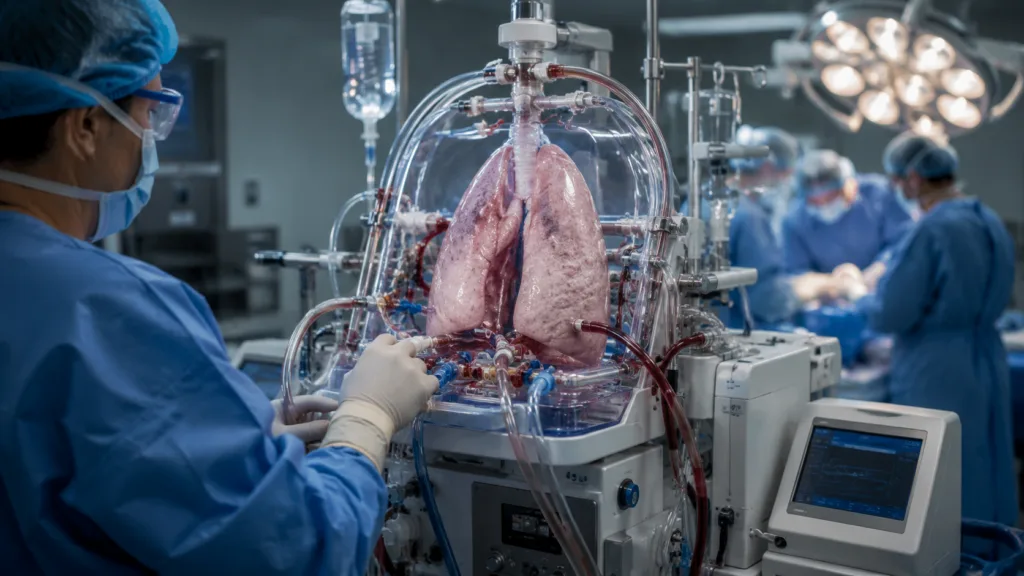
United Therapeutics Corporation has secured United States Food and Drug Administration premarket approval for the LungFX device, developed by its Lung Bioengineering subsidiary, for centralized ex vivo lung perfusion of deceased-donor lungs that could not otherwise be placed for transplantation. The device is intended to reassess single or double donor lungs for adults awaiting a first lung transplant, giving transplant teams another regulated pathway to evaluate organs that might otherwise remain unused.
The significance extends beyond the addition of another perfusion device. LungFX creates a regulatory framework around a centralized service model in which donor lungs are transported to a specialist facility, perfused and evaluated by a dedicated team, and potentially returned to cold storage before being sent to the recipient centre. That approach could make ex vivo lung perfusion available to transplant programmes that lack the staff, capital equipment or case volume needed to operate their own service.
Why LungFX changes the operating model for EVLP more than it changes the science
Ex vivo lung perfusion is not a new clinical concept. Existing systems already allow procured lungs to be ventilated, perfused at near-normal body temperature and monitored outside the donor’s body. Transplant teams can use the resulting physiological data to decide whether lungs initially considered unsuitable have sufficient function for transplantation.
What is genuinely new is the regulatory alignment between the LungFX device and a purpose-built centralized facility. Rather than requiring each hospital to establish an in-house programme, Lung Bioengineering can provide the equipment, specialised personnel, operating procedures, data infrastructure and round-the-clock support as an integrated service.
This potentially lowers the entry barrier for smaller or less experienced transplant centres. Running EVLP locally requires more than buying a machine. Hospitals need trained perfusion personnel, surgeons experienced in interpreting evolving lung function, quality systems, disposable supplies and the ability to activate a team whenever a suitable donor becomes available. Those requirements can be difficult to justify when case volumes are low or unpredictable.
Centralization could concentrate experience and make procedures more consistent. Lung Bioengineering has already performed approximately 1,100 EVLP procedures using other approved devices, with about 600 lungs subsequently accepted for transplantation. That operating history demonstrates experience with the workflow, but it should not be confused with a commercial track record for LungFX itself. The newly approved device will enter the service portfolio only in 2027, leaving its real-world reliability, throughput and conversion rates to be established after launch.
The same concentration that supports standardization also creates dependency. LungFX may be operated only by qualified Lung Bioengineering personnel, which means access will depend on the subsidiary’s facilities, staffing levels and transportation network. A transplant centre cannot simply purchase the device and incorporate it independently into its existing programme.
Why the pivotal survival signal will remain the central adoption question for LungFX
The most consequential issue in the approval is not whether LungFX can perfuse and evaluate donor lungs. It is whether organs selected through the system produce outcomes that transplant teams, recipients and regulators consider acceptable when balanced against the alternative of remaining on the waiting list.
The CLES pivotal study enrolled 174 patients across approved transplant study sites, including 94 patients in the EVLP group and 80 in a contemporaneous non-EVLP group. Twelve-month survival was the primary endpoint, while secondary assessments included earlier survival, primary graft dysfunction, extracorporeal membrane oxygenation use, intensive care and hospital stays, respiratory failure, chronic lung allograft dysfunction and pulmonary function.
The observed 12-month survival rate among recipients of LungFX-evaluated lungs did not satisfy the study’s prespecified performance goal. Twelve-month overall mortality and adjudicated lung graft-related mortality were also higher in the EVLP group than in the contemporaneous non-EVLP group. Several prespecified subgroup analyses showed clinically less favourable survival through two years.
Those results prevent the approval from being interpreted as an uncomplicated validation of equivalence with conventional transplantation. The FDA labeling instructs physicians to examine the clinical evidence carefully and assess the risks and benefits of LungFX against other preservation and evaluation options. Longer-term effects on recipient survival, graft function and chronic lung allograft dysfunction remain uncertain.
However, the comparison has an important structural limitation. The study was not a randomized head-to-head test in which similar donor lungs were assigned to LungFX or conventional preservation. LungFX was designed for lungs that an organ procurement organisation could not place through direct-to-recipient procedures, while the comparison patients received lungs accepted through conventional pathways.
The EVLP group therefore began with a different organ-selection problem. The central clinical question is not simply whether a LungFX-evaluated lung performs identically to an organ accepted immediately under standard criteria. It is whether the additional transplant opportunity provides an acceptable benefit-risk balance for a suitable recipient who might otherwise continue waiting.
FDA approval indicates that the regulator considered the evidence sufficient for the defined population and controlled operating environment. It does not remove the outcome uncertainty. Transplant teams will still make decisions case by case, particularly when recipient urgency, donor characteristics, expected waiting time and access to alternative organs point in different directions.
Can centralized lung perfusion expand access without creating a logistics bottleneck?
The need for better donor lung utilization remains clear. Despite improvements in allocation, only around the high teens as a percentage of donated lungs are ultimately transplanted in the United States. Many organs are declined because of uncertain function, possible injury, infection concerns, poor oxygenation or preservation constraints.
LungFX addresses one part of that problem by creating time and a controlled environment for further assessment. The lungs are initially preserved using cold static storage, transported to a centralized facility and connected to the system for normothermic perfusion and ventilation. When accepted after evaluation, they undergo another period of cold storage before being transported to the recipient centre.
That journey adds decision points and physical transfers. The approved workflow limits cumulative preservation time for transplanted LungFX lungs to 20 hours, making coordination among the donor hospital, organ procurement organisation, centralized facility, transport provider and recipient centre essential. Delayed aircraft, severe weather, operating room availability or equipment issues can consume a meaningful part of that window.
Changes in national lung allocation have already increased the distances travelled by donor lungs. A centralized model may help hospitals manage offers originating farther from their programmes, but routing an organ through an additional facility can also magnify transportation complexity. The service must prove that specialist assessment offsets the time and handling introduced by centralization.
The two existing Lung Bioengineering facilities in Silver Spring, Maryland, and Jacksonville, Florida, provide initial regional coverage, but widespread adoption may require additional centres. Facility expansion cannot be judged only by population density. Sites would need to reflect donor availability, transplant programme locations, air connectivity, procurement patterns and the number of organs capable of reaching the facility within the approved preservation window.
Operational resilience will also matter. Because the model depends on centralized expertise, transplant programmes will want confidence in backup systems, staffing redundancy, disposable supply availability, maintenance procedures and contingency plans. Device malfunction or user error can result in the loss of an already scarce donor lung, making reliability as important as theoretical capacity.
How LungFX could reshape competition with portable and hospital-based EVLP systems
LungFX enters a market that already includes established static and portable approaches. The XVIVO Perfusion System with Steen Solution supports normothermic assessment of donor lungs, while the TransMedics Organ Care System Lung provides a portable platform that maintains lungs in a near-physiological condition during transport.
The platforms solve overlapping but not identical problems. Portable perfusion can reduce dependence on prolonged cold storage and support assessment during transportation. Hospital-based static EVLP gives experienced transplant centres direct control over the evaluation process. LungFX instead moves assessment to a dedicated external facility and provides the service as an integrated operational model.
That distinction could make LungFX attractive to centres that want access to EVLP without investing in an internal programme. It may be less compelling for large transplant institutions that already have trained teams, established equipment and sufficient volumes to operate their own systems efficiently.
Competition will therefore involve service design as much as device performance. Transplant programmes will compare how quickly each platform can be activated, which donor lungs are eligible, how the system affects preservation time, what clinical information it generates, how decisions are communicated and who assumes responsibility at each stage.
Pricing will be another important variable. United Therapeutics has not disclosed commercial terms for LungFX or detailed how the 2027 service will be priced. Hospitals will need to assess the cost of centralized perfusion, transportation and coordination against the clinical and financial value of completing additional transplants.
Reimbursement pathways for organ acquisition and transplant services can be complex. Even when EVLP is clinically attractive, uncertainty over cost allocation may slow adoption. The strongest commercial proposition will be one that demonstrates not merely that more lungs can be evaluated, but that the service produces a sustainable increase in completed transplants without disproportionate logistical or financial burdens.
Why the 2027 LungFX launch leaves key commercialization questions unanswered
The gap between approval and planned service introduction suggests that United Therapeutics still has substantial implementation work to complete. The medical device manufacturer must integrate LungFX into operating facilities, establish production and disposable supply capacity, train personnel, validate procedures and prepare transplant partners for the approved workflow.
A staged rollout would allow Lung Bioengineering to concentrate early experience among familiar transplant programmes and refine logistics before broader expansion. It would also limit the initial evidence base. Early utilization may be shaped by centres already comfortable with centralized EVLP, making results less representative of hospitals adopting the model for the first time.
Conversion rate will be closely watched. Lung Bioengineering’s historical EVLP activity has resulted in approximately 600 accepted lungs from 1,100 procedures, but LungFX may receive a different donor mix under its approved indication. High evaluation volumes will not necessarily translate into high transplant volumes if the organs referred are increasingly marginal.
The service must also avoid creating incentives to divert lungs that could have been successfully placed without centralized evaluation. LungFX is not intended for donor lungs that can be matched and transplanted through conventional procurement and preservation. Appropriate referral criteria will be necessary to ensure that the platform expands the donor pool rather than adding unnecessary processing to already usable organs.
Near-term revenue potential is difficult to estimate without service pricing, expected case volumes or facility expansion plans. The strategic value is clearer. United Therapeutics now controls an approved device, specialised facilities, clinical personnel, logistics relationships and data systems across the donor lung evaluation pathway.
What LungFX adds to United Therapeutics’ broader organ replacement strategy
United Therapeutics has built its commercial foundation in pulmonary hypertension medicines, but it is also pursuing technologies designed to increase the supply of transplantable organs. These programmes include xenotransplantation, regenerative medicine, bioengineered organ alternatives and three-dimensional bioprinting.
LungFX gives that long-term strategy a nearer-term clinical and regulatory asset. The platform can generate experience in organ transportation, physiological monitoring, recipient matching and transplant-centre coordination while the more ambitious manufactured-organ programmes remain under development.
A centralized perfusion network could eventually support more than viability assessment. EVLP is being studied as a potential environment for organ repair, infection management, targeted therapeutics, gene delivery and other interventions before transplantation. A controlled specialist facility may be well suited to such applications because procedures, data collection and personnel can be standardized.
The approval does not validate any of those future uses. LungFX is approved for evaluating defined deceased-donor lungs, not for therapeutic modification, xenotransplantation or bioengineered organs. Each additional application would require its own evidence and regulatory review.
The platform nevertheless gives United Therapeutics an infrastructure advantage. Instead of developing a future organ technology and then building a delivery network from the ground up, the biotechnology firm may be able to expand an existing system of facilities, logistics, specialists and transplant-centre relationships.
What transplant teams and regulators are likely to watch after commercial rollout
The first priority will be recipient outcomes, particularly 12-month and longer-term survival, primary graft dysfunction, chronic lung allograft dysfunction and graft-related mortality. Real-world evidence must show whether the concerns visible in the pivotal study persist, narrow or become more pronounced across broader clinical practice.
The second measure will be incremental organ utilization. LungFX will have the greatest clinical value when it converts lungs that genuinely could not be placed into successful transplants. Utilization data should distinguish between organs evaluated, organs accepted, procedures completed and recipients achieving durable graft function.
Operational performance will be equally important. Transplant programmes will examine total preservation time, transport reliability, device malfunctions, cancelled procedures and differences across facilities. A centralized model depends on repeatability, and even occasional failures may influence confidence because each case involves a scarce, time-sensitive organ.
LungFX therefore enters the market with both strategic promise and unusually visible clinical caveats. It may widen access to ex vivo lung perfusion and help rescue organs that would otherwise be discarded, but approval is the beginning of the evidence cycle rather than its conclusion. Adoption will depend on whether United Therapeutics can turn centralized expertise into reproducible transplant outcomes while controlling the logistical, economic and clinical risks built into the model.