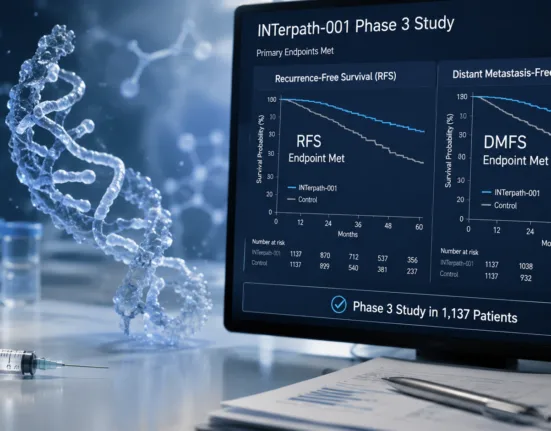
Samsung Bioepis has reported that SB27, its proposed biosimilar to Merck’s pembrolizumab cancer therapy Keytruda, met the primary endpoints of separate Phase 1 and Phase 3 studies. The preliminary results demonstrated pharmacokinetic bioequivalence and an equivalent objective response rate in non-small cell lung cancer, giving the South Korean biopharmaceutical developer a potentially important clinical package for future regulatory submissions.
The development moves SB27 beyond proof of concept and into the more consequential phase of biosimilar competition, where analytical comparability, regulatory execution, patent access, manufacturing readiness and commercial partnerships become as important as the headline clinical result. Samsung Bioepis has cleared two significant scientific hurdles, but the data do not yet establish when SB27 could be filed, approved or launched.
Why does meeting two different equivalence endpoints strengthen the SB27 regulatory case?
The Phase 1 and Phase 3 programmes were designed to answer different but complementary questions. The Phase 1 study examined whether patients exposed to SB27 experienced drug concentrations comparable to those receiving European Union-sourced or United States-sourced Keytruda. The Phase 3 trial then tested whether those pharmacokinetic similarities translated into equivalent tumour response outcomes in a clinically relevant cancer population.
In the three-arm Phase 1 study, 163 patients with stage II or IIIA non-small cell lung cancer received SB27, European Union-sourced Keytruda or United States-sourced Keytruda following complete tumour resection and platinum-based chemotherapy. The preliminary analysis found that drug exposure, measured through area under the concentration-time curve, remained within the predefined bioequivalence boundaries.
That result provides the bridging evidence needed to connect SB27 with reference products sourced from different regulatory markets. This matters because a global biosimilar developer may need to show that the reference medicines used in its clinical programme are sufficiently comparable to the products authorised in the jurisdictions where approval will be sought.

The larger Phase 3 study enrolled 555 patients with metastatic non-squamous non-small cell lung cancer and compared SB27 directly with Keytruda in a chemotherapy-containing regimen. The 90% confidence interval for the objective response rate ratio at week 24 was 0.737 to 1.071, remaining inside the predefined equivalence range of 0.712 to 1.405.
Taken together, the studies address both exposure and clinical activity. That combination is more informative than a positive pharmacokinetic study alone because it supports the argument that any minor molecular or manufacturing differences between SB27 and pembrolizumab do not create a clinically meaningful difference in the tested setting.
However, regulators will evaluate SB27 through the totality of evidence rather than through these two endpoints in isolation. Analytical characterisation, biological activity, manufacturing controls, process validation, impurity profiles and batch consistency will remain central to any future application.
What does the Phase 3 response endpoint prove, and what does it leave unresolved?
Objective response rate is a practical endpoint for detecting potential differences between two oncology products within a manageable clinical development period. It allows investigators to compare the proportion of patients whose tumours shrink by a predefined amount without waiting several years for mature survival results.
For a biosimilar trial, the objective is not to prove that SB27 improves outcomes beyond Keytruda. The purpose is to show that the candidate performs within an accepted range around the reference treatment. The reported confidence interval achieved that objective at week 24, supporting clinical equivalence in the studied population.
The randomised, double-blind and multicentre design also reduces several forms of bias. A direct comparison involving more than 500 patients gives regulators a more controlled basis for examining response, safety, pharmacokinetics and immune reactions than an uncontrolled or historical comparison would provide.
Nevertheless, an equivalent objective response rate is not the same as demonstrating identical long-term progression-free survival or overall survival. The preliminary disclosure did not provide detailed response percentages for each treatment arm, duration of response, subgroup outcomes, discontinuation rates or mature survival results.
The absence of those details does not invalidate the equivalence finding, since the trial was designed around a specific primary endpoint. It does mean that clinicians and regulators will want to examine the complete dataset before drawing broader conclusions about performance across patient subgroups and treatment duration.
Detailed safety findings will be especially important because pembrolizumab works by modifying immune checkpoint activity. Small differences in immune-mediated adverse events, infusion reactions or antidrug antibody development may become meaningful even when aggregate safety profiles appear comparable.
Samsung Bioepis said the preliminary safety, pharmacokinetic and immunogenicity profiles were comparable with Keytruda. The next analytical step will be determining whether the full results provide enough exposure duration and patient-level detail to rule out clinically relevant differences with confidence.
How could one lung cancer study support access across Keytruda’s broader indications?
Pembrolizumab is used across a wide range of tumour types, making indication extrapolation one of the most commercially significant components of the SB27 programme. A successful biosimilar application could potentially seek approval across multiple eligible indications without independently repeating efficacy trials in every cancer type.
Regulators may permit extrapolation when the totality of evidence supports biosimilarity and when differences in mechanism, target biology, dosing, patient population and safety can be scientifically addressed. For a programmed cell death protein 1 inhibitor such as pembrolizumab, the developer must demonstrate that SB27 behaves comparably in the biological functions that drive therapeutic activity.
Non-small cell lung cancer offers a relevant clinical model because pembrolizumab is deeply established in the treatment pathway, response can be measured objectively and the disease setting can reveal potential differences in antitumour activity. The programme also includes both earlier-stage and metastatic populations, giving Samsung Bioepis pharmacokinetic and clinical evidence across distinct treatment contexts.
Extrapolation is not automatic, however. Regulators could request additional justification for indications involving different combinations, biomarker requirements, lines of therapy or immune environments. They may also examine whether the analytical assays adequately capture every biological function relevant to pembrolizumab’s approved uses.
The commercial value of SB27 would be materially greater if approval extended across a broad portion of Keytruda’s label. A narrow initial label would limit addressable demand, complicate hospital protocols and reduce the efficiency advantages that health systems typically seek from biosimilar procurement.
Why is the Keytruda biosimilar opportunity unusually large but commercially complicated?
Keytruda has become one of the pharmaceutical industry’s most valuable medicines. It generated $29.5 billion in worldwide sales during 2024, while Merck disclosed that the product represented almost half of its total sales in 2025. First-quarter 2026 Keytruda sales reached approximately $8 billion, reflecting continued expansion even as the loss of exclusivity approaches.
That revenue base creates an exceptional opportunity for biosimilar manufacturers and healthcare systems. Even a modest share of the intravenous pembrolizumab market could produce substantial sales for a successful entrant, while competitive pricing could generate meaningful savings for payers and public procurement programmes.
The opportunity is complicated by timing. Merck expects United States biosimilar competition could begin in December 2028 when the principal compound patent expires, although additional patents extending into 2029 may be litigated. European market timing could differ because patent protection, data exclusivity, supplementary protection certificates and country-specific legal challenges do not produce one universal launch date.
Clinical development leadership therefore does not guarantee commercial leadership. A company can finish trials early but still face regulatory review delays, patent litigation, manufacturing inspections or the absence of a commercial partner capable of securing formulary and tender access.
The competitive field is also developing. Alvotech and Dr. Reddy’s Laboratories are jointly advancing AVT32, another proposed pembrolizumab biosimilar, while additional manufacturers are expected to pursue one of the largest biologic loss-of-exclusivity opportunities of the decade.
The first approved product may gain an important negotiating and contracting advantage, but long-term market share will also depend on supply reliability, price strategy and commercial reach. Oncology biosimilars are purchased through hospitals, infusion centres, government tenders, insurers and specialist networks, creating multiple access points that differ substantially across markets.
Could subcutaneous Keytruda reduce the addressable market for intravenous SB27?
Merck has already begun shifting the competitive framework by introducing Keytruda Qlex, a subcutaneous formulation of pembrolizumab that can be administered in approximately one or two minutes, depending on the dose. The intravenous formulation generally requires a longer infusion and greater use of treatment-chair capacity.
That convenience could become a meaningful differentiator as intravenous biosimilars approach the market. Hospitals may value the lower acquisition cost of an intravenous biosimilar, while patients and clinics may prefer the shorter administration time offered by the subcutaneous reference product.
The result could be a segmented market rather than a simple replacement cycle. Price-sensitive systems and tender markets may shift rapidly toward intravenous biosimilars, while some established markets could retain a larger portion of patients on the subcutaneous formulation.
Merck previously indicated that the injectable formulation could capture a substantial portion of Keytruda use. Early 2026 sales already included contributions from the newer presentation, suggesting the transition began well before expected intravenous biosimilar entry.
Samsung Bioepis will therefore be competing not only against the original intravenous product but against a redesigned Keytruda franchise. SB27’s commercial proposition may need to combine a meaningful price advantage with dependable supply and straightforward integration into existing infusion protocols.
A lower list price alone may not guarantee adoption. Provider reimbursement structures, purchasing contracts, payer preferences and differences between new and existing patients could influence how rapidly oncologists and treatment centres move to a biosimilar.
What manufacturing and commercial capabilities will determine whether SB27 can scale?
Pembrolizumab is a complex monoclonal antibody produced through living cell systems. Commercial success requires more than demonstrating similarity in controlled clinical batches. Samsung Bioepis must show that large-scale manufacturing can repeatedly produce material matching the quality attributes used throughout development.
Any regulatory filing will likely face detailed examination of production processes, analytical methods, stability, fill-and-finish operations, cold-chain controls and the consistency of batches manufactured at commercial scale. The size of the potential Keytruda market increases the importance of capacity planning because supply disruption could quickly undermine hospital confidence.
Samsung Bioepis enters this process with established biosimilar experience, including oncology programmes referencing trastuzumab and bevacizumab. That record supports the credibility of its development platform and its familiarity with complex global regulatory submissions.
Previous success does not remove product-specific risk. Pembrolizumab’s scale, crowded patent environment and broad oncology footprint create a more demanding launch challenge than many earlier biosimilars. The South Korean developer will also need commercial arrangements capable of reaching major markets and managing tender, contracting and pharmacovigilance responsibilities.
Partnership strategy remains an important unanswered question. Samsung Bioepis has used regional and global commercial partners for several earlier products, but SB27’s eventual market structure, territories and launch responsibilities have not yet been defined publicly.
What should regulators and oncology stakeholders watch after the preliminary SB27 results?
The immediate milestone will be completion of both studies and presentation of the full datasets. Detailed results should clarify absolute response rates, treatment exposure, adverse-event patterns, immune-mediated toxicities, antidrug antibody incidence, discontinuations and longer-term outcomes.
A regulatory filing would provide the clearest indication of how quickly Samsung Bioepis believes its evidence package can be converted into an approvable product. Submission timing will also show whether the developer expects to be ready well before the major United States loss-of-exclusivity window.
Regulators will then need to determine whether the analytical and clinical evidence justifies broad indication extrapolation. The scope of any eventual label could matter as much as the approval itself because pembrolizumab’s commercial strength comes from its extensive presence across tumour types and treatment combinations.
Commercial observers will watch for manufacturing disclosures, partnership agreements and patent settlements. Those developments may reveal more about the likely launch sequence than another positive clinical update.
SB27 has now crossed a meaningful threshold. Samsung Bioepis has demonstrated preliminary pharmacokinetic and clinical equivalence in two complementary trials, strengthening its position in the emerging pembrolizumab biosimilar market. The next phase will determine whether that scientific progress can survive regulatory scrutiny, intellectual-property complexity and a rapidly changing Keytruda franchise.