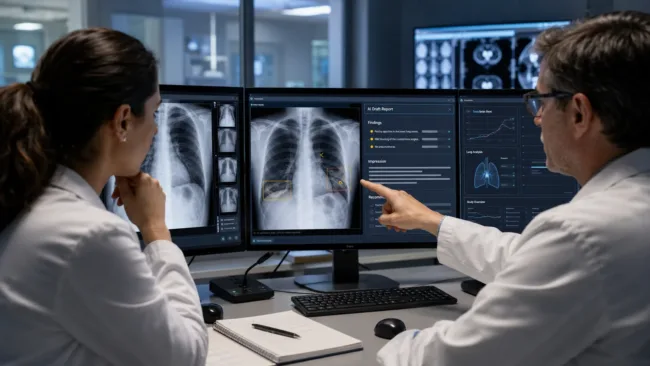
The U.S. Food and Drug Administration has granted 510(k) clearance to Aidoc’s CARE platform, a foundation-model-based clinical AI system that integrates 11 newly cleared acute triage indications with three previously approved ones into a single, unified abdomen CT workflow. Delivered via Aidoc aiOS™, the system is designed to improve real-time identification of critical findings in emergency department imaging backlogs and high-volume ambulatory settings.
This FDA decision marks the first time a foundation model in clinical AI has been cleared to triage double-digit acute conditions through a single pipeline—an inflection point that signals how foundational AI systems are beginning to reshape the radiology and diagnostic landscape at scale.
What this milestone reveals about the FDA’s evolving posture on multi-indication AI models
This clearance is not simply a regulatory nod to Aidoc’s performance metrics. It reflects an important shift in how the U.S. Food and Drug Administration is approaching complex AI models that rely on foundational architectures rather than single-algorithm, narrow applications. The clearance comes five months after the CARE platform was granted Breakthrough Device designation, underscoring how regulators are beginning to formally validate the safety and utility of more expansive, generalized AI tools in clinical settings.
Industry observers note that what distinguishes CARE from earlier computer-aided detection (CAD) platforms is not only the breadth of acute findings covered—ranging from free air and bowel obstruction to urgent vascular findings—but the shared inference engine underpinning all detections. The model’s ability to maintain high sensitivity (up to 98.5%) and specificity (up to 99.7%) across a wide array of conditions in a prospective pivotal study strengthens confidence among hospital systems hesitant to onboard AI due to concerns over false positives and clinical trust.
In that context, the CARE platform’s FDA-reviewed safety profile serves as a bellwether for how future foundation models in diagnostics, imaging, and clinical reasoning might be evaluated.
Why this changes the calculus for imaging workflow optimization in high-pressure settings
The value proposition of foundation model-based triage becomes most apparent in emergency departments, where imaging workloads are often subject to first-in-first-out reads, regardless of urgency. By integrating multiple acute conditions into a single AI triage workflow, Aidoc’s system enables earlier surfacing of critical findings without requiring radiologists to toggle between siloed AI solutions.
Clinicians tracking radiology operations suggest that unified triage pipelines could significantly reduce time-to-diagnosis in scenarios such as occult bleeding, perforation, or unsuspected critical findings on routine abdomen CTs. This is particularly relevant in institutions experiencing sustained imaging backlogs due to staffing shortages or rising scan volumes.
From a clinical operations standpoint, the ability to deploy one AI model that can triage over a dozen acute conditions allows for tighter integration into radiologist and technologist workflows. It may also help health systems consolidate validation, governance, and quality assurance processes—an often overlooked barrier to scale in clinical AI deployments.
What this means for adoption barriers, infrastructure readiness, and AI model lifecycle governance
Aidoc’s use of its proprietary aiOS platform as the delivery mechanism for CARE provides a second layer of strategic significance. While model accuracy often dominates AI discourse, real-world adoption is equally dependent on systems that allow integration, monitoring, and updating of models without disrupting hospital infrastructure.
The aiOS platform’s focus on data normalization, continuous performance monitoring, and in-built governance addresses a persistent challenge in clinical AI adoption: the ability to ensure version stability, regulatory compliance, and traceability in live environments.
According to clinicians familiar with multi-site deployments, hospital systems want more than just accurate AI—they want AI that behaves predictably, scales efficiently, and integrates without requiring IT overhauls. Aidoc’s deployment base of over 1,600 medical centers and 100 million patient cases positions it to test the limits of model durability and operational interoperability at scale.
However, the platform’s long-term success will depend on how it handles issues like clinical drift, differences in scanner protocols, and site-level variation in imaging quality and case mix. Regulatory watchers suggest that future post-market surveillance may place greater emphasis on real-world performance continuity, especially as foundation models begin to replace multiple narrow-AI tools in critical workflows.
What questions remain around clinical workflow reliance and downstream interpretability
While the CARE platform’s performance metrics are impressive, some clinicians caution against over-reliance on automated triage as a frontline diagnostic tool. The transition from assistive triage to true diagnostic aid—especially in multi-indication models—raises new questions about cognitive offloading, interpretability, and the evolving role of the radiologist.
Even if the AI flags a case as high priority, radiologists must remain vigilant for findings not yet covered by the model’s scope. Moreover, the integration of such models into PACS systems, reporting software, and physician communication pipelines introduces new interfaces where delays or misinterpretation could occur.
Experts in the space emphasize the need for transparency in how model decisions are made and presented. As foundation models begin to power more of the diagnostic decision-making chain, clinicians will need robust explainability features, particularly when discrepancies arise between AI flags and human interpretations.
What the next 18 months could unlock if Aidoc expands into full-body CT and X-ray coverage
Aidoc’s declared roadmap includes expansion of CARE across all CT and X-ray modalities over the next year and a half, along with ambitions to support automated draft report generation. If successful, this would move the company closer to realizing a full-stack clinical AI assistant capable of triage, pre-diagnosis, and structured documentation.
Such capabilities could transform the economics of radiology departments under strain, reduce turnaround times, and enable more precise allocation of human expertise to high-acuity cases. However, any movement toward semi-autonomous reporting will be closely scrutinized by professional societies and regulatory bodies to ensure that safety, auditability, and physician oversight remain intact.
The broader industry will be watching whether Aidoc can sustain CARE’s performance across additional imaging types and whether the foundation model paradigm can accommodate growth without sacrificing accuracy. Clinical AI firms that can demonstrate this kind of scalable generalization—without creating new failure points—may shape the competitive terrain for years to come.