Alcon and RxSight have entered a non-exclusive collaboration to develop and commercialise adjustable presbyopia-correcting intraocular lenses, combining Alcon’s premium lens optics with RxSight’s post-operative light-adjustment platform.
The July 6 agreement gives RxSight a $60 million upfront payment and creates eligibility for up to $140 million in additional development and regulatory milestones. Alcon will lead global commercialisation, while RxSight will be responsible for development and manufacturing and will receive royalties on future net sales.
The collaboration could address one of the most persistent limitations in premium cataract surgery. Conventional presbyopia-correcting lenses are selected before surgery using measurements and predictive formulas, but the final visual result can be affected by healing, lens position and individual eye anatomy. An adjustable lens could allow surgeons to refine the optical outcome after the eye has stabilised.
The strategic logic is compelling, but the programme remains in development. Alcon and RxSight must demonstrate that adjustability can be combined with presbyopia-correcting optics without creating unacceptable glare, halos, loss of contrast, treatment burden or manufacturing complexity.
Why are Alcon and RxSight developing an adjustable presbyopia-correcting lens?
Cataract surgery replaces the clouded natural lens of the eye with an artificial intraocular lens. A standard monofocal lens generally provides clear vision at one primary distance, leaving many patients dependent on glasses for near or intermediate tasks.
Presbyopia-correcting intraocular lenses are designed to provide a broader range of vision and reduce reliance on spectacles. These premium lenses may use multifocal, extended-depth-of-focus or other advanced optical designs to distribute light across different focal ranges.
The challenge is that surgeons must select the lens power and visual target before surgery. Even sophisticated calculations cannot perfectly predict how every eye will heal or where the implanted lens will ultimately sit.
A small residual refractive error can reduce patient satisfaction, especially when individuals pay additional out-of-pocket costs for a premium lens. Some patients may require glasses, contact lenses, laser vision correction or another intervention despite expecting greater independence from spectacles.
The Alcon and RxSight collaboration aims to move part of that decision-making process into the post-operative period. Surgeons could implant a presbyopia-correcting lens, assess the patient’s vision after healing and then fine-tune the lens using controlled light treatments.
How does RxSight’s light-adjustable lens technology work after cataract surgery?
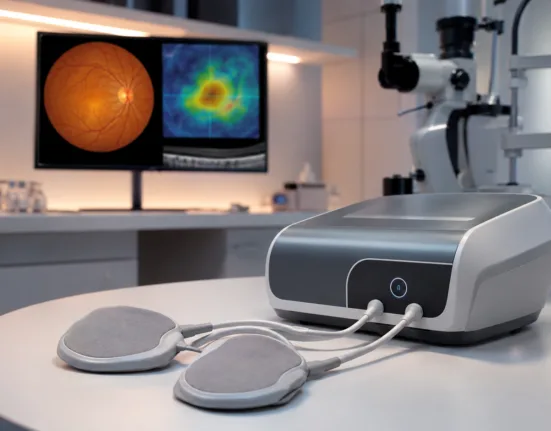
RxSight’s existing Light Adjustable Lens is made from a photosensitive silicone material that changes shape and refractive power when exposed to specific ultraviolet light patterns generated by the company’s Light Delivery Device.
After cataract surgery, the eye is allowed to heal before the surgeon measures the remaining refractive error and discusses the patient’s visual priorities. The Light Delivery Device then delivers a programmed light pattern to modify the implanted lens.
Patients may receive more than one adjustment before the desired result is reached. Final lock-in treatments stabilise the lens power so that it no longer responds to environmental ultraviolet exposure.
The process allows post-operative correction of residual nearsightedness, farsightedness and astigmatism within the approved adjustment range. The original United States approval was supported by a 600-patient clinical study in which the adjustable lens produced better uncorrected distance vision than a conventional monofocal lens.
The technology also requires patient participation. Individuals must return for multiple light treatments and comply with ultraviolet-protective eyewear requirements until the adjustment and lock-in process is complete.
What does Alcon contribute beyond funding and global commercial reach?
Alcon brings established expertise in cataract surgery, intraocular lens design, surgical equipment and ophthalmic commercialisation. Its portfolio includes premium lenses intended to provide distance, intermediate and near vision after cataract removal.
Designing a presbyopia-correcting lens involves more than adding multiple focal points. Engineers must balance visual range against contrast sensitivity, glare, halos and other optical effects that can become noticeable in dim lighting or while driving at night.
Alcon’s optical designs could give the collaboration a starting point that is already familiar to cataract surgeons. RxSight would add the ability to modify the visual result after implantation.
The combination could be particularly valuable because adjustability and presbyopia correction solve different problems. Presbyopia-correcting optics attempt to expand the range of vision, while post-operative adjustment attempts to improve the precision with which the intended result is achieved.
Alcon will lead global commercialisation if the product reaches the market. Its sales organisation, surgeon relationships and cataract-surgery infrastructure could accelerate adoption beyond what RxSight could achieve independently.
Why is the $60 million upfront payment important for RxSight?
The upfront payment is meaningful for RxSight because it provides non-dilutive capital while preserving the company’s responsibility for development and manufacturing.
RxSight reported $30.9 million in first-quarter 2026 sales, driven by 27,472 Light Adjustable Lens units and 20 Light Delivery Device placements. Its installed base reached 1,154 Light Delivery Devices, while approximately 332,000 adjustable lenses had been implanted through March 2026.
The company also held approximately $217.9 million in cash, cash equivalents and short-term investments at the end of the quarter. The Alcon payment therefore strengthens an already substantial liquidity position while reducing the amount of internal capital required to fund the new programme.
Milestone eligibility of up to $140 million provides further development support, although those payments will depend on technical and regulatory progress. Royalties would give RxSight recurring economics if Alcon successfully commercialises the resulting lenses.
The agreement also validates the strategic value of RxSight’s platform at a time when its commercial growth has faced pressure. First-quarter sales declined from the previous year, and Light Adjustable Lens procedure volume was broadly flat. A partnership with Alcon creates a second route for the technology beyond RxSight’s existing branded lens portfolio.
Could the collaboration expand RxSight without weakening its own commercial franchise?
The agreement is non-exclusive, meaning RxSight retains the ability to develop its technology independently and potentially work with other companies, subject to the specific intellectual-property and programme terms.
This structure protects RxSight from becoming dependent on one partner while allowing Alcon to build products using jointly developed technology. It also reflects the possibility that different optical designs may serve different groups of cataract patients.
There is still a risk of channel conflict. A successful Alcon-branded adjustable lens could compete with RxSight’s own Light Adjustable Lens products for surgeon attention, Light Delivery Device capacity and premium cataract patients.
The companies can reduce that tension by segmenting the portfolio. RxSight may continue to focus on its existing adjustable monofocal and extended-range offerings, while the collaboration targets a distinct presbyopia-correcting category built around Alcon optics.
Much will depend on commercial pricing, branding and ownership of the patient relationship. RxSight benefits most if the collaboration expands use of its adjustment platform rather than replacing procedures it could have captured directly.
What clinical evidence will regulators require before adjustable PCIOLs reach patients?
The new lenses will require extensive testing because combining two established concepts does not automatically produce a safe or effective device.
Clinical trials will need to evaluate distance, intermediate and near visual acuity, refractive predictability, spectacle independence and patient-reported satisfaction. Regulators will also examine contrast sensitivity, night vision, glare, halos and other visual disturbances associated with presbyopia-correcting optics.
The studies must show that the adjustment process remains predictable when applied to a more complex lens design. Changing one portion of the optical profile could unintentionally affect another focal range or alter the balance between the two eyes.
Manufacturing consistency will be another important requirement. Presbyopia-correcting lenses depend on highly precise optical structures, while RxSight’s material must remain responsive to programmed ultraviolet treatment before final lock-in.
The companies have not disclosed a launch timetable. Development, clinical testing and regulatory review could take several years, particularly if they pursue approvals across the United States, Europe and other international markets.
Could post-operative adjustability reduce dissatisfaction after premium cataract surgery?
Premium cataract patients often have higher expectations because they pay additional fees for refractive benefits that are not fully covered by standard insurance or public reimbursement.
Dissatisfaction may occur even when surgery is technically successful. Residual refractive error, dry eye, retinal disease, corneal irregularity or unrealistic expectations can prevent a patient from achieving the desired range of vision.
Adjustability directly addresses the refractive component. Surgeons could modify the lens after observing the actual healed eye rather than relying entirely on pre-operative estimates.
It could also support a more interactive decision process. Patients may better understand their preferred balance between distance and near vision after experiencing the initial result, allowing the surgeon to refine the target before lock-in.
The technology cannot eliminate every cause of dissatisfaction. It will not correct retinal disease, advanced corneal pathology or all forms of optical intolerance. Careful patient selection and counselling will remain necessary.
Will multiple post-operative visits limit adoption of adjustable cataract lenses?
The Light Adjustable Lens requires more follow-up than a conventional intraocular lens. Patients must attend adjustment and lock-in sessions after surgery and follow protective eyewear instructions during the treatment period.
This burden may be acceptable for motivated premium patients seeking a highly customised result. It may be less attractive for people who live far from the clinic, have limited mobility or struggle to comply with repeated appointments.
Practices must also invest in Light Delivery Devices, staff training, scheduling capacity and post-operative workflow. A growing adjustable-lens patient base can create recurring procedure revenue, but it also increases demands on clinic time.
The collaboration could improve adoption if Alcon integrates the process into its broader cataract-surgery ecosystem and helps practices standardise patient selection, counselling and follow-up.
Long-term success will depend on whether the visual benefit is large enough to justify the added visits. A technically impressive lens may still face resistance if patients and clinics view the treatment pathway as too complex.
How large is the commercial opportunity in premium cataract surgery?
Cataract surgery is one of the most commonly performed procedures worldwide, and ageing populations are increasing the number of patients requiring lens replacement.
Most procedures still use standard monofocal lenses, leaving substantial room for premium technologies that reduce dependence on glasses. Adoption varies by country because reimbursement rules, patient income and private-payment models differ significantly.
Adjustable presbyopia-correcting lenses would likely enter the highest-value portion of the market. Pricing could reflect both advanced optics and the post-operative customisation process.
Alcon’s global reach is important because RxSight’s current business remains concentrated primarily in the United States. A successful co-developed product could extend the adjustment platform into markets where Alcon already has surgeon relationships and established premium-lens distribution.
The opportunity is not guaranteed. Premium cataract demand can weaken when consumers face economic pressure, while competing lenses continue to improve refractive accuracy and visual range without requiring light treatments.
What competitive threats could challenge the Alcon and RxSight programme?
The premium intraocular lens market includes major ophthalmic companies developing multifocal, extended-depth-of-focus, enhanced monofocal and other advanced designs.
Competitors may improve predictive formulas, diagnostic imaging and intraoperative measurement, reducing the frequency of residual refractive error. Better pre-operative precision could weaken the argument that all premium patients need post-operative adjustment.
Other companies are also pursuing adjustable or modular lens technologies. A rival platform could offer simpler treatment, fewer visits or broader correction without ultraviolet exposure.
Alcon and RxSight therefore need to prove that their approach delivers a meaningful improvement rather than an incremental refinement. The strongest competitive advantage would be a combination of broad visual range, low rates of disturbing optical symptoms and highly predictable post-operative customisation.
What risks remain for patients considering light-adjustable technology?
Existing light-adjustable lenses carry the general risks of cataract surgery and intraocular-lens implantation, including infection, inflammation, retinal complications, lens displacement and the possible need for additional procedures.
The adjustment process adds specific requirements. Patients must be able to complete light treatments, maintain steady fixation and comply with ultraviolet-protective eyewear instructions until final lock-in.
Individuals using ultraviolet-sensitising medicines or living with certain ocular conditions may not be suitable candidates. Surgeons must also consider pupil dilation, corneal health, retinal status and the patient’s ability to attend follow-up visits.
Presbyopia-correcting optics may introduce glare, halos or reduced contrast even when the refractive target is accurate. Adjustability might refine lens power, but it may not fully remove visual phenomena created by the underlying optical design.
Patient expectations will require careful management. Customisation should not be presented as a guarantee of perfect vision at every distance or complete freedom from glasses.
What does the market reaction say about the balance of opportunity and risk?
RxSight shares traded near $4.93 on July 7, falling approximately 12% during the session despite the collaboration and upfront payment. The company’s market value was approximately $202 million, making the $60 million upfront consideration financially significant.
The negative reaction suggests that investors remain focused on weak near-term commercial trends, execution risk and uncertainty over how long the new programme will take to generate product revenue.
Alcon shares traded near $67.32, down approximately 1.5%. The transaction is financially modest for Alcon, meaning its investment case will not change materially until the collaboration produces a clinically differentiated and commercially viable lens.
For RxSight, the strategic impact is much larger. The agreement validates its adjustment technology, extends its development runway and provides access to Alcon’s global commercial organisation.
Could adjustable PCIOLs become a new standard in premium cataract care?
The collaboration addresses a genuine weakness in premium cataract surgery. Surgeons can implant increasingly sophisticated lenses, but they must still make critical optical decisions before knowing exactly how the eye will heal.
Post-operative adjustability changes that sequence. It allows the final refractive result to be shaped using real patient experience rather than predictions alone.
My assessment is that the Alcon and RxSight agreement has the potential to create an important new premium-lens category, but the commercial value will depend on simplicity as much as optical performance.
The product must offer a clear improvement in visual outcomes without adding excessive clinic visits, patient inconvenience or optical side effects. It must also fit within a premium-payment model that patients understand and surgeons can deliver efficiently.
If the companies demonstrate reliable distance, intermediate and near vision with fewer refractive surprises, adjustable presbyopia-correcting lenses could become a compelling option for patients seeking greater spectacle independence.
If development is slow, treatment remains burdensome or visual disturbances outweigh the benefits, the programme may remain a specialised premium offering rather than reshaping cataract care. The deal creates a strong technological and commercial partnership, but its success will ultimately be judged through the vision patients achieve after surgery and adjustment.