Aravind Eye Care System and Alcon (SIX/NYSE: ALC) have launched the Aravind Alcon Global Centre of Excellence for Vitreoretinal Surgery Training in Coimbatore, India, creating a dedicated facility for hands-on retinal surgery education and virtual fellowship programmes. Announced on July 24, 2026, the centre is expected to train approximately 60 participants annually and represents the second phase of the organisations’ training partnership following the opening of a cataract surgery centre in Chennai in 2024.
The initiative should be understood primarily as a healthcare workforce and surgical capacity programme rather than a medical device launch or evidence that patient outcomes have already improved. Its eventual clinical value will depend on whether participating ophthalmologists gain measurable competency, receive sufficient supervised practice and continue performing vitreoretinal procedures after returning to their hospitals.
That distinction is important because retinal surgery is not simply another procedure that can be scaled through equipment installation. It involves technically demanding operations performed within the posterior segment of the eye, often for conditions such as retinal detachment, vitreous haemorrhage, diabetic eye disease and macular disorders. The quality of training, mentoring and case selection can therefore be as consequential as access to surgical systems.
The Coimbatore centre includes a wet laboratory for vitreoretinal training and is intended to combine physical surgical instruction with virtual education. Alcon and Aravind said the international programme will focus particularly on regions where access to trained retina specialists remains limited, including parts of Africa, Latin America and Asia.
Why does vitreoretinal surgery require a deeper training model than a conventional equipment demonstration?
The need for specialised retina training is supported by long-standing evidence that ophthalmology residency exposure can vary substantially between institutions. An Indian survey comparing ophthalmologists trained during different periods found improvements in diagnostic education involving optical coherence tomography, fundus photography and fluorescein angiography, but reported that most residency programmes still provided limited exposure to vitreous and retinal detachment surgery. The median number of such procedures performed by respondents during residency was zero.
This creates a difficult transition between understanding retinal disease and independently managing complex surgical cases. A trainee may be able to recognise a retinal detachment or interpret imaging without possessing the operative judgment needed to select instruments, maintain intraocular stability, manage peripheral pathology or respond to complications.
A dedicated wet laboratory can allow surgeons to practise instrument handling and procedural sequences without placing patients at risk during the earliest stages of learning. However, wet-lab exposure alone does not establish clinical competence. It must be incorporated into a structured progression involving observation, simulation, supervised surgery, case review and assessment against defined performance standards.
A multicentre survey involving 37 vitreoretinal fellows in India found that most participants considered simulators valuable before operating on patients. It also highlighted implementation problems, with many trainees reporting limited simulator time and identifying insufficient structure or supervision as barriers. The study was small and based on self-reported experience, so it did not demonstrate improved patient outcomes, but it reinforces the importance of organised and supervised training rather than merely making technology available.
The new centre’s most meaningful contribution could therefore be the creation of a repeatable training pathway. If the programme defines competencies, provides adequate faculty oversight and maintains contact with participants after their initial course, it could address weaknesses that one-off workshops and equipment demonstrations cannot solve.
How much capacity can a 60-participant annual programme create across underserved eye care markets?
An initial capacity of around 60 physical participants annually may appear modest against the scale of retinal disease and the centre’s global ambition. The number becomes more strategically relevant, however, if participants are selected from hospitals that currently lack advanced retina services and are supported in transferring their skills to local teams.
One newly trained surgeon can potentially influence more than the patients treated personally. The surgeon may establish referral protocols, teach residents, supervise technicians, introduce retinal imaging pathways and help a hospital decide when complex cases should be treated locally or referred to a higher-level centre.
Virtual fellowships could expand the programme beyond its physical intake, particularly for case discussions, surgical video review, diagnostic interpretation and post-training mentoring. Online education cannot replace operating-room experience, but it can reduce professional isolation and allow participants to seek guidance as they encounter unfamiliar cases.
The effectiveness of this model will depend on whether trainees return to facilities with functioning operating theatres, appropriate imaging, consumables, anaesthesia support, maintenance arrangements and sufficient patient volume. Training a surgeon without addressing these surrounding requirements risks producing knowledge that cannot be translated into a sustainable clinical service.
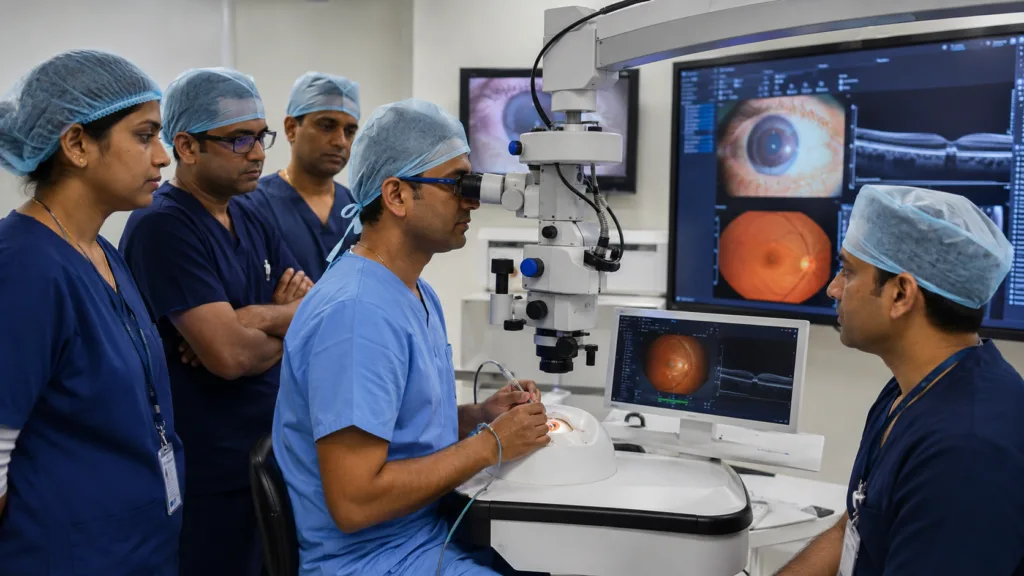
Aravind already possesses a substantial education platform on which to build the programme. During the April 2024 to March 2025 reporting year, the organisation trained 577 candidates across postgraduate, fellowship, clinical, paramedical and management programmes. This included 37 participants in its two-year retina and vitreous fellowship, seven in medical retina and nine in a short-term course covering retinopathy of prematurity and paediatric retinal disorders.
The new centre is therefore not starting from an empty classroom. It is being added to an institution that already runs long-term clinical education, short courses and specialty fellowships. That experience may help Aravind integrate the centre into established faculty, hospital and patient-care systems rather than operating it as a separate corporate training showroom.
Why is Aravind Eye Care System a strategically important training partner for Alcon?
Aravind’s value to the partnership extends beyond its reputation as a large eye-care provider. Its model links high-volume clinical services with education, outreach and systems development, giving trainees exposure to the organisational requirements surrounding surgery.
That matters because expanding access to retinal treatment is not solely a surgeon-training problem. Hospitals need patient identification, timely referral, diagnostic imaging, operating-room scheduling, sterile processing, postoperative monitoring and reliable access to consumables. A training institution that understands these operational dependencies can provide a more realistic model than a programme focused only on device functions.
The partnership also has a history that predates the new centre. Alcon and Aravind described their relationship as extending for more than two decades, while their first Global Centre of Excellence, opened in Chennai in 2024, concentrated on advanced cataract surgery training. That facility included equipment for phacoemulsification, biometry, microscopy and three-dimensional surgical visualisation.
The move into retina training therefore represents a progression from a high-volume, relatively standardised surgical field into a more technically complex specialty. Cataract training can often be organised around a defined sequence of surgical steps and large procedure volumes. Vitreoretinal surgery includes a broader range of pathologies, instruments and intraoperative decisions, making structured mentorship and graded responsibility particularly important.
Aravind-Coimbatore and Alcon had already conducted a two-day vitreoretinal surgical skills programme in April 2026. That programme included case discussions, wet-lab work, three-dimensional visualisation and practical exposure using the Alcon Constellation Vision System. It involved fellows from several Aravind hospitals and vitreoretinal surgeons in private practice, suggesting that the organisations had tested elements of the training model before opening the permanent centre.
The July announcement did not specify whether the same systems form the permanent equipment package at the new centre. It also did not disclose whether Alcon donated the equipment, whether the arrangement includes consumable supply commitments or whether participants will receive formal certification.
How does the Coimbatore centre fit Alcon’s expanding vitreoretinal equipment strategy?
For Alcon, the initiative supports a broader commercial strategy built around surgical equipment, instruments and recurring consumables. Training programmes can help surgeons become familiar with advanced systems, understand workflow requirements and evaluate how equipment performs across different procedure types.
This does not mean the centre will automatically generate product sales. No purchase order, revenue target, exclusivity provision or financial terms were disclosed. Hospital procurement will continue to depend on capital budgets, regulatory availability, maintenance support, procedure volumes and the affordability of recurring surgical packs.
The commercial context is nevertheless significant. Alcon reported first-quarter 2026 surgical sales of approximately $1.46 billion, up 10% on a reported basis and 6% at constant currency. Equipment and other surgical revenue increased 27% to $253 million, with the company attributing the growth partly to recent launches involving its Unity surgical platform.
Alcon introduced the Unity Vitreoretinal Cataract System internationally in 2025 as a combined platform for anterior and posterior segment surgery. The system incorporates vitreoretinal cutting, fluidics, illumination and laser-related capabilities, although the precise authorised uses and commercial availability vary by jurisdiction. The Coimbatore announcement did not state that Unity will be used at the centre, so the training partnership should not be interpreted as confirmation of a specific system deployment.
The longer-term commercial logic is more subtle. Surgeons who receive structured training on contemporary vitreoretinal workflows may be better equipped to advise hospitals on equipment selection, theatre configuration and consumable requirements. At the same time, Aravind’s involvement provides clinical credibility and teaching experience that a manufacturer-run demonstration facility would struggle to replicate independently.
The partnership therefore connects two different capabilities. Alcon provides a broad surgical technology ecosystem, while Aravind contributes clinical volume, faculty experience and a healthcare delivery model designed around access. The centre will be most credible if its curriculum remains driven by surgical competency rather than product promotion.
What must the programme measure before it can claim wider access or better surgical outcomes?
The launch establishes infrastructure and intent, but it does not yet provide evidence that the programme will increase surgical availability or improve outcomes. Those claims would require follow-up data extending beyond the number of ophthalmologists who attend courses.
Useful measures would include participant completion rates, improvement in objectively assessed technical skills, the number of supervised cases performed, progression to independent surgery and the proportion of graduates who establish or expand retina services at their home institutions.
The centre could also track where its participants practise, how many patients they treat, whether referral distances decline and whether hospitals retain the trained surgeons. Such information would show whether the programme is reaching underserved regions rather than mainly training clinicians who already work within well-equipped urban centres.
Clinical outcome measurement would require even greater care. Complication rates, reoperations, visual outcomes and case complexity would need to be analysed within an appropriate governance structure. Differences between hospitals, patient populations and disease severity could make simple comparisons misleading.
The programme should also distinguish between medical retina training and vitreoretinal surgery. Medical retina involves diagnosis and non-surgical management, including imaging, laser procedures and intravitreal therapies, while vitreoretinal surgery requires a different level of operating-room infrastructure and procedural competency. Expanding one capability does not automatically establish the other.
Virtual training will require its own evaluation. Attendance figures can show reach, but they cannot confirm skill acquisition. The most useful virtual components are likely to involve case-based learning, surgical planning, complication review and continued mentorship for ophthalmologists who have already completed in-person practical training.
Which execution details will determine whether the centre becomes a durable global training hub?
The first test will be curriculum transparency. Prospective participants and partner hospitals will need to understand course duration, eligibility, faculty involvement, wet-lab exposure, assessment methods and the amount of supervised clinical experience provided.
The second test will be continuity. Complex surgical skills are unlikely to be secured through brief exposure alone. A model that combines preparatory online teaching, intensive practical training and continued mentoring would be more likely to produce lasting capability than a standalone workshop.
The third test will be institutional readiness. Trainees returning to hospitals without reliable equipment, consumables, imaging, maintenance and appropriate patient referral pathways may struggle to use their new skills. Partnerships with local hospitals, health systems and professional organisations could therefore become as important as the centre’s activity in Coimbatore.
Alcon and Aravind have created a credible platform for addressing a recognised weakness in retina education. The approximately 60 annual training places provide a starting point rather than evidence of global scale. The initiative’s importance will ultimately be determined by what happens after participants leave the wet laboratory, whether they remain supported, perform procedures safely and build sustainable retina services in the communities they were trained to serve.