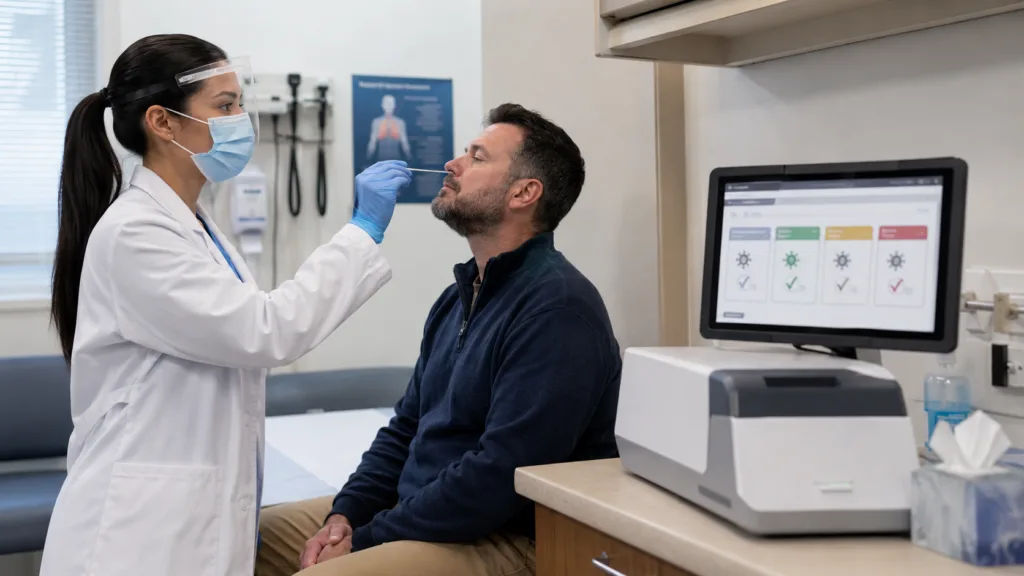
Autonomous Medical Devices Incorporated has received United States Food and Drug Administration 510(k) clearance and a CLIA waiver for its Fast PCR Instrument and Mini Respiratory Panel. The system uses an anterior nasal swab to detect and differentiate influenza A, influenza B, respiratory syncytial virus and SARS-CoV-2 in less than ten minutes, positioning molecular testing within urgent-care, primary-care and physician-office visits.
Why the combined FDA clearance and CLIA waiver matters more than test speed alone
The regulatory outcome gives Autonomous Medical Devices Incorporated, commonly known as AMDI, access to a much broader clinical market than a conventional laboratory-only molecular system. The 510(k) decision confirms that the test was considered substantially equivalent to a legally marketed device, while the CLIA waiver allows it to be used in settings that do not operate high-complexity molecular laboratories.
That combination is commercially important because urgent-care centres, physician offices and retail clinics frequently lack specialised molecular-testing personnel. A rapid platform may have little practical value if it requires laboratory infrastructure, complex pipetting or extensive operator training. The waiver indicates that the Fast PCR workflow can be performed reliably by intended users under the conditions evaluated for regulatory review.
The system addresses a familiar diagnostic problem. Influenza, respiratory syncytial virus and COVID-19 can produce overlapping symptoms, including fever, cough, fatigue and congestion. Clinical assessment alone may not reliably identify the responsible virus, particularly during periods when several pathogens are circulating simultaneously.
A molecular result delivered while the patient remains at the clinic could allow the provider to make a more informed decision during the original appointment. This may reduce delayed telephone follow-up, unnecessary return visits and treatment decisions based primarily on symptom patterns.
However, a CLIA waiver should not be confused with the absence of operational requirements. Clinics must still collect specimens correctly, follow quality-control procedures, maintain instruments, manage invalid results and ensure that staff understand the limits of the assay. Simplification reduces the training burden, but it does not eliminate the possibility of pre-analytical or operator error.
How the clinical performance compares with the speed promised by the platform
The Fast PCR Mini Respiratory Panel was evaluated in a multicentre clinical study involving 1,906 participants. The study compared AMDI results with the Cepheid Xpert Xpress CoV-2/Flu/RSV plus assay, an established molecular platform used in laboratories and point-of-care environments.
The enrolled population included 242 influenza A-positive specimens, 77 influenza B-positive specimens, 71 respiratory syncytial virus-positive specimens and 87 SARS-CoV-2-positive specimens. Overall agreement with the comparator was reported at 97.2% for influenza A, 99.7% for influenza B, 99.3% for respiratory syncytial virus and 99.3% for SARS-CoV-2.
Those results support the regulatory conclusion that the system can provide clinically useful molecular information rapidly. They also show that sub-10-minute processing does not necessarily require the performance compromises historically associated with some faster antigen-based approaches.
The study recorded 85 discrepant results, representing approximately 4.4% of the total. Nearly three-quarters of those discrepancies were associated with low viral loads.
Low viral load is a predictable challenge for respiratory diagnostics. It may occur early in infection, late in the illness, after partial immune clearance or because specimen collection captured limited viral material. These are also the cases in which differences between molecular platforms become more likely.
The presence of discrepancies does not invalidate the system, but it reinforces that no respiratory test should be interpreted as infallible. A negative result may not fully exclude infection when the viral burden is near the detection limit, the specimen is poorly collected or the virus is present mainly in a different part of the respiratory tract.
The evidence base also requires independent expansion. Much of the currently available technical work involves investigators affiliated with AMDI, and the comparative study used one established platform as the reference. Broader post-launch studies across independent healthcare networks will be needed to confirm performance under routine conditions.
Why less than ten minutes could change decisions made during a single urgent-care visit
The practical difference between a ten-minute result and a result available thirty minutes later is not merely twenty minutes on a laboratory clock. It can determine whether the answer arrives before or after the clinician has completed the consultation and the patient has left.
Cepheid’s four-virus molecular assay can report selected results in approximately 25 minutes, with a longer full runtime depending on the test mode and result. Other molecular platforms may require fifteen to forty-five minutes, while central-laboratory testing can take several hours or longer when transport and batching are included.
AMDI is attempting to fit molecular testing into the ordinary duration of an outpatient appointment. A nasal sample can be collected near the beginning of the visit, allowing the provider to review the result before finalising the assessment.
This model could be particularly relevant when antiviral treatment is being considered. Influenza treatment decisions are often time sensitive, and providers may be reluctant to prescribe without diagnostic confirmation when several respiratory viruses are circulating. A result returned during the visit could reduce empirical treatment while avoiding delays for patients who may benefit.
Rapid differentiation may also support infection-control decisions. A clinic can advise patients and caregivers more specifically when influenza, respiratory syncytial virus or COVID-19 is detected. In paediatric, elderly and immunocompromised populations, identifying respiratory syncytial virus can influence monitoring and escalation decisions even when no simple outpatient antiviral pathway exists.
The benefit should not be overstated. Diagnostic speed does not automatically improve outcomes. Providers must use the information appropriately, treatment must be available and patients must present early enough for the result to change management.
A clinic that runs the test but continues the same prescribing behaviour will gain less value than one that integrates testing into defined treatment and antimicrobial-stewardship pathways. Commercial adoption will therefore depend partly on clinical workflow design rather than instrument performance alone.
Can faster molecular testing reduce unnecessary antibiotics in outpatient respiratory care?
One of the broader arguments for rapid respiratory testing is that identifying a viral pathogen may reduce inappropriate antibiotic use. Antibiotics do not treat influenza, respiratory syncytial virus or COVID-19, yet they may still be prescribed when clinicians face diagnostic uncertainty or pressure to provide treatment.
A positive molecular result can give the provider greater confidence that a common respiratory virus is responsible for the symptoms. It can also provide patients with a clearer explanation for why an antibiotic is not indicated.
The effect is not guaranteed. Viral infection does not exclude bacterial coinfection, and some clinicians may continue prescribing antibiotics because of concern about pneumonia, sinusitis, otitis media or another bacterial complication. Patient expectations and local prescribing culture can also outweigh diagnostic evidence.
The panel does not test for bacterial causes of respiratory symptoms. It cannot identify group A streptococcus, pertussis, bacterial pneumonia or atypical respiratory bacteria. It also does not cover many other viruses capable of causing similar illness.
A negative four-virus panel may therefore create another form of uncertainty. Providers may interpret the absence of influenza, respiratory syncytial virus and SARS-CoV-2 as support for bacterial disease even when another untested virus is responsible.
AMDI will need real-world evidence showing how the platform changes prescribing, additional testing, referral and follow-up. Demonstrating analytical accuracy was necessary for clearance. Demonstrating measurable improvement in healthcare utilisation will be important for long-term commercial value.
Why the four-pathogen menu is useful but may be too narrow for some clinical settings
The initial Mini Respiratory Panel covers four of the most prominent respiratory viruses, making it relevant for seasonal outpatient testing. Its focused menu may help keep the system fast, simple and economically manageable.
A narrow panel can be preferable when providers need answers to specific treatment questions. Large syndromic panels may detect pathogens that do not change immediate management, increasing cost and creating uncertainty about whether every positive finding is clinically important.
The limitation is that many patients with respiratory symptoms will test negative for all four targets. Rhinovirus, adenovirus, human metapneumovirus, parainfluenza viruses and seasonal coronaviruses are among the causes not included in the cleared panel.
Hospital emergency departments and immunocompromised-patient programmes may prefer broader syndromic panels because missing an alternative pathogen could affect isolation or treatment. Those settings may accept a longer runtime in exchange for a larger menu.
AMDI has described the underlying architecture as scalable to as many as 32 targets. That claim refers to the platform’s potential capacity rather than the regulatory status of the currently cleared four-pathogen panel.
Expanding the menu will require additional assay development, clinical validation and regulatory submissions. Multiplexing more organisms can also create technical challenges involving primer interactions, competition between targets and interpretation of multiple detections.
The commercial trajectory may depend on whether AMDI can build a menu beyond respiratory viruses. A single seasonal panel can generate meaningful consumable demand, but healthcare organisations often prefer instrument platforms that support several types of testing throughout the year.
How modular throughput could determine whether AMDI fits busy urgent-care networks
The Fast PCR Instrument includes a base station that can be configured with multiple operating modules. This modular design may allow clinics to run several patient samples in parallel rather than waiting for one test to finish before starting another.
Parallel capacity becomes important during the respiratory season, when urgent-care sites may evaluate many symptomatic patients within a short period. A ten-minute assay can still create a queue if the instrument processes only one sample at a time.
A multi-module configuration allows healthcare groups to adjust capacity according to location. A lower-volume physician office may begin with a limited configuration, while a busy urgent-care centre may install additional modules.
Actual throughput will depend on more than runtime. Staff must label samples, transfer material, load the test disc, verify patient information, review results and clean or prepare the workspace between tests. Quality controls and invalid-result repeats can also reduce practical capacity.
The economics of modular expansion will matter. Health systems will compare instrument cost, consumable pricing, service agreements and staffing requirements with the reimbursement available for molecular respiratory testing.
AMDI has not publicly established whether the commercial model will rely on instrument sales, reagent rental, placement agreements or volume-based consumable contracts. These details could influence adoption as much as the ten-minute result.
A private company entering a market containing established diagnostics manufacturers may need aggressive pricing or flexible placement arrangements. Buyers will also consider the supplier’s ability to provide technical service across geographically distributed networks.
Why cloud connectivity creates operational value and a new category of risk
The Fast PCR platform includes cloud connectivity and is designed to transmit results into electronic health record systems. For multi-site urgent-care or retail-clinic networks, central connectivity can provide visibility into instrument utilisation, test volumes, error rates and inventory needs.
Automated electronic reporting can reduce manual transcription errors and make results available across the care team. It may also support public-health reporting and respiratory-surveillance programmes, depending on system configuration and regulatory requirements.
Connectivity becomes particularly valuable when hundreds of instruments are deployed across a distributed network. A central operations team can identify malfunctioning modules, monitor consumable use and compare testing patterns between locations.
The same architecture introduces dependency and cybersecurity concerns. Healthcare providers will want to know how the system operates during an internet outage, how patient information is encrypted and where diagnostic data are stored.
Cloud-connected medical devices can become targets for cyber intrusion, ransomware or unauthorised access. Even when an attacker cannot alter the underlying assay, disruption of result transmission or instrument authentication could interrupt clinical service.
Integration with electronic health records is also rarely effortless. Healthcare organisations use different interfaces, data standards and security processes. A technically capable system may still require substantial local configuration before results flow correctly into the patient record.
AMDI must therefore compete on software reliability as well as molecular performance. Diagnostics companies increasingly sell connected clinical infrastructure rather than isolated instruments, making cybersecurity, uptime and interoperability part of the product’s clinical value.
Can AMDI manufacture enough instruments and consumables to support a national launch?
AMDI operates an ISO 13485-certified facility of approximately 110,000 square feet in Santa Ana, California. The diagnostics manufacturer has stated that it has expanded instrument and consumable manufacturing in preparation for commercial deployment.
In-house production can provide greater control over instrument quality, test-disc manufacturing and supply continuity. It may also allow faster design changes and menu expansion than a model dependent on several external manufacturers.
Regulatory clearance is only the beginning of the manufacturing test. The company must deliver large numbers of cartridges with consistent reagent performance, maintain shelf life across distribution conditions and respond quickly when customers report failures.
Respiratory testing demand is highly seasonal and can change abruptly during outbreaks. Manufacturers must build inventory before demand peaks without producing excessive stock that expires unused.
The COVID-19 pandemic demonstrated how quickly diagnostics supply chains can become constrained by plastics, swabs, reagents and transport disruptions. A new entrant must show that it can maintain production when demand increases beyond normal forecasts.
Established competitors have mature distribution, technical-service and customer-support networks. AMDI may need commercial partners or distributors to reach urgent-care centres, physician offices and retail clinics nationally.
A rapid test that is unavailable during the respiratory season loses much of its strategic value. Buyers may therefore begin with limited placements until the manufacturer demonstrates dependable supply and service.
What reimbursement and test economics could mean for commercial adoption
Molecular diagnostics generally cost more than antigen tests. The additional expense may be justified when greater sensitivity and pathogen differentiation change treatment, reduce follow-up or prevent unnecessary care.
Urgent-care operators will assess whether reimbursement covers the test, staff time and instrument-related costs. Payers may question frequent use in patients with mild disease when the result is unlikely to alter management.
The strongest economic case may involve higher-risk groups, treatment-eligible patients, paediatric and elderly populations, or situations in which several pathogens are circulating and clinical differentiation is difficult.
Retail and employer-based clinics may value the system for operational reasons even when direct reimbursement is uncertain. A rapid answer can shorten the patient journey and reduce later communication, but those savings must be measured rather than assumed.
AMDI may also face price competition from rapid antigen testing. Antigen tests can deliver results quickly with lower equipment requirements, although sensitivity may be lower, particularly when viral burden is limited.
The Fast PCR system must occupy the middle ground between inexpensive rapid testing and broader but slower molecular platforms. Its commercial argument will depend on offering enough accuracy, speed and workflow efficiency to justify the molecular-testing premium.
What clinicians and diagnostics buyers will watch after the commercial launch
The first issue will be real-world invalid and repeat rates. A ten-minute runtime loses its advantage if a meaningful proportion of samples must be rerun because of operator, cartridge or instrument errors.
The second issue will be performance at low viral loads. Most disagreements in the comparative study occurred near the limit of detection, making independent evaluation during different respiratory seasons important.
The third issue will be clinical impact. Health systems will want evidence that the test changes antiviral prescribing, antibiotic use, patient follow-up, isolation decisions or emergency-department referrals.
The fourth issue will be economics. Instrument placement, consumable pricing, reimbursement and seasonal utilisation will determine whether the system produces sustainable value for outpatient providers.
The fifth issue will be menu expansion. The current four-virus panel creates an entry point, but a broader range of cleared assays could make the platform more useful throughout the year and reduce reliance on respiratory-season demand.
Autonomous Medical Devices Incorporated has achieved a meaningful regulatory milestone by combining sub-10-minute RT-PCR performance with a CLIA-waived workflow. The system has the potential to move molecular respiratory testing into the same time window as an ordinary urgent-care consultation.
The harder challenge begins after clearance. AMDI must prove that its speed remains reliable in routine practice, that clinics can afford the platform and that rapid molecular information produces better decisions rather than simply faster test results.