AngioDynamics, Inc. has received United States Food and Drug Administration approval to begin the RELIEF feasibility study of its NanoKnife irreversible electroporation platform in men with lower urinary tract symptoms caused by benign prostatic hyperplasia. The small-cap medical technology company plans to enrol up to 40 patients and test whether non-thermal electrical ablation can reduce urinary symptoms while preserving urinary control and sexual function.
Why the FDA IDE clearance is a meaningful catalyst without being a commercial approval
The regulatory milestone gives AngioDynamics permission to evaluate NanoKnife for benign prostatic hyperplasia in a prospective United States clinical study. It does not permit the company to promote NanoKnife as an approved treatment for enlarged prostate symptoms.
That distinction matters for investors because an Investigational Device Exemption represents entry into clinical development rather than the end of the regulatory process. AngioDynamics must first show that the procedure can be performed safely, produces a meaningful reduction in symptoms and maintains those benefits over time.
The RELIEF study will enrol only 40 men across as many as five United States sites. Its primary effectiveness measure will be the average change in the International Prostate Symptom Score six months after treatment. The safety analysis will examine the incidence and severity of device-related adverse events during the same period.
The International Prostate Symptom Score captures problems including urinary frequency, urgency, weak stream, incomplete bladder emptying and nighttime urination. Improvement would demonstrate that patients feel and function better, but it will not by itself establish superiority over medication, transurethral surgery or established minimally invasive systems.
The study is therefore best viewed as a signal-generation programme. Positive findings could support a larger pivotal trial, refine patient selection and help AngioDynamics determine whether the BPH opportunity justifies broader investment. Weak efficacy or unexpected functional complications could prevent the programme from progressing despite the FDA’s permission to begin testing.
How NanoKnife irreversible electroporation differs from heat-based and tissue-removing BPH procedures
NanoKnife uses irreversible electroporation, a process in which short, high-voltage electrical pulses create permanent microscopic openings in cell membranes. The affected cells lose their ability to maintain normal function and undergo a form of cell death, allowing the treated tissue to shrink or be cleared gradually.
The procedure is non-thermal, meaning it is not designed to destroy tissue through heat or freezing. This could reduce collateral injury near sensitive structures when compared with procedures that rely on thermal energy.
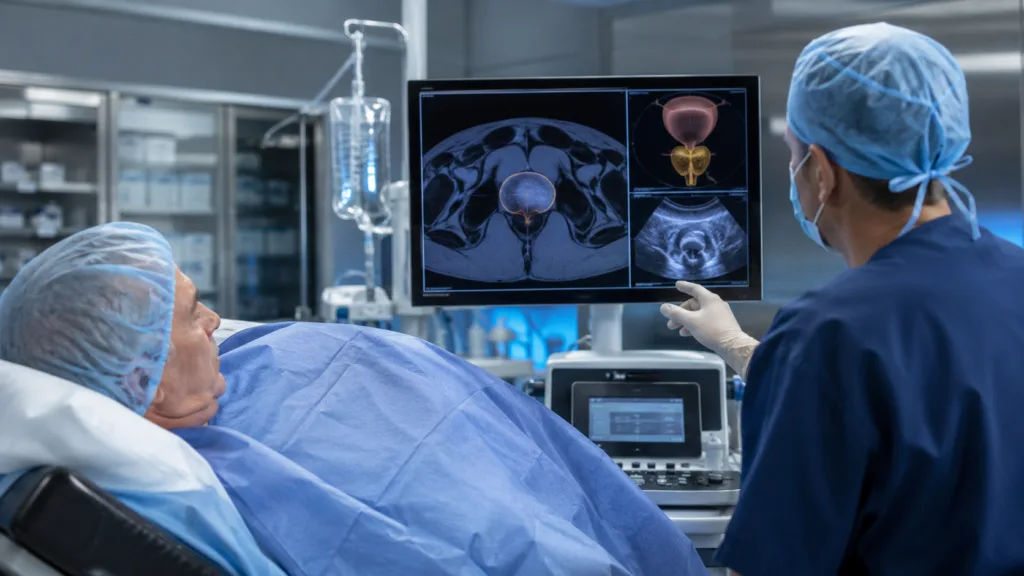
In the RELIEF study, physicians will place electrodes through the perineum and into predefined areas of the prostate using transrectal ultrasound guidance. Treatment planning will target both sides of the transition zone, where benign prostatic enlargement commonly develops, while attempting to preserve the urethra, external urinary sphincter and neurovascular bundles.
This tissue-sparing proposition is central to the investment and clinical narrative. Men considering a BPH procedure frequently worry about urinary incontinence, erectile dysfunction and ejaculatory changes. A treatment capable of producing durable symptom relief while reducing those risks could attract meaningful interest from patients and urologists.
However, non-thermal does not mean non-invasive or risk free. The procedure requires needles to be positioned inside the prostate and is expected to be performed under general anaesthesia. Incorrect electrode placement or unintended treatment near critical structures could still cause bleeding, infection, urinary retention, pain or functional injury.
The technology is also irreversible. Once tissue has been ablated, the treatment cannot be adjusted or switched off. Clinical success will depend on precise planning, consistent electrode positioning and sufficient experience among treating urologists.
Why observations from prostate cancer procedures provide rationale but not BPH proof
AngioDynamics already markets NanoKnife for surgical ablation of prostate tissue, and the platform has been used in patients receiving focal treatment for intermediate-risk prostate cancer. Physicians reportedly observed improvements in urinary symptoms among some men treated in that setting.
Those observations provided the clinical rationale for RELIEF. If ablation performed for cancer also reduced obstruction or prostate-related urinary symptoms, targeting enlarged transition-zone tissue specifically for BPH could potentially produce a similar functional effect.
The evidence remains indirect. A patient undergoing prostate cancer ablation differs from a patient seeking treatment solely for benign enlargement. Cancer location, prostate anatomy, treatment zones and baseline urinary symptoms may all differ.
An improvement observed after cancer treatment may also reflect several factors beyond irreversible electroporation. Changes in medication, catheter use, swelling, tissue remodelling and follow-up care could influence symptoms.
RELIEF must establish the effect prospectively in a defined BPH population. Investigators will need to show that symptom improvement is consistent, clinically meaningful and accompanied by objective changes in urinary flow or bladder emptying.
The study will also monitor sexual function and durability for up to five years. Long follow-up is important because the prostate can continue enlarging with age, and a procedure that performs well at six months may lose effectiveness later.
Can a 40-patient single-arm study distinguish real benefit from placebo and procedural effects?
A feasibility study is intended to determine whether a concept deserves larger testing, not to settle the final clinical question. RELIEF’s small size and single-arm structure limit how confidently the results can be interpreted.
Every participant will receive NanoKnife treatment, and there will be no randomized medication, sham procedure or established-device control. Without a comparator, changes could partly reflect patient expectations, natural symptom fluctuation or temporary effects associated with catheterisation and postoperative care.
Benign prostatic hyperplasia symptoms are subjective and can vary over time. The International Prostate Symptom Score is validated and widely used, but patients who expect improvement after an advanced procedure may report feeling better even when anatomical obstruction changes only modestly.
Objective measures such as urinary flow rate, post-void residual volume and prostate size can strengthen the dataset. They still need to be interpreted alongside symptom improvement, adverse events and retreatment rates.
A larger pivotal programme would ideally compare NanoKnife with an appropriate standard or use a design capable of reducing expectation bias. The comparator could depend on the eventual target population, which may include men failing medication, men seeking to avoid resection or patients with prostate anatomy unsuitable for other minimally invasive procedures.
AngioDynamics must also define what magnitude of improvement would justify a more complex procedure requiring general anaesthesia. A statistically significant change may not be enough if patients could obtain similar relief through a shorter office-based treatment.
Why the BPH market is attractive but already crowded with effective alternatives
Benign prostatic hyperplasia is one of the most common urological conditions affecting ageing men. AngioDynamics estimates that approximately 15 million men in the United States experience symptoms and that more than 300,000 surgical procedures are performed annually.
The addressable market is therefore large, recurrent and supported by demographic trends. An ageing population should increase the number of men seeking treatment for urinary frequency, weak stream, urgency and incomplete emptying.
The market is not waiting for NanoKnife. Initial treatment often includes alpha blockers, 5-alpha reductase inhibitors or combination medication. These therapies are widely available and relatively inexpensive, although they may produce dizziness, sexual side effects or inadequate relief.
Transurethral resection of the prostate remains an established surgical benchmark. Laser enucleation and vaporisation procedures can provide strong and durable symptom control, especially in larger prostates, but may require specialised surgical expertise and can affect ejaculation.
Minimally invasive options include prostatic urethral lift systems, water-vapour therapy, temporary implanted devices, robotic waterjet ablation and prostate artery embolisation. These treatments compete through different combinations of symptom improvement, recovery time, anaesthesia requirements, sexual-function preservation and durability.
NanoKnife must therefore identify a specific clinical gap. It could compete as a non-resecting option for men who require more substantial tissue treatment than office-based procedures provide but want to avoid conventional surgery. It may also prove useful in anatomical situations where preserving the urethra and surrounding structures is especially important.
The danger is becoming technologically interesting but commercially indistinct. Urologists will not adopt another BPH device merely because its energy source is different. AngioDynamics must demonstrate a benefit patients can recognise and hospitals can justify economically.
Could preservation of ejaculation and erectile function become NanoKnife’s strongest differentiator?
Sexual outcomes strongly influence treatment choice in benign prostatic hyperplasia. Some established procedures improve urinary flow effectively but cause retrograde ejaculation, reduced semen emission or other changes that patients may find unacceptable.
NanoKnife’s targeted non-thermal mechanism is designed to preserve structures associated with sexual and urinary function. RELIEF will monitor these outcomes carefully, and a low rate of new erectile, ejaculatory or continence problems could support differentiation.
Functional preservation must be considered alongside efficacy. A treatment with fewer sexual side effects will be attractive only if it provides enough symptom relief and durability to justify undergoing the procedure.
Patients may accept a modestly lower improvement when sexual preservation is a high priority. Others with severe obstruction, recurrent urinary retention or bladder damage may prioritise maximum urinary improvement and choose a more established tissue-removing procedure.
The ideal NanoKnife profile would combine substantial symptom reduction with low retreatment rates and preservation of ejaculation, erections and urinary control. Producing all four outcomes consistently would create a compelling clinical proposition.
The feasibility study is too small to define uncommon complications reliably. One or two adverse functional outcomes could materially change the reported percentage, while the absence of events among 40 patients would not guarantee the same safety profile after broader use.
What reimbursement and procedure economics could decide about future commercial adoption
Regulatory success alone would not guarantee commercial uptake. AngioDynamics must establish a reimbursement pathway covering the capital equipment, disposable probes, imaging, general anaesthesia, physician time and facility costs associated with the procedure.
NanoKnife has gained a Category I Current Procedural Terminology code for prostate tissue ablation, supporting the existing prostate application. That coding progress does not automatically establish payment for BPH treatment.
Payers will want evidence that the procedure is medically necessary, durable and economically competitive. A treatment that costs more initially could still be attractive if it reduces medication use, repeat procedures, complications and hospitalisation.
The requirement for general anaesthesia could weaken the economic argument relative to office-based BPH technologies. Hospital and ambulatory surgery centre utilisation increases cost and may make the procedure less convenient for patients.
AngioDynamics could offset that disadvantage if NanoKnife provides stronger durability, treats larger or more complex prostates, or preserves function better than lower-intensity alternatives. Those benefits must be demonstrated through comparative evidence rather than assumed from the mechanism.
Commercial adoption would also require physician training. Transperineal electrode placement and treatment planning are more technically involved than prescribing medication or deploying some single-use office devices. Early use is likely to concentrate in specialist urology centres already familiar with focal prostate ablation.
Why the BPH expansion matters to AngioDynamics’ wider NanoKnife growth strategy
NanoKnife is already one of AngioDynamics’ fastest-growing technology platforms. Fiscal third-quarter 2026 NanoKnife revenue increased 21% to $7.6 million, including 20% growth in disposable probes and nearly 25% growth in capital equipment.
The company’s wider Med Tech segment generated $37.3 million during the quarter, increasing 19%. NanoKnife sits alongside the Auryon atherectomy business and the AngioVac and AlphaVac thrombectomy platforms as a central part of AngioDynamics’ transition toward higher-growth, higher-margin technologies.
BPH could expand NanoKnife beyond oncology into a high-volume benign disease market. That would increase the potential utilisation of installed systems, create recurring probe demand and give hospitals another reason to purchase the capital platform.
Installed-base economics are especially important in medical devices. A hospital may justify the equipment more readily when the system can support prostate cancer ablation, selected tumour procedures and eventually BPH treatment.
The expansion also carries opportunity cost. Clinical development, regulatory work, physician education and reimbursement activities require capital. AngioDynamics ended its fiscal third quarter with $37.8 million in cash and no debt, but it remains GAAP loss-making and must allocate resources carefully across several growth platforms.
A successful feasibility study could attract investor attention because it would suggest that NanoKnife has a larger market ceiling than current prostate-cancer and tumour-ablation applications imply. A disappointing study would limit the expansion narrative without damaging existing cleared uses directly.
What ANGO stock performance says about investor expectations after the FDA milestone
AngioDynamics shares closed at approximately $12.15 in the latest session, giving the company a market capitalisation of around $505 million. The stock remained below its 52-week high of $13.99 but well above the low of $8.36.
Shares gained only about 0.4% over five trading days, suggesting the RELIEF IDE clearance did not trigger an immediate speculative rerating. Over one month, the stock advanced approximately 6.2%, reflecting broader confidence in the company’s Med Tech growth and NanoKnife adoption rather than the BPH programme alone.
The muted short-term reaction is understandable. An IDE for a 40-patient feasibility trial does not produce immediate revenue and remains several regulatory steps away from a commercial BPH indication.
Retail-investor interest could increase when the company announces first-patient treatment, enrolment progress or initial six-month results. NanoKnife is a visually understandable platform, BPH represents a large market and AngioDynamics has a relatively small valuation, all ingredients that can attract discussion on Stocktwits and other trading communities.
The risk for investors is confusing market size with near-term revenue. Even positive feasibility data would probably be followed by a larger trial, regulatory review, reimbursement work and commercial preparation. The BPH opportunity should currently be treated as pipeline optionality rather than included as an established sales franchise.
What clinicians and investors should watch as the RELIEF study begins enrolment
The first milestone will be how quickly AngioDynamics activates the planned clinical sites and enrols 40 appropriate patients. Slow recruitment could indicate narrow eligibility, limited physician interest or competition from other BPH studies.
Baseline prostate size and symptom severity will influence interpretation. Results in moderately symptomatic patients with smaller prostates may not apply to men with severe obstruction or very large glands.
The six-month change in International Prostate Symptom Score will provide the headline efficacy result, but urinary flow, residual urine, quality of life, catheter duration and retreatment will determine whether the outcome is clinically persuasive.
Sexual and urinary function will be central. NanoKnife’s commercial differentiation becomes much weaker if meaningful rates of erectile dysfunction, ejaculatory impairment, incontinence or prolonged urinary retention emerge.
Long-term durability may ultimately decide the programme’s value. A procedure that preserves function but requires frequent retreatment could struggle against more durable surgical alternatives.
AngioDynamics has opened a credible pathway into one of urology’s largest procedural markets. The RELIEF study is a strategically interesting small-cap catalyst because it could transform NanoKnife from a specialist ablation platform into a broader men’s-health technology.
The evidence burden remains substantial. NanoKnife must prove that precise non-thermal ablation produces durable urinary improvement, protects sexual and urinary function and offers enough operational and economic value to compete in an increasingly crowded BPH market.