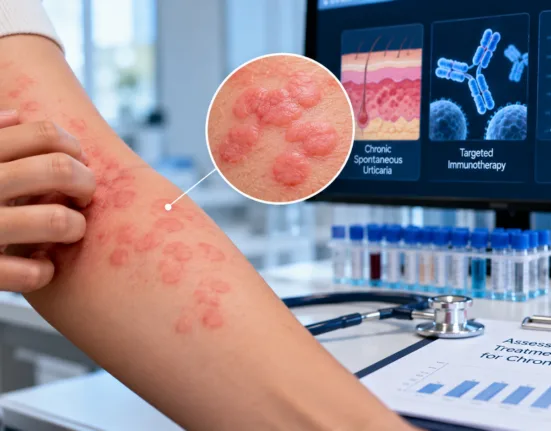
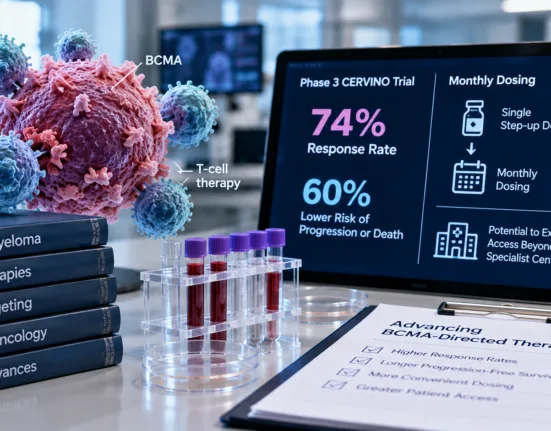
AbbVie is reportedly nearing an approximately $10.9 billion all-cash acquisition of Apogee Therapeutics, the Nasdaq-listed biotechnology company developing the long-acting anti-IL-13 antibody zumilokibart for atopic dermatitis and other inflammatory diseases. The potential transaction has not been formally announced, but it could give AbbVie a Phase 3-ready biologic designed to challenge established eczema therapies through deeper disease control and substantially less frequent maintenance dosing.
Why AbbVie could pay a large premium for Apogee despite already leading in immunology
AbbVie does not need Apogee Therapeutics to establish credibility in immunology. The pharmaceutical group already generated $7.29 billion from its global immunology portfolio during the first quarter of 2026, led by $4.48 billion from Skyrizi and $2.12 billion from Rinvoq. Those two products have largely replaced the growth lost as biosimilar competition reduces Humira revenue.
The strategic issue is not AbbVie’s current position. It is whether the company has enough differentiated immunology products to sustain growth through the next decade as competition intensifies around Skyrizi and Rinvoq. Both medicines are expanding across indications, but dependence on two dominant franchises creates concentration risk. A successful zumilokibart programme could provide AbbVie with another large-market immunology asset using a different treatment mechanism and safety profile.
Rinvoq is already approved for atopic dermatitis and can deliver rapid and substantial efficacy. However, oral Janus kinase inhibitors carry safety warnings and monitoring considerations that can influence physician and patient preferences. A long-acting biologic could allow AbbVie to compete for patients who need systemic therapy but prefer an antibody with less frequent administration and a treatment profile more familiar to dermatologists.
The proposed acquisition would therefore strengthen AbbVie at both ends of the treatment decision. Rinvoq could remain a high-efficacy oral option, while zumilokibart could become a lower-frequency biologic for patients seeking sustained control without daily tablets or the broader safety concerns associated with Janus kinase inhibition.
The risk is that AbbVie may be paying nearly $11 billion for strategic fit before Apogee has begun its pivotal programme. Strong Phase 2 results improve the probability of success, but they do not establish that zumilokibart will reproduce its efficacy, durability and safety across larger Phase 3 trials.
What the reported $10.9 billion valuation reveals about competition for late-stage immunology assets
The reported price would represent a premium of roughly 60% to Apogee Therapeutics’ June 18 closing valuation. Apogee ended that session with a market capitalisation of approximately $6.8 billion, meaning AbbVie would be paying several billion dollars above the value assigned by public investors before the acquisition report emerged.

That premium reflects more than the value of a single positive clinical trial. Large pharmaceutical companies are competing for assets that have moved beyond early biological uncertainty but have not yet reached a commercial valuation. Zumilokibart sits in that attractive but expensive zone because its target is clinically validated, its Phase 2 results are positive and its Phase 3 programme is expected to begin during the second half of 2026.
Buying Apogee now would allow AbbVie to control trial design, regulatory strategy, manufacturing and commercial preparation before the pivotal programme becomes fully established. Waiting for Phase 3 data would reduce clinical uncertainty but could increase the acquisition price dramatically if the trials succeed.
The proposed valuation also signals the scarcity of biologics that combine a validated target with a potentially differentiated dosing schedule. AbbVie would not be betting that IL-13 is a newly discovered pathway. It would be betting that antibody engineering can produce a commercially superior version of an already proven therapeutic approach.
That strategy reduces target risk while leaving product risk intact. Zumilokibart still needs to prove that longer exposure does not create unexpected safety or immunogenicity issues, that infrequent dosing maintains control across diverse patients and that its Phase 2 efficacy survives the transition into larger trials.
How strong are the Phase 2 results supporting AbbVie’s reported acquisition interest?
The Phase 2 APEX Part B study enrolled 346 adults with moderate-to-severe atopic dermatitis and evaluated high, medium and low doses of zumilokibart against placebo. The medium dose, which Apogee plans to advance into Phase 3, produced the most favourable overall profile.
At week 16, 65.9% of patients receiving the medium dose achieved at least a 75% improvement in the Eczema Area and Severity Index, compared with 23.4% receiving placebo. The medium-dose group also recorded meaningful responses across stricter measures of skin clearance, itch improvement and very low disease activity.
Nearly half of medium-dose recipients achieved a 90% improvement in eczema severity, while 46% reached clear or almost clear skin under the investigator assessment measure. Complete skin clearance was observed in 16.5%, and approximately one-fifth reached the combined very low disease activity endpoint involving strong lesion and itch control.
The results support a competitive efficacy profile, particularly because the induction period required only four dosing days. Apogee has also reported that patients responding during the earlier APEX Part A study maintained or deepened their responses with administration every three or six months during maintenance.
This dosing proposition may be the most valuable element of the programme. Existing biologics for atopic dermatitis often require administration every two or four weeks. A therapy given only several times per year could reduce treatment burden, improve persistence and create a clearer reason for physicians to switch or initiate therapy.
However, the medium and high doses did not show a straightforward dose-response relationship. The medium dose produced a numerically higher EASI-75 response than the high dose, while conjunctivitis was more frequent with the higher regimen. That does not invalidate the medicine, but it confirms that more exposure is not automatically better and makes Phase 3 dose optimisation particularly important.
Can zumilokibart genuinely compete with Dupixent and other established eczema biologics?
The central commercial comparison will be with Dupixent, the IL-4 receptor alpha antibody developed by Regeneron Pharmaceuticals and Sanofi. Dupixent blocks signalling from both IL-4 and IL-13 and has established a major franchise across atopic dermatitis, asthma, eosinophilic oesophagitis and other inflammatory diseases.
Zumilokibart targets IL-13 directly. Apogee’s strategy is to generate high and sustained antibody exposure, seeking strong disease control with a substantially longer interval between maintenance doses. The product does not need to prove that IL-13 biology is relevant because approved anti-IL-13 medicines and Dupixent have already validated the pathway.
It does need to show why physicians should choose zumilokibart over treatments with established long-term safety, reimbursement and prescribing experience. Less frequent dosing offers a persuasive differentiator, but it may not be sufficient if Phase 3 efficacy merely matches existing drugs or if payers prefer discounted incumbent therapies.
The broader eczema market also includes lebrikizumab, tralokinumab, oral Janus kinase inhibitors and emerging approaches targeting OX40, OX40 ligand and other immune pathways. By the time zumilokibart reaches the market, physicians may have even more choices and could segment treatment according to speed, depth of response, safety, dosing convenience and previous treatment history.
AbbVie’s scale could materially improve the asset’s competitive position. The pharmaceutical group already has relationships with dermatologists, payer-contracting infrastructure, global manufacturing capabilities and experience launching immunology medicines across multiple indications. Apogee would otherwise need to build or outsource much of that commercial system.
The unanswered clinical question is whether zumilokibart can exceed the efficacy ceiling of existing biologics while preserving the safety advantages expected from a targeted antibody. Phase 2 comparisons across separate studies are not sufficient to establish superiority.
Why Apogee’s pipeline could matter almost as much as the lead eczema programme
Zumilokibart is being positioned as a pipeline within a product rather than a medicine limited to atopic dermatitis. Apogee plans to evaluate it in asthma and eosinophilic oesophagitis, with additional possible opportunities in chronic rhinosinusitis with nasal polyps, chronic spontaneous urticaria and prurigo nodularis.
The asthma programme has already generated positive early clinical findings, while a Phase 2b study is expected to begin during the first half of 2027. A Phase 2a eosinophilic oesophagitis trial is planned for the second half of 2026.
These expansion indications resemble the commercial development path that helped transform Dupixent from an eczema medicine into a broad type 2 inflammation franchise. AbbVie may therefore be valuing zumilokibart not simply as one late-stage dermatology candidate, but as a potential multi-indication biologic capable of producing revenue across dermatology, respiratory medicine and gastroenterology.
Apogee also owns combination programmes that could extend beyond the lead antibody. APG279 combines zumilokibart with the OX40 ligand antibody APG990, seeking broader control across several immune pathways. The programme is being evaluated against dupilumab in a Phase 1 study involving adults with moderate-to-severe atopic dermatitis.
APG273 combines IL-13 and thymic stromal lymphopoietin targeting for asthma and chronic obstructive pulmonary disease. The scientific objective is to address both central and local drivers of airway inflammation and potentially exceed the efficacy available from single-mechanism biologics.
These programmes remain substantially less mature than zumilokibart. Their value is therefore optional rather than established. AbbVie would gain multiple opportunities to develop combination biologics, but it would also inherit the cost and uncertainty associated with proving that dual targeting provides enough incremental benefit to justify more complex manufacturing and higher treatment costs.
How Apogee’s Blackstone financing could complicate the economics of a buyout
Apogee recently secured access to as much as $1.3 billion through a strategic financing arrangement with Blackstone Life Sciences. The package includes up to $800 million through a synthetic royalty structure and access to as much as $500 million in senior corporate debt.
The transaction was designed to finance Phase 3 development and potential commercialisation while reducing dependence on future equity offerings. Combined with Apogee’s existing cash, it gave the biotechnology company a credible path toward filing for approval without needing to sell itself.
That financial independence may have strengthened Apogee’s negotiating position. AbbVie would not be acquiring a distressed company facing an immediate cash shortage. It would be buying a well-funded biotechnology firm capable of continuing independently if the proposed terms were not attractive enough.
The financing could also affect the net economics of the acquisition. AbbVie would need to assess any royalty commitments, debt access, termination provisions and change-of-control obligations embedded in the Blackstone agreement. The headline acquisition value may not capture every future payment connected to the asset.
A buyer may prefer to restructure, repay or renegotiate parts of the financing to retain more of zumilokibart’s future economics. The exact treatment will depend on how much capital has been drawn and the contractual terms, which have not been disclosed in connection with the reported negotiations.
The presence of the financing therefore cuts both ways. It increases the price Apogee can demand by removing financing pressure, but it may also make the final transaction structure more complicated than a simple purchase of equity.
What the deal would mean for AbbVie’s post-Humira immunology strategy
Humira once defined AbbVie’s immunology business, but biosimilar entry has accelerated the decline of the franchise. First-quarter 2026 Humira revenue fell to $688 million, down nearly 39% from the previous year.
Skyrizi and Rinvoq have already demonstrated that AbbVie can replace a major patent-expired product through internally developed and partnered successors. Their combined quarterly sales now exceed $6.6 billion, making AbbVie one of the industry’s strongest immunology companies even after the Humira decline.
A purchase of Apogee would suggest that AbbVie is not satisfied with managing the current replacement cycle. The pharmaceutical group would be adding a biologic capable of extending immunology growth into the 2030s while diversifying away from complete dependence on interleukin-23 inhibition and Janus kinase inhibition.
Zumilokibart could also give AbbVie a more prominent biologic position in atopic dermatitis. Skyrizi is not an eczema therapy, while Rinvoq occupies the oral systemic segment. A long-acting IL-13 antibody would fill a portfolio gap and give the company additional leverage in payer negotiations across the immunology category.
The risk is strategic overlap rather than direct duplication. AbbVie would need to position Rinvoq and zumilokibart clearly enough to avoid internal competition that merely redistributes patients between two company-owned products. The commercial strategy may focus Rinvoq on patients needing rapid high-efficacy oral treatment and zumilokibart on biologic-preferred patients seeking durable control with infrequent dosing.
What the latest ABBV and APGE stock performance reveals about investor sentiment
Apogee Therapeutics shares closed at $90.38 on June 18, before the acquisition report became public. The stock had gained approximately 2.3% over five trading days, 11.4% over one month and 19.7% since the beginning of 2026.
The shares were already trading close to the top of their 52-week range of $34.34 to $95.32. This indicates that investors had assigned substantial value to the Phase 2 results, Blackstone financing and expected Phase 3 transition before reports of AbbVie’s interest emerged.
A reported 60% premium would therefore not be rescuing a depressed biotechnology valuation. AbbVie would be paying well above a price that already reflected significant confidence in the programme. That is one reason the potential deal carries meaningful execution risk for the buyer.
AbbVie shares closed at $216.49 on June 18 after falling about 4.9% over five sessions. The stock was roughly flat over one month and down approximately 5.3% for 2026, while remaining within a 52-week range of $181.73 to $244.81.
Investor reaction after a formal announcement would likely depend on the final purchase price, financing structure and management’s explanation of zumilokibart’s peak-sales potential. Apogee shareholders may focus primarily on whether the premium fully reflects the pipeline, while AbbVie shareholders will examine whether the company is paying too much for an unapproved medicine.
What could still prevent the reported AbbVie and Apogee transaction from being completed?
The companies may still fail to agree on price, liability allocation, financing obligations, employee retention or the treatment of future development commitments. Last-minute changes are particularly possible when a transaction involves a rapidly appreciating biotechnology asset and complex external financing.
Apogee’s board must determine whether an immediate cash exit provides more value than remaining independent through Phase 3 development. Accepting the deal would remove clinical and commercial risk for shareholders. Rejecting it would preserve the larger upside available if zumilokibart becomes a major multi-indication franchise.
AbbVie must make the opposite calculation. Buying now requires paying for future success before it is proven, but waiting could allow another pharmaceutical company to acquire the asset or force AbbVie to pay more after positive Phase 3 data.
Regulatory review is unlikely to focus on the transaction with the same intensity seen in combinations involving two dominant commercial products. Zumilokibart is not approved, and AbbVie does not currently market an IL-13 biologic. The deal would still require customary competition and closing reviews.
The greatest risk is clinical rather than antitrust-related. If zumilokibart misses Phase 3 endpoints or fails to show meaningful differentiation, AbbVie could face a large impairment on one of its biggest recent acquisitions.
Why the reported deal makes strategic sense but the valuation demands Phase 3 excellence
The reported acquisition has a clear industrial logic. AbbVie understands immunology development, has the commercial system needed to launch a global eczema biologic and can use zumilokibart across several type 2 inflammatory diseases.
Apogee brings a lead candidate with strong mid-stage results, a compelling low-frequency dosing proposition and several combination programmes built around validated targets. Those characteristics make it one of the more attractive independent immunology companies approaching Phase 3 development.
The proposed $10.9 billion price leaves little room for an average outcome. Zumilokibart would need to become more than another anti-IL-13 antibody. It would need to establish a commercially meaningful advantage in dosing, efficacy, treatment persistence or multi-indication expansion.
AbbVie may be willing to accept that risk because late-stage immunology assets with global franchise potential are scarce. The transaction could become a disciplined extension of the company’s strongest therapeutic area, or an expensive reminder that attractive Phase 2 data do not always survive pivotal testing.
Until the companies make a formal announcement, the reported acquisition remains a negotiation rather than a completed deal. The next decisive information will be the final transaction terms and whether AbbVie explains the valuation through zumilokibart alone or through Apogee’s wider antibody platform.