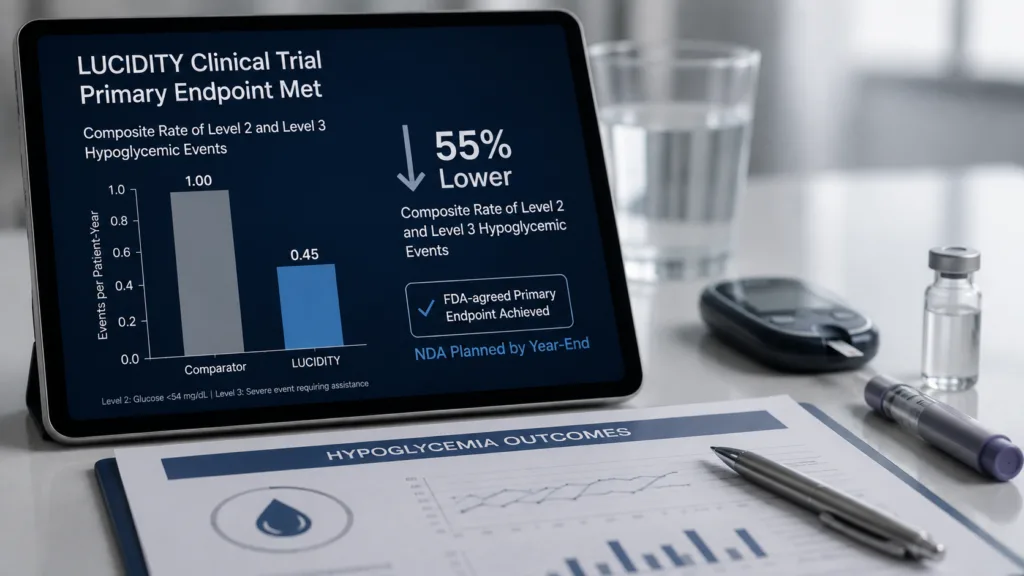
Amylyx Pharmaceuticals, Inc. has reported positive topline Phase 3 results for avexitide in post-bariatric hypoglycemia, with the investigational GLP-1 receptor antagonist producing a 55% reduction in the composite rate of clinically significant Level 2 and severe Level 3 hypoglycemic events compared with placebo. The 78-participant LUCIDITY study met its FDA-agreed primary endpoint with a P value of 0.000003 and achieved every announced secondary efficacy endpoint, putting Amylyx on course for a New Drug Application by the end of 2026 if the full dataset supports the topline result.
The finding is particularly interesting because avexitide uses almost the opposite pharmacological logic from the GLP-1 medicines dominating obesity and type 2 diabetes treatment. Instead of stimulating the GLP-1 receptor, avexitide competitively blocks it. In post-bariatric hypoglycemia, exaggerated GLP-1 signaling after food intake can trigger excessive insulin secretion, causing glucose to fall to clinically significant or dangerous levels after meals. Amylyx is attempting to interrupt that pathological response without broadly reversing the metabolic benefits of bariatric surgery.
There is currently no FDA-approved therapy specifically for post-bariatric hypoglycemia, or PBH. Amylyx estimates that the disorder may affect about 8% of US patients who have undergone Roux-en-Y gastric bypass or sleeve gastrectomy, potentially representing roughly 160,000 people, although the pivotal LUCIDITY trial specifically enrolled participants with PBH following Roux-en-Y gastric bypass.
What exactly did the Phase 3 LUCIDITY trial measure?
LUCIDITY was a multicenter, randomized, double-blind and placebo-controlled Phase 3 study conducted at 21 US sites. Seventy-eight participants with confirmed post-bariatric hypoglycemia after Roux-en-Y gastric bypass were randomized in a three-to-two ratio to receive avexitide 90 mg subcutaneously once daily or placebo for 16 weeks.
The primary endpoint was the composite rate of Level 2 and Level 3 hypoglycemic events. Level 2 hypoglycemia represents clinically significant low glucose, while Level 3 events are characterized by severe cognitive or physical impairment requiring assistance from another person rather than by a specific glucose threshold alone.
Amylyx reported a 55% reduction in that composite event rate with avexitide compared with placebo. The wording is important: the result is a reduction in the rate of qualifying hypoglycemic events, not a claim that avexitide reduced each individual patient’s probability of having an event by exactly 55%.
All secondary endpoints were also met, including Level 2 hypoglycemia measured through self-monitoring of blood glucose, Level 2 events detected by continuous glucose monitoring and adjudicated Level 3 events. The consistency across measurement methods strengthens the topline result because the efficacy signal did not depend exclusively on one monitoring technology or patient-reported event definition.
ClinicalTrials.gov describes LUCIDITY as including a screening and run-in period, the 16-week randomized treatment phase and a 32-week open-label extension. Participants had to demonstrate recurrent PBH despite dietary management before randomization, including at least three qualifying events during the run-in period.
That enrollment requirement matters because the trial was not testing avexitide in people with occasional mild symptoms after surgery. It selected patients with objectively recurrent disease despite attempts at dietary management, creating a population with a clearer unmet treatment need.
Why can blocking GLP-1 reduce hypoglycemia after bariatric surgery?
Roux-en-Y gastric bypass changes the rate and anatomical route through which nutrients reach the intestine. For some patients, meals subsequently generate an exaggerated incretin response, including unusually high GLP-1 secretion.
GLP-1 stimulates insulin secretion when glucose rises. In the usual physiological setting, that contributes to appropriate post-meal glucose control. In PBH, the response can become excessive: rapid nutrient delivery produces a strong glucose excursion, GLP-1 signaling drives disproportionate insulin secretion and circulating glucose then falls too far after the meal.
Avexitide is a competitive GLP-1 receptor antagonist designed to blunt this pathway. By reducing GLP-1 receptor activation, the drug aims to prevent excessive insulin release while preserving sufficient physiological glucose control.
The mechanism creates an interesting contrast with semaglutide, tirzepatide and other incretin-based therapies, but it does not imply that GLP-1 signaling is inherently harmful. The same receptor can represent a valuable therapeutic target in obesity and diabetes while becoming part of a pathological feedback loop in the very different physiological setting created by PBH.
Amylyx’s Phase 3 result provides strong evidence that this mechanistic hypothesis translates into fewer hypoglycemic events over 16 weeks. What the topline release does not yet establish is how individual components of the primary endpoint contributed to the overall 55% reduction or how benefits varied according to baseline disease severity.
Those details should become clearer when the complete LUCIDITY results are presented at a medical meeting.
What does the safety profile tell us about chronic avexitide treatment?
Amylyx said most treatment-emergent adverse events in LUCIDITY were mild or moderate and that no serious adverse events were considered related to avexitide. The most commonly reported adverse events included diarrhea, injection-site erythema and injection-site bruising.
The company also reported no weight change in either the avexitide or placebo group during the 16-week randomized period. That observation could prove clinically relevant because a therapy blocking GLP-1 signaling might raise questions about whether it could reverse some weight-related benefits of bariatric surgery or alter appetite and metabolism adversely.
Sixteen weeks is too short to establish long-term weight neutrality, however. The ongoing 32-week extension should provide a larger cumulative exposure period and help determine whether the safety profile remains stable with more prolonged use.
Daily subcutaneous administration also creates an adherence consideration. Patients who have undergone bariatric surgery may prefer a medicine that prevents severe hypoglycemia despite the injection burden, but chronic adherence will depend on the magnitude of symptom relief, injection tolerability and whether future formulations can reduce treatment frequency.
Amylyx has already launched an expanded-access programme intended to provide avexitide to qualifying adults with PBH following Roux-en-Y gastric bypass while the regulatory process continues. The programme can accommodate up to 250 qualifying patients and uses the 90 mg once-daily regimen.
Expanded access is not a substitute for approval and does not establish broader efficacy, but it can provide treatment availability for patients with serious unmet need while generating additional experience with real-world administration.
What remains unknown before Amylyx files avexitide with FDA?
The positive primary endpoint creates a credible filing path, but several important pieces of the evidence package have not yet been disclosed publicly.
Amylyx has not released numerical rates for each treatment group, absolute differences in hypoglycemic episodes, confidence intervals around the 55% relative reduction or detailed results from all prespecified subgroups. Those numbers will help clinicians assess how much day-to-day benefit an average patient experienced rather than relying on the relative treatment effect alone.
The full Level 3 event dataset will be particularly important because severe hypoglycemia is the most clinically consequential part of the disease. Events can involve confusion, loss of consciousness, falls, accidents or the need for assistance from another person, so even relatively small numerical reductions could be important if the baseline frequency is meaningful.
Durability remains another question. PBH can persist for years after bariatric surgery, making a 16-week controlled trial appropriate for demonstrating efficacy but insufficient to establish whether avexitide can maintain that benefit over several years of chronic use.
The company has said it plans to submit a New Drug Application by the end of 2026, with a potential US launch in 2027 if FDA approves the medicine. Avexitide already holds FDA Breakthrough Therapy designation for PBH and Orphan Drug designation for hyperinsulinemic hypoglycemia, although neither designation guarantees approval.
Amylyx is also studying avexitide in congenital hyperinsulinism, providing a second potential indication where excessive insulin secretion and recurrent hypoglycemia create a related mechanistic rationale.
Why did Amylyx raise more than $500 million immediately after the Phase 3 result?
One day after announcing LUCIDITY, Amylyx priced an upsized public offering of 14.09 million shares at $35.50 each, generating expected gross proceeds of approximately $500.2 million before underwriting discounts, commissions and expenses. Underwriters also received an option to purchase as many as another 2.1135 million shares.
The timing connects the clinical result directly to commercial preparation. Amylyx said proceeds would support avexitide pre-commercial activities, including additional manufacturing capacity, alongside research and development, working capital and general corporate purposes.
For a company approaching a potential first launch into an indication without an approved therapy, manufacturing readiness matters well before FDA completes its review. Additional drug supply must be produced under commercial-quality standards, distribution infrastructure needs to be established and clinicians must be educated about identifying PBH patients who may currently move between bariatric surgeons, endocrinologists and primary-care providers without a standardized pharmacological pathway.
The financing also reduces the need for Amylyx to approach the regulatory filing with a narrowly funded launch plan. A successful NDA submission would move avexitide rapidly from a clinical-development asset toward a commercial programme requiring investment before revenue begins.
The most consequential fact remains the clinical result rather than the financing. LUCIDITY has shown that antagonizing GLP-1 reduced the rate of clinically significant and severe hypoglycemic events by 55% in a randomized Phase 3 population and produced consistent secondary endpoint wins.
The next regulatory question is whether the complete efficacy, safety and manufacturing package supports approval. If it does, avexitide could establish an entirely new pharmacological category in a disorder created partly by the same GLP-1 biology that has transformed modern metabolic medicine.