
Applied Biologics has administered the first dose of BIOxHEAL to a patient in its Phase 3 clinical trial for chronic diabetic foot ulcers, marking an important advancement for the company’s investigational biologic wound-healing therapy. The randomized, controlled, multicenter study will investigate whether adding BIOxHEAL to standard wound care improves complete ulcer closure over 12 weeks compared with standard care alone. The milestone moves the treatment into active late-stage clinical evaluation for a serious diabetes complication associated with persistent wounds, infections, hospitalizations and lower-limb amputations.
The announcement follows U.S. Food and Drug Administration clearance of the company’s Investigational New Drug application, completion of initial clinical manufacturing activities and regulatory approval from a central institutional review board. Although BIOxHEAL has not yet demonstrated safety or effectiveness in this Phase 3 trial, the study could generate important evidence concerning the role of investigational biologic therapies in treating diabetic wounds that fail to heal with conventional management.
How will the Phase 3 BIOxHEAL clinical trial evaluate healing in chronic diabetic foot ulcers?
Applied Biologics has designed the Phase 3 BIOxHEAL study to determine whether the investigational treatment can increase the proportion of patients achieving complete wound closure when administered alongside standard wound care. The study will compare BIOxHEAL plus standard of care against standard of care alone in patients with chronic, nonhealing diabetic foot ulcers.
The primary evaluation will focus on complete wound closure during a 12-week treatment period. This endpoint is clinically significant because sustained closure of an ulcer represents a meaningful treatment objective for patients whose wounds remain open despite appropriate medical attention.
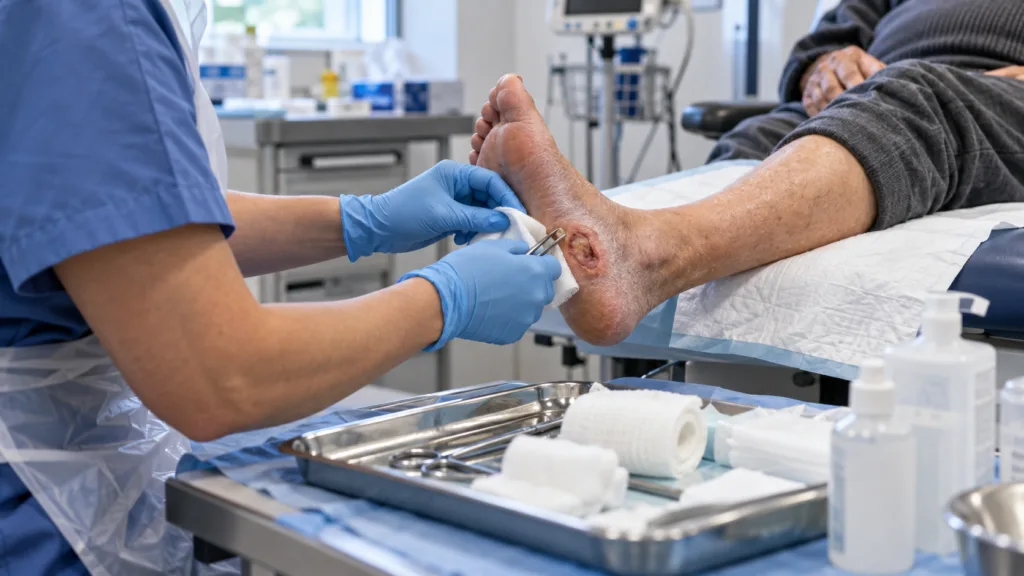
According to the trial registration, the randomized phase uses a 2:1 allocation between BIOxHEAL plus standard care and standard care alone, with treatment administered weekly for up to 12 weeks or until complete closure. The protocol also incorporates a nonrandomized sentinel cohort, which supports an initial stage of treatment evaluation before broader randomized assessment.
Participants receiving standard care undergo wound management measures that may include appropriate debridement, cleansing, moisture-retaining dressings, pressure offloading and optimization of diabetes management. These interventions remain central to diabetic foot ulcer treatment regardless of whether an investigational biologic is added.
By incorporating an active standard-care comparison, the trial is intended to determine whether BIOxHEAL delivers an additional clinical benefit beyond established wound-management practices. This distinction is essential because diabetic foot ulcers can improve with comprehensive conventional care, making a controlled comparison necessary to determine the treatment’s actual contribution.
Applied Biologics has indicated that additional research sites will continue screening and enrolling patients as the study advances. However, Applied Biologics did not provide a timeline for completing enrollment or reporting top-line Phase 3 results.
Why do chronic diabetic foot ulcers remain a major challenge for diabetes treatment?
Diabetic foot ulcers are among the most serious complications of diabetes, often developing through a combination of peripheral neuropathy, impaired circulation, repetitive pressure and reduced tissue-repair capacity. Patients may experience diminished sensation in their feet, allowing relatively minor injuries to progress into persistent wounds before they are detected.
High blood glucose levels and diabetes-associated vascular disease can further compromise wound healing. In some patients, inadequate tissue oxygenation, impaired immune responses and continued mechanical pressure create conditions in which ulcers remain open despite repeated medical intervention.
The consequences can extend far beyond local skin damage. Chronic ulcers may become infected, require prolonged antibiotic treatment or lead to hospitalization. Severe cases can involve deeper tissues and bone, increasing the likelihood of surgical intervention or lower-extremity amputation.
Successful treatment therefore involves more than applying a wound dressing. Clinicians must assess circulation, control infection when present, remove nonviable tissue, reduce pressure on the affected area and address underlying metabolic and nutritional factors.
Even with comprehensive treatment, some diabetic foot ulcers remain difficult to heal. These persistent wounds create demand for additional therapies capable of supporting tissue repair and achieving reliable closure within a clinically meaningful period.
The potential importance of BIOxHEAL lies in whether it can improve outcomes for this difficult-to-treat population. Demonstrating higher wound closure rates could help establish an additional treatment option, although the effect on complications such as infection, hospitalization or amputation would require appropriate clinical evidence.
What is BIOxHEAL and how could biologic wound therapies support tissue repair?
BIOxHEAL is an investigational biologic therapy being developed by Applied Biologics for chronic wounds, including diabetic foot ulcers. The company’s development program is intended to evaluate the product under the clinical, manufacturing and regulatory standards applicable to biologic medicines.
The registered study identifies BIOxHEAL as a single-layer placental-derived biologic. Placental-derived materials are of interest in regenerative medicine because extracellular matrix structures and associated biological components may provide a supportive environment for tissue repair.
However, wound-healing effects cannot be assumed simply because a product originates from biological tissue. Processing methods, material composition, manufacturing controls and the characteristics of the treated wound may all influence clinical performance.
The precise contribution of BIOxHEAL to wound closure must therefore be demonstrated through the ongoing randomized study. The trial is designed to measure whether the investigational treatment improves healing outcomes relative to standard wound management, rather than relying on theoretical regenerative properties.
Applied Biologics is pursuing BIOxHEAL development under Section 351 of the Public Health Service Act, the regulatory framework governing licensure of certain biological products in the United States. This approach subjects the therapy to requirements concerning manufacturing quality, safety and clinical effectiveness.
The company has already completed Good Manufacturing Practice manufacturing of initial clinical lots, an important prerequisite for supplying consistent investigational material during the study. Nevertheless, successful manufacturing and authorization to conduct clinical research do not establish that BIOxHEAL is effective. Those questions remain the central focus of the Phase 3 program.
How does FDA clearance and clinical site activation support BIOxHEAL’s development?
BIOxHEAL reached several regulatory and operational milestones before its first patient received treatment. In June, the U.S. Food and Drug Administration cleared the company’s Investigational New Drug application, permitting the proposed clinical investigation to proceed.
The company subsequently completed initial clinical manufacturing activities and received central institutional review board approval in August. Institutional review boards evaluate research protocols and participant protections, including informed consent procedures and the balance of anticipated risks and potential benefits.
Applied Biologics activated its first Phase 3 clinical research site in September, moving the program from regulatory and manufacturing preparation into patient-level clinical execution. The first patient treatment now confirms that investigational product administration has begun.
Edward Britt, chief executive officer of Applied Biologics, previously emphasized that the company was seeking to develop BIOxHEAL through a structured clinical and regulatory process supported by pharmaceutical-quality manufacturing and controlled research. David G. Armstrong, the study chair, also highlighted the clinical consequences of diabetic foot ulcers and the importance of randomized studies in determining whether new treatments meaningfully improve healing outcomes.
These milestones establish that the development infrastructure is progressing, but several important uncertainties remain. Enrollment must advance across participating sites, investigators must maintain protocol adherence, and the study must generate sufficiently reliable evidence to support conclusions about efficacy and safety. If the clinical findings are favorable, the company would still need to satisfy applicable regulatory requirements before BIOxHEAL could become an approved treatment.
What does Applied Biologics’ broader diabetic wound-care pipeline reveal about its strategy?
The BIOxHEAL trial forms part of a wider Applied Biologics research program focused on chronic wound management and regenerative medicine. Another important component is CAMPX, a multicenter randomized controlled study evaluating the company’s XWRAP wound-cover technology in patients with diabetic foot ulcers.
In September, Applied Biologics announced completion of the final scheduled patient visit in CAMPX, which enrolled 222 participants. The study is progressing toward final database reconciliation, database lock and statistical analysis.
Previously reported updated analyses suggested improved healing outcomes with XWRAP plus standard care compared with standard care alone. Complete wound closure was reported in 30.9% of participants receiving XWRAP compared with 17.5% in the control group, a statistically significant difference.
These results are associated with XWRAP rather than BIOxHEAL and should not be interpreted as evidence of BIOxHEAL’s effectiveness. The products are being evaluated through separate development programs, and their clinical findings must be assessed independently.
Alongside its wound-care portfolio, Applied Biologics is advancing APPB-515, a preclinical gene therapy candidate being investigated for osteoarthritis, and APPB-429, a preclinical program targeting diabetic peripheral neuropathy. The latter program addresses another important complication of diabetes that contributes to foot ulcer development by reducing sensation and increasing vulnerability to unnoticed injuries. Both gene therapy candidates remain at an early research stage, with clinical safety and efficacy yet to be established. Together, these programs indicate an effort to develop therapies addressing several aspects of tissue degeneration, diabetic complications and impaired repair, although each requires independent clinical validation.
What are the next milestones for BIOxHEAL and its potential role in diabetic wound care?
The immediate priority for Applied Biologics is continued patient recruitment, activation of additional research sites and successful execution of the randomized Phase 3 protocol. The primary wound closure assessment will be particularly important because it directly addresses whether BIOxHEAL provides incremental clinical benefit when added to established wound-management practices.
Investigators will also need to evaluate safety findings carefully, particularly in a population vulnerable to infection, vascular complications and delayed healing. Reliable interpretation will require attention to differences in baseline ulcer severity, patient characteristics and adherence to standard-care measures.
A positive outcome could support further regulatory development of BIOxHEAL and strengthen the evidence base for biologic therapies in chronic diabetic wound management. However, the company has not yet reported Phase 3 efficacy findings or established that the treatment reduces amputation risk.
For patients and clinicians, the most meaningful development would be a therapy capable of producing consistent, durable wound closure without introducing unacceptable risks or unnecessary treatment complexity. The first patient treatment represents an important operational milestone, but the decisive test lies ahead. The Phase 3 study must determine whether BIOxHEAL can translate its proposed biological approach into measurable improvements for people living with chronic diabetic foot ulcers.
Alte
