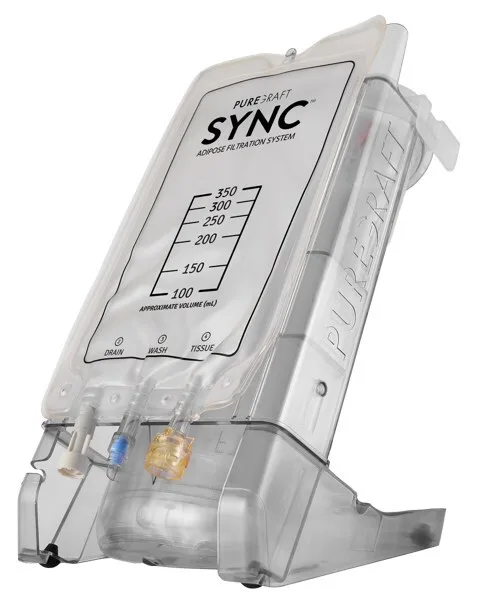
Bimini Health Tech has received United States Food and Drug Administration 510(k) Class II clearance for its Puregraft SYNC Adipose Filtration System, a single-use disposable device designed for fat graft preparation in aesthetic and reconstructive procedures, expanding its Puregraft portfolio within a regulated surgical workflow context.
From an industry perspective, the clearance matters less for what it introduces technologically and more for what it reinforces strategically. Fat grafting is no longer a niche adjunct procedure. It has matured into a repeatable, scalable surgical workflow spanning breast reconstruction, body contouring, facial aesthetics, and revision procedures. Devices that reduce procedural friction, variability, and contamination risk are increasingly viewed as operational tools rather than premium add-ons, and Puregraft SYNC enters the market squarely in that framing.
How disposable adipose filtration reflects a broader shift from artisanal technique to standardized surgical workflows
Fat grafting historically depended on surgeon preference and manual handling. Techniques varied widely in centrifugation, washing, and decanting steps, creating variability in graft quality and outcomes. Over the past decade, the category has steadily shifted toward closed-system processing designed to reduce exposure, standardize output, and compress operative time. Disposable filtration systems sit at the center of this transition.
Puregraft SYNC’s single-use design aligns with this trend by prioritizing consistency and speed over customization. Industry observers note that while many surgeons retain strong technique preferences, institutional settings increasingly favor systems that minimize training burden and reduce variability across operators. In this context, disposability becomes less about convenience and more about operational reliability, particularly in high-throughput practices.
What is genuinely new versus incremental in the Puregraft SYNC platform
The Puregraft SYNC system does not introduce a fundamentally new biological principle. Filtration-based adipose processing is well established, and Bimini Health Tech has built its reputation around incremental refinement rather than disruptive reinvention. The novelty lies in integration rather than mechanism.
SYNC consolidates multiple preparation steps into a single disposable pathway with no reusable components. Regulatory watchers suggest this matters because it removes sterilization cycles, eliminates cross-procedure contamination risk, and simplifies compliance in outpatient surgical environments. These gains are incremental from a scientific standpoint but meaningful from a workflow economics perspective, particularly for practices operating across multiple procedure types.
Competitive positioning within the fat transfer device landscape
The adipose filtration market is populated by both reusable systems and disposable alternatives, each with trade-offs in cost structure, throughput, and perceived tissue quality. Reusable platforms may appeal to high-volume centers seeking amortization advantages, while disposable systems increasingly appeal to outpatient and ambulatory settings prioritizing simplicity.
Puregraft has historically competed on consistency and closed-system design. With SYNC, Bimini Health Tech appears to be doubling down on disposability as a core differentiator. Industry analysts tracking the segment note that as procedure volumes rise globally, disposables offer manufacturers more predictable recurring revenue while aligning with infection control expectations that have tightened post-pandemic.
Clinical relevance and what surgeons are likely to value in practice
From a clinical standpoint, fat graft survival and handling characteristics remain paramount. Surgeons evaluate processing systems based on tissue integrity, oil and fluid removal efficiency, and ease of reinjection. While the clearance itself does not establish superiority on these metrics, Puregraft’s existing clinical footprint provides a reference baseline.
Clinicians tracking fat grafting trends suggest that devices perceived as preserving adipocyte viability while reducing waste tend to gain adoption faster, particularly in breast reconstruction and revision cases where graft volumes are larger and repeatability matters. SYNC’s positioning around minimal waste and rapid processing speaks directly to these use cases, even if long-term comparative outcome data remains limited.
Regulatory clarity and why 510(k) matters for adoption momentum
The 510(k) pathway signals substantial equivalence rather than breakthrough innovation, but it provides essential regulatory clarity. For surgical device procurement committees, especially in hospital-affiliated practices, Class II clearance lowers adoption friction and shortens internal review cycles.
Regulatory observers note that fat processing systems sit at an intersection of device regulation and procedural practice. Any ambiguity around classification can slow uptake. By securing clearance within a familiar regulatory framework, Bimini Health Tech removes uncertainty for both surgeons and administrators evaluating whether a new processing system fits within existing protocols.
Reimbursement realities and the economic logic behind workflow simplification
Fat grafting is often bundled within broader procedures rather than reimbursed as a standalone intervention. This places pressure on devices to justify their cost through efficiency rather than direct reimbursement uplift. Disposable systems must therefore demonstrate value through time savings, reduced complications, or simplified staffing requirements.
Industry analysts point out that when a device can shave even modest minutes off operating room time or reduce preparation steps, the economic impact can outweigh per-unit cost concerns. SYNC’s out-of-the-box readiness and elimination of reusable components may resonate most strongly with practices where staff turnover and procedural standardization are ongoing challenges.
Manufacturing scale and global expansion considerations
Bimini Health Tech already markets Puregraft systems in more than 50 countries, which suggests that SYNC is not a speculative product but an extension designed for global scalability. Single-use devices often face fewer logistical hurdles in international markets compared to reusable systems that require validated reprocessing infrastructure.
Manufacturing scalability will be closely watched, particularly as disposable devices place continuous demand on supply chains. Industry observers will look for signals that Bimini can maintain quality and availability as adoption expands, especially in regions where procedural volumes are growing faster than trained personnel.
Risks, blind spots, and unresolved questions the market will monitor
Despite the favorable clearance, several uncertainties remain. Comparative clinical data specific to SYNC versus existing Puregraft systems has not yet been widely disseminated. Surgeons may initially view the system as a convenience upgrade rather than a performance leap.
Cost sensitivity also remains a risk. In markets where margins are tightening, disposable systems must continually justify their premium. Additionally, sustainability considerations around single-use medical devices are gaining traction, and while infection control benefits remain compelling, environmental scrutiny could influence future procurement decisions.
What clinicians, regulators, and industry observers are likely to watch next
The next inflection point will likely come from real-world adoption patterns rather than formal clinical trials. Observers will track whether SYNC becomes a default option in outpatient settings or remains a niche tool for specific procedures. Feedback on handling characteristics, waste reduction, and procedural efficiency will shape its trajectory.
From a regulatory standpoint, consistency in post-market performance will matter more than expansion claims. For Bimini Health Tech, the challenge now shifts from clearance to execution, ensuring that SYNC reinforces the Puregraft brand as a workflow standard rather than just another iteration.
In the broader context of the fat transfer device market, Puregraft SYNC underscores how incremental device innovation can still be strategically meaningful when it aligns with shifting clinical and operational priorities. The clearance does not redefine adipose filtration, but it reflects a sector increasingly driven by efficiency, standardization, and scalability rather than artisanal technique.