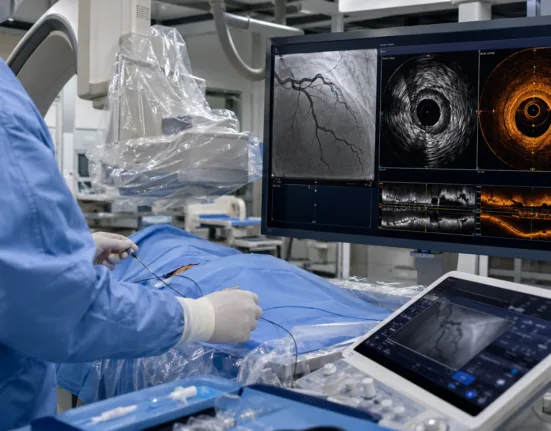
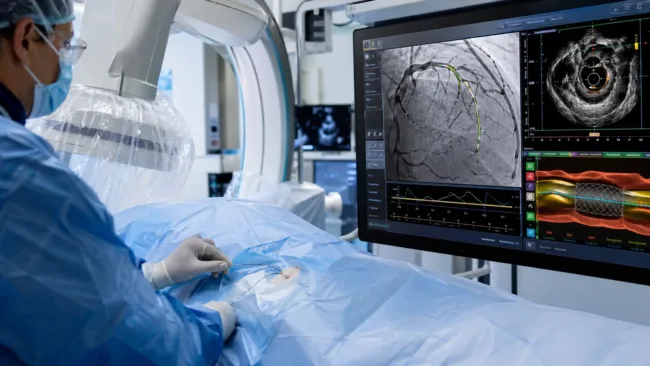
Cleerly, a U.S.-based cardiovascular imaging software company, has published data from the multicenter INVICTUS registry demonstrating that its artificial intelligence-based quantitative computed tomography platform matches intravascular ultrasound across a comprehensive set of coronary plaque measurements. The findings, presented at the European Congress of Radiology in Vienna in March 2026 and simultaneously published in European Radiology, cover 85 patients enrolled across 17 centres in Japan and represent the most extensive head-to-head comparison of AI-driven coronary CT angiography against catheter-based plaque imaging yet reported in a peer-reviewed journal.
Why replacing IVUS with a CT scan matters for clinical practice at scale
Intravascular ultrasound has occupied a privileged position in coronary imaging for decades precisely because it resolves plaque architecture that conventional angiography cannot detect. Its limitations are equally well understood: IVUS requires catheterisation, adds procedural time and cost, carries a small but non-zero complication risk, and remains concentrated in specialist centres with experienced operators. The practical consequence is that high-resolution plaque data rarely influences decisions made earlier in a patient’s care pathway, when lifestyle modification, statin intensification, or aspirin de-escalation might prevent an event rather than merely treat one. What the INVICTUS analysis establishes is that Cleerly’s software, applied to a standard coronary CT angiography scan obtained noninvasively as an outpatient procedure, can replicate the quantitative output of IVUS with a mean difference of 0.09 percent and 94.4 percent of measurements within the limits of agreement. That degree of concordance is not incremental; it reframes the question from whether AI-driven CT can approximate IVUS to whether routine IVUS adds information that cannot be obtained more cheaply and safely upfront.
The correlation coefficients reported across five key metrics reinforce this reading. Lumen volume correlation reached r of 0.943, calcium index r of 0.960, external elastic membrane volume r of 0.899, plaque volume r of 0.833, and length-normalised percent atheroma volume r of 0.851. The calcium index result is particularly notable because calcified plaque is the component most visible on conventional CT and least dependent on AI segmentation, providing an internal consistency check that supports the validity of the softer-tissue measurements. The 99.1 percent agreement rate in classifying predominant plaque type at the minimum lumen area is the figure clinicians tracking vulnerable-plaque identification will focus on most, given that misclassification at that specific location is the scenario most directly linked to missed high-risk lesion assessment.
What the study design reveals about methodological rigour and its limits
The INVICTUS analysis was conducted with core laboratory blinding, meaning Cleerly’s CT analysis team and Yale’s IVUS core laboratory worked independently without access to each other’s outputs. That design choice matters because co-registration studies are particularly vulnerable to confirmation bias when both modalities are assessed by the same team or when analysis is performed knowing the comparator result. Statistical oversight and manuscript preparation were handled independently at Yale University, with the study authors retaining control over interpretation. Cleerly sponsored the study and provided the CCTA analysis platform, a disclosure that will attract scrutiny in the usual way, but the structural safeguards are consistent with rigorous academic-industry collaboration standards.
Two design limitations deserve consideration before the data are extrapolated to broader practice. First, the 85-patient cohort drawn from 17 Japanese centres reflects a population that underwent both CT angiography and invasive coronary imaging clinically, meaning most had haemodynamically significant or suspected disease warranting catheterisation. That selection bias skews the sample toward higher plaque burden and more obstructive disease than would appear in a screening or primary prevention population, where the technology’s eventual commercial value arguably lies. Performance in patients with predominantly mild or subclinical atherosclerosis remains less characterised. Second, the registry was conducted entirely in Japan, a population with known differences in coronary artery dimensions and plaque phenotype distributions compared with Western patient groups. External validation in European and North American cohorts will be a reasonable prerequisite before some health systems accept the INVICTUS data as definitive.
How INVICTUS fits into Cleerly’s broader evidence-building strategy
Cleerly has been methodically assembling a clinical evidence package across several years, spanning diagnostic performance studies, prognostic registries, and now this head-to-head validation against an invasive gold standard. The CONFIRM2 registry previously demonstrated a 12-fold risk gradient in major adverse cardiovascular events based on total plaque burden assessed by the same AI-QCT platform. The ISCHEMIA-related analyses established incremental value over conventional risk stratification. The INVICTUS data addresses a different and arguably more fundamental objection: not whether the technology predicts events, but whether the underlying measurements are accurate enough to be trusted as a substitute for what a cardiologist would observe on IVUS. Passing that test is a prerequisite for guidelines bodies and payers to support its use in interventional guidance contexts, not merely in noninvasive risk stratification.
The reimbursement trajectory also warrants attention. The American Medical Association approved a Category I CPT code for Cleerly’s AI-QCT plaque analyses in late 2024, effective January 2026, representing a transition from the temporary Category III codes in place since 2020. Category I status is reserved for established procedures with demonstrated clinical utility, and several major U.S. insurers including UnitedHealthcare, Cigna, and Humana have extended coverage to the technology. The INVICTUS publication arrives as that reimbursement structure is being operationalised, providing the scientific foundation that payers and hospital procurement teams will cite when evaluating contract terms for broad deployment.
Competitive dynamics in AI coronary imaging and what differentiates Cleerly’s position
Cleerly is not the only company with FDA clearance for AI-assisted CCTA analysis. HeartFlow, Elucid, Circle Cardiovascular Imaging, Caristo Diagnostics, and Artrya all hold cleared tools in the coronary imaging space. The competitive distinction Cleerly is pressing with INVICTUS is plaque quantification breadth: most competing platforms have historically emphasised fractional flow reserve estimation from CT, a physiology-first approach that identifies haemodynamic significance but does not characterise plaque volume or composition in granular detail. Cleerly’s approach provides both ischaemia assessment and plaque phenotyping from a single CT dataset, and INVICTUS strengthens the argument that the plaque characterisation component reaches a quantitative precision that rivals the catheter lab rather than merely approximating it.
Industry observers tracking the cardiology AI sector note that the race to establish head-to-head validation against IVUS has become a defining credentialling exercise in 2025 and 2026 as players compete for guideline inclusion and formulary placement in large health systems. A study published in JACC: Cardiovascular Imaging in December 2025 by the American College of Cardiology outlined quantitative coronary plaque analysis frameworks for clinical practice, signalling that professional societies are moving toward formalising what constitutes acceptable noninvasive plaque data for clinical decisions. Cleerly’s INVICTUS publication positions the company to participate in those guideline discussions with a peer-reviewed, gold-standard comparison rather than registry-derived prognostic associations alone.
Risks, unresolved questions, and what clinical adoption will actually require
Several practical adoption barriers sit between a strong registry publication and routine clinical use. CT image quality remains a non-trivial variable: the AI-QCT workflow requires a qualified radiology technologist to review automated outputs before sign-off as a condition of FDA clearance, introducing a quality-assurance step that presupposes trained personnel and integrated radiology workflows. In lower-resource settings or centres with high CT volumes and limited specialist support, that review step may create throughput bottlenecks that offset some of the procedural efficiency gains over IVUS. The technology also depends on scanner capability and acquisition protocols, and the degree to which INVICTUS’s correlation coefficients hold across different CT hardware generations and contrast protocols outside Japan has not been fully characterised.
The clinical pathway question also remains open. IVUS is performed intraoperatively, providing real-time plaque data that directly influences procedural decisions such as stent sizing, lesion preparation strategy, and post-deployment assessment. AI-QCT provides pre-procedural data that can inform planning but cannot replicate the intraoperative feedback loop that experienced interventionalists rely on for high-complexity cases. Regulators watching the field will likely draw a distinction between using AI-QCT to reduce upstream IVUS use in lower-risk diagnostic workups versus substituting it entirely in complex intervention planning, and INVICTUS does not resolve that boundary question. Clinicians tracking the field will also note that the 85-patient sample, while sufficient for correlation analysis, is modest for subgroup analyses that would clarify which plaque types or stenosis severities drive the strongest and weakest agreement. Prospective validation in a larger, geographically diverse cohort is the logical next step.