FairJourney Bio on August 20 highlighted a peer-reviewed mAbs study describing an antibody-engineered system designed to keep interleukin-12, or IL-12, functionally masked in systemic circulation and make it available when the molecule encounters Fibronectin Extra Domain B, a tumor-associated extracellular matrix antigen. FairJourney Bio carried out antibody discovery and engineering work for the Third Rock Ventures-funded oncology program through teams in Porto, Portugal, and Cambridge, United Kingdom, but the publication remains a preclinical engineering study rather than evidence that the approach is safe or effective in patients.
The significance lies in the architecture rather than in a newly disclosed clinical candidate. IL-12 has long attracted oncology researchers because of its ability to stimulate immune activity, including interferon gamma production and T-cell and natural killer cell responses, yet systemic exposure has repeatedly created a difficult therapeutic window. The new work attempts to address that problem using a reversible molecular switch that responds to a feature of the tumor microenvironment, effectively asking whether antibody engineering can separate where a cytokine travels from where it becomes biologically available.
That distinction matters commercially as well as scientifically. FairJourney Bio is primarily demonstrating the sophistication of its antibody discovery and engineering capabilities rather than announcing a company-owned drug entering development, and the publication does not disclose a clinical development timetable, investigational new drug submission plan or named therapeutic program moving toward human testing. The immediate value of the study is therefore platform validation and scientific credibility, while the larger oncology opportunity will depend on whether the molecular logic survives more complex biological models and eventually clinical translation.
What exactly did FairJourney Bio engineer, and why is the switch architecture different?
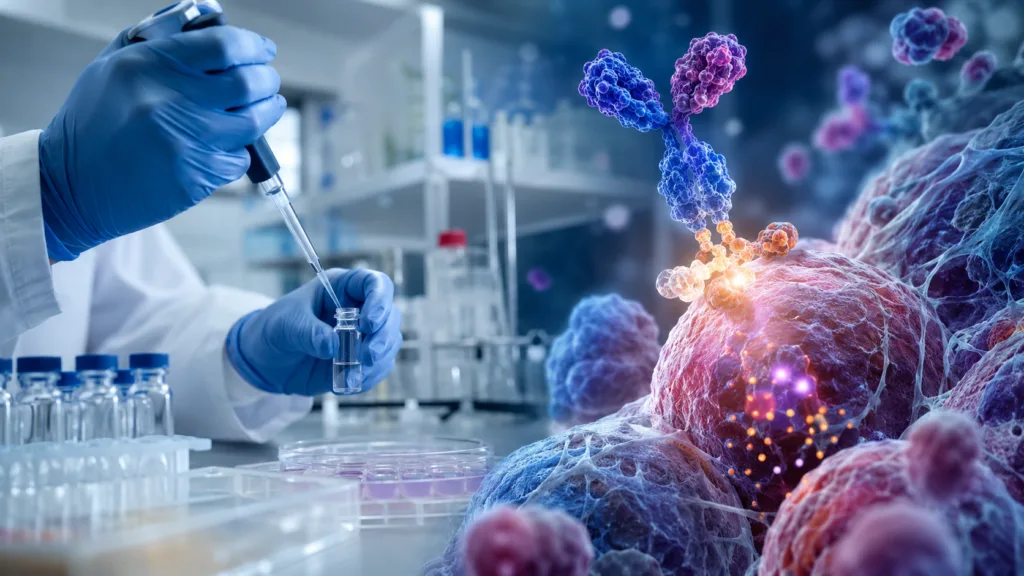
The proposed Switch-IL-12 molecule combines two functional antibody elements. One is a dual-specificity antigen-binding fragment that can interact competitively with either tethered IL-12 or Fibronectin Extra Domain B, while the second is a higher-affinity targeting arm directed toward Fibronectin Extra Domain B. In systemic circulation, the switch arm is intended to bind the molecule’s own IL-12 cargo and keep it masked; in a Fibronectin Extra Domain B-rich tumor environment, binding to the matrix antigen is designed to shift that equilibrium and expose IL-12 for receptor engagement.
The authors describe this as a reversible trans-activation logic gate, which is an important technical distinction from approaches that depend on irreversible protease cleavage. Instead of cutting away a molecular mask, the format relies on competitive binding and local antigen concentration to determine whether IL-12 remains inhibited or becomes accessible. A separate Fibronectin Extra Domain B targeting arm adds avidity, increasing localization around the tumor-associated matrix and helping create the conditions needed for unmasking.
FairJourney Bio’s engineering campaign was unusually specification-driven. Quantitative systems pharmacology modeling was used before candidate generation to identify an affinity range thought capable of reducing systemic IL-12 receptor engagement while preserving activity in a tumor compartment. One modeled configuration called for an IL-12 affinity of roughly 0.27 nanomolar for the switch arm, much weaker Fibronectin Extra Domain B binding of around 160 nanomolar for that same arm, and approximately 0.5 nanomolar binding from the separate targeting arm.
That meant the discovery team was not simply searching for the strongest antibody binder available. It had to engineer two unrelated specificities into a single antigen-binding fragment and tune their relative affinities so neither interaction overwhelmed the switching behavior, which is a considerably narrower design problem than conventional affinity maturation.
Why does IL-12 remain attractive despite decades of systemic toxicity challenges?
IL-12 is attractive because its biological potency is also the source of its development difficulty. The cytokine can promote strong cell-mediated immune responses and induce interferon gamma, creating a rationale for using it to increase antitumor immune activity in tumors that may otherwise remain poorly inflamed. Yet the same systemic immune activation can make dosing difficult, producing the central problem that successive generations of IL-12 developers have attempted to solve.
Different strategies have included intratumoral administration, prolonged half-life formats, tumor-targeted fusion proteins and conditionally activated cytokines. FairJourney Bio’s contribution does not invalidate those approaches; instead, it adds another mechanism for trying to make cytokine activity conditional on the tumor environment. The most useful question is therefore not whether the new molecule is inherently superior, because there is no head-to-head clinical evidence, but whether reversible antigen-dependent switching can eventually deliver a wider and more controllable exposure margin.
Fibronectin Extra Domain B provides a plausible gating target because it is associated with tumor extracellular matrix and active angiogenesis while being much less prominent across normal adult tissues. Its extracellular location is particularly relevant to this design because the antigen does not need to be internalized for the switch to operate, allowing the surrounding tumor matrix itself to become part of the activation mechanism.
That biological rationale still needs to survive tumor heterogeneity. Fibronectin Extra Domain B abundance is unlikely to be identical across every cancer, lesion or patient, and an eventual clinical program would need to establish whether sufficient target levels are present across the tumors chosen for development and whether variability meaningfully changes cytokine activation.
What do the laboratory results and quantitative systems pharmacology model actually establish?
The strongest experimental evidence is biochemical and cell-based. The researchers generated two engineered switch arms, Switch1 and Switch2, with different affinity balances. Switch1 bound Fibronectin Extra Domain B at approximately 180 nanomolar and IL-12 at 2.91 nanomolar, while Switch2 bound the matrix antigen at about 250 nanomolar and IL-12 much more tightly at roughly 0.33 nanomolar.
In an assay designed to mimic the absence of tumor antigen, both constructs showed limited IL-12 availability, consistent with the intended masked state. When Fibronectin Extra Domain B was introduced, Switch1 produced substantially greater IL-12 exposure, while Switch2 showed a more modest effect that became evident mainly at higher molecule concentrations. A functional assay using IL-12 receptor-expressing NK-92 cells subsequently showed dose-dependent interferon gamma release from Switch1 in the presence of Fibronectin Extra Domain B but not under the corresponding antigen-negative condition.
The modeling layer then projected how those measured binding properties might behave in humans. Quantitative systems pharmacology simulations predicted that Switch2 could generate lower systemic IL-12 receptor occupancy while preserving stronger receptor occupancy in the modeled tumor compartment than an unmasked IL-12 Fc construct. Simulations also suggested that tighter IL-12 masking or attenuation of IL-12 receptor binding could further expand the predicted therapeutic window.
The word “predicted” is crucial. There was no directly translatable murine pharmacology experiment for the human Switch-IL-12 molecule because human IL-12 does not interact appropriately with the mouse IL-12 receptor, according to the authors. The study therefore used modeling to bridge the gap between laboratory assays and estimated human pharmacology, which makes the work informative for molecule design but does not establish tolerability, pharmacokinetics or antitumor efficacy in a living organism.
Why does the Switch1 versus Switch2 tradeoff matter for future development?
The contrast between Switch1 and Switch2 illustrates one of the more interesting engineering problems in conditional cytokines. Switch1 demonstrated stronger unmasking experimentally because its weaker IL-12 affinity made it easier for Fibronectin Extra Domain B to shift the equilibrium and expose the cytokine. Switch2, by contrast, masked IL-12 more tightly and therefore appeared less readily activated in the laboratory assay, yet its affinity profile more closely matched the model-generated parameters expected to suppress systemic activity.
This creates a balancing problem rather than a simple optimization contest. A molecule that masks too weakly could allow unwanted systemic IL-12 signaling, while one that masks too strongly could arrive in a tumor yet fail to release enough active cytokine. Development therefore depends on locating a useful middle ground where systemic inhibition is robust but the concentration and avidity of Fibronectin Extra Domain B within the tumor are sufficient to reverse that inhibition.
The authors noted that the concentration of Fibronectin Extra Domain B achievable in their in vitro assay was roughly 100-fold below concentrations reported in human tumors, potentially making the assay particularly challenging for the more tightly masked Switch2. They suggested that patient-derived tumor fragments or ex vivo tumoroid systems preserving native extracellular matrix architecture could offer a more realistic next step. That experiment would be important because it could test whether the favorable tumor assumptions built into the quantitative model are reproduced in biological tissue rather than on an assay plate.
How does FairJourney Bio’s approach compare with tumor-activated IL-12 programs already in the clinic?
FairJourney Bio is entering a scientific field where conditional IL-12 is no longer purely theoretical. Xilio Therapeutics is developing efarindodekin alfa, formerly known as XTX301, as a tumor-activated IL-12 and was evaluating the candidate in an ongoing Phase 2 study in advanced solid tumors as of its August 2026 corporate update. The program is covered by an exclusive license arrangement with Gilead Sciences, with Xilio expected to deliver an option data package in the first half of 2027.
That clinical precedent raises the development bar for newer architectures. A compelling molecular mechanism will not be sufficient by itself if competing approaches can already demonstrate tolerability, pharmacodynamic activation and objective tumor responses in patients. Conversely, the existence of clinical investment in tumor-activated IL-12 supports the broader proposition that controlling where IL-12 becomes active remains an industry-relevant oncology problem rather than an academic engineering exercise.
Direct performance comparisons would be premature. Efarindodekin alfa and the FairJourney Bio-associated switch use different activation designs, have different evidence packages and sit at dramatically different points in development. The relevant competitive question is whether reversible Fibronectin Extra Domain B-dependent switching ultimately provides a practical advantage in exposure control, tumor penetration, repeat dosing, manufacturability or patient selection that can be demonstrated prospectively rather than inferred from separate datasets.
What must happen before Switch-IL-12 becomes a credible clinical-stage oncology asset?
The next development stage needs to move beyond proving that the molecular switch can be engineered. A more physiologically representative system should establish that the construct remains masked in non-tumor environments while consistently becoming active across relevant Fibronectin Extra Domain B-positive tumor models, and that activation is not excessively sensitive to variations in antigen density. Pharmacokinetic behavior, cytokine release, systemic immune activation, tumor exposure, dose response and toxicology would subsequently need to be characterized using models capable of informing human development.
Manufacturability will also matter because multidomain, dual-specificity biologics can introduce complexity that is largely invisible in an early functional paper. Stability, aggregation, expression yield, molecular homogeneity, developability and retention of the required affinity balance after scale-up will ultimately influence whether the architecture can progress from a sophisticated discovery construct to a reproducible investigational medicine.
For FairJourney Bio, however, the publication already has strategic relevance independent of whether this particular molecule eventually enters a clinical trial. The company has been expanding an integrated antibody discovery operation spanning Porto, Cambridge and the United States, with IONTAS joining the group in 2020 and antibody engineering remaining central to its service proposition. Demonstrating that its teams can work backward from model-defined pharmacological requirements to produce a dual-specificity Fab occupying a narrow functional affinity window strengthens the case for using the company on technically demanding biologics programs.
The more consequential test now sits with the biology rather than the engineering. FairJourney Bio and its collaborators have shown that the reversible switch can be constructed and that Fibronectin Extra Domain B can control IL-12 availability under defined laboratory conditions; what they have not yet shown is that this control remains sufficiently precise inside a living system to produce a clinically useful separation between tumor immune activation and systemic toxicity. Closing that gap will determine whether Switch-IL-12 becomes another elegant solution to IL-12’s longstanding therapeutic-window problem or a genuinely translatable route toward localized cytokine therapy.