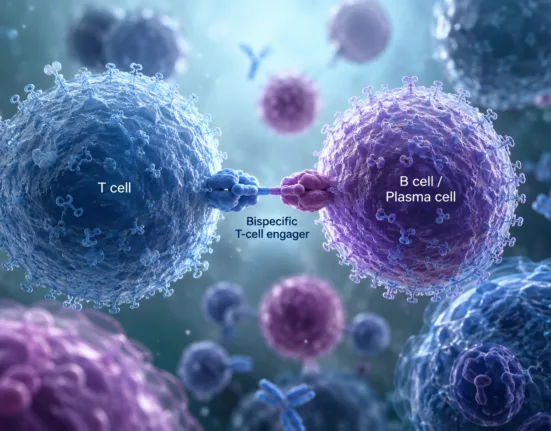
Biocytogen Pharmaceuticals (Beijing) Co., Ltd. has launched RenSuper Workstation, an AI-powered therapeutic antibody discovery platform, alongside the RenSuper High-Throughput Antibody Manufacturing Automation Center. The Beijing-based biotechnology firm said the platform combines its RenMice systems, a large validated antibody sequence library, AI-driven candidate selection, automated experimental validation, and scalable production infrastructure for monoclonal antibodies, bispecifics, multispecifics, antibody-drug conjugates, VHHs, and other advanced biologic formats.
Why Biocytogen’s RenSuper launch matters for the changing economics of antibody discovery
The strategic importance of RenSuper lies less in the existence of another antibody discovery platform and more in the attempt to compress a traditionally fragmented workflow into a repeatable industrial system. Antibody discovery has long depended on iterative cycles of immunisation, screening, engineering, expression, validation, and optimisation. Each stage can introduce delay, uncertainty, and failure risk. Biocytogen is positioning RenSuper as a way to convert that sequence into a more searchable, programmable, and automated process.
That shift matters because the antibody therapeutics market is becoming more crowded and more technically demanding. Developers are no longer focused only on conventional monoclonal antibodies. The field now increasingly depends on bispecific antibodies, multispecific constructs, antibody-drug conjugates, heavy-chain antibodies, and format-specific engineering strategies that must satisfy both biological function and manufacturability. A candidate that binds well but expresses poorly, aggregates easily, or fails later-stage developability checks can still become a costly dead end.
RenSuper is designed to address that bottleneck by linking discovery data with experimental validation and manufacturing automation. In theory, this could reduce early attrition by pushing more developability assessment into the front end of discovery. The risk is that AI-based prioritisation is only as useful as the quality, diversity, and translational relevance of the data used to train and validate it. Biocytogen’s claim that the platform is based on biologically validated immune repertoires is therefore central to the story, because purely computational discovery systems can struggle when model outputs are not tightly connected to wet-lab performance.
How the RenSuper Workstation could change target-to-lead workflows in biologics research
RenSuper Workstation appears to be aimed at making therapeutic antibody discovery less like a bespoke service project and more like a database-enabled design workflow. The platform provides access to fully human antibody sequences against more than 1,000 validated targets, with supporting data packages intended to help users compare and select candidates more quickly. This could be particularly relevant for biotech companies and pharma partners seeking to reduce the time between target nomination and lead selection.
The most commercially meaningful feature is the combination of off-the-shelf sequence access and one-click filtering by target, epitope, and physicochemical properties. In antibody discovery, speed alone is not enough. A platform must help identify candidates with functional relevance, specificity, binding strength, and development potential. By building search and comparison functions around experimentally validated sequences, Biocytogen is trying to make early discovery more decision-oriented rather than merely faster.
However, there is a practical limitation that industry observers will watch closely. Antibody discovery platforms often perform best in internal case studies or partner-specific programmes where the target biology, assay design, and selection criteria are tightly controlled. The broader test for RenSuper will be whether it can repeatedly generate differentiated, developable candidates across difficult target classes, including membrane proteins, complex epitopes, and targets where species cross-reactivity or functional antagonism is hard to engineer. A searchable library is valuable, but the clinical and commercial payoff depends on whether selected candidates can survive downstream optimisation, preclinical testing, and eventual human translation.
Why AI-selected antibody candidates still need wet-lab validation to win confidence
Biocytogen said RenSuper’s AI models were trained on more than 100 million biologically validated antibody sequences. The company also highlighted data from its RenNano fully human heavy-chain antibody platform, where the AI-powered screening workflow produced an average positive hit rate of 46%, peak hit rates of 98%, and an 82% success rate for high-purity Fc-format antibody expression. Those figures are notable because they address two common pain points in AI-enabled biologics discovery: hit quality and expression feasibility.
The inclusion of experimental validation is the more important detail. In drug discovery, AI can generate or prioritise large numbers of candidates, but the industry increasingly distinguishes between computational novelty and experimentally useful output. Biocytogen is trying to close that credibility gap by ensuring AI-selected antibody sequences undergo binding, affinity, and specificity testing. This matters for partners that need reproducible candidates rather than model-generated sequences that require extensive rescue work.
The unresolved issue is whether early hit rates translate into better development outcomes. Positive screening performance can help shorten discovery timelines, but it does not guarantee superior pharmacology, reduced immunogenicity risk, clean toxicology, scalable chemistry, or clinical efficacy. For antibody-drug conjugates, bispecifics, and multispecifics, the final product profile depends not only on the binding arm but also on geometry, valency, payload selection, linker chemistry, target biology, and tumour or tissue context. RenSuper may improve the front end of discovery, but later-stage risk remains very much alive.
What the automated manufacturing centre adds beyond the AI discovery layer
The RenSuper High-Throughput Antibody Manufacturing Automation Center is the second half of the announcement and arguably the part that gives the platform its industrial character. Biocytogen said the centre covers the full protein production workflow, including bacterial inoculation, plasmid extraction, transfection, fed-batch cultivation, and purification. The system is designed to deliver antibody yields averaging 50 mg to 100 mg, with throughput of up to 800 samples per day and more than 5,000 samples per week.
This matters because antibody discovery often stalls at the handoff between candidate identification and experimental characterisation. A platform that can nominate candidates quickly but cannot produce and test them at scale merely shifts the bottleneck downstream. By integrating automated production and validation capacity, Biocytogen is trying to create a closed-loop system in which AI selection can be rapidly tested, refined, and scaled.
The challenge is that automation does not remove biological complexity. High-throughput expression systems can speed ranking and validation, but antibody behaviour can change across formats, expression systems, purification methods, and scale-up conditions. Manufacturing-readiness for early validation is not the same as chemistry, manufacturing, and controls readiness for clinical development. Partners will likely assess whether RenSuper-generated candidates produce cleaner handoffs into investigational new drug-enabling work, not just whether the platform can process large sample volumes.
How RenSuper fits into Biocytogen’s broader platform and partnership strategy
RenSuper builds on Biocytogen’s RenMice family of technologies, including RenMab, RenLite, RenNano, RenTCR, and TCR mimic antibody discovery systems. This is strategically important because Biocytogen is not presenting RenSuper as a standalone software tool. It is positioning the platform as an extension of a broader biologics discovery infrastructure built around fully human antibody generation, humanised animal models, and preclinical pharmacology capabilities.
That integrated model could make the platform attractive to companies that want discovery depth without building every capability internally. Biocytogen said it has established more than 350 agreements involving therapeutic antibodies and clinical assets across co-development, out-licensing, and transfer arrangements. That partnership base gives the RenSuper platform a potential commercial channel, especially among companies looking for faster access to antibody candidates against validated targets.
The strategic question is how Biocytogen balances platform access with asset ownership. In biologics, the most valuable economics often sit not in service revenue but in royalties, licensing rights, co-development stakes, or downstream participation in high-value assets. If RenSuper mainly functions as a discovery infrastructure service, the revenue model could be scalable but potentially lower-margin than asset-centric biotech development. If it generates proprietary or partnered clinical candidates, the upside could be larger, but so would the capital requirements and development risk.
Why this launch reflects a wider shift toward AI-native biologics infrastructure
Biocytogen’s RenSuper launch fits a broader industry trend in which AI is moving from target discovery and small-molecule design into biologics engineering, candidate selection, developability screening, and manufacturing workflows. The next competitive frontier is not simply whether a platform uses AI. It is whether AI is embedded into an experimental system that continuously learns from biological outcomes.
This is where the phrase closed-loop discovery becomes commercially meaningful. A closed-loop system can use experimental results to improve future selection, reduce repeat failure patterns, and strengthen predictive confidence over time. For antibody platforms, that could help researchers identify not only binders but candidates that are more likely to express well, remain stable, preserve function across formats, and move efficiently into translational studies.
However, the industry has also seen enough AI-driven drug discovery enthusiasm to remain cautious. Investors, pharma partners, and scientific reviewers will want evidence that AI-enabled platforms improve real programme outcomes, not just discovery speed. The strongest validation for RenSuper would come from repeated partner adoption, disclosed lead-generation success, licensing activity, and eventually clinical-stage assets whose origins can be traced back to the platform.
What investors may read into Biocytogen’s RenSuper expansion after recent share strength
Biocytogen is listed in Hong Kong and Shanghai, which makes the RenSuper launch relevant not only to drug discovery partners but also to public-market investors tracking China’s biologics innovation ecosystem. Recent market data show that the Shanghai-listed shares have attracted strong attention, with the stock trading near elevated levels after its STAR Market listing, even though it declined on the latest available trading day. That combination suggests investors are rewarding the platform story but are also sensitive to valuation, execution, and proof of commercial conversion.
For shareholders, RenSuper strengthens the narrative that Biocytogen is moving from a technology provider into a more scalable discovery infrastructure company. The platform’s appeal is that it could support repeatable revenue through collaborations while also creating optionality around higher-value antibody assets. In a market where investors increasingly prefer platform companies with visible deal flow, validated biology, and automation-led scalability, RenSuper gives Biocytogen a clearer story to tell.
The caution is that platform valuation can move ahead of platform economics. High throughput, large libraries, and AI-enabled screening can excite investors, but revenue quality matters. The key questions will be whether RenSuper accelerates new partnerships, improves deal terms, expands recurring demand, or produces assets with meaningful licensing potential. Without those commercial signals, the launch risks being viewed as a technological milestone rather than a valuation-changing event.
What clinicians, partners, and regulators will watch as RenSuper moves from launch to proof
For clinicians, the immediate impact of RenSuper is indirect. This is not a new approved therapy, nor does it change patient care today. Its relevance lies upstream, in whether faster and more reliable antibody discovery can produce better therapeutic candidates for cancer, immunology, metabolic disease, infectious disease, and other areas where biologics remain central to innovation.
For pharma and biotech partners, the platform will be judged on speed, quality, reproducibility, and flexibility across formats. A useful antibody discovery engine must support conventional antibodies as well as more complex modalities. It must also produce candidates that can pass practical development checks, not merely early binding assays. RenSuper’s ability to support antibody-drug conjugates, bispecifics, multispecifics, VHHs, and other advanced formats broadens its relevance, but it also raises the bar for validation.
For regulators, the platform itself is not the primary object of review. The candidates emerging from it will still need to meet established standards for preclinical evidence, manufacturing control, safety, pharmacology, and clinical trial performance. AI-assisted discovery does not lower regulatory expectations. If anything, developers may need to document how candidates were selected, modified, characterised, and controlled across development. That makes Biocytogen’s emphasis on experimental validation and manufacturing infrastructure important, because traceability and reproducibility will matter as AI-generated biologics move deeper into regulated development.
Why RenSuper could become more than another AI antibody discovery platform
RenSuper should be viewed as strategically important, but not yet clinically transformative. The launch does not prove that Biocytogen can deliver better drugs than conventional discovery platforms. It does, however, show how the company is trying to solve one of biologics R&D’s most persistent problems: the slow and failure-prone transition from target idea to developable lead.
The most persuasive part of the announcement is the integration of AI selection with biologically validated repertoires and automated experimental throughput. Many discovery platforms can claim one of those strengths. Fewer can credibly claim all three within a single workflow. If Biocytogen can demonstrate that RenSuper reduces timelines, improves candidate quality, and supports repeatable partner programmes, the platform could become a meaningful differentiator in antibody discovery.
The most important risk is that the platform’s early metrics may not fully predict late-stage success. Drug development remains unforgiving, particularly for complex antibody formats where target biology, tissue distribution, immune response, dosing, safety margins, and manufacturing consistency can determine commercial viability. RenSuper may reduce front-end friction, but it cannot eliminate translational risk. That is why the next phase of the story will depend less on platform description and more on partner uptake, disclosed programme outcomes, and whether RenSuper-originated assets advance into higher-value development stages.