A pharmaceutical candidate can appear safe in rodents, dogs or monkeys and still fail when the first human receives it because every animal model is ultimately an approximation of human biology. Conversely, a medicine can produce an animal-specific toxicity that stops development even when the mechanism may not translate meaningfully to people. Those limitations are one reason drug developers have spent more than a decade building human-derived organoids and microphysiological systems, commonly called organs-on-chips, that attempt to recreate selected elements of human tissue biology in the laboratory. What was once principally an academic effort has now become a regulatory-development question after FDA formally began encouraging new approach methodologies as part of a strategy to reduce, refine and eventually replace substantial portions of routine animal testing.
FDA’s April 2025 roadmap began with monoclonal antibodies, where the agency argues that conventional nonhuman-primate studies are not always the most informative route to human safety. By April 2026, FDA said it had met several first-year targets, including reducing routine six-month primate testing for certain antibody programmes and developing validation pathways for alternative methods. The agency specifically lists organoids, organs-on-chips, advanced in-vitro systems and computational modeling among the new methodologies it wants sponsors to incorporate where scientifically appropriate.
What is the difference between an organoid and an organ-on-a-chip?
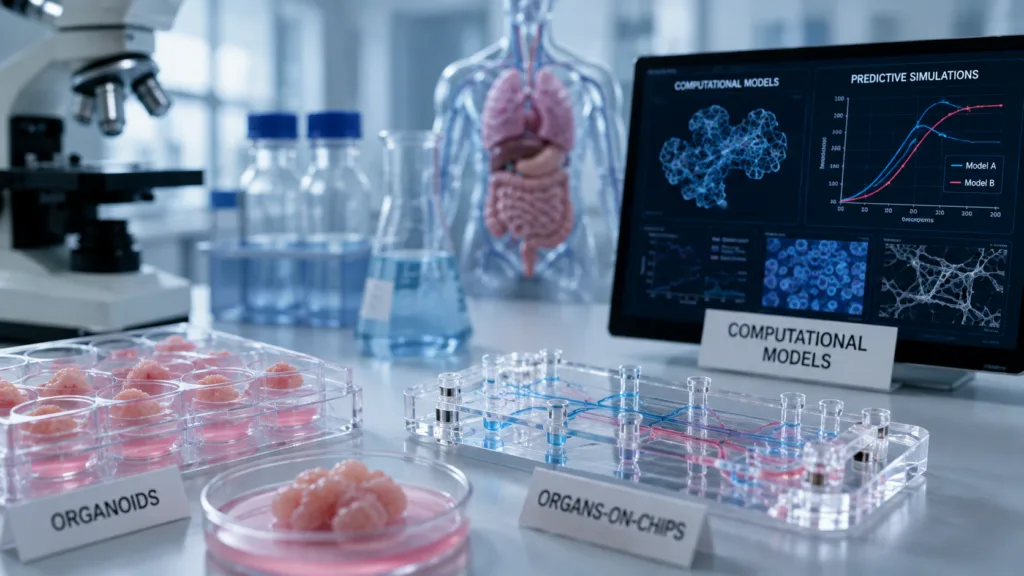
An organoid is a three-dimensional structure grown from stem cells or tissue-derived progenitor cells that self-organizes into some of the cellular architecture and functionality associated with a real organ. Intestinal organoids can contain several epithelial cell types arranged in structures resembling the gut, while brain, liver, kidney and tumor organoids can reproduce selected aspects of their corresponding tissues. Compared with a conventional two-dimensional cell monolayer, this creates a much richer biological environment in which cells interact spatially and can reproduce disease phenotypes that flat culture often loses.
An organ-on-a-chip approaches the problem from an engineering direction. Microfluidic channels, human cells, engineered membranes, fluid flow and mechanical forces are combined inside a small device to reproduce selected physiological functions. A lung chip can expose epithelial cells to air on one side while flowing medium past vascular cells on another and mechanically stretching the system to mimic breathing. Liver chips can reproduce perfusion and multicellular interactions relevant to drug metabolism, while kidney chips can model filtration or tubular transport.
The technologies therefore overlap but are not interchangeable. Organoids are particularly strong at self-organized human tissue complexity, while chip platforms provide engineers greater control over flow, mechanical forces, cell interfaces and real-time sensing. Increasingly, researchers combine them by placing organoid-derived cells inside microphysiological systems.
Why can human tissue sometimes predict toxicity that animals miss?
Drug toxicity depends on receptors, metabolic enzymes, immune pathways and cellular responses that can differ substantially between species. An antibody engineered specifically to recognize a human protein may have little or no equivalent activity in a mouse, forcing developers to use genetically modified animals or nonhuman primates whose biology still does not perfectly reproduce the human target.
Human-derived models remove one major source of uncertainty by testing the medicine against human cells from the beginning. A liver model constructed with human hepatocytes can potentially reveal human-specific metabolism, while a cardiac model can expose effects on human cardiomyocytes that differ from animal physiology.
FDA’s rationale explicitly includes the possibility that human-based laboratory models can reveal toxic effects that animal studies fail to predict. The agency has also noted the high overall failure rate of drugs after apparently successful preclinical programmes as evidence that historical animal testing is not itself a perfect gold standard.
This does not mean every organ chip is automatically more predictive than an animal. A poorly designed human model can provide misleading information just as an inappropriate animal model can. The regulatory question is therefore becoming “which model is fit for this particular decision?” rather than “animal or non-animal?”
Why is the monoclonal-antibody field the first major FDA target?
Monoclonal antibodies often recognize highly specific molecular targets and can exhibit different binding behavior across species. Long-term studies in nonhuman primates are expensive, require relatively small numbers of animals and can still be difficult to interpret when the antibody’s human target biology is not perfectly reproduced.
FDA issued draft guidance describing circumstances in which long-term general toxicology studies for certain monospecific monoclonal antibodies may be reduced or potentially unnecessary, particularly where existing pharmacological knowledge, shorter studies and other evidence provide sufficient characterization. This does not abolish animal testing for every antibody and the guidance remains a regulatory framework requiring product-specific scientific justification.
The strategy is important because it shifts alternative-method adoption from voluntary scientific experimentation toward regulatory planning. If a sponsor knows FDA may accept a validated human-relevant model instead of a six-month primate study, there is suddenly a direct economic reason to invest in the technology.
What can an organ chip do that a conventional cell culture cannot?
Two-dimensional cells grown on plastic lack many features determining how drugs behave inside humans. They often lose natural architecture, experience unrealistic mechanical conditions and interact with only one cell type. Drug concentrations are static or artificially changed rather than continuously perfused.
Microphysiological systems can introduce blood-like flow, tissue barriers, pressure gradients, mechanical stretch and communication between different cellular compartments. Researchers can also connect several organ chips to study how one tissue metabolizes a medicine before another tissue is exposed.
This is particularly relevant to toxicity. A parent drug may be relatively harmless until liver metabolism creates a toxic metabolite that damages the kidney or another organ. A linked liver-kidney platform can theoretically model a sequence that an isolated kidney cell culture cannot reproduce.
The emerging platforms also support continuous measurement. Sensors can monitor oxygen, electrical activity, barrier integrity and biochemical markers in real time, producing dynamic datasets rather than one endpoint collected after cells are destroyed for analysis.
Why can’t researchers simply replace animal studies now?
Reproducibility remains one of the largest obstacles. Organoids can vary according to cell source, culture conditions, differentiation protocol, matrix material and laboratory technique. Organ chips add device geometry, flow rates, membrane materials, sensors and fabrication differences. Two laboratories can therefore claim to operate a “liver-on-chip” while using systems sufficiently different that regulators cannot assume their results are interchangeable.
Scale presents another problem. A pharmaceutical toxicology programme may need to test multiple dose levels, metabolites and conditions with tightly controlled quality standards. A sophisticated chip that requires an expert researcher to assemble each experiment manually may produce excellent academic data while remaining unsuitable for routine industrial screening.
Human biology is also systemic. An isolated liver model does not fully reproduce endocrine signaling, immune responses, neural control, microbiome effects or interactions among dozens of organs. An intact animal remains imperfectly human but does provide an integrated organism in which unexpected cross-organ effects can emerge.
The likely regulatory transition is therefore substitution by question rather than replacement by ideology. A validated liver chip might replace a particular hepatotoxicity study, an in-vitro immune model might replace part of an antibody safety package and computational modeling might remove redundant dose testing, while animals continue to be used where no sufficiently validated alternative exists.
How are patient-derived organoids changing oncology beyond safety testing?
Tumor organoids add another dimension because they can be created from individual patients’ cancers. These three-dimensional cultures preserve selected features of tumor genetics and architecture and can be exposed to different medicines, creating a laboratory system for studying treatment sensitivity and resistance.
In drug discovery, companies can use panels of organoids representing molecularly diverse tumors to examine why one subgroup responds while another does not. That can reveal biomarkers before a large clinical trial is launched and may help prevent development programmes from treating biologically distinct cancers as one uniform disease.
Patient-specific testing raises the possibility of precision medicine in which therapy selection is informed partly by how a person’s own tumor organoid responds ex vivo. Research remains uneven across cancer types, and turnaround time and reproducibility limit routine adoption, but organoids can capture human tumor heterogeneity far better than many immortalized cancer cell lines.
Could AI make organ-on-chip data more useful?
Microphysiological systems generate large multidimensional datasets containing microscopy, sensor measurements, genomic information and dynamic responses across time. Artificial intelligence can potentially identify subtle toxicity patterns or integrate data from several chips more effectively than conventional endpoint analysis.
AI may also help design experiments. A computational model could predict which concentrations or tissue conditions are most informative, while chip experiments provide human biological data that refine the computational model in return. This creates a loop between simulation and physical testing rather than treating the two technologies as competing alternatives.
The risk is that combining two emerging technologies does not automatically make either one validated. An AI model trained on inconsistent chip data can amplify experimental variability rather than resolve it. Standardized reference compounds, shared datasets and clearly defined performance thresholds will remain necessary before regulators can rely on these combinations routinely.
Will animal testing disappear from pharmaceutical development?
Not quickly, and probably not uniformly. FDA’s policy is moving toward reducing unnecessary studies where strong alternatives exist rather than declaring one date after which animal research ends. The first regulatory wins are likely to involve well-understood questions where human-based models have repeatedly demonstrated equivalent or superior predictive performance.
The shift could nevertheless become structurally important. Once one category of animal testing is removed from an established regulatory programme without compromising human safety, companies gain both financial and development incentives to validate alternatives in another category. Hundreds of programmes repeating that process can gradually change the default preclinical toolkit.
The most consequential result may not be fewer animals by itself. Better human models could also stop ineffective or toxic molecules earlier, before companies spend years and hundreds of millions of dollars advancing them into clinical trials. Conversely, they could rescue medicines abandoned because an animal-specific finding was incorrectly assumed to predict human harm.
Organs-on-chips will therefore not become miniature humans sitting on laboratory benches. Their value lies in something more practical: reproducing one human biological question well enough that a scientist no longer needs an entire animal to answer it. FDA’s recent roadmap has turned that objective from an engineering ambition into an increasingly credible part of regulatory drug development.