Sanofi’s June 2026 European and Japanese regulatory progress for subcutaneous Sarclisa has turned a formulation update into a broader test of how anti-CD38 therapy may be delivered in multiple myeloma. With the CirCLIQ on-body injector approved in the European Union but still under review in Japan, the industry is confronting a larger question: can wearable systems shift established cancer treatment away from the infusion chair without weakening clinical oversight, safety or reimbursement logic?
The significance extends beyond Sarclisa, or isatuximab, because multiple myeloma is becoming an important proving ground for delivery innovation in oncology. Patients frequently receive multidrug regimens over extended periods, creating repeated demands on infusion centres, healthcare professionals, caregivers and patients. As effective therapies move into earlier treatment settings and remain in use for longer, administration burden is becoming a competitive issue rather than a secondary consideration.
Why multiple myeloma has become a proving ground for delivery innovation in oncology
Multiple myeloma treatment has changed from a sequence of relatively limited options into a complex continuum involving proteasome inhibitors, immunomodulatory medicines, corticosteroids, anti-CD38 monoclonal antibodies, bispecific antibodies and cellular therapies. Better disease control has extended treatment journeys, but it has also multiplied the number of appointments, injections, laboratory assessments and supportive-care interventions that patients may require.
This creates a capacity problem for oncology services. An intravenous medicine occupies more than the time required to deliver the drug. It can involve pharmacy preparation, vascular access, premedication, chair allocation, observation and management of administration-related reactions. A medicine used repeatedly across large patient populations can therefore consume substantial clinical capacity even when the infusion itself becomes familiar.
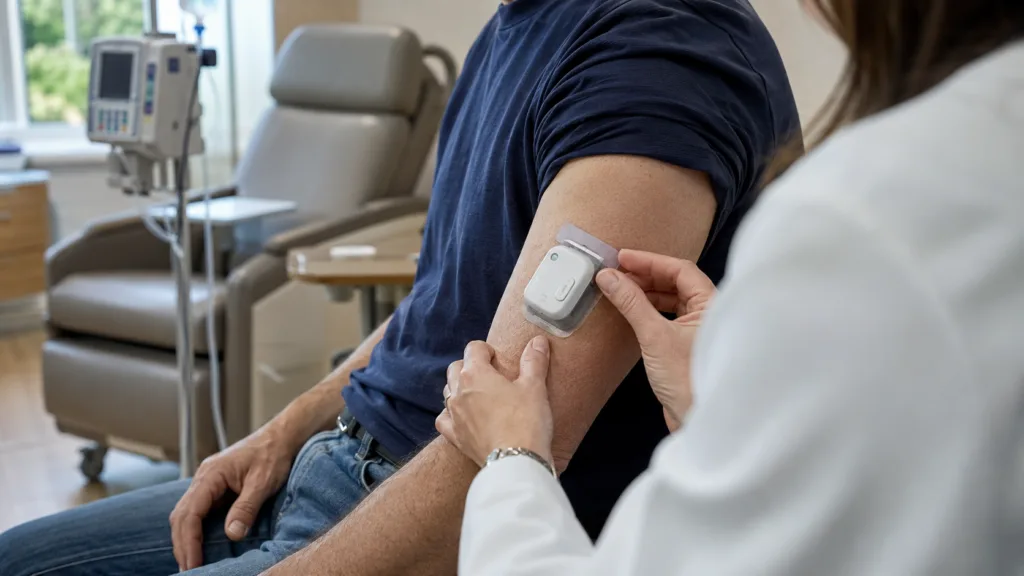
Subcutaneous delivery addresses part of this burden by moving the medicine beneath the skin rather than through an intravenous line. Wearable systems attempt to go further by reducing the amount of active staff time needed during administration. The device can deliver a larger volume over several minutes while the patient remains mobile or seated, potentially allowing a nurse to supervise more than one clinical activity.
However, the disease does not become simple merely because the injection becomes easier. Multiple myeloma regimens still produce cytopenias, infections and other toxicities that require laboratory monitoring and clinical judgement. Delivery innovation can remove a logistical bottleneck, but it cannot remove the need for specialist management.
That tension makes multiple myeloma a revealing test for oncology drug-device combinations. The treatment is sufficiently repetitive for convenience to matter, yet sufficiently complex for uncontrolled decentralisation to carry genuine risk.
How subcutaneous anti-CD38 therapy changes clinic workflow without simplifying the disease
Anti-CD38 antibodies have become central to multiple myeloma treatment across newly diagnosed and relapsed disease. Their expanding use means that administration efficiency can affect a large and growing share of clinic activity.
Johnson & Johnson established an important benchmark through the subcutaneous formulation of daratumumab. Darzalex Faspro can be administered into the abdomen over approximately three to five minutes, sharply reducing direct administration time compared with traditional intravenous dosing. Its broad clinical integration has already demonstrated that subcutaneous delivery can become routine rather than remain a niche alternative.
Sanofi’s approach with subcutaneous Sarclisa introduces a different operational proposition. The CirCLIQ system uses Enable Injections’ technology to deliver a fixed dose through an automated on-body injector. In clinical evaluation, administration took a median of approximately 13 minutes, making it longer than the direct injection time associated with subcutaneous daratumumab.
The comparison cannot be reduced to a stopwatch. Darzalex Faspro requires a healthcare professional to administer the injection, while an on-body system is designed to deliver the medicine after activation without continuous manual involvement. A longer hands-free administration may require less active nursing time than a shorter manually delivered injection.
This distinction could become important in busy outpatient centres. A nurse may be able to initiate the device, complete required checks and attend to other responsibilities while the injection continues. The operational value would come from staff utilisation and scheduling flexibility rather than from claiming the shortest delivery time.
The limitation is that workflow benefits depend on implementation. A treatment centre must train staff, prepare the device, confirm attachment, monitor delivery and respond if the system fails or is interrupted. The injector may reduce one form of workload while introducing another involving device management, documentation and troubleshooting.
Why Sanofi needs the CirCLIQ injector to differentiate Sarclisa from daratumumab
Subcutaneous delivery alone is no longer a novel proposition in the anti-CD38 market. Daratumumab has already established the convenience argument and accumulated extensive physician familiarity. Sanofi therefore needs more than formulation parity to strengthen the competitive position of Sarclisa.
CirCLIQ offers a potential point of differentiation because it combines large-volume subcutaneous delivery with hands-free operation. European approval also creates a framework for administration in outpatient or home settings where local healthcare rules and clinical protocols permit it. This gives Sanofi an opportunity to position Sarclisa as a flexible drug-device platform rather than merely another injection.
The commercial challenge is that clinicians do not choose anti-CD38 regimens solely on the basis of administration method. Treatment selection depends on approved combinations, transplant eligibility, previous therapy, refractory status, cytogenetic risk, toxicity, reimbursement and institutional experience. Delivery convenience can influence a decision when clinical options are closely matched, but it is unlikely to override major differences in evidence or regimen suitability.
Sanofi must therefore integrate the injector into a broader clinical value proposition. The strongest argument is not that a wearable device makes Sarclisa a better anticancer molecule. It is that preserved clinical activity can be delivered with fewer systemic administration reactions and potentially more adaptable use of healthcare resources.
There is also a risk that the technology becomes easier to describe than to monetise. Hospitals may recognise the convenience but remain reluctant to redesign established pathways. Patients may prefer the device, yet payers may not assign additional value to the delivery platform. Sanofi will need adoption evidence showing that the injector produces measurable benefits beyond satisfaction scores.
What the IRAKLIA data establish about convenience and what they do not prove
The Phase 3 IRAKLIA trial provides the central clinical foundation for subcutaneous Sarclisa. The study compared a fixed subcutaneous dose delivered through an on-body injector with weight-based intravenous isatuximab, with both approaches used alongside pomalidomide and dexamethasone in relapsed or refractory multiple myeloma.
The subcutaneous group achieved an objective response rate of 71.1%, compared with 70.5% in the intravenous group, meeting the study’s non-inferiority requirement. Pharmacokinetic assessment also supported the ability of the fixed subcutaneous dose to produce appropriate drug exposure.
These findings answer an essential regulatory question. Moving Sarclisa from an intravenous infusion to a subcutaneous device did not result in an evident loss of short-term antimyeloma activity. Without that equivalence, convenience would have little clinical relevance.
The study does not demonstrate that the wearable formulation improves disease control. Objective response rate measures whether patients achieve a defined reduction in disease burden, but it does not establish superior progression-free survival, overall survival or durability of response. The principal innovation lies in administration, not in a new biological mechanism.
The safety findings also require balanced interpretation. Systemic administration-related reactions occurred much less frequently with subcutaneous treatment than with intravenous Sarclisa, strengthening the argument for moving away from infusion. Local injection-site reactions were uncommon and were predominantly mild.
However, severe neutropenia was numerically higher in the subcutaneous group than in the intravenous group. The trial was not designed to establish whether the route of administration caused that difference, and the background regimen already carries substantial haematological toxicity. Nevertheless, the imbalance reinforces why simpler delivery should not be confused with a simpler safety profile.
Patient satisfaction and preference results support the device concept. More patients receiving the on-body formulation reported being satisfied or very satisfied than those receiving intravenous treatment. A separate study comparing on-body and manual subcutaneous administration also showed a substantial preference for the wearable option.
Preference data matter because repeated therapy can make small inconveniences accumulate into a major burden. They do not, however, establish health-system savings, improved adherence or better clinical outcomes. Those questions will require broader real-world evidence.
Can home administration work when multiple myeloma care still requires intensive monitoring
Home administration is the most disruptive possibility associated with wearable oncology delivery. It could reduce travel, waiting time and caregiver disruption, particularly for older patients or those living far from specialist centres. It could also create new models in which hospital teams supervise treatment through home nursing services or structured remote-care programmes.
Clinical experience with Sarclisa delivered through the on-body injector included home administration in countries where it was permitted. The reported median administration duration was similar at home and in the clinic, all documented home injections were completed and no new safety signal emerged.
Those findings are encouraging but should not be treated as proof that every eligible patient can receive the medicine independently. Trial participants are selected, trained and monitored within a research framework. Real-world patients may have frailty, cognitive limitations, skin conditions, dexterity problems, anxiety or limited caregiver support.
Multiple myeloma therapy also extends beyond the administration of the anti-CD38 antibody. Patients may need blood counts, infection assessment, premedication, antiviral prophylaxis, dose adjustments and management of combination partners. A device can move the injection out of the clinic, but the surrounding clinical infrastructure must follow it.
The likely near-term model is therefore controlled decentralisation rather than unrestricted self-administration. Initial doses may remain in specialist centres, followed by carefully selected home treatment supported by trained nurses, laboratory schedules and escalation protocols.
Regulators and providers will need clear rules for device failure, incomplete dosing, delayed reactions and emergency contact. The home-care promise is credible, but it depends on building a care pathway around the injector rather than treating the device as a substitute for medical supervision.
Why reimbursement and provider economics could decide whether wearable oncology scales
The economic case for wearable delivery appears straightforward. Shorter visits and reduced active nursing time could release infusion capacity, allowing centres to treat more patients or redirect staff toward complex procedures. Patients may also face lower travel costs and less time away from work or family responsibilities.
Healthcare financing can complicate that logic. Some reimbursement systems compensate providers for administering infused or injected medicines in clinical facilities. A hospital that moves treatment into a shorter appointment or home setting may reduce its operational burden while also reducing reimbursable activity.
The financial value of the device will therefore vary by country, payer and treatment setting. A system facing severe infusion-chair shortages may prioritise capacity gains. Another system may require formal health-economic evidence demonstrating lower total costs before supporting decentralised administration.
Payers may also question whether a wearable injector deserves a premium when an established subcutaneous competitor can be administered in several minutes. Sanofi’s response will need to focus on staff time, flexibility and patient experience rather than administration duration alone.
Reimbursement design will ultimately influence whether the technology becomes transformative or remains a convenience option in selected centres. Regulatory approval permits use, but payment policy determines how widely providers can redesign care.
How drug-device partnerships introduce new manufacturing and operational vulnerabilities
CirCLIQ also illustrates the growing dependence of pharmaceutical companies on specialised delivery-technology partners. Sanofi supplies the oncology medicine, while Enable Injections contributes the platform needed to administer a large subcutaneous volume through a wearable system.
This model can accelerate innovation because drugmakers do not need to build every device capability internally. It also creates a more complicated product ecosystem involving medicine manufacturing, device production, assembly, packaging, quality control and regulatory coordination.
A shortage or quality problem affecting either component could interrupt treatment availability. Device malfunctions could generate complaints even when the medicine itself remains clinically effective. Manufacturing changes may require regulators to examine the impact on the complete drug-device combination rather than one isolated product.
Healthcare providers must also manage inventory differently. They need the correct drug presentation, compatible device, instructions, storage conditions and disposal procedures. Home delivery adds further requirements involving shipment integrity, patient training and collection of used devices.
The commercial reputation of Sarclisa could therefore become partly dependent on how reliably CirCLIQ performs outside controlled trials. A wearable system that works consistently may reinforce confidence in the medicine. A difficult rollout could create frustration disproportionate to the underlying clinical problem.
What clinicians and industry observers will watch as anti-CD38 delivery competition expands
The first measure of success will be conversion. Sanofi will need to show whether patients already receiving intravenous Sarclisa move to the subcutaneous formulation and whether new patients begin treatment with the wearable option where it is available.
The second measure will be actual care-pathway change. Use within the same infusion unit may improve efficiency, but the larger strategic claim depends on expansion into outpatient and home settings. Adoption rates across these environments will reveal whether the platform changes care or simply changes the route of administration.
The third measure will involve real-world safety and reliability. Clinicians will monitor cytopenias, infections, administration reactions, incomplete doses and device-related problems. They will also assess whether home programmes can maintain the same quality of monitoring as specialist centres.
The fourth measure will be competitive response. Daratumumab retains a major advantage in clinical familiarity, established subcutaneous use and broad integration across treatment regimens. Sanofi must prove that hands-free delivery creates enough value to alter prescribing or institutional purchasing decisions.
The wider industry will also watch whether other oncology biologics adopt similar systems. Success could encourage development of wearable delivery for medicines that currently require lengthy or frequent infusions. Failure could indicate that oncology’s clinical and reimbursement complexity limits the practicality of decentralisation.
The emerging anti-CD38 delivery race is therefore about more than convenience. It is a test of whether drug-device combinations can reduce treatment burden while preserving safety, creating measurable value for healthcare systems and supporting commercially sustainable care outside the traditional infusion chair.